

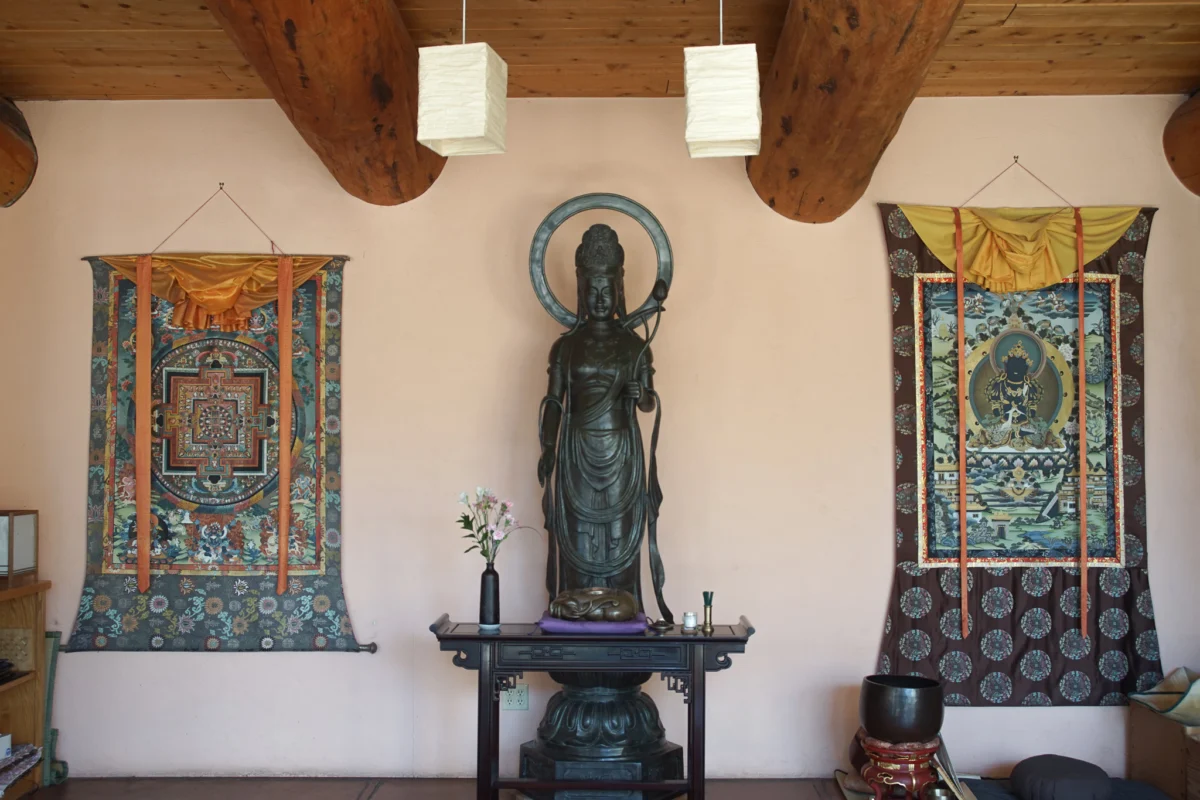
At the first hint of dawn in the serene San Luis Valley of Colorado, a resonant wooden han breaks the mountain-rimmed stillness surrounding the Crestone Mountain Zen Center. The air, crisp and thin at this high altitude, carries the sound, inviting practitioners to settle onto their tatami mats within the meditation hall. This ancient ritual, a cornerstone of Zen practice, is mirrored thousands of miles away at the Zen Buddhist Center Schwarzwald in Germany, and countless other centers and individual homes across the globe. Whether physically present or joining virtually through the expanding reach of online platforms, individuals are drawn into these seated meditations. As the fading resonance of the bell ushers in profound quietude, a palpable sense of stillness emerges, unfolding not just within each individual, but somatically, palpably, and mutually, connecting practitioners across geographical vastness and, in a way that continues to intrigue, even across time.
The Bedrock of Monastic Life: Trust and Shared Attention
While monastic life is often characterized by its profound stillness, its enduring strength is built upon a foundation of trust. This is not a superficial agreement on opinions, but a deeper, more fundamental reliability. It is the implicit understanding that each individual will commit to showing up, day after day, bringing their unique struggles, questions, and insights. The shared endeavor is to refine conduct, to confront the self, and to immerse the collective mind in the practice.
This potent form of trust is not an abstract concept; it is forged and nurtured through direct, personal encounters. One practitioner recounts a pivotal moment during a ninety-day intensive practice period, known as an ango, at the Crestone Mountain Zen Center. Describing what felt like a “dark morning of the soul,” the individual confessed to an overwhelming sense of fragility, feeling too unmade to navigate the day ahead. A raw thought surfaced: a desperate wish for someone, anyone, to alleviate the intense emotional pain. While intellectually acknowledging the impossibility of such a transference, the profound vulnerability remained.
It was during the subsequent walking meditation, kinhin, that a transformative encounter occurred. As the practitioner’s eyes met those of another participant, an unspoken connection was made. Unlike the usual averted gaze, this fellow practitioner held the gaze, his eyes conveying warmth, a gentle smile, and a small nod. This brief, silent exchange, occurring without a single word spoken or any explicit understanding of what was seen or perceived, held immense significance. It “meant the world,” shifting the practitioner’s internal landscape and profoundly altering their perception of reality. This moment illuminated the essence of a monastery: a sacred space for shared attention, a field upon which one can unequivocally rely. It fosters a unique form of sanity, one that cannot be artificially manufactured through solitary effort.
Zen: A Transmitted Culture, Not Merely Content
In the West, Buddhism is frequently discussed as a philosophy or a collection of practical techniques. However, Zen transcends this categorization. It is not a body of knowledge to be acquired and mastered, but a way of being that is transmitted through cultural immersion. This transmission occurs at a pace that outstrips verbal explanation, shaping the very fabric of how individuals move, gesture, think, and perceive the world. Learning Zen is not an academic pursuit; it is an organic absorption that arises from deep participation and intimate engagement within a community.
The profound impact of this cultural transmission is evident in the collective rhythm of monastic life. When the bell signals the commencement of sutra recitation, forty bodies simultaneously turn, bow, and chant, each finding their unique resonance within the unified sound. As the influential Zen master Shunryu Suzuki Roshi famously advised, "Don’t chant with your mouth. Chant with your ears!" This instruction extends far beyond mere auditory perception; it speaks to the act of releasing oneself into a shared field of aliveness and discovering one’s authentic voice within that collective experience.
Monasteries, with their intricate forms and established rhythms, remain vital as laboratories for this embodied culture. The very aesthetics of monastic life – the precise bow, the dignified robe, the deliberate placement of a simple cup – are not merely decorative but are profound expressions of the dharma. When these forms are practiced within a community built on trust, they transmit a depth of understanding that words alone often fail to convey.
The Paradox of Freedom Found in Form
To modern eyes, Zen practices can appear unconventional: shaved heads, traditional Japanese robes, and the often unfamiliar choreography of ritual. While some find beauty in these forms, others perceive them as austere or inaccessible. In response to this, many Zen centers have sought to demystify their practices by shedding certain formalities, aiming for greater approachability. However, for many long-term practitioners, these forms are an essential pathway to participating in the “body of the Buddha.”

The human body, in its very posture and movement, can be seen as a mudra, a gesture of awakening itself. Forms like wearing robes and the act of bowing are not arbitrary; they are gestures that embody connection. Zen rituals unfold as a sequence of such gestures, each punctuated by moments of stillness. During walking meditation, for instance, practitioners often observe a remarkable synchronization of breath and movement: an inhalation as heels lift, an exhalation as feet shuffle forward. The step ceases to be an individual act and becomes an integral part of the shared field. Instead of being tethered to the continuous flow of mental activity, practitioners learn to inhabit each moment wholeheartedly, embodying and clarifying the present situation.
Initially, these forms may feel restrictive. However, with sustained practice, they paradoxically unlock a profound sense of freedom. This liberation arises from surrendering to the inherent rhythm of the practice, allowing each gesture to ground one in the dynamic field of human relationship. Over time, bowing can feel more natural than a handshake, not simply due to familiarity with an unfamiliar custom, but because a new mode of meeting has been discovered – one rooted in connection rather than separation.
The Enduring Significance of the Monastery as an Inner Landmark
As Zen Buddhism established roots in the West, it expanded both outward into lay communities and inward into dedicated monastic settings. The establishment of practice centers invariably led to a deepening of practice for all involved, including those who participated only intermittently. This phenomenon persists today. Monasteries serve as an essential “inner landmark.” Even for lay practitioners living at a distance, the knowledge that a place exists where silence, discipline, and trust are meticulously cultivated profoundly influences the texture of their own lives.
The advent of the internet has further extended the reach of this inner landmark, transcending the physical confines of monastic walls. Students who have trained in person and subsequently returned to their homes report that joining online zazen sessions—hearing the familiar resonance of the bell, the subtle settling of the hall—evokes a powerful, embodied memory. One participant shared, “When I hear the bell, I can smell the incense,” illustrating the potent psychosomatic connection forged through sustained practice.
Shifting the Inner Address: A Transformation of Being
Zen monasticism fundamentally reorients the mind, relocating it into its inherent nature—a felt sense of embodiment within a vibrant, living world. Most individuals navigate life from the "address" of their personal identities, defined by their stories, roles, and accumulated experiences. Entering a monastery involves not only changing one’s external location but, more significantly, transforming this internal address.
From this newly established inner address, the world reveals itself as more porous and interconnected. The gentle rise of steam from a cup of tea, the evening bell announcing the close of day, a breeze carrying the scent of mountain air through an open door – all become occasions for profound encounter. In this state, everything meets everything else; mind and world greet each other in a shared, synchronous rhythm. This inner address is characterized by openness, responsiveness, and a capacity to receive the world’s greetings without defense. To live from this awakened, embodied, and undefended place is, in essence, the practice itself.
The Unfolding Practice: Connection Across Time and Space
The quietude shared between the resonant strikes of the han carries an energy as potent and penetrating as a precisely articulated line of Zen master Dogen’s teachings. Today, the practice of shared stillness, to a remarkable extent, can occur across vast distances.
As dawn breaks, the han sounds once more, a wooden call resonating in the pre-dawn darkness, summoning all to zazen. Across minds and screens, the stillness unfolds, its transformative power connecting individuals in a shared experience of profound presence. This enduring resonance underscores the timeless relevance of Zen monasticism in cultivating not only individual peace but also a deeply connected human experience.

