

A comprehensive study conducted in southwestern Nigeria in 2026 has shed critical light on the complex and often symbiotic relationship between psychoactive substance use and internet fraud among young adults. The research, which involved 22 young adults undergoing addiction treatment, revealed that these two behaviors frequently feed into each other, creating a vicious cycle exacerbated by deep-seated societal pressures and a challenging economic landscape. Participants in the focus groups described both drug use and the prevalent online scams known locally as "Yahoo Yahoo" as being driven by intense peer pressure, a pervasive lack of legitimate employment opportunities, and a nuanced, often contradictory, community acceptance. Furthermore, the study underscored the significant personal costs borne by those involved, including profound feelings of guilt and psychological distress, despite any perceived financial gains.
Unpacking the 2026 Nigerian Study
The study’s methodology involved recruiting patients from a specialized unit at a teaching hospital in southwestern Nigeria, dedicated to treating mental and behavioral disorders stemming from psychoactive substance use. Psychoactive substances encompass drugs that alter mood, thinking, or alertness, such as alcohol, cannabis, and opioids like tramadol and codeine, all of which were cited by participants. The internet fraud discussed, "Yahoo Yahoo," refers to various online scams, including romance scams and advance-fee schemes, which leverage digital tools and psychological manipulation to defraud victims of money. To ensure the protection and candidness of participants, discussions deliberately avoided the specific details of individual scams, focusing instead on the broader behavioral patterns and their underlying motivations.
The research aimed to explore a critical gap in existing literature, as previous studies on internet fraud in Nigeria often did not delve into its intersection with drug use. By focusing on individuals directly experiencing both issues, the 2026 study offers a unique, qualitative perspective on their interconnectedness, moving beyond simple cause-and-effect narratives to reveal a more intricate web of influence.
The Bidirectional Reinforcement: Drugs Fueling Fraud, Fraud Funding Drugs
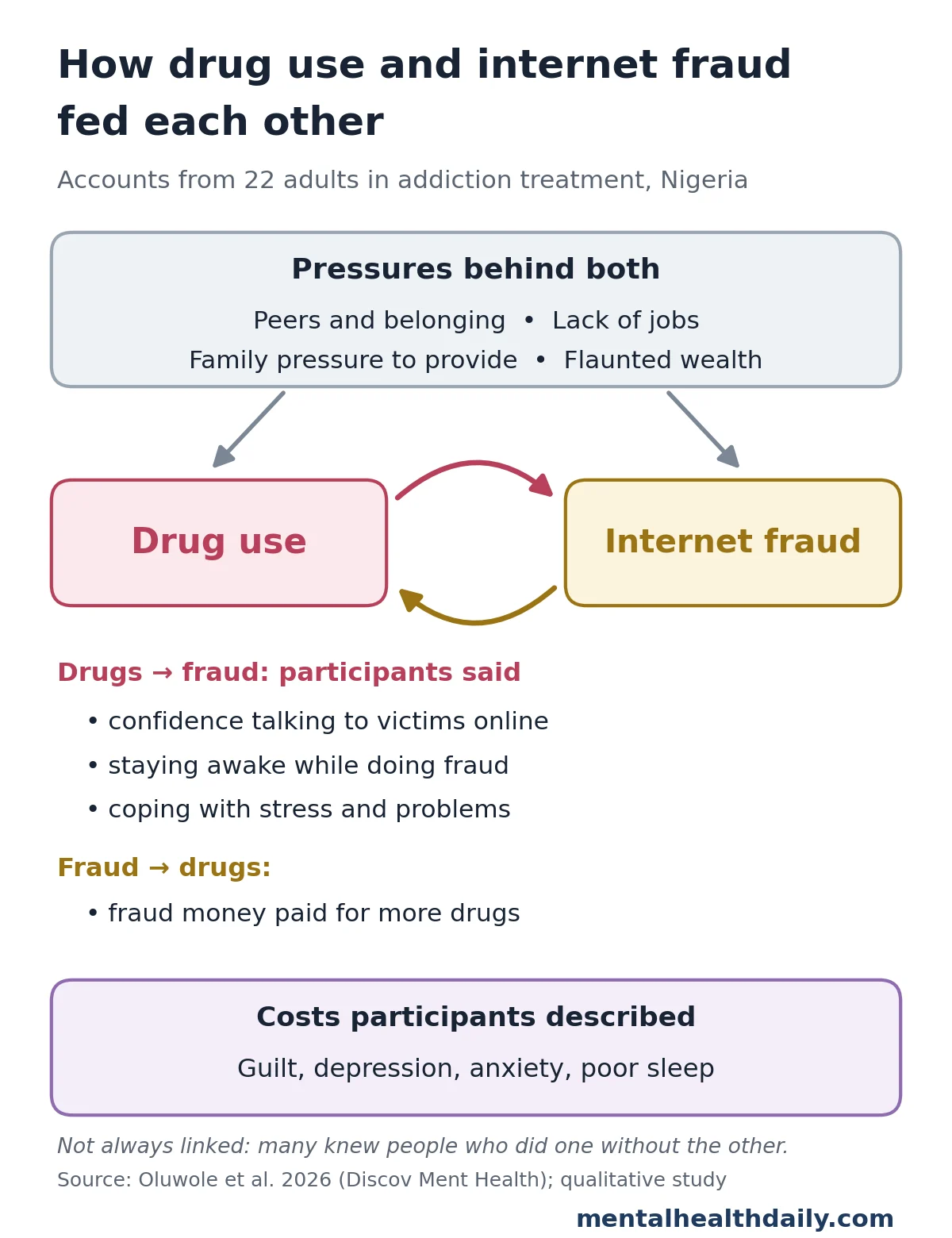
Participants identified a range of substances central to their experiences, including cannabis, tramadol, codeine, alcohol, and a locally sold synthetic cannabinoid known as "Colorado." They articulated three overlapping reasons for their substance use in the context of fraud:
- Confidence and Disinhibition: Drugs were often used to bolster confidence, particularly when interacting with victims online, enabling participants to overcome inhibitions and maintain deceptive personas. This suggests a form of self-medication to manage the psychological demands of sustained deceit.
- Sustained Alertness: The nature of online fraud often requires long hours, sometimes through the night, to communicate with victims in different time zones or to execute complex schemes. Substances were used to stay awake and maintain focus during these extended periods.
- Coping Mechanism: The inherent stress, anxiety, and moral conflict associated with defrauding others were significant. Drugs provided a temporary escape or a way to cope with the psychological burden, acting as a form of self-medication for the guilt and distress that inevitably arose.
Conversely, the financial proceeds derived from internet fraud played a crucial role in sustaining drug habits. This creates a powerful feedback loop, termed "bidirectional reinforcement" by the researchers, where each behavior actively helps to perpetuate the other. The money gained from scams directly funded the purchase of more drugs, which in turn facilitated the continued engagement in fraudulent activities.
It is important to note that this link, while significant, was not universal. Many participants acknowledged knowing individuals who engaged in fraud without using drugs, and vice versa. As one participant succinctly put it, "Not everyone doing fraud uses drugs… some are even scared of it." This nuanced observation led researchers to conclude that the relationship is complex, ranging from a direct functional link to complete independence, and cannot be reduced to a simplistic cause-and-effect explanation. This challenges prevailing assumptions and calls for more sophisticated interventions.
Deep Roots: Peer Pressure, Economic Hardship, and Societal Expectations
The study meticulously detailed the primary drivers pushing young adults towards both drug use and internet fraud, painting a vivid picture of the socioeconomic and cultural landscape.
Peer and Belonging Influence: Across all focus groups, peer influence emerged as the most consistently cited factor. The desire to fit in, avoid social exclusion, or emulate the perceived success of friends proved a powerful motivator. The allure of material wealth, often flaunted by those involved in "Yahoo Yahoo," created a compelling narrative. As one participant articulated, "If your guy is doing Yahoo and you see him driving Benz, you go want join too." This highlights the immense pressure within social circles to conform to certain markers of success, even if achieved through illicit means.
Pervasive Economic Hardship: Participants frequently articulated a profound disillusionment stemming from the stark contrast between societal expectations of financial success and the severe lack of legitimate avenues to achieve it. Nigeria, despite its vast resources, grapples with high youth unemployment rates, often exceeding 30-40% in various age brackets. This economic precarity, coupled with the perceived failure of traditional routes like education and hard work to deliver tangible rewards, was often cited as a justification for turning to fraud. The informal economy struggles to absorb the large number of graduates and young people entering the workforce, leaving many feeling disenfranchised and desperate.
Pressure on Men to Provide: A significant cultural dimension highlighted by the study was the immense pressure on young men to act as primary providers for their families. Men were described as more directly involved in both fraud and drug use, often driven by the expectation to support their households, particularly as first-born sons. This cultural imperative, combined with economic realities, creates an overwhelming burden, pushing some towards illicit activities as a perceived shortcut to fulfilling their familial duties. Women, while less directly involved in the perpetration of fraud, were often implicated indirectly through romantic partners or friends, suggesting a gendered dynamic in how these issues manifest.
The Role of Social Media Display: The advent of social media has amplified these pressures. Participants noted how young people are increasingly exposed to and influenced by online personalities who openly flaunt wealth acquired through illicit means. This digital display of "Yahoo Yahoo" proceeds normalizes and glamorizes the lifestyle, extending its appeal far beyond immediate peer circles and embedding it within the broader youth culture. The constant bombardment of images showcasing luxury cars, designer clothes, and extravagant lifestyles creates a distorted reality where success is equated with quick money, regardless of its origin.
Mixed Messages: Community and Family Responses to Internet Fraud
The study revealed a complex and often contradictory set of responses from families and communities regarding internet fraud. This ambiguity, researchers suggest, might be more influential than clear-cut approval or rejection, as it creates a moral grey area that allows individuals to rationalize their choices.
Normalization of Fraud: In some communities, "Yahoo Yahoo" has become alarmingly normalized, almost seen as an alternative profession. "Now Yahoo is like normal job… even parents sometimes support it," one participant stated, underscoring the erosion of traditional moral boundaries. Some individuals drew a distinction between online fraud and violent crimes, framing it as "not stealing with a gun," which provides a convenient justification for their actions. This perceived "softer" nature of the crime contributes to its gradual acceptance within certain societal segments.
Varied Family Responses: Family reactions to involvement in fraud fell into three distinct patterns:
- Direct Condemnation: Some families outright rejected the behavior, often with severe consequences for the individual involved.
- Tacit Acceptance/Beneficiation: Other families, while perhaps not openly endorsing fraud, would accept and benefit from the financial proceeds, effectively turning a blind eye to the source of income.
- Active Encouragement: In more extreme cases, families actively encouraged or even pressured young members into fraud, particularly when facing severe economic hardship, viewing it as a necessary means of survival or advancement.
Simultaneously, participants criticized harsh, authoritarian parenting styles, arguing that such approaches often pushed young people towards secrecy and rebellion, making them more susceptible to external influences. Religious institutions also exhibited mixed responses; while some churches outright refused donations from or participation by individuals known to be involved in fraud, others welcomed their contributions, further blurring the moral lines and sending conflicting signals to the community.
The Invisible Costs: Guilt, Depression, and Sleepless Nights
Despite the allure of wealth and the sometimes-mixed societal acceptance, participants consistently described profound psychological distress among those involved in fraud. The study highlighted several critical mental health consequences:
- Persistent Guilt: A deep sense of guilt and remorse frequently plagued individuals, particularly after successful scams.
- Depression and Anxiety: Many reported experiencing symptoms of depression, including feelings of hopelessness and worthlessness, alongside heightened anxiety.
- Poor Sleep Quality: Insomnia and disturbed sleep patterns were common, often attributed to the weight of their actions and the constant fear of exposure or reprisal.
- Paranoia and Mistrust: A pervasive sense of paranoia, both towards potential victims and within their own circles, was also reported, leading to isolation and difficulty forming genuine connections.
As one participant poignantly expressed, "Sometimes it’s hard to sleep, even after making money. The guilt is real." Researchers suggest that this internal conflict between external rewards and inner turmoil complicates the simplistic image of fraudsters as purely immoral actors. They further hypothesize that drug use, in this context, may serve as a desperate attempt at self-medication, a means to temporarily alleviate the crushing weight of guilt, depression, and anxiety. This finding underscores the need for a holistic approach to intervention that addresses not only the addiction but also the underlying psychological trauma and moral injury.
Broader Context: Substance Use and Fraud in Nigeria
The findings of the 2026 study resonate with existing research on substance use and internet fraud in Nigeria and West Africa, providing a more detailed understanding of their convergence.
Prevalence of Substance Use: A 2024 meta-analysis of 22 studies across West Africa, involving over 43,000 participants, estimated pooled prevalence rates of 44% for alcohol, 30% for tramadol, 11% for codeine, and 6% for cannabis. These figures highlight the widespread nature of substance use in the region, with rates varying significantly between different studies, often linked to factors such as peer influence and prevailing socioeconomic conditions. The substances cited by the 2026 study’s participants are consistent with these broader regional trends.
Similar Drivers for Fraud: Previous research on internet fraud in Nigeria has also identified similar social drivers. Interviews with 12 young men involved in "Yahoo Yahoo" revealed that peer networks were crucial in introducing them to the illicit activity, and that communities and families often offered tacit support. Some even rationalized fraud as a form of "payback" to Westerners for historical injustices, adding another layer of justification to their actions. Furthermore, interviews with 40 frontline officers of Nigeria’s Economic and Financial Crimes Commission (EFCC) described the culture surrounding fraud as being deeply intertwined with notions of masculinity and material wealth, aligning with the "provider pressure" discussed by the 2026 study’s participants. These earlier fraud studies, however, did not specifically explore the concurrent issue of drug use, thus emphasizing the unique contribution of the 2026 research.
Challenges and Limitations
As a qualitative study based on focus groups, the 2026 research provides invaluable insights into how individuals explain and perceive their experiences. However, it is inherently limited in its ability to quantify the prevalence of these behaviors or definitively establish cause-and-effect relationships. The findings reflect the experiences of a specific group of young adults in addiction treatment and should not be generalized to the entire Nigerian youth population. Nonetheless, the rich, nuanced data gathered offers a critical foundation for understanding the complex interplay between drug use and internet fraud.
Pathways Forward: Recommendations and Implications
Both the study participants and the researchers offered practical suggestions for prevention and intervention, emphasizing a multi-faceted approach.
Participant-Led Prevention Ideas: Young adults involved in the study proposed several community-based solutions:
- Job Creation: The most prominent suggestion was the creation of legitimate and sustainable employment opportunities for youth, directly addressing the economic hardship that serves as a primary driver.
- Skill Acquisition Programs: Providing access to vocational training and skill-building initiatives to equip young people with marketable talents.
- Community Sensitization: Educational campaigns to raise awareness about the dangers and consequences of drug use and fraud, particularly targeting youth and families.
- Parental Guidance: Encouraging parents to provide more supportive and constructive guidance, moving away from authoritarian approaches that can alienate young people.
- Youth Empowerment: Establishing youth-friendly programs and safe spaces that offer positive alternatives and foster a sense of belonging and purpose.
Clinical and Policy Recommendations: Researchers urged clinicians to adopt a more holistic approach to addiction assessment, moving beyond mere symptom evaluation. They recommended inquiring about peer networks, financial pressures, potential trauma, and cultural influences. For treatment, they suggested addressing guilt and moral conflict alongside substance use, recognizing the psychological toll of fraud. Group therapy was also proposed as a promising modality, capable of redirecting negative peer influence into a supportive and recovery-oriented environment.
From a policy perspective, the findings underscore the urgent need for integrated public health and social welfare strategies. This includes robust investments in youth employment schemes, accessible mental health services that cater to the specific needs of this demographic, and community-led initiatives that promote ethical values and provide positive role models. Law enforcement efforts, while crucial, must be complemented by preventative measures that address the root causes, rather than solely focusing on punitive actions.
The 2026 study offers a compelling and sobering look into a critical societal challenge in Nigeria. By highlighting the bidirectional reinforcement between drug use and internet fraud, and by dissecting the underlying socioeconomic and cultural drivers, it provides an essential roadmap for developing more effective, compassionate, and culturally sensitive interventions. The long-term implications for Nigeria’s youth, public health, and national security demand concerted efforts from all stakeholders to break this cycle and foster a future of legitimate opportunity and well-being.

