

Mice that only observed another mouse being subjected to an attack developed anxiety- and depression-like behaviors, though these changes were notably milder and more circumscribed compared to mice that endured direct physical aggression, according to a landmark 2026 study published by Xin-Ran Sun et al. at the Chinese Academy of Medical Sciences in Beijing. This pivotal research provides crucial insights into the neurobiological distinctions between direct and vicarious trauma, carrying significant implications for the understanding and treatment of stress-related psychiatric disorders such as depression and post-traumatic stress disorder (PTSD) in humans.
The Evolution of Stress Models: Chronic Social Defeat and Vicarious Trauma
The study delves into two prominent animal models for inducing stress: chronic social defeat stress (CSDS) and vicarious defeat stress (VDS). Chronic social defeat stress has long been a cornerstone in preclinical research for modeling depression and anxiety. In this established paradigm, a smaller, typically C57BL/6 mouse, is intentionally placed into the home cage of a larger, more aggressive CD-1 mouse. This immediately provokes a brief but intense physical confrontation, during which the smaller mouse is attacked. Following this initial violent encounter, the mice are separated by a clear, perforated divider, ensuring that the defeated mouse remains in constant visual, auditory, and olfactory proximity to the aggressor. This persistent exposure to a perceived threat, repeated over several days, consistently leads to a range of lasting behavioral and physiological changes, most notably a pronounced tendency to avoid social interaction with unfamiliar mice – a hallmark of depression and social anxiety.
The vicarious defeat stress model, introduced by Warren et al. in 2013, represents a significant refinement. This model removes the direct physical confrontation entirely. Instead, a "witness" mouse is positioned behind the clear, perforated divider from the outset, observing, hearing, and smelling another mouse being subjected to a social defeat by an aggressor. The witness mouse then spends the remainder of the day in close proximity to the aggressor, experiencing the psychological stress without direct physical harm. Warren and colleagues initially found that these witness mice also developed discernible depression- and anxiety-like behaviors, accompanied by elevated levels of corticosterone, a key stress hormone.
The vicarious defeat model rapidly gained traction within the scientific community for two primary reasons. Firstly, it offers a method to induce stress responses without the confounding physiological effects of physical injury or pain, allowing researchers to isolate the purely psychological components of trauma. Secondly, and perhaps more importantly, witnessing violence is a well-recognized pathway to trauma in humans, contributing to the development of PTSD and other mental health conditions. This human parallel makes the VDS model particularly appealing for translational research, offering a more direct analogy to the psychological stressors experienced by individuals who witness traumatic events. However, the critical question of whether these two mouse models—direct vs. witnessed defeat—are interchangeable in their neurobiological and behavioral outcomes remained largely unsettled, prompting the comprehensive side-by-side comparison undertaken by Sun et al.
A Rigorous Comparative Methodology: Unpacking Behavioral and Molecular Differences
To address this crucial question, Xin-Ran Sun and colleagues at the Chinese Academy of Medical Sciences in Beijing designed a robust experiment. They randomly divided 68 young adult male C57BL/6N mice into four distinct groups, each comprising 17 animals. These groups included: a control group (no stress), a direct social defeat group (attacked), a vicarious defeat group (witness), and an aggressor group (the CD-1 mice, which were not the focus of the analyzed stress responses). The stress paradigms were applied over a period of 14 days, a standard duration known to induce chronic changes in CSDS.
Following the 14-day stress period, a subset of 10 to 12 mice from each relevant group underwent a battery of seven widely recognized behavioral tests designed to assess various aspects of anxiety, depression, and social interaction. These tests included the social interaction test (measuring avoidance of a novel mouse), the open field test (exploring anxiety by assessing time spent in the center vs. periphery), the light/dark box test (another measure of anxiety based on preference for dark spaces), the elevated plus maze (assessing anxiety by time spent in open versus closed arms), the forced swim test or tail suspension test (measuring behavioral despair/immobility), and the sucrose preference test (anhedonia, or loss of interest in pleasurable activities). After behavioral assessments, researchers meticulously analyzed a wide array of hippocampal measures. The hippocampus, a critical brain region, plays a central role in memory formation, emotional regulation, and, significantly, the negative feedback loop that helps to terminate the body’s stress-hormone response. The measurements included hippocampal proteins, synapse markers, indicators of energy metabolism, oxidative stress markers, neurotransmitter levels, and inflammation-related gene expression.
Behavioral Divergence: Milder Anxiety and Anhedonia in Witness Mice
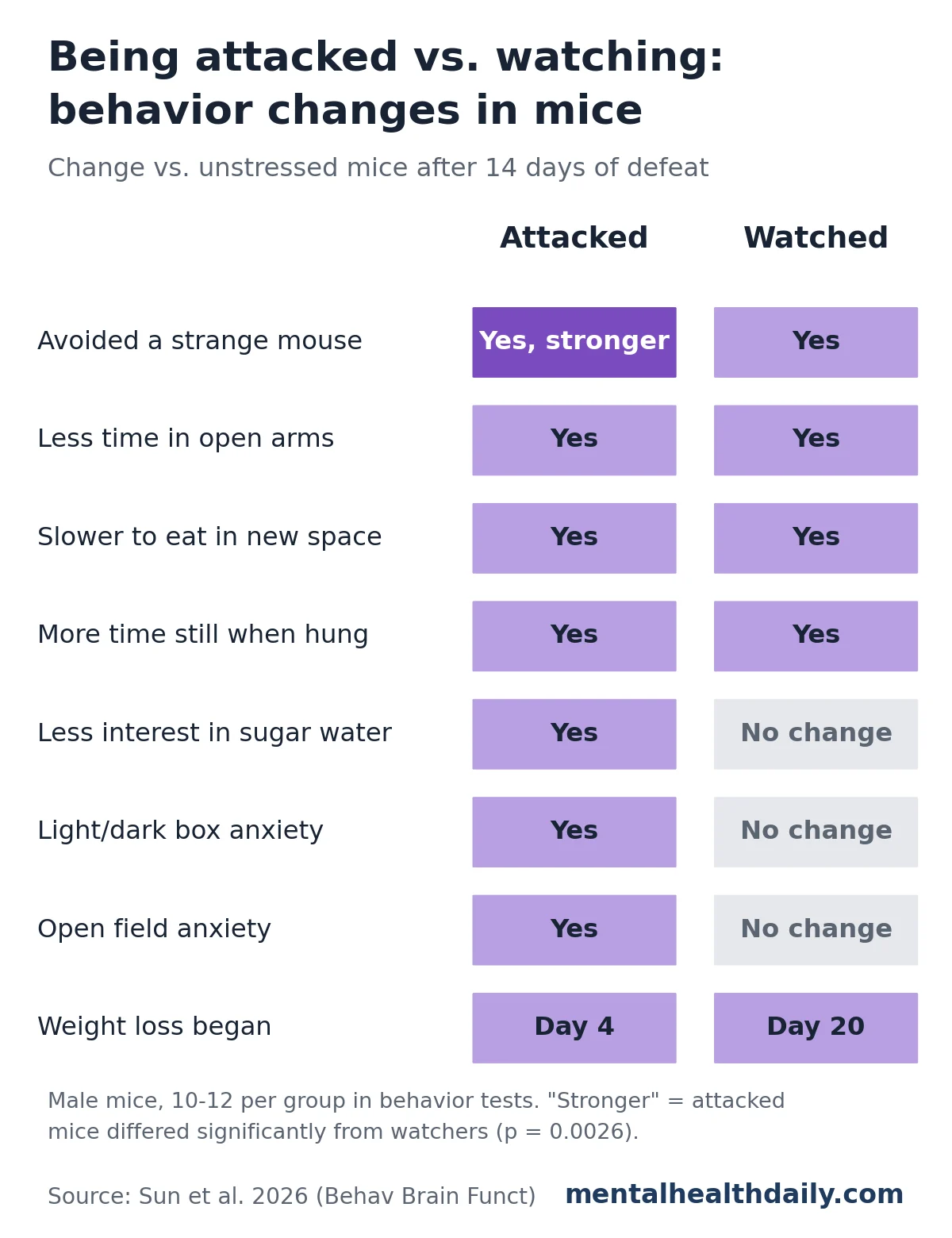
The behavioral analyses revealed both shared stress responses and significant distinctions between the attacked and witness mice. Both groups, when compared to the unstressed control mice, developed a core set of stress behaviors. These shared traits included increased social avoidance of a novel mouse, reduced time spent in the open arms of an elevated plus maze (indicating heightened anxiety), a longer latency to consume food in a novel environment (suggesting neophobia or anxiety-induced inhibition), and increased immobility in the tail suspension test (a proxy for behavioral despair).
However, the attacked mice exhibited more pervasive and severe behavioral alterations. They displayed a significantly greater avoidance of the strange mouse compared to the witness mice (p = 0.0026). Furthermore, attacked mice showed clear signs of anxiety in two specific tests—the light/dark box and the center of an open field—where witness mice appeared indistinguishable from the control group, suggesting that their anxiety was less generalized.
Perhaps the clearest differentiation between the two stress models emerged in the assessment of anhedonia, defined as the loss of interest in pleasurable things. Mice typically show a strong preference for sugar water over plain water. Attacked mice demonstrated a notable loss of this preference, consuming significantly less sugar water compared to controls (p = 0.0379). In stark contrast, witness mice maintained their preference for sugar water at levels comparable to the control group (p = 0.9909) and showed a significantly higher preference than the attacked mice (p = 0.0466). This finding underscores a fundamental difference in the hedonic processing pathways affected by direct versus witnessed trauma.
Beyond behavioral metrics, physiological markers also revealed disparities. Attacked mice began to lose body weight as early as day 4 of the stress paradigm, a common indicator of chronic stress. Witness mice, however, did not experience significant weight loss until day 20, well after the 14-day stress exposure period, despite no difference in their overall food intake compared to attacked mice. Interestingly, both groups exhibited enlarged spleens, a physiological sign of immune activation, with no statistically significant difference between them (p = 0.1119). This suggests that while both types of stress activate the immune system, the metabolic and hedonic impacts differ substantially.
Molecular Signatures: Distinct Hippocampal Alterations
To delve deeper into the neurobiological underpinnings of these behavioral differences, the research team employed label-free proteomics, a sophisticated mass-spectrometry method capable of quantifying the levels of hundreds of proteins simultaneously. Analyzing 953 hippocampal proteins in four mice per group, the study uncovered striking molecular distinctions. Compared to control mice, attacked mice exhibited alterations in 38 specific proteins, while witness mice showed changes in 32 proteins. Crucially, only 11 proteins were shared between the two stressed groups, representing a mere 18.6% overlap of the total 59 distinct proteins identified as altered. This low overlap at the proteomic level strongly indicates that direct and witnessed social defeat trigger largely divergent molecular pathways within the hippocampus.
The altered proteins pointed towards different functional disruptions. In attacked mice, the changes suggested impairments in synaptic plasticity—the ability of synapses to strengthen or weaken over time, crucial for learning and memory—and disruptions in energy metabolism. Conversely, witness mice showed protein changes primarily related to cytoskeletal regulation and oxidative stress responses, indicating different cellular mechanisms at play. This molecular divergence provides a biological basis for the observed behavioral differences.
Neurochemical and Inflammatory Pathways: A Tale of Two Stresses
Further detailed biochemical measurements confirmed the existence of both shared and distinct changes in inflammation, neurotransmitter systems, and brain energy metabolism.
Shared changes observed in both attacked and witness mice included elevated levels of the pro-inflammatory cytokine IL-6 in the hippocampus, a general indicator of neuroinflammation, and increased activity of the kynurenine pathway, which is known to influence mood and cognition. Both groups also exhibited reduced levels of serotonin (5-HT) and its metabolite (5-HIAA) in the hippocampus, suggesting a general perturbation of the serotonergic system, a key neurotransmitter pathway implicated in depression.
However, several critical changes were specific to each type of stress. Only attacked mice showed an increase in TNF-alpha, another potent pro-inflammatory cytokine, and a reduction in glutamate, the primary excitatory neurotransmitter, potentially contributing to synaptic dysfunction. They also exhibited a decrease in hippocampal ATP levels, indicating impaired energy metabolism, and an increase in reactive oxygen species, markers of oxidative stress. These findings suggest a stronger inflammatory response and a more severe energetic and oxidative burden in mice subjected to direct physical trauma.
Conversely, changes seen only after witnessing stress included lower levels of GABA, the primary inhibitory neurotransmitter in the brain. A reduction in GABAergic signaling can lead to increased neuronal excitability and contribute to anxiety. Interestingly, witness mice also showed an increase in the anti-inflammatory cytokine IL-10, suggesting a more nuanced or perhaps counter-regulatory immune response compared to the direct attack group. In summary, attacked mice experienced a more robust pro-inflammatory and kynurenine pathway activation, alongside metabolic and oxidative stress, while witness mice exhibited specific alterations in inhibitory neurotransmission and a unique anti-inflammatory signature.
Precedent and Context: Earlier Comparative Studies
The findings of Sun et al. are consistent with a 2020 study by Nakatake et al., which similarly concluded that witnessed and physical social defeat are not identical in their effects. However, some specific behavioral outcomes in the Nakatake study differed from the current research. For instance, Nakatake et al. found that only witness mice lost sugar-water preference, while only attacked mice lost open-arm time in an anxiety test. This contrasts with Sun et al.’s findings where anhedonia was specific to attacked mice, and both groups showed reduced open-arm time.
These discrepancies highlight the sensitivity of these models to methodological details. Nakatake et al. deliberately used milder aggressors, which likely influenced the severity and pattern of stress responses. Together, these two studies underscore a critical point: the specific symptoms and neurobiological changes induced in a witness mouse can vary depending on precise laboratory parameters, such as the intensity of the aggressor’s attacks or the duration of exposure. This emphasizes the need for careful standardization and consideration of experimental design when utilizing these models.
Implications for Neuroscience and Mental Health Research
This comprehensive comparative study by Sun et al. offers invaluable guidance for researchers investigating stress-related disorders. Witnessing trauma is a well-established pathway to conditions like PTSD in humans, making a robust mouse model of this phenomenon exceptionally useful. The results unequivocally support the utility of witnessed defeat to study purely psychological stress and its underlying mechanisms. However, the study also firmly establishes that vicarious defeat stress is not a direct, interchangeable substitute for direct social defeat.
For laboratories engaged in depression and PTSD research, the choice of model should be dictated by the specific research question. If the aim is to investigate the consequences of direct physical and psychological trauma, including its more severe anhedonic and broad anxiety components, then the chronic social defeat model remains appropriate. Conversely, if the focus is on the neurobiological underpinnings of purely psychological trauma, such as that experienced by witnesses of violence, or if researchers seek to avoid the confounding factors of physical injury, then the vicarious defeat model offers a more refined and relevant tool. This distinction is crucial for developing targeted therapeutic interventions, as different underlying neurobiological pathways imply different potential pharmacological or behavioral targets.
While this study significantly advances our understanding of stress models, it is important to note that it did not test any therapeutic treatments. Furthermore, mouse behavioral tests, while informative, are considered stand-ins or proxies for human symptoms rather than direct diagnoses. The complexity of human mental health conditions involves a myriad of genetic, environmental, and social factors that cannot be fully replicated in animal models.
Acknowledged Limitations and Future Directions
The study acknowledged several limitations. The research was conducted exclusively on young adult male C57BL/6N mice. It is well-established that sex differences exist in stress responses and the prevalence of psychiatric disorders; therefore, future studies should investigate whether female mice exhibit similar distinctions between direct and witnessed trauma. Additionally, the findings are specific to the C57BL/6N strain, and responses might vary across different mouse strains. The aggressor mice were CD-1, a commonly used strain, but the characteristics of the aggressor can influence the severity of the defeat.
Future research could explore the long-term trajectory of these distinct stress responses, including potential recovery mechanisms or the development of resilience. Investigating the efficacy of different therapeutic interventions, both pharmacological and behavioral, within each model would also be a critical next step. Understanding how these distinct molecular and behavioral profiles respond to various treatments could pave the way for more personalized and effective interventions for human patients suffering from different forms of trauma and stress-induced disorders. The work by Sun et al. provides a foundational framework for such crucial investigations, reinforcing the nuanced complexity of stress and trauma.

