

Language is the bedrock of identity, a profound conduit for cultural transmission, and a vital link to heritage. For Tibetans, the mother tongue is not merely a means of communication but the very vehicle for their rich philosophical traditions, intricate narratives, and sacred liturgy. Since His Holiness the Dalai Lama’s exile from Tibet in 1959, a significant aspect of his lifelong mission has been the preservation of Tibetan culture, simultaneously fostering confidence among Tibetans to engage with the contemporary global landscape. In this endeavor, the Tibetan language stands as a cornerstone, indispensable for the continuity of Tibetan Buddhist teachings and identity.
Tibet, a region of immense geographical and cultural diversity, faces escalating challenges to its linguistic heritage. Environmental shifts and political pressures have placed numerous indigenous languages at risk. While Tibetan remains prevalent in daily life and religious practice, Mandarin Chinese increasingly dominates public institutions, with the proliferation of Chinese-medium preschools and kindergartens presenting a significant challenge to the linguistic development of young Tibetans. Within diaspora communities, younger generations often encounter both incentives and pressures to assimilate into dominant linguistic environments. Paradoxically, these same globalizing forces have also ignited opportunities for innovative collaboration and preservation efforts beyond Tibet’s borders.
Switzerland has emerged as a significant welcoming nation for Tibetan refugees, hosting the largest Tibetan diaspora community in Europe. Within this community, a remarkable initiative is underway, spearheaded by Franziska Oertle, a Swiss scholar whose dedication to the Tibetan language has made her a respected educator across Asia, Europe, and the United States. Oertle’s unique approach to teaching colloquial Tibetan has been described by her students as having “cracked the code,” making the language more accessible to a global audience. This article delves into her groundbreaking work and the broader implications for Tibetan language preservation.
The Genesis of a Passion: From Language Nerd to Tibetan Advocate
Franziska Oertle’s fascination with languages began in her native Switzerland, a country characterized by its four national languages. Even as a child, she exhibited a prodigious aptitude and passion for linguistic acquisition. This innate curiosity was coupled with a deep interest in foreign cultures and religions. The pivotal moment that redirected her academic and personal trajectory occurred in 2005 when she attended a public teaching by His Holiness the Dalai Lama. The profound emotional connection she felt was underscored by a frustrating inability to comprehend his words directly, relying instead on a translator. This experience ignited a fervent desire: “I want to understand this myself.” This aspiration propelled her to make a life-altering decision. A year later, she resigned from her teaching post, relinquished her apartment, and bid farewell to family and friends, embarking on a transformative journey to Nepal to immerse herself in the study of Tibetan.
Unraveling the Nuances: A Scholar’s Dedication in Kathmandu
During her formative years in Nepal, Oertle became a familiar figure at Ka-Nying Shedrub Ling Monastery in Kathmandu, often referred to as the White Gompa. It was there that her distinctive approach to Tibetan language study began to crystallize. While many focused on classical texts, Oertle displayed an unusual passion for indigenous grammar and a deep commitment to mastering the colloquial language. Her unconventional interests led her friends to affectionately label her the “black sheep” of the monastery.
Her academic pursuits soon focused on intricate grammatical structures. She delved deeply into texts like The Thirty Verses and The Application of Gender, works that even challenge native Tibetan speakers. Driven by a desire to understand the Tibetan interpretation of these complex texts, Oertle eschewed reliance on existing academic scholarship. Instead, she engaged directly with local scholars and exclusively consulted Tibetan sources. Her primary mentor during this period was Mingyur Dorje-la, widely regarded as one of Nepal’s most erudite Tibetan linguists. Oertle’s master’s thesis, an outcome of this intensive study, is a testament to her passion for grammar and her ambition to bridge the accessibility gap for English-speaking audiences concerning crucial Tibetan textual traditions.
The Compelling Architecture of the Tibetan Language
Oertle articulates a profound appreciation for the unique characteristics of the Tibetan language, describing it as “such a special language.” A key distinction she highlights is the divergence between colloquial and literary Tibetan. This chasm is so pronounced that scholars who have dedicated decades to translating Tibetan Buddhist texts may struggle with basic conversational exchanges, such as ordering a cup of tea. Conversely, the average Tibetan speaker might find classical texts challenging due to their complex vocabulary and intricate literary grammar.
The very structure of the Tibetan language is imbued with Buddhist philosophical underpinnings. It meticulously distinguishes between direct, personal observation and knowledge acquired through inference. Furthermore, Tibetan grammar captures the degree of volition behind an action, differentiating between intentional acts and events that transpire involuntarily. A fundamental grammatical principle, bdag and gzhan, underscores the mutual interdependence of “self” and “other,” a concept deeply embedded in Tibetan thought. These grammatical intricacies, often overlooked in non-Tibetan language manuals, reveal a sophisticated reflection of a wide spectrum of philosophical ideas.
Beyond its philosophical resonance, Tibetan boasts a sophisticated honorific register. While many European languages employ formal and informal pronouns, Tibetan, like numerous Asian languages, extends honorifics to nouns, adjectives, and verbs. These honorifics are not solely reserved for individuals but also applied to sacred places, offering a window into the cultural values of Tibet. The nuanced application of honorifics varies regionally, leading to a specific term, zhe sa rkang chag—literally, “honorific with broken legs”—to describe the awkward mixing of honorific and non-honorific forms, underscoring the linguistic precision valued within the culture.
Language Preservation: A Vital Pillar of Tibetan Identity
The profound connection between language and culture underscores the importance of language preservation efforts championed by leaders like the Dalai Lama. While Oertle refrains from speaking on behalf of Tibetan leadership, she firmly believes that language and culture are inextricably linked, each a dynamic and evolving entity expressed through the other. His Holiness himself has often emphasized the symbiotic relationship between language and identity.

The historical reality of Tibetan speakers being a relatively small population has been further compounded by a declining birth rate and the challenges of exile. The hundreds of thousands of Tibetans who fled their homeland in 1959 faced the immediate and immense task of navigating a new, modern world. The additional burden of maintaining their language and cultural heritage has been an extraordinary undertaking. His Holiness the Dalai Lama, acutely aware of these challenges, established the Tibetan Children’s Village shortly after his arrival in India, a testament to his commitment to safeguarding the future of Tibetan identity through education.
Oertle’s Contribution: Bridging the Gap with Accessible Resources
For the past fifteen years, Franziska Oertle has dedicated her efforts to making resources for learning spoken Tibetan widely available. While classical Tibetan has been a subject of academic study for decades, colloquial Tibetan has remained a comparatively underdeveloped field. Oertle’s work is her personal expression of gratitude and a profound act of honoring the kindness of her Tibetan Buddhist teachers.
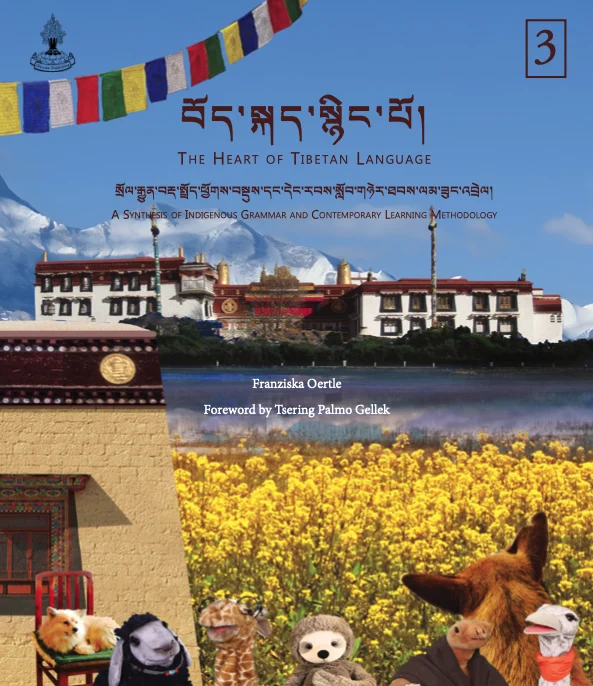
Her seminal work, The Heart of Tibetan Language: A Synthesis of Indigenous Grammar and Contemporary Learning Methodology, is a four-volume series of which three have been published. This series is complemented by innovative online courses designed to guide students through the textbooks. Oertle currently teaches Tibetan online and at the Sarnath International Nyingma Institute. The success of her textbooks has led to translations into Spanish and Portuguese, with Italian and German versions forthcoming.
A cornerstone of Oertle’s pedagogical approach is the collaborative design and delivery of language courses alongside Tibetan tutors and teachers. This partnership has fostered a sense of shared purpose and mutual enrichment. Her native-speaker colleagues often use the term po pa to describe the pride they feel in their culture and the uniqueness of their language when they witness non-Tibetans engaging with it. Po pa, a concept not easily translated into English, encapsulates a profound sense of self-confidence and cultural affirmation. Together, Oertle and her Tibetan collaborators are actively contributing to the preservation of the Tibetan language.
A Unique Pedagogical Approach
The traditional Tibetan educational system, characterized by the oral transmission of knowledge from teacher to disciple, can be perceived as conservative. Oertle believes that preserving this invaluable linguistic heritage requires presenting it in a manner that is both engaging and accessible, rather than dry or intimidating. Her textbooks, informed by her extensive graduate research, aim to demystify profound grammatical concepts without oversimplifying them.
While Tibetan has a reputation for being exceptionally difficult, Oertle offers a nuanced perspective. She acknowledges that certain aspects, such as spelling and the vast dialectical variations, present genuine challenges. A learner of one dialect might find themselves understanding little when interacting with speakers from a different region. However, she argues that labeling Tibetan as inherently more difficult than other languages is an oversimplification. The key, she contends, lies in effective presentation and pedagogy.
Oertle emphasizes that language learning transcends the mere memorization of vocabulary and grammatical structures. It is a transformative process that reshapes our relationship with ourselves and with others, a journey unique to each individual. Consequently, her pedagogy is student-centered, characterized by a friendly and encouraging tone.
Navigating Cultural Boundaries: A Swiss Scholar’s Perspective
Oertle candidly addresses the complexities of her role as a Swiss woman teaching Tibetan. Her initial immersion in Nepal was marked by a limited understanding of Tibetan culture. However, years of living with Tibetan families and the invaluable guidance of friends and colleagues have cultivated a deeper appreciation and understanding. She acknowledges that despite her linguistic proficiency, her encounters with His Holiness, or her commitment to the language, she remains a cultural outsider—a Swiss national.
Her work has generally been met with profound respect. His Holiness the Dalai Lama graciously provided the foreword for her first textbook. Her books have been discussed on Tibetan radio, and the launch of her initial volume took place at the prestigious Library of Tibetan Works and Archives. The entire event was conducted in Tibetan, a significant undertaking given the distinct nature of spoken and written Tibetan. The visual representation of colloquial Tibetan in print often surprises native speakers. Nevertheless, the overarching response has been one of immense appreciation for her sincere dedication to understanding and supporting their language and culture.
Charting the Future: Expanding the Reach of Tibetan Language Education
Looking ahead, Oertle envisions numerous avenues for her work to further foster cultural exchange. She identifies as a global citizen and dreams of her Tibetan language textbooks and online courses reaching dedicated learners across diverse global regions. The immediate priority is the translation of her books into more languages, with Mandarin and Russian at the forefront of their aspirations. The long-term vision is to offer the complete textbook series and online courses in multiple languages, enabling individuals worldwide to embark on their Tibetan language learning journey with joy and enthusiasm in their own mother tongue. This initiative represents a crucial step in ensuring the enduring vitality of the Tibetan language and the rich cultural tapestry it embodies.

