

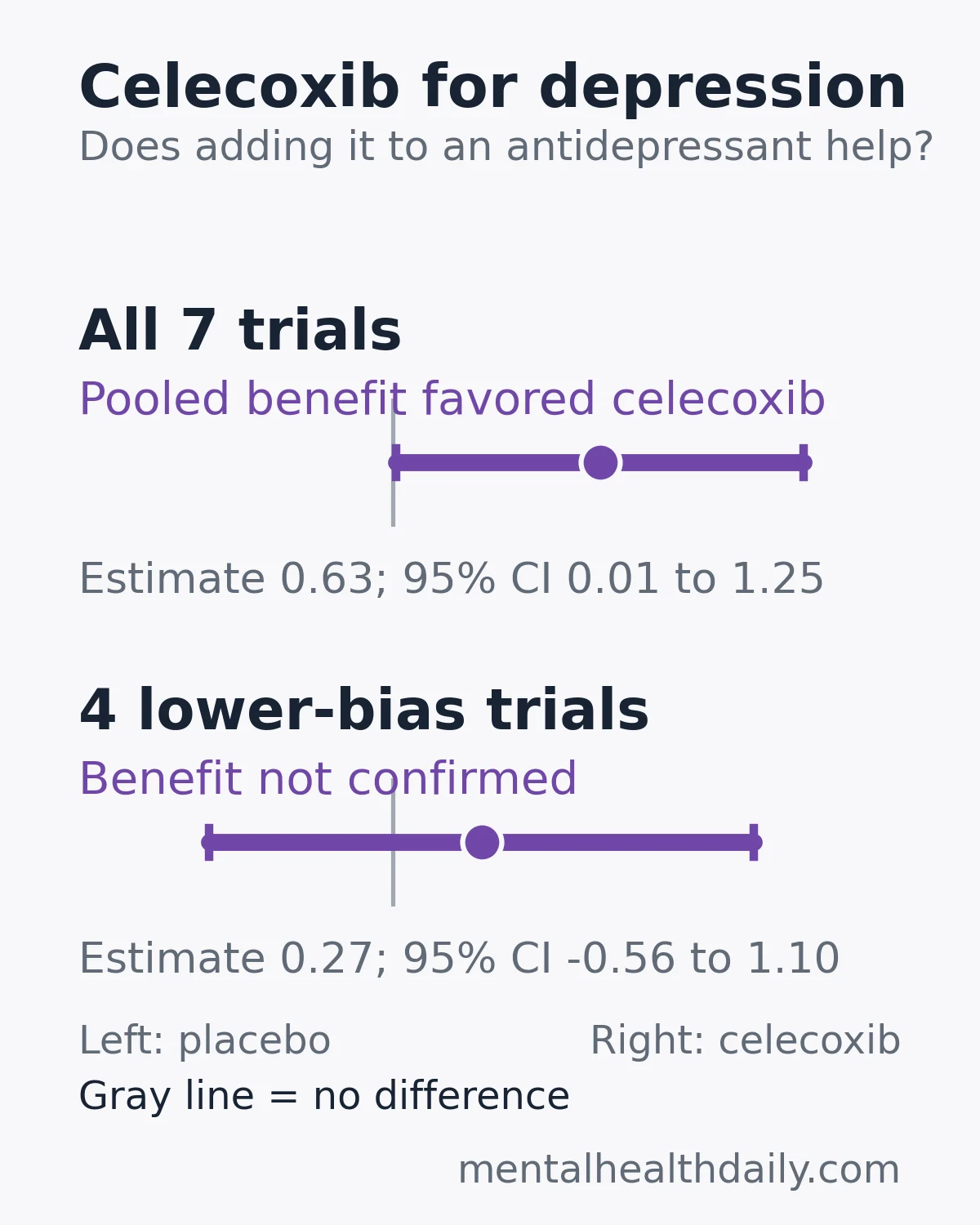
A comprehensive review of seven randomized trials published in 2026 has cast a critical light on the potential efficacy of celecoxib, a common anti-inflammatory drug, when used as an add-on treatment for major depressive disorder. Initially, the pooled analysis of 365 adults indicated that combining celecoxib with an antidepressant was associated with lower depression scores, marked by a standardized mean difference (SMD) of –0.63, with a 95% confidence interval (CI) ranging from –1.25 to –0.01. While this interval just barely excluded the possibility of no difference, suggesting a statistically significant benefit, the finding proved remarkably fragile. When researchers meticulously removed three trials identified as having a high risk of bias—primarily due to issues like missing outcome data—the apparent benefit diminished significantly and, crucially, was no longer statistically confirmed. This shift in findings underscores the paramount importance of study quality in medical research and suggests that the enthusiasm for celecoxib as an adjuvant therapy for depression may have been premature, requiring a more cautious interpretation.
The Landscape of Major Depressive Disorder and the Inflammatory Hypothesis
Major Depressive Disorder (MDD) is a debilitating mental health condition characterized by persistent feelings of sadness, anhedonia (loss of interest or pleasure), and a range of cognitive and physical symptoms that significantly impair daily functioning. Affecting millions globally, MDD is a leading cause of disability. Despite the availability of various antidepressant medications and psychotherapies, a substantial portion of patients do not achieve full remission, and many experience treatment-resistant depression (TRD). This ongoing challenge has spurred extensive research into novel therapeutic targets and augmentation strategies, leading scientists to explore the potential role of inflammation in the pathophysiology of depression.
The "inflammatory hypothesis of depression" proposes that systemic inflammation, often evidenced by elevated levels of pro-inflammatory cytokines and C-reactive protein (CRP), can contribute to the development and persistence of depressive symptoms. These inflammatory molecules can influence neurotransmitter systems, neuroplasticity, and neuroendocrine function, all of which are implicated in depression. Consequently, there has been considerable interest in repurposing anti-inflammatory drugs, particularly non-steroidal anti-inflammatory drugs (NSAIDs) like celecoxib, as adjunctive treatments to dampen these inflammatory pathways and potentially enhance the effects of conventional antidepressants.
Celecoxib: Mechanism, Existing Uses, and the Rationale for Depression
Celecoxib, marketed under brand names such as Celebrex, is a prescription anti-inflammatory drug belonging to the class of selective cyclooxygenase-2 (COX-2) inhibitors. Unlike traditional NSAIDs that inhibit both COX-1 and COX-2 enzymes, celecoxib primarily targets COX-2. This enzyme is largely responsible for the synthesis of prostaglandins, which are key inflammatory signaling molecules involved in pain, fever, and inflammation. By selectively blocking COX-2, celecoxib aims to reduce inflammation and pain with a potentially lower risk of gastrointestinal side effects compared to non-selective NSAIDs, though it carries its own distinct set of risks, particularly cardiovascular and renal.
The rationale for testing celecoxib in MDD stems directly from the inflammatory hypothesis. If inflammation contributes to depression, then an agent that effectively reduces inflammation, like celecoxib, might complement the actions of antidepressants. Researchers hypothesized that by modulating the inflammatory response, celecoxib could create a more conducive neurobiological environment for antidepressants to exert their effects, thereby improving patient outcomes, particularly in those with evidence of elevated inflammation. It is crucial to note that celecoxib was never proposed as a standalone treatment for depression but rather as an add-on, to be used alongside existing antidepressant regimens.
The 2026 Meta-Analysis: A Deep Dive into the Evidence
The 2026 review, conducted by Srisurapanont et al., performed a rigorous meta-analysis of seven double-blind, randomized controlled trials. These trials compared the efficacy of an antidepressant combined with celecoxib against the same antidepressant combined with a placebo. The primary outcome measured was the change in depression scores, standardized to allow for comparison across different scales used in individual studies.
The initial pooled analysis yielded a standardized mean difference (SMD) of –0.63, with a 95% confidence interval (CI) of –1.25 to –0.01. In statistical terms, a negative SMD in this context indicates that celecoxib favored lower depression scores. The confidence interval, which represents the range within which the true effect size is likely to lie, just barely excluded zero (no difference). This proximity to the null effect highlights the borderline nature of the initial statistical significance, suggesting a potentially small or uncertain benefit. Furthermore, the wide confidence interval (spanning 1.24 standardized units) implies a high degree of uncertainty around the point estimate and makes it challenging to predict the magnitude of improvement an individual patient might experience.
Heterogeneity and Variability: A Complex Picture
A significant finding within the review was the high degree of heterogeneity among the trial results. The I² statistic, a measure of inconsistency across studies, was 81.3%. This exceptionally high value indicates that 81.3% of the observed variation in treatment effects across the trials was due to true differences between the studies rather than mere random chance. In practical terms, this means that the individual trial results varied considerably; four trials reported a statistically significant advantage for celecoxib, while three did not. This high heterogeneity makes it difficult to draw a single, generalizable conclusion from the pooled data, as the "average" effect may not accurately represent any particular study or patient population.
Further emphasizing this variability, the 95% prediction interval for another similar trial ranged from –2.23 to 0.97. Unlike a confidence interval, a prediction interval estimates the range of effects that would be observed in a future study. This wide interval, encompassing strong benefits, no benefit, and even a result favoring placebo, powerfully illustrates the unpredictability of celecoxib’s effect in new research settings. Such broad uncertainty underscores the lack of a consistently robust effect.
The Crucial Role of Bias and Quality Control
Perhaps the most critical finding of the 2026 review emerged from its meticulous assessment of trial quality. Researchers identified three of the seven trials as having a high risk of bias, particularly due to significant amounts of missing outcome data. Missing data can severely distort results, often leading to an overestimation of treatment effects, especially if patients who drop out are those who are not responding well to treatment or experiencing side effects.

After excluding these three high-risk studies, the meta-analysis was re-run on the remaining four higher-quality trials. The revised estimate for the standardized mean difference moved considerably closer to zero, shrinking to –0.27. More importantly, the 95% confidence interval for this adjusted estimate widened and clearly crossed the line of no effect, ranging from –1.10 to 0.56. While the point estimate still leaned slightly towards celecoxib, the data no longer provided statistical evidence to establish that it works better than placebo. This dramatic change in conclusion based on the removal of biased studies serves as a powerful reminder of the fragility of initial findings and the absolute necessity of robust methodological quality in clinical research. The confidence in the efficacy result, considering this finding, was rated "very low" by the review authors.
A Chronological Perspective: How the Evidence Has Shifted
The journey of celecoxib in depression research illustrates a common pattern in medical science: initial promising signals followed by more rigorous scrutiny that tempers early enthusiasm.
- Early, Small Trials: Initial studies, often small in scale, provided the first glimmers of hope. For instance, an early 40-person trial combining celecoxib with reboxetine reported greater depression improvement. However, such trials often suffered from methodological limitations. The aforementioned 40-person study, for example, had a substantial dropout rate of 55% before the 6-week assessment, making its favorable estimate less reliable. Small sample sizes are also prone to random fluctuations and can easily yield false positives.
- Expanding to Diverse Settings: As interest grew, later trials began to test celecoxib in different clinical contexts, involving various types of antidepressants and patient populations (e.g., those with or without treatment resistance, varying severities of depression). These studies, while expanding the evidence base, also introduced more variability, as different patient characteristics or concomitant medications could influence outcomes.
- Previous Meta-Analyses (e.g., 2023): Prior to the 2026 review, a 2023 meta-analysis had estimated a larger benefit (SMD –0.85) for celecoxib as an add-on. This earlier review, incorporating the evidence available at that time, likely included some of the studies later identified as high-risk for bias and might not have given as much weight to heterogeneity and study quality.
- The 2026 Review: A Refined Perspective: The most recent 2026 meta-analysis distinguished itself by incorporating newer, potentially negative evidence and placing a strong emphasis on methodological quality and heterogeneity. By critically evaluating and excluding biased trials, it offered a more conservative and likely more accurate assessment of celecoxib’s true effect, ultimately weakening the case for its routine use. This evolution underscores a maturation of the scientific understanding of celecoxib’s role in depression.
The Elusive Biomarker: C-Reactive Protein (CRP)
A particularly appealing aspect of the inflammatory hypothesis was the prospect of identifying specific patient subgroups who would most benefit from celecoxib, potentially through a biomarker like C-reactive protein (CRP). CRP is a widely available blood marker of systemic inflammation, and the idea was that celecoxib might be most effective in patients with elevated baseline CRP levels. This personalized medicine approach could optimize treatment and minimize unnecessary exposure to risks.
However, the trials reviewed have not confirmed this appealing idea. For example, a 119-person trial specifically investigated whether baseline CRP levels could predict a differential response to celecoxib. The study found no clear "treatment-by-CRP interaction," meaning that measured inflammation did not reliably predict an added antidepressant effect from celecoxib. While the 2026 review did note one exploratory finding regarding a treatment-resistance subgroup pattern from a single trial, this is considered too narrow and preliminary to guide patient selection.
In essence, while depression can involve inflammatory processes, a plausible biological mechanism does not automatically translate into a validated treatment rule. Routine CRP testing to decide on celecoxib for depression would currently be "running ahead of the evidence," lacking the necessary scientific validation to justify its clinical application.
Safety Concerns: A Persistent Shadow Beyond Short Trials
Beyond the questions of efficacy, the safety profile of celecoxib presents significant considerations that short-term depression trials are ill-equipped to fully address. Only five of the reviewed trials, involving a modest 265 people, contributed data to the dropout analyses related to adverse events. Neither comparison in the review definitively settled whether celecoxib as an add-on is well-tolerated. The confidence intervals for dropout rates with celecoxib were wide, spanning possibilities of both substantially fewer and substantially more dropouts compared to placebo. This means the trials were underpowered to reliably detect differences in tolerability.
The inherent limitations of these short-term studies (mostly lasting only six weeks) are critical when considering celecoxib’s established long-term risks. The U.S. prescribing information for celecoxib carries prominent warnings about serious cardiovascular events (e.g., heart attack, stroke), significant gastrointestinal bleeding or ulcers, and kidney risks. These are not minor side effects and can have severe, life-threatening consequences, particularly with prolonged use.
Furthermore, a critical drug-drug interaction concern arises when celecoxib is co-administered with certain classes of antidepressants. Selective serotonin reuptake inhibitors (SSRIs) and serotonin-norepinephrine reuptake inhibitors (SNRIs), two common antidepressant classes, can independently increase the risk of bleeding. Combining them with celecoxib, which also carries a bleeding risk, could potentially amplify this danger, particularly for gastrointestinal bleeding.
Given these well-established and serious drug warnings, a short, underpowered comparison of dropout rates in depression trials cannot, and should not, negate these known risks. Clinicians considering celecoxib for its primary indications (pain or inflammatory conditions) must conduct a thorough medication review, especially if the patient is already taking an antidepressant. The current depression evidence alone does not justify routine add-on prescribing, particularly given the unresolved safety questions and the potential for serious adverse events.
Implications for Clinical Practice and Future Research
The findings of the 2026 review provide crucial guidance for both clinicians and researchers.
- For Clinicians: The current evidence does not support the routine use of celecoxib as an add-on treatment for major depressive disorder. While a modest benefit might still be theoretically possible, the lack of confirmation from higher-quality evidence, coupled with the known serious risks of celecoxib, means that the risk-benefit ratio for this specific indication remains unfavorable. Clinicians should continue to rely on established, evidence-based augmentation strategies for treatment-resistant depression and counsel patients on the current state of the science. Any consideration of celecoxib for depression would be off-label and should only occur within a carefully considered clinical context, weighing individual patient factors and risks.
- For Patients: Individuals experiencing depression and seeking novel treatments should be aware that celecoxib, in this context, remains a "research lead" rather than a "tested routine add-on." Expectations should be managed, and discussions with healthcare providers should focus on treatments with stronger, more consistent evidence.
- For Researchers: The review highlights the urgent need for larger, well-designed clinical trials. Such trials would need:
- Robust Methodology: Strict protocols to minimize bias, including comprehensive blinding, complete outcome data collection, and rigorous statistical analysis.
- Defined Subgroups: A clear strategy to identify potential responder subgroups before enrollment, perhaps using advanced inflammatory biomarkers, genetic markers, or specific clinical profiles, rather than relying on post-hoc exploratory analyses.
- Longer Follow-up: Assessment of both depression symptoms and clinically meaningful harms over an extended period to fully evaluate long-term efficacy and safety, especially considering celecoxib’s known risks.
- Patient-Reported Outcomes: Incorporating measures that capture the patient’s perspective on improvement and quality of life.
Conclusion: A Call for Caution and Continued Scrutiny
In conclusion, the 2026 meta-analysis of celecoxib as an add-on for major depressive disorder presents a nuanced and ultimately cautionary picture. While an initial pooled analysis of all trials suggested a statistically significant, albeit fragile, benefit, this finding evaporated when studies with a high risk of bias were excluded. The high degree of heterogeneity among trials and the inability to identify a reliable responder subgroup through inflammatory biomarkers further weaken the case for its widespread adoption. Given the established and serious cardiovascular, gastrointestinal, and renal risks associated with celecoxib, and the lack of robust evidence for a repeatable, clinically meaningful depression benefit, the scientific consensus remains that celecoxib is not currently justified for routine add-on prescribing in depression. The journey from a promising hypothesis to a validated treatment is arduous, and for celecoxib in depression, the path ahead remains squarely in the realm of further, more rigorous research.

