

Weight stigmatization, often described as the "last acceptable form of bias," is a deeply ingrained and pervasive issue that affects individuals across various sectors of society, from childhood to healthcare and employment. This phenomenon encompasses the widespread discrimination, stereotyping, and prejudice directed towards individuals perceived as overweight or obese. Emerging research and historical studies paint a stark picture of how deeply this bias is entrenched, leading to significant negative consequences for those targeted.
The Daily Assault of Weight Bias
The lived experiences of individuals facing weight stigma are often characterized by a constant barrage of negative encounters. A significant study involving fifty overweight women who meticulously documented instances of weight-based discrimination over a single week recorded over a thousand such occurrences. This translates to an average of approximately three stigmatizing events per day for each participant. These incidents range from overt harassment, such as verbal insults and name-calling, to encountering physical barriers, like the inability to comfortably fit into public seating. Furthermore, individuals frequently report experiencing perceived poorer service in commercial settings, such as restaurants and retail stores, directly attributable to their weight.
While women appear to bear a disproportionate burden of this discrimination, obese men are not immune. They report approximately three times less discrimination than women of similar weight, suggesting that for them, daily encounters with stigma might be less frequent but still a reality. The impact of this bias extends beyond everyday interactions, permeating crucial aspects of life such as employment.
Employment Discrimination: A Stark Reality
Empirical evidence highlights the tangible impact of weight stigma on employment opportunities. In a notable study, professional actors posing as job applicants were intentionally made to appear overweight using theatrical prostheses. The results were unequivocal: these individuals faced significantly higher rates of discrimination compared to when they appeared at their natural weight. This employment bias was found to be particularly pronounced against overweight women, underscoring a gendered dimension to weight-based discrimination in the professional sphere. The implications of such bias are profound, potentially limiting career progression, economic stability, and overall well-being for affected individuals.
Public Perception: Deep-Seated Disdain
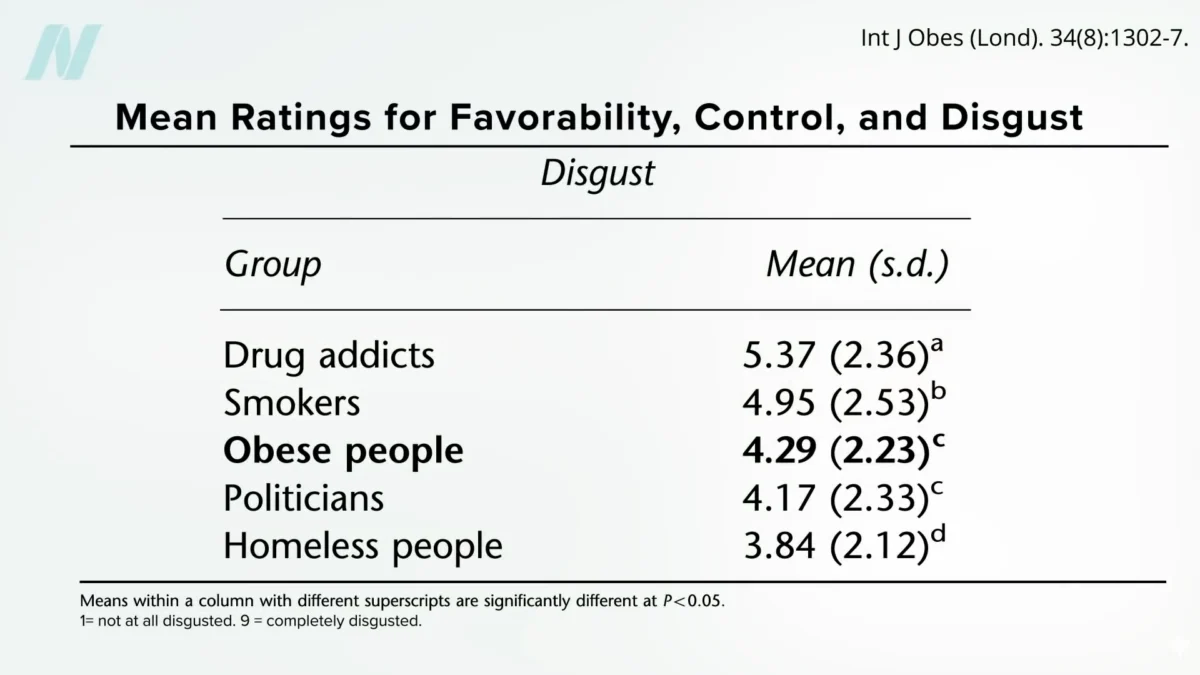
Surveys exploring public attitudes further illuminate the depth of societal prejudice against individuals with higher body weights. In a comparative analysis of sixteen stigmatized social groups, including those experiencing homelessness, individuals with obesity were ranked as more disgusting than all but drug addicts and smokers. This finding, which places individuals with obesity in a particularly negative light, was reinforced by researchers who noted that obese individuals were rated as equally disgusting as politicians. This comparison, while perhaps intended to highlight the severity of the bias, reveals a disturbing trend of associating weight with inherent negative character traits and moral failings.
The Early Roots of Stigma: Childhood Prejudice
The roots of weight stigma are alarmingly shallow, taking hold even in early childhood. Research indicates that children as young as three years old begin to associate overweight peers with negative descriptors such as "mean," "stupid," "lazy," and "ugly." This negative linguistic association intensifies with age, suggesting a developmental trajectory of increasing prejudice.

A landmark study published in 1961 provided early and compelling evidence of this phenomenon. Children participating in summer camps and schools across diverse social, cultural, and ethnic backgrounds were shown pictures of various children and asked to rank their preferences. Among the images presented were children with physical disabilities and an obese child. In every tested group, the obese child consistently ranked last, indicating a profound and uniform aversion.
The Worsening Trend: A Four-Decade Perspective
The concerning trajectory of weight stigma was further illuminated by a follow-up study conducted in 2003, forty years after the initial research. Titled "Getting Worse: The Stigmatization of Obese Children," the study repeated the original experiment. The findings were disheartening: the obese child was liked even less in the 2003 study compared to 1961. This trend mirrors broader societal shifts, with national surveys recording a nearly 70% surge in perceived weight discrimination since the mid-1990s. This data suggests a significant and ongoing escalation of anti-fat sentiment within society.
Institutional Complicity: Educators, Parents, and Healthcare Professionals
The pervasive nature of weight stigma is exacerbated by its presence within influential institutions. Educational settings, where children spend a significant portion of their formative years, are not immune. A substantial portion of teachers and school staff surveyed expressed the belief that becoming obese is "one of the worst things that could happen to a person." This attitude, held by those in positions of authority, can inadvertently shape the perceptions and treatment of students.
The bias extends to the familial sphere as well. Parents have been found to exhibit weight bias, sometimes providing less support for the college education of their overweight daughters compared to their thinner siblings. This parental discrimination, as noted by prominent obesity researchers, represents a particularly potent form of prejudice, impacting the fundamental support structures within a child’s life.
Perhaps most concerning is the documented bias within the healthcare system, where individuals often seek care and support. A representative national survey revealed that more than half of physicians held negative views of obese patients, describing them as "awkward, unattractive, ugly, and noncompliant." Furthermore, a significant percentage of nurses agreed with the statement, "Caring for an obese patient usually repulses me." This antagonism within healthcare can have severe and tangible health consequences for individuals who may require medical attention the most.
Health Consequences: Screening Disparities and Refusal of Care
The health implications of weight stigma within the medical community are substantial. Obese women, who are at a higher risk for developing certain cancers, including cervical, endometrial, and ovarian cancers, are less likely to receive recommended screenings. Morbidly obese patients, for instance, have approximately half the odds of undergoing recommended pelvic exams.
This disparity can stem from a complex interplay of factors. While some patients may avoid medical appointments due to anticipated stigma, some healthcare providers actively refuse care to individuals of certain weights. A survey of OB/GYN practices in Florida revealed that as many as one in seven refused to see heavier women, with some setting weight cut-offs for new patients as low as 200 pounds. Such practices create significant barriers to essential healthcare services for a substantial portion of the population.
The Subtle Erosion of Care: Time and Rapport
Even when healthcare providers do not outright refuse care, their interactions with overweight and obese patients can be compromised by subtle biases. A study involving physicians presented with a migraine patient’s medical chart indicated that those who saw the patient as obese allocated approximately 28% less time to them compared to patients of average or overweight status. This reduction in time can translate to less thorough examinations and a diminished capacity to address patient concerns effectively.
Furthermore, recorded doctor-patient visits have shown that physicians tend to build "less emotional rapport with overweight and obese patients." This lack of connection can hinder open communication, trust, and the overall effectiveness of the therapeutic relationship, impacting patient satisfaction and adherence to treatment plans.
Bias Among Specialists: A Disturbing Trend
The issue of weight stigma is not confined to general practitioners; it extends even to obesity specialists themselves. Surveys conducted between 2001 and 2013 revealed a worsening trend in explicit anti-fat attitudes among these professionals. Obesity specialists increasingly described individuals with higher body weights as significantly more lazy, stupid, and worthless compared to their thinner counterparts.
This deeply ingrained prejudice is even reflected in the medical literature. An example from the Annals of Internal Medicine starkly illustrates this, with a line stating, "Obesity is an aesthetic crime: it is ugly." Such language, appearing in peer-reviewed publications, contributes to the normalization and perpetuation of harmful stereotypes within the medical community.
The Illusion of Respect: A Disconnect in Perception
Despite the often-unacknowledged negative attitudes held by physicians towards their obese patients, a study titled "Obese Patients Overestimate Physicians’ Attitudes of Respect" revealed a curious disconnect. The research found that obese patients frequently expressed satisfaction with their healthcare providers, even when the providers harbored underlying biases. Researchers concluded that while physicians might be "successfully playing the part," the "lack of true respect suggests…the authenticity of the patient-physician relationship should be questioned." This raises concerns about the genuine nature of care received and the potential for underlying biases to impact treatment decisions and patient outcomes in ways that are not immediately apparent.
The pervasiveness of weight stigma across various societal domains, from early childhood to professional and healthcare settings, highlights a critical and ongoing public health concern. Addressing this deeply rooted bias requires a multi-faceted approach, encompassing education, policy changes, and a fundamental shift in societal attitudes to foster a more inclusive and equitable environment for all individuals, regardless of their body weight. The next installment in this series will further explore the profound burdens imposed by weight bias.

