

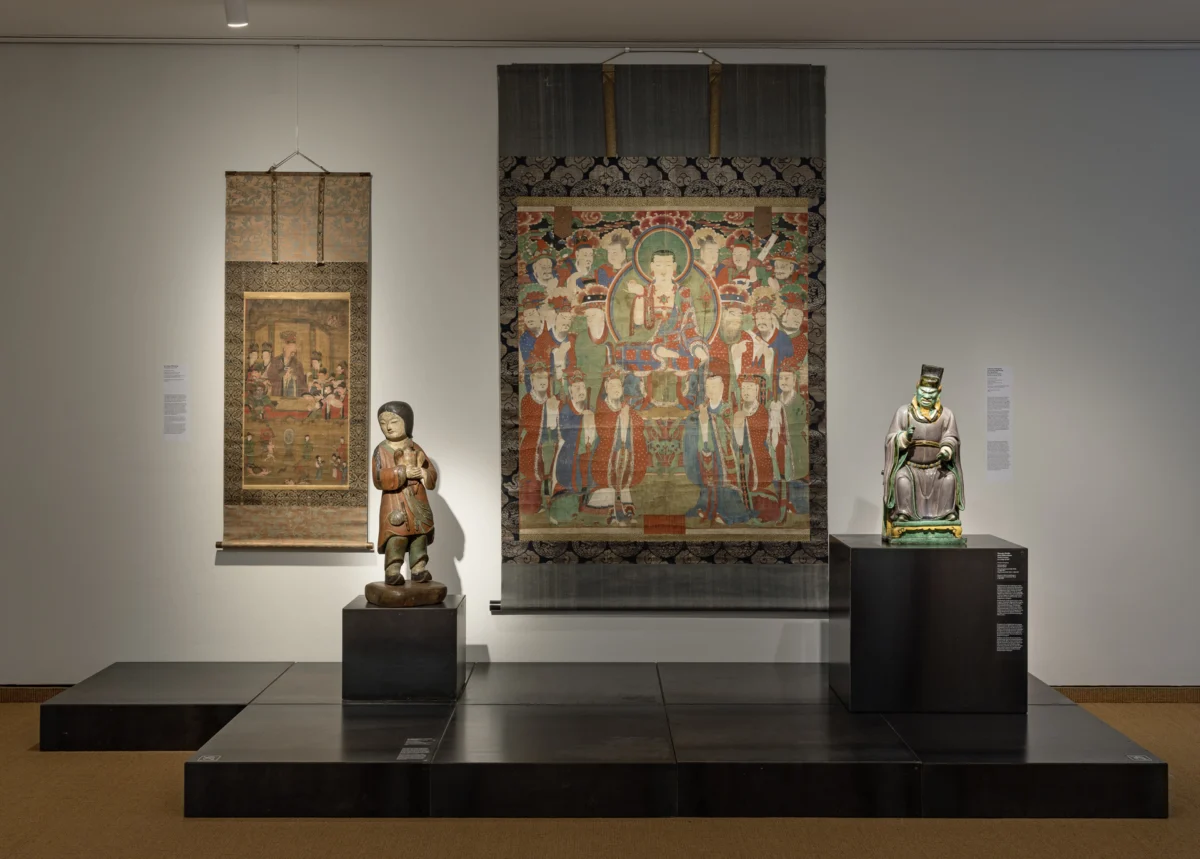
An exhibition at the Museum of East Asian Art in Cologne presents a profound and compelling argument: the objects on display were never intended to be mere passive observers of human contemplation. Titled "Living Images," this meticulously curated exhibition by Petra Rösch, the museum’s curator of Korean and Buddhist art, brings together a remarkable collection of ritual paintings, sculptures, and calligraphy from China, Japan, and Korea, primarily dating from the medieval period. The exhibition’s central thesis explores the dynamic life of these devotional objects, delving into the consecrations, offerings, and ceremonies that imbue them with spiritual significance, transforming them from static artifacts into active participants in religious practice.
The Korean Consecration Ritual: Breathing Life into Sacred Objects
At the heart of "Living Images" lies the Korean ritual known as Bulbokjang Jakbeop, which translates roughly to "enshrining objects in a Buddhist image." This practice underscores the exhibition’s core message about the activation and spiritual animation of sacred art. On May 17, 2025, a significant ceremony took place within the museum, bringing Venerable Gyeongam, a distinguished monk of the Jogye Order and an officially recognized successor in this ritual tradition, to Cologne. Designated as South Korea’s National Intangible Cultural Heritage No. 139, Venerable Gyeongam, accompanied by nine fellow monks, performed the consecration of a facsimile of the Sermon of Buddha Shakyamuni at Vulture Peak Mountain.

The original of this significant hanging scroll, anonymously painted in 1729, is housed at Haein-sa, a temple of immense historical and religious importance in South Korea. Haein-sa is renowned not only for its spiritual gravitas but also as the custodian of the Tripitaka Koreana, the monumental Buddhist canon carved onto over 80,000 wooden blocks. The inclusion of this live consecration ceremony within the exhibition’s final gallery provided a rare and powerful demonstration of Bulbokjang Jakbeop for an international audience, offering a direct encounter with the living tradition that the exhibition aims to illuminate.
The purpose of such a ritual is to elevate an image from a mere representation to a potent object of worship. It is a process of infusing spiritual life, transforming a visual depiction into a sanctified focal point for devotion. The Sermon of Buddha Shakyamuni at Vulture Peak Mountain facsimile, depicting a vibrant celestial assembly surrounding a serene, cross-legged Buddha, became the focus of this sacred act. During the ceremony, Venerable Gyeongam meticulously observed the five cardinal directions, placing a carefully selected array of medicines, fragrances, texts, and relics into a consecration bag. This bag, itself a gift to the museum and now a poignant exhibit, is a testament to the tangible elements involved in spiritual activation. Its modest size and delicate, paper-thin fabric, dyed in hues of violet, pink, and yellow against a backdrop of floral and celestial patterns, stand in stark contrast to the profound spiritual energy it represents.
A Curatorial Journey Through East Asian Devotional Art
The exhibition "Living Images" unfolds across two interconnected galleries within the Museum of East Asian Art. The museum’s architectural setting, a building designed by Kunio Maekawa and situated beside the serene Aachener Weiher lake in Cologne’s inner city, further enhances the contemplative atmosphere. The surrounding Japanese garden, conceived by sculptor Masayuki Nagare, provides a tranquil counterpoint to the profound spiritual themes explored within.

Near the exhibition’s entrance, a silk gauze rakusu, a garment worn by a Zen Buddhist monk during the Meiji era (1868–1912), subtly echoes the significance of the Korean consecration bag. Both objects, characterized by their spare, minimal aesthetics and the subtle glimmer of their materials, hint at the deeper spiritual dimensions often conveyed through understated forms.
The Narrative Arc: From Nirvana to the Founders’ Legacy
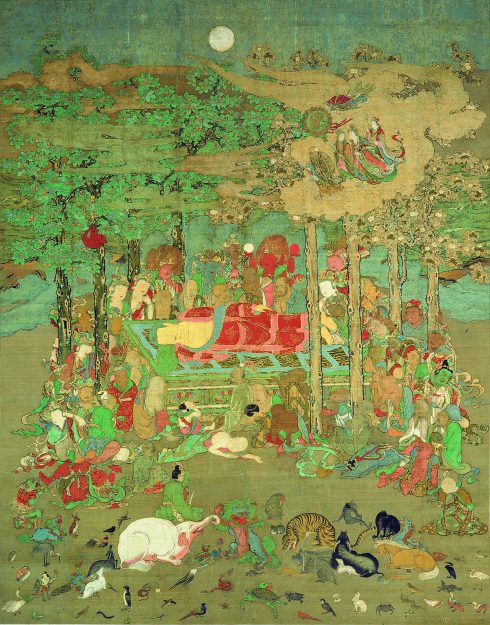
The exhibition commences with a striking hanging scroll, Buddha’s Entry into Complete Nirvana, a masterful work from Japan’s Nanbokucho period (1336–1392). This 1392 piece, rendered in ink, color, and gold on silk by an anonymous artist, was acquired by the museum’s founders, Adolf and Frieda Fischer. The painting vividly portrays the passing of the historical Buddha Shakyamuni, his reclining form enveloped by a multitude of grieving celestial beings, humans, bodhisattvas, animals, hungry ghosts, and demons. Above, his mother, Maya, watches from a cloud amidst wilting sala trees. The composition bears a remarkable resemblance to Byzantine depictions of the Dormition of the Virgin, its mourners captured in a moment of profound sorrow, a visual parallel to the Buddhist concept of letting go as a prerequisite for parinirvana.
These depictions of the Buddha’s death were not merely artistic renderings; they served as objects of ritual veneration in Japanese temples, traditionally displayed on the fifteenth day of the second lunar month to commemorate the Buddha’s passing. This enduring afterlife of meaning extends to the legacy of the museum’s founders. Adolf Fischer passed away in 1914, shortly after the museum’s inauguration. Frieda Fischer, who remarried a Jewish jurist in 1921, faced increasing peril under the Nazi regime. Her dismissal as museum director in 1937, a significant professional setback for one of the earliest women to hold such a position in Germany, highlights the turbulent historical context in which these objects have been preserved. Her death in December 1945 marked the end of a life intertwined with the museum’s destiny. Today, their names are inscribed beneath many of the works displayed in "Living Images," a testament to their enduring contribution.
Sculptural Presence: Ascetics and Arhats
Petra Rösch’s curatorial approach grants the artworks ample space to command their own presence, fostering a contemplative pace that mirrors the deliberate engagement with devotional objects. The initial sequence of paintings gracefully transitions into a collection of figurative sculptures carved from wood and stone. These figures possess a lifelike quality, capturing the essence of the ascetics they represent – individuals who dedicated themselves to prolonged periods of meditation, their earthly existence profoundly connected to the ground beneath them.
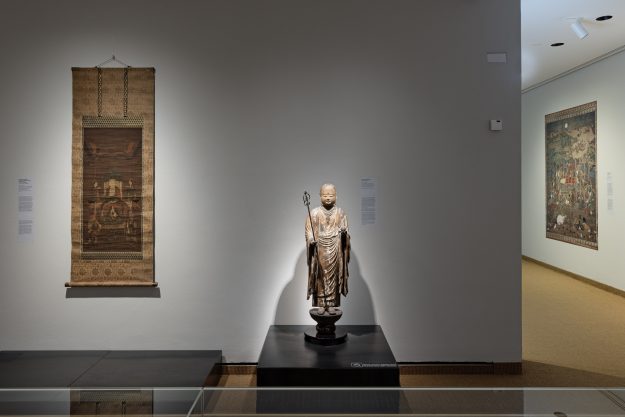
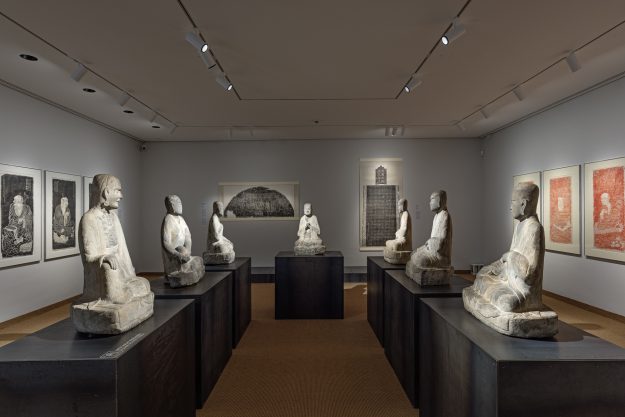
A notable example is the sculpture of Bodhisattva Kshitigarbha, known in Japanese as Jizo Bosatsu. Crafted by an anonymous artist around 1300 during Japan’s Kamakura period (1185–1333), this figure stands with the stillness of a sentinel. Its surface, composed of hinoki wood with layers of applied coatings that have aged like skin, exhibits a mottled texture, yet the figure’s gaze remains serenely unworn. It looks directly forward, engaging with a grouping of seven wise men. This series, titled Seven of the Group of Eighteen Luohan, shares a similar quality of individual presence. The faces appear to have been carved from life, each expressing a distinct personality, remarkably preserved despite the passage of time, though created in China during the Song dynasty (960–1279).
The term Luohan refers to arhats, disciples of the Buddha who have attained liberation. In the subdued lighting of Rösch’s installation, it is easy to envision these sculptures originally housed within cave temples, reminiscent of the Feilai Feng grottos in Hangzhou, Zhejiang province. The faces of the Luohan possess a human, almost humorous quality, even within their devotional context. The figures clutch scrolls, their chests bare beneath flowing robes, with visible ribs serving as a stark reminder of the physical austerity inherent in their spiritual path.
Calligraphy, Rubbings, and the Human Form
Surrounding the sculptures, a collection of stone rubbings, rendered in monochrome ink on paper – some in black, others in vermilion red – extend the exhibition’s thematic exploration of devotional subjects across a broader temporal spectrum, from the 18th century to the latter half of the 20th century. These aged, eccentric figures leap from the page, their depictions featuring long hair, earrings, body-length eyebrows, unclipped nails, and canes. They are depicted seated on rocks, confronting their destinies with an expression of humility born from profound wisdom.
This meticulous attention to ritualistic detail is a recurring motif throughout "Living Images." The placement of slippers on the floor, the natural drape of loose-fitting robes, and the posture of a seated reader are all subtle gestures recognized as aids to mindfulness on the path to awakening. The artists, sculptors, and calligraphers who created these objects were acutely aware of their functional purpose. Under glass, a copy of a chapter from the Great Sutra of Perfected Wisdom, a late 12th-century work from Chuson-ji, created during Japan’s Heian period, exemplifies this. Anonymously inscribed on blue-dyed paper in gold and silver, its precise symmetry rewards close examination.
Across the entirety of "Living Images," the recurring motif of the human figure serves as a powerful reminder of the Buddhist teaching that human birth is itself a rare and precious opportunity, the singular condition in which liberation is attainable. This profound idea is perhaps most vividly conveyed in a hanging scroll depicting Bodhisattva Kshitigarbha and the Ten Kings of Hell. Created in 1764 during Korea’s Joseon dynasty, this work by an anonymous artist, rendered in ink and color on hemp and coarse silk, features Kshitigarbha enthroned at the center, surrounded by a dense assembly of attendant figures and judges. The same principle is reflected in an Edo-period depiction of Hariti, the Mother of Demons, presented in both a wood sculpture and a hanging scroll. These images portray judgment in explicitly human terms, underscoring that the stakes of spiritual practice are inextricably linked to the human existence that makes such practice possible.
The Living Legacy of Devotional Objects
The final section of the exhibition brings the viewer full circle, returning to the themes introduced at the beginning. The last gallery is dedicated to the Bulbokjang Jakbeop ceremony, the very practice that defines the exhibition’s exploration of living images. The objects surveyed in "Living Images" are presented not as finished products but as entities that achieve their full potential through use. They are consecrated, offered to, and ultimately worshipped, thereby becoming what they are. Through Petra Rösch’s insightful curation, the exhibition makes a compelling case, gallery by gallery, that this dynamic, active state of being is the very essence of the art on display, inviting visitors to engage with these sacred artifacts not just as historical relics but as vessels of enduring spiritual power.

