

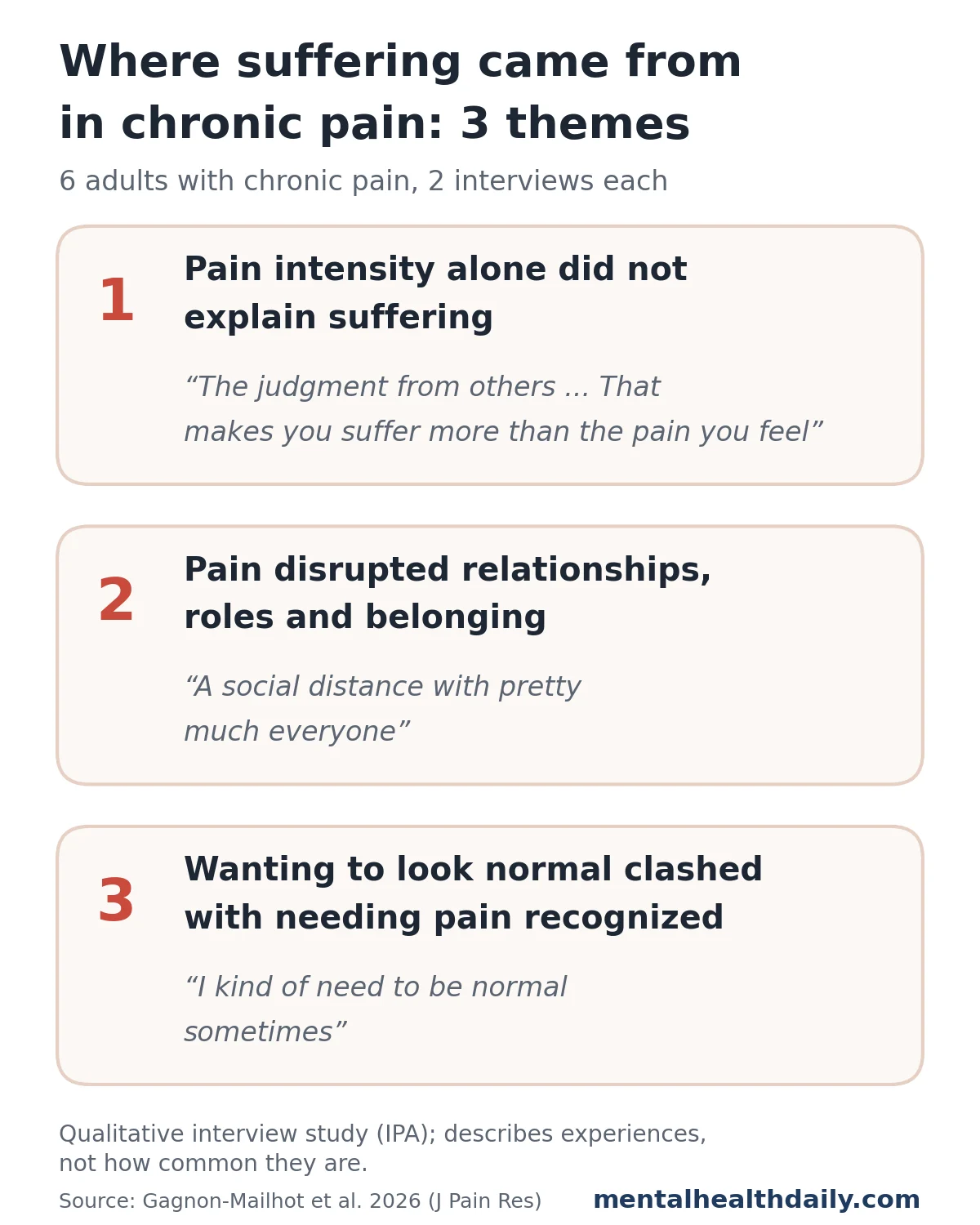
A recent 2026 interview study, conducted with six adults in Quebec living with long-term chronic pain, has brought to light a profound and often overlooked dimension of suffering: its social nature. Participants articulated that their deepest anguish stemmed less from the physical intensity of their pain and more from its devastating impact on their social lives. This included pervasive feelings of loneliness, the sting of societal judgment, and the exhausting effort required to maintain a facade of normalcy. The findings challenge conventional understandings of chronic pain, advocating for a more holistic approach that acknowledges and addresses the intricate interplay between physical sensation and social well-being.
The Quebec Study: Unveiling the Depths of Suffering
The groundbreaking research, led by Mael Gagnon-Mailhot et al. from the Université de Montréal and McGill University, embarked on a detailed exploration of what constitutes suffering for individuals grappling with persistent pain. The study specifically recruited six participants through the Quebec Chronic Pain Association, a vital support organization dedicated to assisting those with chronic conditions. All participants shared a common experience: chronic non-cancer pain that had persisted for more than three months and had, at various times, significantly disrupted their daily lives and sense of self.
To delve into these deeply personal experiences, the research team employed Interpretative Phenomenological Analysis (IPA). IPA is a specialized qualitative research method designed to meticulously examine how individuals make sense of major life events. Unlike quantitative studies that test pre-defined hypotheses, IPA involves an in-depth, iterative process where researchers immerse themselves in each participant’s interview transcript. The primary goal is to interpret the subjective meaning of the experience for that individual, only then moving to identify broader patterns and themes across the small, carefully selected sample. This methodology intentionally utilizes small sample sizes, typically ranging from six to ten interviews, to ensure that each personal narrative receives the rigorous, nuanced attention it requires.
The interview process was structured in two rounds. The initial interviews were broad and open-ended, focusing on participants’ experiences of pain, stress, and suffering. Following a preliminary review, a second round of interviews incorporated more targeted prompts concerning feelings of threat or challenge, and the availability of resources, as the topic of stress had only briefly emerged in the first discussions. Throughout this process, the study maintained a laser focus on "pain-related suffering," which the researchers defined as the profound distress that arises when pain fundamentally disrupts a person’s sense of self – the narrative they construct about who they are and how they navigate the world on a day-to-day basis. This definition underscores the study’s commitment to understanding suffering beyond mere physical discomfort.
Beyond Physical Pain: The Social Dimensions of Suffering
One of the most striking and, as the researchers noted, unexpected findings was the overwhelming prominence of social experiences in participants’ descriptions of suffering, despite social life being only briefly touched upon in the initial interview guides. This indicated that for many, the social consequences of pain eclipsed the physical sensation itself in terms of distress.
Several participants explicitly drew a clear distinction between physical pain and suffering. One individual remarked, "Physically I can tolerate; I suffer from situations." Another elaborated that even on days characterized by intense physical pain, they would not necessarily use the word "suffering." For them, suffering was a term reserved for the devastating loss of independence or, tellingly, "how others look at me." These statements powerfully illustrate a cognitive and emotional separation between the raw sensory input of pain and the deeper, more existential crisis of suffering.
The theme of loneliness emerged as a central pillar of this social suffering. One participant unequivocally stated, "The biggest source of suffering in my case was just the loneliness I felt." This sentiment highlights the profound isolation that chronic pain can impose, severing individuals from their social networks and leaving them feeling profoundly alone in their struggle. Another poignant account depicted a participant being offered morphine during a distressing episode, alone amidst a cacophony of screaming, yet refusing it. Their reasoning was clear: the pain itself was not the primary issue. "Yes I was in pain but I was not suffering from my pain," they explained, emphasizing that the hostile, isolating environment was the true source of their distress, not merely the bodily sensation.
While the study’s focus illuminated the social dimensions of suffering, the researchers were careful to note that pain intensity still matters. For some individuals, acute, overwhelming bodily pain can indeed be the primary driver of suffering in the moment. However, qualitative interview methods like IPA are particularly adept at capturing the insidious, slower erosion of identity and life narrative that often accompanies chronic conditions, a process distinct from transient physical discomfort.
Disrupted Lives: Relationships, Roles, and Identity
The second major theme identified by the study detailed how suffering manifested in the daily lives of participants, specifically through the disruption of relationships, established roles, and their fundamental sense of self. Chronic pain was found to fundamentally alter a participant’s place within their social fabric in multiple ways. This included the inability to participate in social activities, leading to withdrawal and reduced interaction; the loss of professional or personal roles that previously defined them; and the strain placed on existing relationships as friends and family struggled to understand or cope with the chronic nature of the illness.
Over time, this cumulative impact led to a profound internal shift. One participant vividly described becoming "a completely different person" – a version of themselves they actively disliked. This individual’s actions further underscored the social struggle: they meticulously kept foam tubes used to make utensils easier to grip hidden at home, specifically to avoid questions or judgment from people who "don’t understand." This small act reveals the constant burden of managing perceptions and the emotional toll of feeling misunderstood.
The researchers astutely linked these personal narratives to the inherently social nature of identity formation. Human beings construct their sense of who they are through their interactions and relationships with others. When chronic pain severs or profoundly alters these vital connections, it inevitably fragments and undermines the self, leading to a profound sense of loss and disorientation. The self, once a coherent narrative, becomes fractured, defined by limitations and external judgments rather than inherent strengths and connections.
The Double Bind: Normalcy Versus Recognition
The third significant theme uncovered by the study described a pervasive "double bind" experienced by individuals with chronic pain. Participants expressed a strong desire to fit in and resist being solely defined by their illness, articulated by one who stated, "I kind of need to be normal sometimes." Simultaneously, however, they also harbored a deep-seated need for others to genuinely understand the immense challenges and realities of living with chronic pain.
This inherent conflict was often exacerbated by the nature of "invisible pain." When pain lacked visible markers or outward signs, it made the pursuit of normalcy easier, as there was less to explain or hide. Yet, paradoxically, the very invisibility of their suffering meant that their pain often went unrecognized and unvalidated by others. This created a cruel dilemma: visible signs of pain risked reinforcing a stigmatized identity and undermining efforts to appear "normal," but without them, the profound reality of their condition often remained unseen and unsupported. The constant negotiation of this paradox added another layer of emotional and psychological burden.
Even well-meaning individuals could inadvertently miss the mark, contributing to this sense of invalidation. One participant lamented, "People really forget," expressing the hurt they felt when others ceased to acknowledge their pain, even though they admitted, "even though I don’t necessarily want them to see it." This intricate dance between wanting to conceal pain and needing it to be acknowledged highlights the complex social dynamics surrounding chronic illness and the subtle ways in which perceived neglect can deepen suffering.
The Link to Stress and Future Research
The study also shed light on the intricate relationship between stress and suffering in the context of chronic pain. The initial research design intended to explore how both pain and stress contribute to suffering. However, when participants were specifically asked about stress, their responses frequently merged into discussions about suffering itself, or described stress as a direct pathway into deeper suffering. This suggests that for individuals with chronic pain, stress may not be an independent variable but rather intimately intertwined with, or even perceived as a form of, suffering. The researchers cautiously flagged this observation as a compelling hypothesis for future dedicated research, suggesting that a deeper exploration of this connection could yield valuable insights into intervention strategies.
A Broader Context: Reinforcing Existing Research
The findings of the Quebec interview study are not isolated; they resonate strongly with a substantial and growing body of research exploring the multifaceted social dimensions of chronic pain. This consistency underscores the widespread nature of these experiences among chronic pain populations.
A comprehensive 2013 review, which synthesized findings from 77 papers encompassing 60 qualitative studies on chronic musculoskeletal pain, described an ongoing and arduous struggle for patients to affirm their sense of self, effectively explain their pain, and prove its legitimacy to others. Patients in those studies likewise grappled with the delicate balance between concealing and revealing their pain – precisely the "double bind" identified by the Quebec participants. This earlier work provides a strong historical and contextual foundation for the recent findings, demonstrating that these social struggles are deeply embedded in the chronic pain experience across diverse populations and research contexts.
The concept of "invalidation" – where an individual’s symptoms are dismissed, doubted, or misunderstood by others – has also been robustly linked to tangible health outcomes in larger quantitative studies. For instance, a 2019 survey study involving 1,173 adults with chronic pain found that higher levels of perceived invalidation were associated with worse physical and mental health. Further solidifying this connection, a 2021 study of 1,189 adults with chronic pain demonstrated that greater experiences of invalidation were linked to increased healthcare utilization and higher healthcare costs. While these questionnaire-based studies, being associative in nature, cannot definitively prove that invalidation causes worse health or higher costs, their consistent findings, when viewed alongside the rich qualitative insights from studies like the Quebec one, strongly point towards a significant and detrimental relationship between social invalidation and patient well-being.
Recognizing the critical importance of these social factors, a 2022 paper published in the prestigious journal Pain, authored by Ashton-James et et al., put forth a compelling argument. They advocated for a paradigm shift in pain research and clinical care, urging that social outcomes be systematically tracked alongside more traditional metrics such as pain intensity, distress, and disability. Their rationale was simple yet profound: for individuals living with chronic pain, these social outcomes may hold equal or even greater significance in determining their overall quality of life and suffering experience. This call to action aligns perfectly with the Quebec study’s findings, underscoring the urgency of integrating social considerations into the core of chronic pain management.
Implications for Patients and Clinicians
The findings from the Quebec study, reinforced by broader research, carry significant implications for both individuals living with chronic pain and the healthcare professionals who care for them.
Firstly, it profoundly challenges the notion that suffering can be adequately captured by a simple 0-to-10 pain intensity scale. While such a rating provides a snapshot of physical sensation, these deeply personal accounts reveal that it often fails to encompass the debilitating isolation, the loss of valued social roles, and the pervasive judgment that many individuals find most difficult to bear. These non-physical losses are paramount and warrant explicit discussion and exploration with clinicians during appointments. Encouraging patients to articulate these broader aspects of their suffering can lead to more comprehensive and empathetic care.
Secondly, clinicians’ responses to patients can either alleviate or inadvertently deepen suffering. The researchers emphasize the critical importance for healthcare providers to be acutely aware of how their own reactions and communication styles might inadvertently invalidate or subtly blame patients. Repeated experiences of being dismissed, doubted, or made to feel responsible for their pain can lead patients to internalize societal stigma, further eroding their self-worth and trust in the healthcare system. Fostering an environment of empathy, belief, and validation is crucial for building therapeutic alliances and mitigating suffering.
Finally, the study highlights social support as a promising, albeit still underexplored, target for intervention. The researchers propose that wider access to support groups and the proactive involvement of existing social networks could serve as crucial initial steps in addressing the social dimensions of suffering. It is important to note, however, that no specific treatment was tested within this qualitative study. Therefore, while the need for social approaches is evident, which specific social interventions are most effective remains an open question for future empirical research. This paves the way for clinical trials to investigate the efficacy of various social support programs, community-based interventions, and family-centered care models in improving outcomes for chronic pain patients.
Addressing Limitations and Future Directions
While the Quebec study offers invaluable qualitative insights, it is important to acknowledge its inherent limitations. The small sample size, characteristic of IPA methodology, means that the findings, while rich in detail and depth, cannot be broadly generalized to all chronic pain populations. The self-selection of participants, who were recruited through a pain association, might also mean they are more articulate or reflective about their experiences than the general chronic pain population. Furthermore, IPA, by design, prioritizes the subjective meaning-making process over the measurement of pain intensity, potentially downplaying the role of physical sensation for some individuals.
Despite these limitations, the study’s strength lies precisely in its in-depth, nuanced exploration. It provides a foundational qualitative understanding that can inform larger-scale quantitative studies, helping researchers develop more relevant survey instruments and design interventions that truly address the lived realities of chronic pain. The hypothesis regarding the close link between stress and suffering in chronic pain is a prime example of a fertile area for future investigation.
In conclusion, the 2026 Quebec study serves as a powerful reminder that chronic pain extends far beyond mere physical sensation. It is a profound assault on an individual’s social fabric, identity, and sense of belonging. By foregrounding the critical roles of loneliness, judgment, and the exhausting performance of normalcy, this research urges a fundamental re-evaluation of how chronic pain is understood, assessed, and treated. A truly effective approach to chronic pain management must embrace these complex social dimensions, moving towards care models that validate patients’ experiences, foster meaningful social connections, and ultimately address the totality of their suffering.

