

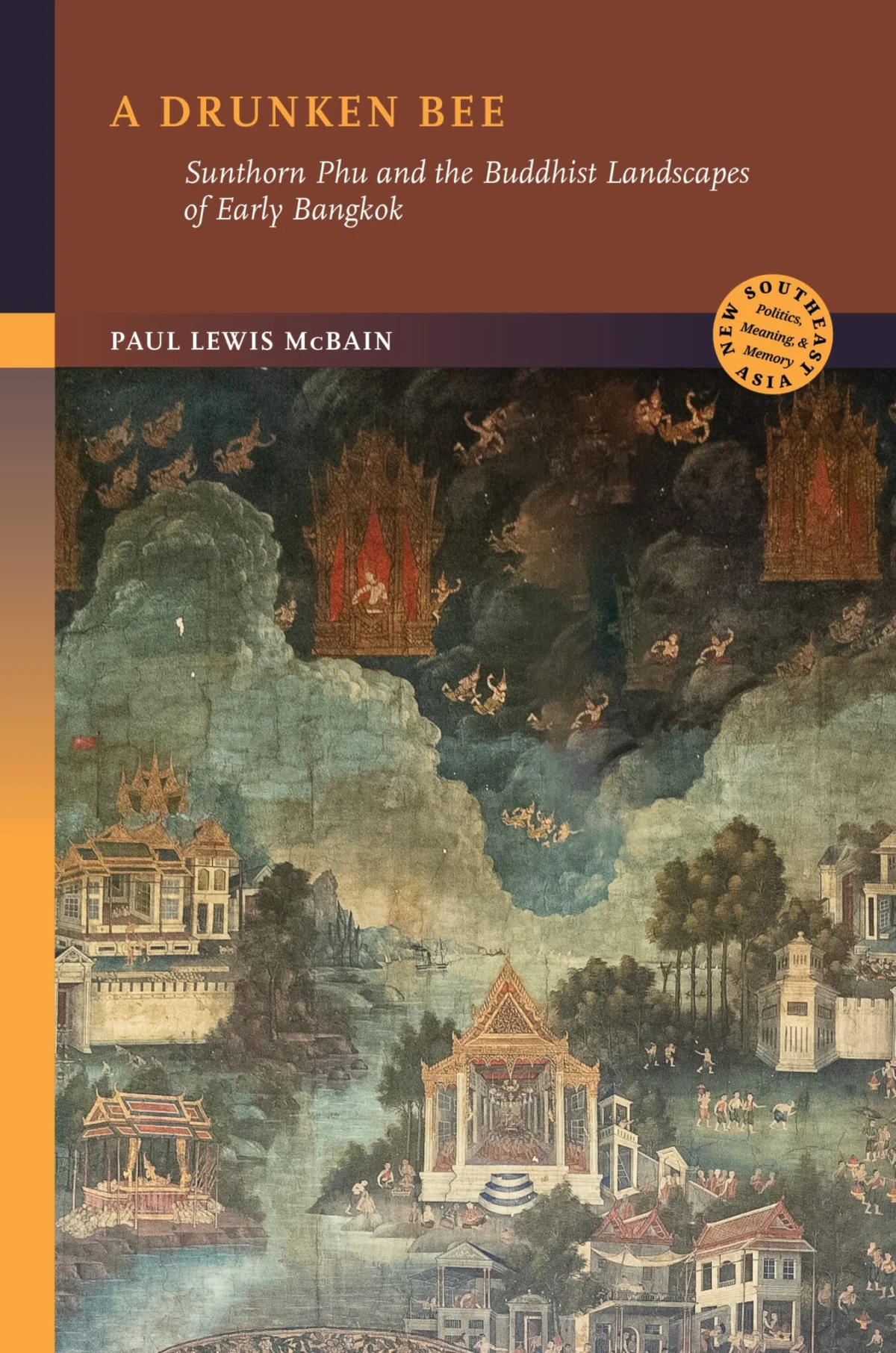
Sunthorn Phu, the revered national poet of Thailand, whose verses have been memorized by generations of schoolchildren and whose legacy is celebrated annually on June 26th, offers a far more complex and nuanced portrait of 19th-century Siamese society and its relationship with Buddhism than commonly acknowledged. While often lauded as the "Shakespeare of Thailand" for his linguistic mastery and celebrated for characters like the enchanting Phra Aphaimani and his adventurous son Sudsakorn, Phu’s life and work were deeply intertwined with the era’s social, political, and religious currents, revealing a vibrant, sometimes scandalous, and deeply human engagement with Buddhist philosophy. His homophone, the Thai word for "bee," aptly reflects his own self-description as a "lusty bee," perpetually drawn to the nectar of earthly pleasures and the unattainable blossoms of desire.
Born in Bangkok in 1786 into a working-class family, Sunthorn Phu’s life trajectory was shaped by the seismic shifts occurring in Siam. The destruction of the ancient capital, Ayutthaya, by the Burmese in 1767, and the subsequent establishment of a new capital in Bangkok, marked a period of profound cultural and political reconstruction. This era saw the vigorous recopying of classical literature, including the Thai adaptation of the Ramayana, Javanese epics, and Persian and Chinese tales, all of which would have formed the backdrop of Phu’s early life. His mother’s service as a wet nurse at the royal court provided him with a unique vantage point, positioning him "between court and temple," a duality that would define much of his literary output.
The Courtly Bard and the Embrace of Desire
Sunthorn Phu’s literary ascent began under the patronage of King Rama II (reigned 1809-1824), a monarch known for his appreciation of the arts and his fostering of poets. Phu, with his prodigious talent and charismatic if rambunctious personality, quickly became a favored court scribe, tutoring the royal children and participating in royal barge processions. His verses from this period, though often tinged with his well-documented penchant for women and drink, were highly valued, earning him a reprieve from the strictures that might have otherwise curtailed his excesses.
However, Phu’s entanglement with a high-born lady named Moon (Chan) led to a dramatic fall from grace. Ancient Ayutthaya codes stipulated severe penalties, even execution, for those who introduced poetry into the palace to seduce its inhabitants. While Phu escaped execution due to a period of relaxed court discipline, he was imprisoned and subsequently released. This episode marked his first retreat into monastic life, a pattern that would recur throughout his career whenever he faced political or personal turmoil. His initial nirat, a genre of travel poetry often lamenting separation and loss, poignantly references his love for Chan, juxtaposing his personal longing with the solemnity of his temporary ordination.
The narrative of Phu’s life during this period is a testament to the era’s complex social fabric. While the kingdom was rebuilding and striving to re-establish monastic discipline, a practice emphasized more in Thailand than in other Theravada Buddhist nations, individuals like Phu navigated the system with a blend of adherence and defiance. The emphasis on the vinaya, the monk’s disciplinary code, stood in stark contrast to Phu’s personal inclinations, creating a fertile ground for his exploration of human fallibility and desire.
Exile, Reflection, and the Search for Immortality
The death of King Rama II in 1824 ushered in a new era under his more sober successor, who was less tolerant of the court’s bohemian elements. Once again, Phu sought refuge in the monastic life, a recurring motif of "ordaining to escape" his worldly troubles. This period saw him embark on a significant journey to the ruins of Ayutthaya, culminating in his composition of Nirat to Golden Mountain. This celebrated work deviates from the traditional nirat by reflecting not on the grandeur of the kingdom, but on its decline and impermanence. Phu, once a celebrated court poet, now found himself a "lonely traveler," comparing his fallen status to a damaged Buddha image.
In an innovative departure for the nirat genre, Phu extended this theme of decay to the entire kingdom, critiquing the widespread violation of the five Buddhist precepts. His lament over his past indulgence in alcohol, a "water of hell," and his vow to consume only "holy water," though with a wry qualification of "not too much, at least," highlights his introspection. The ultimate destination of his journey, the fabled Golden Mountain temple, was found abandoned, reinforcing his meditation on the impermanence of all things.
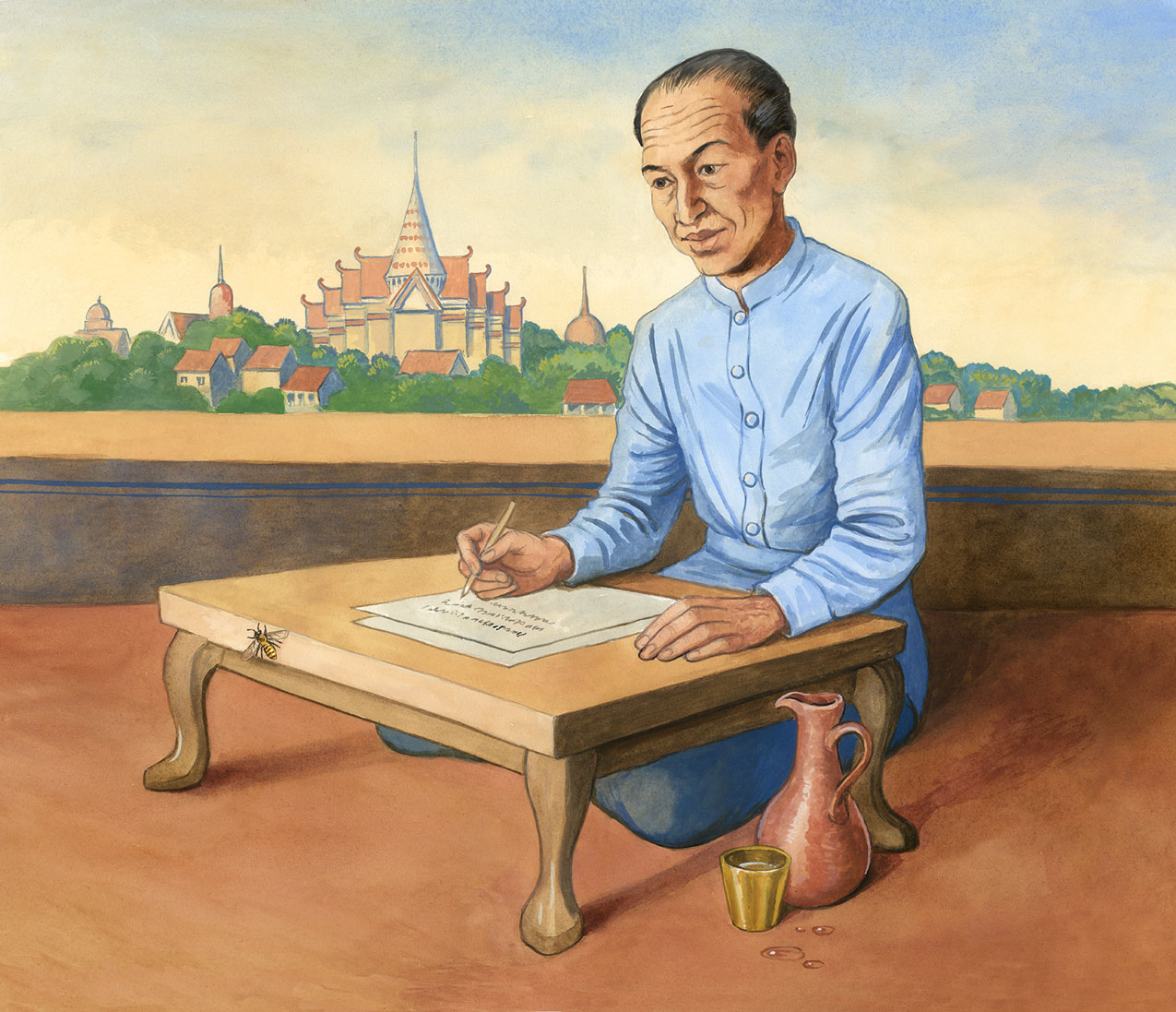
In his later years, Phu, still a monk, became engrossed in the alchemical pursuit of life-prolonging materials, particularly mercury. This quest, detailed in poems like Nirat to Suphanburi, led him on arduous expeditions into the jungle with his children. His belief in mercury as a miraculous substance, capable of restoring youth and beauty, reflected a worldview where potent substances were believed to be accessible only to those with sufficient karmic merit. His elaborate ceremonies to "invite" mercury, invoking arcane rituals and Vedic spells, underscore the syncretic nature of belief in early Bangkok, blending Buddhist cosmology with more esoteric practices. Yet, these quests for immortality were consistently thwarted, either by the refusal of temple spirits or the ghosts of ancient kings, leaving the reader to ponder whether these adventures were literal or symbolic representations of his unfulfilled desires and the fading glory of his life.
Desire as a Creative Force: Phra Aphaimani and Beyond
Sunthorn Phu’s exploration of desire reached its zenith in his epic poem, Phra Aphaimani. The protagonist, a prince exiled not for his martial prowess but for his love of music, wields a magical flute capable of seducing or lulling listeners. Unlike traditional heroes, Phra Aphaimani is portrayed as selfish and cowardly, a parody of both chivalric ideals and insatiable appetites. However, it is precisely through his masterful manipulation of desire—seducing princesses and enlisting foreign allies—that he ultimately reclaims Sri Lanka, a symbolic victory against Western colonial influence.
Phu’s oeuvre consistently exposed the absurdities and hypocrisies stemming from unchecked craving. Yet, through these parodies, he began to illuminate the creative potential of desire. The Phra Aphaimani narrative, where a Brahmin teaches the prince to harness "worldly stratagems of the five senses" to navigate the cycle of existence, suggests a more pragmatic engagement with human impulses. Phra Aphaimani’s response to a mermaid’s fear of their union—"In the end, it is only the heart’s harmonies that should guide us"—speaks to the power of emotional connection and shared passion to bridge divides.
In a society deeply influenced by Buddhist ethical frameworks, Phu’s exploration of desire was both a critique of its excesses and a subtle acknowledgment of its role in human affairs. As Siam faced the encroaching influence of Western powers, Phu’s work can be interpreted as a nascent suggestion that understanding and even embracing the complexities of desire might offer a path for navigating a changing world. This perspective offered a counterpoint to the more rigid interpretations of Buddhist teachings often promoted by elites.
A Legacy of Nuance and Individuality
Toward the end of his life, a new king recognized Phu’s enduring talent, bestowing upon him the honorific name "Sunthorn," meaning "the well-spoken," solidifying his status as the preeminent poet of his time. He died in 1855, leaving behind a rich legacy that continues to be celebrated. While his statues stand as testaments to his national importance, a deeper reading of his work reveals a Buddhism far removed from the uniformly conservative image favored by elite monks and royalty. Phu depicted a world populated by amorous bodhisattvas, errant monks, and mystical practices, all set against the backdrop of a feudal economy undergoing profound strain. In this context, Phu, along with others, began to foster a nascent sense of individualism, challenging the rigid adherence to inherited "karmic" merit.
The central role of desire in Buddhist philosophy provided Phu with a rich vein for exploration. He did not condemn desire outright but rather dissected its myriad manifestations, even suggesting its capacity to inspire. This nuanced approach, often at odds with orthodox Theravada Buddhism, is why most Thais may not remember him as a profound Buddhist thinker. His life, a journey from commoner to court poet, to exiled monk, and ultimately to the grandfather of Thai poetry, was summarized succinctly by a court astrologer as that of a "drunken writer." This appellation, while perhaps intended as a judgment, paradoxically captures the essence of a man who, through his very human flaws and his relentless pursuit of life’s pleasures and complexities, managed to articulate a vision of his era and its spiritual landscape that remains remarkably vibrant and relevant today. His work, a testament to the multifaceted nature of human experience and belief, continues to offer profound insights into the enduring power of desire and its capacity to shape both individual lives and the broader cultural narratives of a nation.

