

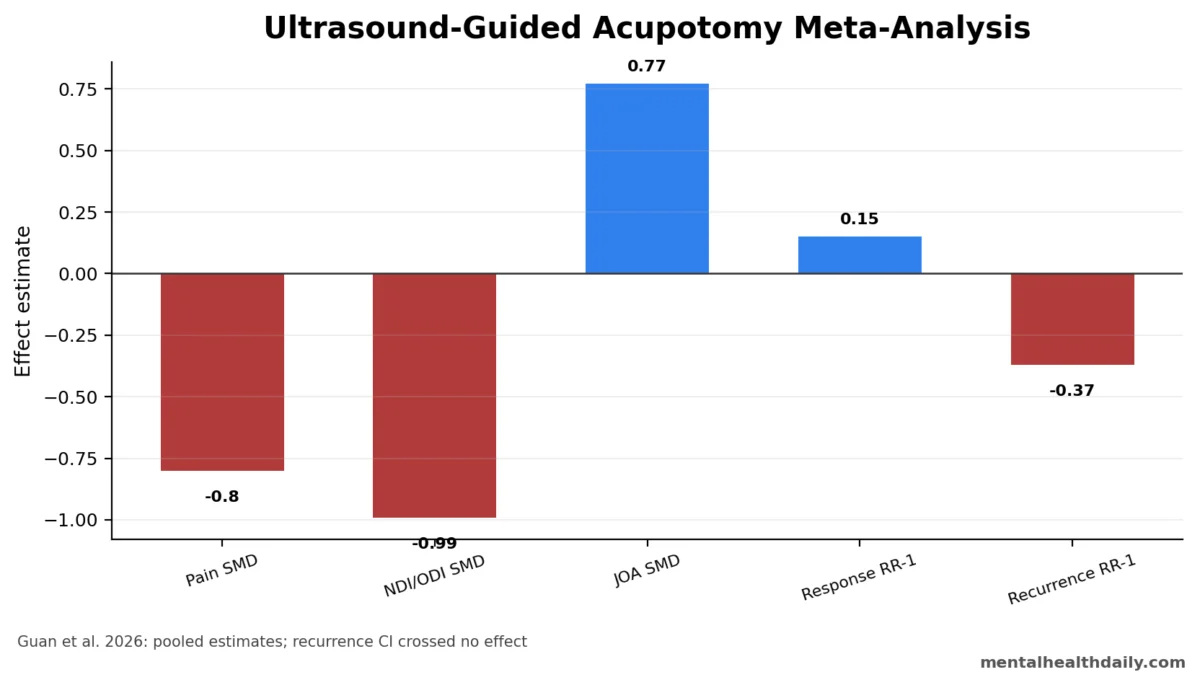
A significant meta-analysis published in 2026, synthesizing data from 32 randomized trials involving 2,669 participants, indicates that ultrasound-guided acupotomy significantly reduces chronic spinal musculoskeletal pain. The comprehensive review found that pain intensity improved by a standardized mean difference (SMD) of -0.80, while disability, measured by the Neck Disability Index (NDI) or Oswestry Disability Index (ODI), showed an improvement of SMD = -0.99. While these findings suggest a favorable direction for the minimally invasive technique, a crucial limitation is that all included trials originated from China, leading to a moderate certainty of evidence for pain reduction and a low certainty for several other endpoints. This geographical constraint and variations in trial protocols necessitate a calibrated interpretation of the results for broader clinical application.
Understanding Chronic Spinal Musculoskeletal Pain: A Global Health Challenge
Chronic spinal musculoskeletal pain, encompassing conditions like cervical spondylosis, lumbar disc herniation, cervicogenic headache, and ankylosing spondylitis, represents a pervasive global health crisis. Affecting millions worldwide, it is a leading cause of disability, diminished quality of life, and substantial economic burden due to healthcare costs and lost productivity. Traditional management strategies often involve a multifaceted approach, including pharmacotherapy (NSAIDs, opioids, muscle relaxants), physical therapy, exercise, lifestyle modifications, injections, and, in severe cases, surgery. However, these interventions frequently offer only partial relief, come with potential side effects, or are not universally effective, driving a continuous search for novel and more effective treatment modalities. The persistent challenge of chronic pain underscores the importance of exploring techniques that can provide sustained relief and improve functional outcomes.
A Deeper Look at Ultrasound-Guided Acupotomy: Technique and Evolution
Acupotomy, also known as the needle-knife technique, is a minimally invasive procedure with roots in traditional Chinese medicine but evolved into a modern therapeutic intervention. It involves the use of a specialized needle with a blade-like tip designed to release soft-tissue adhesions, scar tissue, or mechanically irritated structures that contribute to chronic pain. The underlying principle is that such adhesions can restrict movement, entrap nerves, or cause persistent irritation, and their mechanical release can alleviate pain and restore function.
The integration of ultrasound guidance marks a significant advancement in the application of acupotomy. Traditionally, acupotomy was performed based on anatomical landmarks and palpation, a method that inherently carries risks due to the proximity of vital structures like nerves and blood vessels. Ultrasound guidance introduces real-time imaging, allowing the operator to visualize tissue planes, identify vessels and nerves, and confirm the target depth and precise location of the needle-knife during the procedure. This enhanced precision is paramount for both efficacy and safety, minimizing the risk of iatrogenic injury and ensuring that the intervention directly addresses the pathological tissue. The shift from blind or landmark-based approaches to image-guided techniques is a broader trend in interventional pain management, where tools like fluoroscopy and ultrasound are increasingly employed to improve procedural accuracy and patient outcomes.
The Meta-Analysis: Key Findings and Methodological Rigor
The 2026 meta-analysis, led by Guan et al., systematically searched major English and Chinese databases up to August 2025 to identify randomized controlled trials (RCTs) investigating ultrasound-guided acupotomy for chronic spinal musculoskeletal pain. The included conditions were diverse, reflecting the broad spectrum of spinal pain syndromes. The primary outcomes assessed were pain intensity and disability, along with secondary measures such as overall response rate and recurrence.
The study employed Standardized Mean Difference (SMD) to pool results, a statistical measure used when different studies use varying scales to assess the same concept (e.g., pain measured on a 0-10 or 0-100 scale). A negative SMD for pain or disability indicates that the treated group experienced a greater reduction in symptoms compared to the control group.
- Pain Reduction: The pooled pain result demonstrated an SMD of -0.80, with a 95% confidence interval (CI) ranging from -0.97 to -0.64. This is considered a moderately large effect size in clinical research. For context, an SMD of 0.2 is typically considered "small," 0.5 "moderate," and 0.8 "large." The fact that the confidence interval did not cross zero reinforces the statistical significance of this finding, suggesting a genuine effect.
- Functional Improvement: Disability outcomes also showed a consistent favorable direction. The pooled NDI/ODI score improvement was an SMD of -0.99, indicating a substantial reduction in functional limitations. Similarly, the Japanese Orthopaedic Association (JOA) score, another measure of spinal function, improved by an SMD of 0.77. The parallel improvement in both pain and disability is a crucial aspect, lending greater clinical plausibility to the intervention’s effectiveness. Chronic spinal pain is rarely just about pain intensity; it significantly impacts daily activities, movement, sleep, and work. A treatment that addresses both pain and the ability to perform daily tasks is often more valuable to patients.
- Overall Response Rate: The overall response rate, indicating the proportion of patients who experienced a clinically meaningful improvement, favored ultrasound-guided acupotomy with a Relative Risk (RR) of 1.15. This means patients in the treatment groups were 15% more likely to achieve a positive response compared to control groups.
- Recurrence Data: The data regarding pain recurrence was less conclusive. While the point estimate favored ultrasound-guided acupotomy (RR = 0.63), suggesting a potential reduction in recurrence, the 95% confidence interval was wide, spanning from 0.27 to 1.43. This broad range means that while some studies might have shown a benefit, others did not, and the pooled result cannot reliably confirm a statistically significant reduction in recurrence. This highlights an area requiring more robust investigation in future trials.
Navigating the Nuances: Limitations and Caveats
Despite the promising signals, the meta-analysis clearly outlines significant limitations that temper its generalizability and the strength of its recommendations:
- Geographical Homogeneity: The most prominent limitation is that all 32 included randomized trials were conducted in China. This geographical specificity raises several concerns:
- Training and Clinical Practice: Acupotomy has a more established history and integrated role within parts of the Chinese healthcare system, meaning training, operator expertise, and clinical expectations may differ significantly from Western pain clinics.
- Comparator Care: The "control" conditions in these trials were varied, not a single uniform comparator. They often involved different background treatments, spinal diagnoses, and add-on combinations. This makes direct comparison with guideline-based physical therapy, exercise programs, standard medication regimens, or multidisciplinary pain programs used in other regions challenging.
- Research Ecosystem Norms: Publication and trial-registration norms, as well as patient demographics and cultural attitudes towards interventions, can vary across different research ecosystems, potentially influencing reported outcomes.
- Evidence Certainty (GRADE): The authors applied the GRADE (Grading of Recommendations Assessment, Development and Evaluation) system to assess the certainty of the evidence. While the certainty for pain reduction and response rate was rated as "moderate," it was "low" for other outcomes.
- Moderate Certainty: For pain, moderate certainty suggests that the estimated effect is likely to be close to the true effect, but future research might still change the estimate. This is a meaningful step above speculation.
- Low Certainty: For outcomes like recurrence and some functional measures, low certainty implies that the true effect may be substantially different from the estimated effect, and future high-quality trials are very likely to change the estimate of the effect. Factors contributing to downgrading included lack of blinding, heterogeneity across studies, imprecision in estimates, and potential for publication bias.
- Add-on Signal: Subgroup analysis indicated that the strongest performance of ultrasound-guided acupotomy was observed when it was used as an add-on to other existing care, rather than as a stand-alone intervention. This is a critical distinction, as trials evaluating add-on therapies can sometimes overstate the isolated effect of the new procedure. It suggests that UAGA might best serve as an augmentative therapy within a broader treatment plan.
Safety and Precision: The Role of Ultrasound
The incorporation of ultrasound guidance is central to the modern application of acupotomy, primarily for its role in enhancing safety. By providing real-time visualization, operators can:
- Identify Tissue Planes: Accurately navigate through different layers of tissue.
- Avoid Vessels and Nerves: Minimize the risk of puncturing blood vessels, which could lead to hematoma, or damaging nerves, which could cause neurological deficits.
- Target Depth: Ensure the needle-knife reaches the precise depth required to address the pathological structure without over-penetrating.
The meta-analysis reported adverse events as generally mild and less frequent in the ultrasound-guided acupotomy groups, ranging from 0% to 13.8%, compared with 0% to 51.7% in control groups. However, the article correctly emphasizes that safety is not automatic. It remains heavily dependent on:
- Operator Skill: Extensive training and experience in both acupotomy and ultrasound imaging interpretation are crucial.
- Anatomy Knowledge: A thorough understanding of regional spinal anatomy is indispensable.
- Sterile Technique: Adherence to strict sterile protocols is essential to prevent infections.
- Patient Selection: Appropriately selecting patients who are suitable candidates for the procedure, considering their specific diagnosis, comorbidities, and overall health status.
Chronic spinal pain is a heterogeneous condition, encompassing a wide range of diagnoses, from specific structural issues like disc herniations to more generalized conditions like myofascial pain or non-specific low back pain. Patient-selection risk arises because these diverse conditions may respond differently to a mechanical release technique. A procedure effective for one subgroup might be ineffective or even harmful for another.
Clinical Integration and Future Outlook
The findings suggest that ultrasound-guided acupotomy could be a valuable addition to the armamentarium for managing chronic spinal musculoskeletal pain, but its integration into clinical practice, especially outside of China, requires careful consideration.
- Layered Care Approach: Chronic spinal pain typically demands a layered, multidisciplinary approach. Procedures like UAGA are unlikely to be a universal panacea. Instead, they appear most plausible as an add-on option for selected patients who have a clear mechanical soft-tissue target, access to a skilled operator, and are concurrently engaged in a broader rehabilitation plan involving exercise, education, psychological pain management skills, and other conservative therapies.
- Best-Fit vs. Worst-Fit Use Cases:
- Best-fit: Patients with identifiable soft-tissue adhesions or mechanically irritated structures contributing to their pain, who have not fully responded to conservative care, and are part of a comprehensive rehabilitation program.
- Worst-fit: Patients with high central sensitization (where the nervous system becomes over-reactive to pain signals), severe sleep disruption, uncontrolled depression or anxiety, opioid instability, or unclear structural pain drivers. For these individuals, a broader pain-system management approach is typically required before a localized tissue procedure is likely to yield sustainable benefits.
- Distinguishing from Traditional Acupuncture: It is critical to differentiate ultrasound-guided acupotomy from traditional acupuncture. Acupotomy is a needle-knife technique focused on mechanical tissue release, and the ultrasound guidance adds a layer of precision and procedural logic distinct from the theoretical framework of traditional acupuncture, which typically involves thin needles inserted at specific points for energetic or neurological modulation. The evidence presented here is specific to image-guided mechanical release in spinal musculoskeletal pain, not a general endorsement of acupuncture for all chronic pain syndromes.
Perspectives from the Medical Community
While the meta-analysis offers promising data, the broader medical community, particularly outside of China, would likely respond with cautious optimism and a strong call for further research:
- Pain Specialists: Interventional pain specialists might view ultrasound-guided acupotomy as an interesting new tool, especially given the emphasis on precision and the potential for soft tissue release. However, they would likely demand rigorous training pathways, clear guidelines, and independent validation in diverse populations before widespread adoption.
- Researchers: The research community would highlight the need for larger, cleaner trials. A "better trial" would involve:
- Tightly Defined Diagnoses: Focusing on specific spinal conditions rather than broad categories.
- Standardized Techniques: Ensuring consistent procedural application across different operators and centers.
- Credible Comparators: Head-to-head comparisons against established, guideline-based treatments (e.g., specific physical therapy protocols, targeted injections).
- Blinded Outcome Assessment: Minimizing bias by ensuring that those assessing patient outcomes are unaware of treatment assignments.
- Long-Term Follow-up: Tracking patients for an extended period to assess not just short-term pain relief but also sustained functional improvement, recurrence rates, and overall quality of life.
- Detailed Adverse Event Reporting: Comprehensive and standardized reporting of all adverse events, differentiating between expected post-procedure soreness and more serious complications like infection, bleeding, or nerve irritation.
- Regulatory Bodies: Agencies like the FDA in the United States or the EMA in Europe would typically require evidence from multicenter trials conducted in diverse populations, with robust safety data and clear demonstrations of efficacy against established comparators, before considering widespread approval or specific indications for such a device and procedure.
- International Pain Societies: Organizations such as the International Association for the Study of Pain (IASP) or national pain societies would likely issue statements emphasizing the need for high-quality, reproducible evidence from various geographical contexts to ensure generalizability and ethical integration into global pain management guidelines.
Conclusion
The 2026 meta-analysis provides compelling preliminary evidence that ultrasound-guided acupotomy can effectively reduce chronic spinal musculoskeletal pain and improve disability. The moderately large pooled effect sizes for pain and function are directionally favorable and clinically meaningful for selected patients. However, the geographical limitation of all trials originating from China, coupled with moderate to low evidence certainty, underscores that the technique is not yet ready for universal adoption as a default treatment. Its most plausible role, supported by the "add-on" signal, appears to be as a precise, image-guided intervention within a broader, multidisciplinary chronic pain management strategy for carefully selected patients. The path forward demands rigorous, multinational, high-quality randomized controlled trials that address the current limitations, standardize protocols, and provide comprehensive long-term efficacy and safety data across diverse populations, thereby strengthening the evidence base and informing its appropriate integration into global clinical practice.

