

In 2018, a landmark report from the International Agency for Research on Cancer (IARC), a respected arm of the World Health Organization (WHO), ignited a global conversation about the health implications of processed meats. The agency, renowned for its rigorous scientific evaluations, classified processed meat products—including bacon, ham, hot dogs, sausage, and lunch meats—as Group 1 carcinogens, meaning they are definitively known to cause cancer in humans. This classification placed these common food items in the same category as established carcinogens like asbestos and tobacco, prompting widespread concern and debate. The director of the IARC, in a statement accompanying the report, emphasized that these findings "further support current public health recommendations to limit intake of meat," a sentiment that underscored the gravity of the agency’s conclusions.
However, the IARC’s classification, while definitive regarding the evidence of carcinogenicity, has also been a source of contention. Critics have questioned the direct comparison of processed meats to substances with demonstrably severe and immediate health risks. For instance, a pesticide company, in a pointed analogy, asked how eating processed meat could be placed in the same category as mustard gas, highlighting the perceived disparity in the magnitude of danger. This critique points to a common misunderstanding of how the IARC categorizes carcinogens. The agency’s classifications—Group 1 (carcinogenic to humans), Group 2A (probably carcinogenic to humans), Group 2B (possibly carcinogenic to humans), and Group 3 (not classifiable as to its carcinogenicity)—are based on the strength of evidence that an agent causes cancer, not on the amount of cancer it causes. This distinction is crucial for understanding the nuanced risk assessment.
Understanding Relative vs. Absolute Risk
The IARC’s classification as a Group 1 carcinogen signifies that there is sufficient evidence linking processed meat consumption to cancer. However, this does not imply that all Group 1 carcinogens pose an equivalent level of danger. To illustrate, both plutonium and a pastrami sandwich are classified as Group 1 carcinogens because both are known to cause cancer in humans. Yet, the likelihood and severity of harm from exposure differ vastly. The danger from plutonium, a highly radioactive and toxic element, is exponentially greater than that from consuming a pastrami sandwich.
The key to understanding the practical implications of the IARC’s findings lies in differentiating between relative risk and absolute risk. The IARC report, and subsequent analyses, have quantified the relative risk of colorectal cancer associated with processed meat consumption. Specifically, studies indicate an 18% increase in the relative risk of colorectal cancer for every 50 grams of processed meat consumed daily.
Quantifying the Daily Risk
To contextualize this figure, 50 grams of processed meat is equivalent to approximately one hot dog, two breakfast sausage links, or two slices of Canadian bacon or ham. This means that incorporating a daily sandwich with one or two slices of baloney could elevate an individual’s relative risk of developing colorectal cancer by 18%. For perspective, consuming a larger portion, such as a half-pound of pastrami on rye, could elevate this relative risk to approximately 80%.
While an 18% increase in relative risk might sound significant, its impact on an individual’s absolute risk is more modest. If the lifetime risk of developing colorectal cancer is estimated to be around 5% (or 1 in 20), an 18% increase in this relative risk would translate to an absolute increase of about 1 percentage point, raising the lifetime risk from 5% to 6%. This distinction is vital for public health communication, ensuring that the public understands the magnitude of the risk in practical terms.
Colorectal Cancer: A Significant Public Health Concern
Colorectal cancer stands as the second leading cause of cancer-related deaths for both men and women in the United States, surpassed only by lung cancer. For individuals who do not smoke, colorectal cancer represents a primary cancer threat. The potential to mitigate this risk through dietary adjustments is therefore of considerable public health importance. The finding that reducing processed meat intake by one serving per day could lower the risk of colorectal cancer by approximately one-fifth is a significant, actionable insight.
Comparing Risks: Processed Meat vs. Secondhand Smoke
The magnitude of the risk associated with processed meat consumption can be further understood by comparing it to other known risk factors. In testimony before the Dietary Guidelines Scientific Committee, a stark analogy was drawn: "We try not to smoke around our kids, why would we send them to school with a baloney sandwich?" This comparison is not without scientific backing. According to the U.S. Surgeon General, prolonged exposure to secondhand smoke increases the risk of lung cancer by approximately 15%. This figure is remarkably similar to the 18% increased risk of colorectal cancer associated with the daily consumption of a serving of processed meat. This parallel highlights that the dietary choices involving processed meats carry a risk profile comparable to that of passive smoking, a behavior widely recognized as detrimental to health.
Industry Response and Broader Health Implications
The processed meat industry, in response to these findings, has advocated for a balanced consideration of both risks and benefits when formulating dietary recommendations. The argument often centers on the convenience and palatability of processed meats, suggesting that these factors should be weighed against potential health detriments.
However, the scope of health concerns linked to processed meat extends beyond colorectal cancer. Emerging research, building upon the IARC’s findings, suggests potential associations between processed meat consumption and an increased risk of other cancers, including prostate, breast, and pancreatic cancers. Furthermore, the overall mortality attributed to processed meat consumption is considerably higher than initially suggested by colorectal cancer statistics alone.
A Deeper Look at Mortality Data
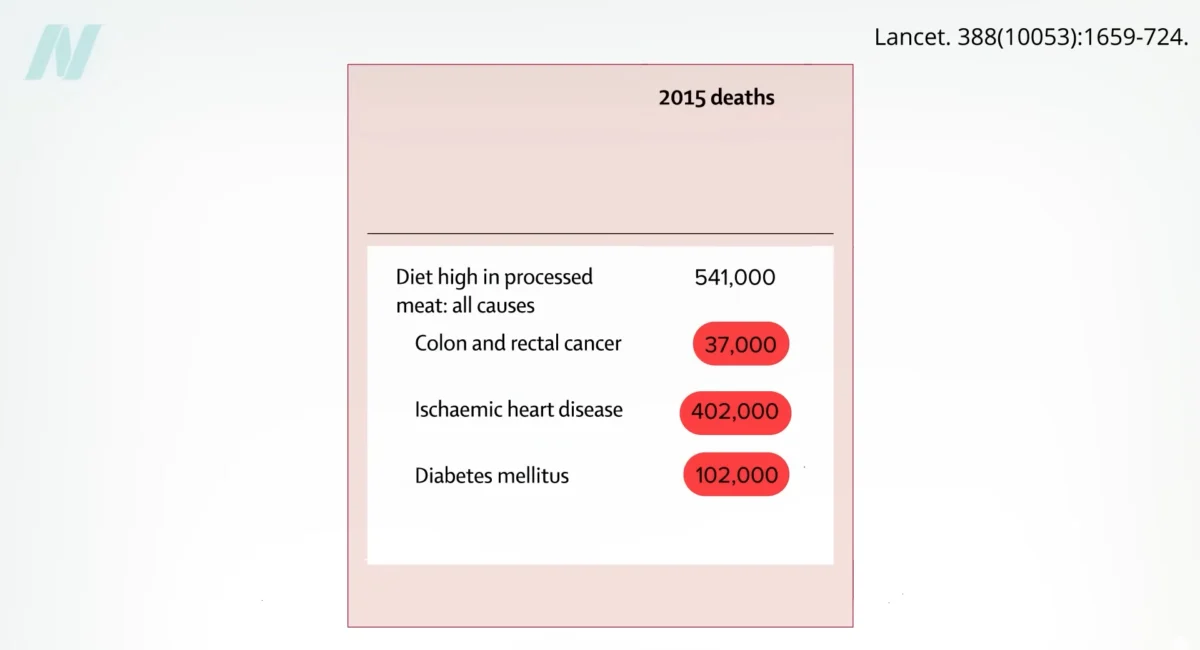
While the IARC report focused on cancer, broader analyses of processed meat consumption reveal a more extensive health burden. Studies referenced in scientific literature indicate that the approximately 37,000 cancer deaths annually attributed to higher processed meat intake represent only a fraction of the total mortality. When considering deaths from associated conditions such as diabetes and heart disease—which are also linked to diets high in processed meats—the total number of attributable deaths could potentially reach half a million per year. This broader perspective underscores the systemic impact of processed meat consumption on public health, encompassing cardiovascular diseases and metabolic disorders in addition to cancer.
Public Health Challenges and Policy Responses
Despite growing public health awareness and scientific consensus, data indicates a concerning lack of change in processed meat consumption patterns among U.S. adults over the past 18 years. This stagnation in dietary habits poses a significant challenge for public health initiatives. Experts have called for the inclusion of explicit, science-based statements on the carcinogenicity of processed meats in official dietary guidelines, such as the U.S. Dietary Guidelines for Americans. The absence of such recommendations in past iterations has been a point of criticism. The 2020 Dietary Guidelines Advisory Committee, for instance, did not include a specific recommendation to address processed meat’s carcinogenic potential.
The lack of nutritional guidance for cancer patients is another critical gap. Research indicates that a significant majority of individuals diagnosed with colorectal cancer do not alter their lifestyle habits post-diagnosis, and a substantial percentage of cancer patients have never received nutritional advice from their healthcare providers during or after treatment. This deficit in patient education hinders the potential for lifestyle interventions to improve outcomes.
Leading the Way: Policy Initiatives
In the face of public health inertia, some jurisdictions are beginning to implement policy changes. New York City, for example, has taken a proactive stance by passing legislation to ban processed meats from school meals. This initiative aims to protect children from early exposure to carcinogens, a move lauded by public health advocates as a significant step toward safeguarding the health of future generations.
Industry Adaptation and Mitigation Strategies
The processed meat industry is not entirely static; it is exploring product reformulation to mitigate some of the identified health risks. These efforts often involve adding components like fiber to products such as hot dogs, attempting to counterbalance the detrimental effects through ingredient modification rather than outright elimination. This approach, while potentially reducing some cancer-related risks by altering processing methods, does not address the fundamental concerns associated with the classification of processed meats as carcinogens. The analogy has been drawn to the pharmaceutical industry, where additional medications are sometimes prescribed to counteract the side effects of another.
Conclusion: A Call for Informed Choices
The scientific evidence linking processed meats to increased risks of colorectal cancer and potentially other serious health conditions is robust and growing. While the IARC’s classification of processed meats as Group 1 carcinogens has been met with debate, the distinction between relative and absolute risk is crucial for a balanced understanding. The cumulative evidence points towards a significant public health imperative to reduce processed meat consumption. Public health bodies, policymakers, and healthcare providers have a critical role to play in educating the public about these risks and supporting individuals in making informed dietary choices. The ongoing obfuscation of these issues by segments of the meat industry, drawing parallels to historical tactics employed by the tobacco industry, underscores the need for continued public health action and clear, science-based guidance. Ultimately, enabling individuals to make informed decisions about their diet, particularly concerning processed meats, is paramount to improving population health outcomes and reducing the burden of diet-related diseases.

