

The Narrow Road to Oku, a seminal travel journal by the celebrated Japanese poet Matsuo Bashō, offers a profound glimpse into the artistic and spiritual evolution of its creator. Composed of a series of impressionistic prose sketches interwoven with concise poems, the work chronicles Bashō’s arduous five-month pilgrimage in 1689 through the remote northern regions of Japan’s main island, Honshu. Undertaken with his devoted disciple Sora, this journey, and the meticulous refinement of its account over the subsequent four years, culminated in a posthumous publication in 1694, solidifying Bashō’s legacy as a master of the literary form known as haibun.
The Genesis of Haibun: A Fusion of Poetry and Prose
Bashō, a preeminent figure in the realm of haikai poetry—the precursor to the modern haiku, a term coined only in the late 19th century—developed haibun as a distinctive fusion of prose and poetry. While the practice of pairing brief poetic verses with contextual prose had existed for centuries, Bashō elevated this tradition into a unique art form. In The Narrow Road to Oku, the prose passages, often seemingly simple, serve not merely as narrative illustration for the poems but, for Bashō and his contemporaries, represented the poetic core, providing the essential framework for the crystallized moments captured in verse.
Bashō’s experimentation with haibun predates The Narrow Road to Oku. His earlier travel journals reveal a nascent exploration of the form, characterized by short, evocative prose passages detailing everyday encounters—a shared meal, a visit from a friend, the creation of a simple rain hat—that invariably culminate in one or two haikai poems. These earlier works, compiled into loosely continuous narratives, presented the highlights of his journeys in intense, fleeting glimpses, each often distilled by a poem or two. It was during the composition of The Narrow Road to Oku that Bashō truly began to grasp the profound potential of haibun, a term he himself adopted during this period.
Artistic Evolution and the Structure of The Narrow Road to Oku
The structure of The Narrow Road to Oku clearly illustrates Bashō’s artistic maturation. Although some translations present the work as continuous prose, it is fundamentally a collection of discrete episodes, varying in length, with nearly every segment concluding in one or more poems. Each episode functions as a self-contained narrative and emotional unit, a "little world" unto itself, defying easy categorization and demanding individual appreciation rather than passive consumption as part of a larger, unbroken story. The inherent continuity is derived solely from the progression of the journey. This deliberate structure encourages the reader to adopt a slower, more contemplative pace, mirroring the meditative quality of a haiku. The constant interplay of styles, tones, and moods, the juxtaposition of light and shadow, the mundane and the spiritual, ensures a continuous sense of surprise and discovery throughout the text.
Unveiling the Artifice: Sora’s Diary and Scholarly Revelations
A significant turning point in the understanding of The Narrow Road to Oku came with the 1943 publication of the diary of Bashō’s traveling companion, Sora. The diary’s contents revealed the extent to which Bashō had artistically manipulated the factual record of their journey. Dates, locations, weather conditions, the sequence and specifics of events, and, most notably, the poems composed during their travels, were frequently altered or even invented. This revelation initially shocked many, prompting scholars to delve deeper into the artistic intentions and techniques behind Bashō’s revisions. The exploration extended to the complex rules of renku (linked verse), a communal poetic form practiced by Bashō and his circle. The poems featured in The Narrow Road to Oku are, in fact, hokku, the initial seventeen-syllable verse that traditionally initiates a renku session. This discovery underscored the intricate layers of craft and deliberate artistry embedded within what might otherwise appear as a simple travelogue.
A Journey Through Landscape and Spirit: Excerpts from The Narrow Road to Oku
The following excerpts offer a direct experience of Bashō’s profound prose and poetry, illustrating the themes and artistic style that define The Narrow Road to Oku.
Departure and the Weight of the Road
"The days and months are time’s eternal travelers, and travelers too are the years that come and go. Those who float their lives away on boats, or greet old age walking before a horse, spend their days in travel and travel is their home. Many men of old died on the road, and for years now I too have felt the lure of drifting wind-torn clouds. Driven by the urge to wander, I roamed along the seacoast; then in the autumn of last year I cleared the cobwebs from my ramshackle hut by the river, and as the year drew to its end, a yearning grew in me to cross the northern Barrier of Shirakawa as the spring mists lifted. Possessed and restless, the wayside gods beckoning me on, I patched my tattered leggings, replaced the cord of my traveler’s hat, and burned moxa to give my legs new strength, while Matsushima’s famous moon hung in my heart. Then, leaving my home in the care of a young family, I moved nearby to Sanpu’s house to prepare for the journey."
On the pillar of my hut I hung the first sheet of a hundred-link set.
Time for my hermit’s hut
to change too—
now a home for dolls
"It was now toward the third month’s end, the early dawn sky hazy, the moon grown pale, Mount Fuji a vague shape in the distance. When will I see again the famous blossoms of Ueno and Yanaka? I thought wistfully. Friends had gathered the evening before and now came on board to see us on our way. When we left the boat again at Senju, thoughts of the countless miles ahead overwhelmed me. Each moment is a parting of ways in this phantom world of ours, yet I wept salty tears now to say goodbye."
Spring passes—
birds cry, fishes’
eyes swim with tears
This was the first poem I recorded for the journey, my spirits still reluctant to set out. People lined the road as we went, surely watching until our departing figures disappeared.
Encounters of Integrity and Awe
"On the thirtieth we stayed the night at the foot of Mount Nikko. The inn-keeper here told us that his name was Buddha Gozaemon. ‘Honesty is my policy in all things,’ he explained, ‘which is why people gave me this name. You can relax and feel perfectly safe to spend the night here.’ What manner of buddha was this, to manifest in our wicked world and aid poor pilgrim monks such as ourselves? I wondered. I watched him curiously, and found him to be indeed a simple, guileless fellow, unwaveringly honest. This was a man such as Confucius spoke of, ‘near to virtue in his unaffected integrity,’ someone to be revered for his innate purity of heart."
The Enchantment of Matsushima
"At close to noon, we borrowed a boat and set out to see famous Matsushima. About five miles away, we arrived on the shore of the little island of Ojima. Now it has long been said but is none the less true that the scene of the islands of Matsushima is the finest in Japan, rivaling the famous Chinese landscapes of Dongting Lake and West Lake. The sea’s entrance lies in the south east, opening into a sheltered bay about seven miles wide, whose brimming waters call to mind China’s great Zhejiang River. There are countless little islands, some that point heavenward, others that crouch low upon the waves. Layer upon layer of island, now doubled, now trebled, here separate and there linked together; islands that seem to bear another on their back, others embracing, as a loving parent would enfold a child; the pines a rich dark green, their branches twisted by the playful sea breeze as by some craftsman’s hand. The scene is deeply enchanting, as captivating as a beauty’s painted face. Perhaps it is the work of the mountain gods of old. What artist or poet’s brush could ever do justice to this marvel of divine creation?"
"We landed at Ojima, which reaches out from the mainland to form an island jutting seawards. The remains of Zen Master Ungo’s hut and the rock on which he meditated are to be found there. A few hermits were living quietly in little brushwood huts beneath the shady pines, smoke rising from their fires of dry pine needles and cones, and though there was no telling what manner of people they might be, I felt drawn to approach them, when suddenly the moon spread its light over the sea, transforming the daylight scene."
"Returning to the shore we sought out lodgings. There on the upper floor, with the windows open, we seemed to sleep among the wind and clouds, a strange and marvelous sensation."
Sora composed:
Ah, Matsushima!
Cuckoo you must borrow
the crane’s elegance here

"As for myself, awe sealed my lips. I tried to sleep, but could not. When I left my old home on this journey, Sodo had composed a Chinese poem on the topic of Matsushima as a parting gift, and Hara Anteki presented me with a Japanese poem on the same subject. Now I undid my traveler’s sack to make them my companions for this evening, along with hokku given to me by Sanpu and Jokushi."
Pilgrimage to Sacred Mountains
"On the eleventh we paid our respects at Zuigan-ji Temple. Thirty-two generations ago, Makabe no Heishiro founded this temple upon returning from China where he took Buddhist vows, having gone there to deepen his practice. Its seven buildings have since been splendidly rebuilt thanks to the virtuous influence of Zen Master Ungo. The walls of gold leaf and the inner sanctum’s ornaments all glitter brilliantly, making it seem that Buddha’s paradise is embodied here in this grand hall. Where now is the temple of the long-ago hermit Kenbutsu? I wondered."
"In the land of Yamagata there is a mountain temple by the name of Ryushaku-ji, a beautiful, serene place founded by the high prelate Jikaku. People assured us that it deserved to be seen, so we went back about seventeen miles from Obanazawa to visit it."
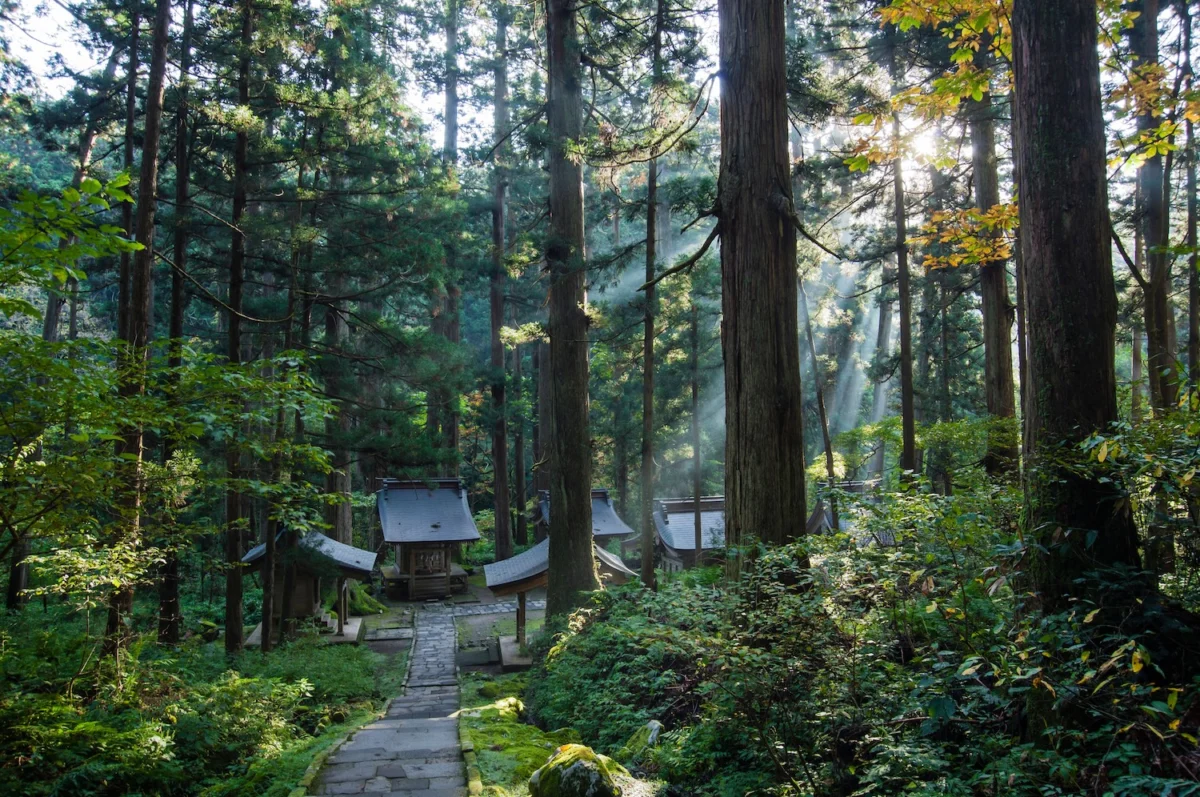
"We arrived when it was still daylight. After finding pilgrims’ lodgings at the foot of the hill, we climbed up to the temple. It was perched high on a mountain of boulders, set among ancient pines and cypresses that grew from yet more ancient earth and rocks velvety with moss. High up on the boulders, the temple doors were all closed, and the place was utterly silent. We circled it, clambering over the boulders, and prayed at the Buddha Hall. The whole splendid scene awed me with its hushed sanctity."
Stillness—
the cicada’s voice
pierces deep into rock
"On the third day of the sixth month we climbed sacred Mount Haguro. We first called on a man called Zushi Sakichi who introduced us to Egaku, the mountain sect’s Acting Abbot, and stayed in the temple’s Minamidani lodgings, where the master took wonderful care of us. A haikai gathering was held at the Abbot’s quarters on the fourth."
Deep thanks
for this pure waft of snow
at Minamidani
"On the fifth we prayed at the holy Gongen shrine on Haguro’s summit. I don’t know when the founder of this mountain temple, Saint Nojo, may have lived, but the early Engishiki mentions a shrine called Satoyama in this area, and perhaps this ‘sato’ is a mistranscription of a similar character in the name Haguro. Dewa, the area’s name, is written with characters meaning ‘feathers come from it,’ and the ancient records apparently state that this originates in the feathers once sent by this region as tribute taxes."
"Haguro and the nearby mountains of Gassan and Yudono are together known as The Three Sacred Mountains. Haguro’s temple is affiliated with the Edo Toeizan sect; here the moon of the Tendai meditation teachings shines bright, and the lamp of instant and complete enlightenment burns unwavering. The mountain is crowded with monastic buildings, the monks are fervent in their ascetic practice, and all worship with wonder and awe the divine power of this sacred place. The glory of this marvelous mountain will surely last through all eternity."
"On the eighth day we climbed Gassan, or Moon Mountain. Decked in the mountain pilgrim’s sacred white paper garlands, heads wrapped in white cloth, we climbed with our guide, a rugged mountain porter, for twenty miles through mountain cloud and mist, treading over snow and ice, until it seemed we were entering the very cloud gates to the circling sun and moon. When, frozen and gasping, we arrived at the summit, the sun was setting as the bright moon rose. Spreading rough bamboo grass for bedding and pillows, we lay and waited for the morning light."
"The sun rose, the clouds vanished, and we made our way down to Yudono."
"In the valley as you descend is an old swordsmith’s hut. This swordsmith sought out the sacred mountain water to purify himself and forge his fine swords, which he inscribed with the name ‘Gassan,’ swords that have been renowned throughout the land. He harks back to those famous Chinese swordsmiths of old, Gan Jiang and Mo Ye, who forged their swords in the waters of the Dragon Springs. Such achievement brings home to us the power of deep dedication to a calling."
"As I sat resting on a rock, I noticed a little late-flowering cherry tree about three feet high whose blossoms were barely open. Admirable flowers, waiting here buried deep in snow, remembering the spring for so long. It was as if the fabled plum blossoms flowering in the mid-summer heat were perfuming the air around me, and I was yet more moved when I recalled the monk Gyoson, who was so touched to find the flowering cherry among the peaks of sacred Omine."
"The rules of this mountain forbid any detailed account of it to others, so I will write no more."
"When we returned to our temple lodgings the Acting Abbot asked us to compose some poems on our Three Mountains pilgrimage. On poem cards we wrote:"
Summer coolness—
a faint crescent moon
over Mount Haguro
Towering clouds
dissolving over and over—
Moon Mountain
Yudono—
there is no telling
these tears
Broader Impact and Literary Significance
The Narrow Road to Oku stands as a testament to the enduring power of Japanese literature and the profound influence of Bashō’s haibun. The work’s meticulous construction, its fusion of personal observation with profound philosophical inquiry, and its exploration of the relationship between nature and the human spirit have resonated with readers for centuries. The revelation of Bashō’s artistic license, far from diminishing the work, has instead highlighted the sophisticated artistry involved in its creation. It underscores that the journal is not merely a factual record but a carefully crafted work of art, designed to evoke a specific emotional and spiritual experience in the reader. The continued study and translation of The Narrow Road to Oku ensure that Bashō’s unique vision and his mastery of haibun remain accessible to new generations, offering timeless insights into the beauty and ephemerality of existence.
Excerpts from The Narrow Road of Oku by Basho, translated by Meredith McKinney, copyright © 2026 by Meredith McKinney. Reprinted by permission of New Directions Publishing Corp.

