

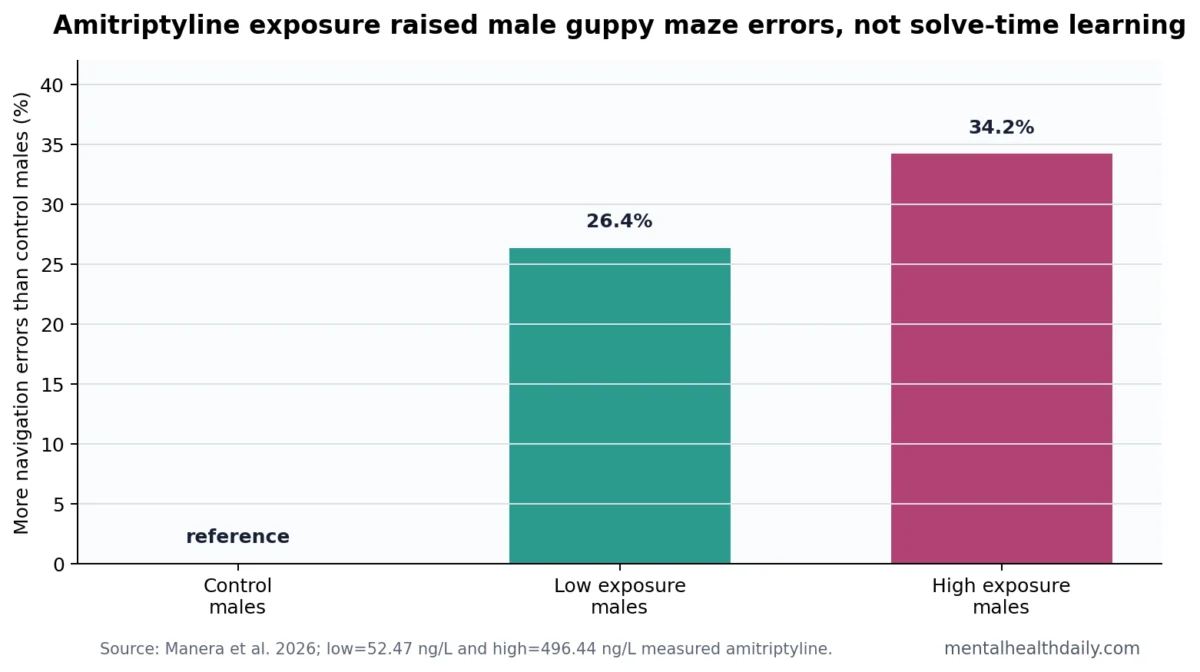
A pioneering 2026 experiment published in Environmental Science & Technology has unveiled that wild guppies, when exposed for 11 days to environmentally motivated concentrations of the antidepressant amitriptyline, retained their ability to reduce maze solve times with practice. However, the study delivered a crucial nuance: exposed male guppies exhibited a significant increase in navigation errors, ranging from 26.35% to 34.21% more than their unexposed control counterparts. This finding underscores a sex-specific accuracy signal, critically distinguishing it from a generalized erasure of learning capacity due to antidepressant pollution. The research highlights the subtle yet potentially profound impacts of pharmaceutical contaminants on wildlife cognition, moving beyond simple mortality metrics to explore complex behavioral alterations.
The Growing Shadow of Pharmaceutical Pollution in Aquatic Ecosystems
The presence of pharmaceutical compounds in aquatic environments has emerged as a pressing environmental concern over the past two decades. As human populations grow and the use of prescription medications, including antidepressants, increases, so does the discharge of these substances into waterways through various pathways. Wastewater treatment plants, while effective at removing many traditional pollutants, are often not equipped to fully eliminate complex pharmaceutical molecules. These "micropollutants" can then enter rivers, lakes, and oceans, reaching non-target organisms that were never intended to receive them. Amitriptyline, a tricyclic antidepressant widely prescribed for depression, neuropathic pain, and migraine prevention, is one such compound. Its neuroactive properties, affecting serotonin and norepinephrine signaling and possessing anticholinergic effects, make its presence in aquatic ecosystems particularly concerning due to its potential to disrupt the neurological functions of exposed wildlife.
The concept of "ecopharmacology" has gained traction, recognizing that these brain-active compounds can act as neuroactive pollutants, influencing the behavior, physiology, and survival of aquatic species. Unlike traditional pollutants that often lead to overt toxicity or mortality, pharmaceuticals can induce sublethal effects, subtly altering crucial behaviors like foraging, reproduction, and predator avoidance. Spatial learning, the ability of an organism to use environmental cues to navigate its surroundings, is fundamental to these survival strategies. For small fish like guppies, effective spatial learning directly impacts their ability to find food, locate shelter, access mates, and evade predators, making any impairment a significant ecological threat.
Unraveling Cognitive Impacts: A Detailed Experimental Design
The study, led by Manera et al., meticulously investigated the cognitive impacts of amitriptyline on guppies. Researchers collected wild adult guppies and subjected them to controlled conditions over an 11-day period. Three exposure groups were established: a freshwater control group, a low amitriptyline concentration group, and a high amitriptyline concentration group. The nominal concentrations were 0, 30, and 300 ng/L, respectively. Crucially, the measured concentrations in the experimental tanks were 52.47 ng/L for the low group and 496.44 ng/L for the high group, confirming the presence of the contaminant at environmentally relevant levels. No amitriptyline was detected in the control tanks, ensuring a clean baseline. These concentrations are not theoretical; the low concentration falls within the broad range reported for surface waters globally, while the high concentration mimics scenarios closer to treated wastewater discharge points, representing a heavier exposure.
Following the exposure period, a total of 169 fish (86 females and 83 males), after initial exclusions, were subjected to a rigorous behavioral analysis. Each guppy completed 12 maze trials over a span of four days, culminating in an impressive 1,938 analyzable trials. The maze assay, a simplified yet ecologically valuable test of cognitive function, required the fish to utilize spatial memory to locate a food reward. A key methodological strength was the inclusion of a final trial where the food reward was removed. This crucial step helped to ascertain that the fish were indeed relying on learned spatial memory rather than simply following scent cues, thereby validating the assessment of cognitive learning.
The repeated-trial design employed by Manera et al. proved instrumental in separating two distinct but often conflated aspects of learning: the speed at which fish solved the maze and the accuracy of their navigation. This nuanced approach allowed researchers to differentiate between an animal simply moving faster through a familiar environment and one making fewer erroneous decisions along the way, providing a far more comprehensive picture of cognitive function.
Divergent Learning Outcomes: Speed Versus Accuracy
The experimental results presented a fascinating dichotomy. Across all treatment groups—control, low amitriptyline, and high amitriptyline—guppies demonstrated clear evidence of learning when assessed by solve time. Fish consistently improved their performance, solving the maze an average of 6.88 seconds faster with each successive trial, within a 95% credible interval of –7.90 to –5.88 seconds. The model-estimated solve time plummeted from an average of 119.07 seconds in the initial trial to a mere 38.37 seconds by the final trial. This robust improvement in speed across all conditions indicates that amitriptyline exposure did not fundamentally impede the guppies’ basic capacity for learning or their ability to habituate to the task environment. The researchers found no strong evidence that amitriptyline significantly altered the solve-time learning rate or the absolute solve time, preventing any overstatement regarding a complete impairment of learning. The fish, in a broad sense of speed, still learned the route.
However, a sharper and more concerning story emerged when analyzing navigation errors. Control males exhibited a progressive improvement in accuracy, making fewer wrong-arm entries than control females, particularly from trial 8 onward. This suggests a natural advantage or a more efficient learning strategy in male guppies under normal conditions for this specific task. Alarmingly, amitriptyline exposure completely erased this male advantage. Low-exposed males made, on average, 0.42 more errors than control males, while high-exposed males made 0.55 more errors. When expressed as percentages, this translates to a 26.35% increase in errors for low-exposed males and a substantial 34.21% increase for high-exposed males compared to their unexposed counterparts.
In stark contrast, female guppies did not exhibit the same detrimental effect on accuracy under amitriptyline exposure. In fact, under high exposure conditions, males initially performed worse than females, a complete reversal of the pattern observed in the control group. This sex-specific vulnerability is a critical takeaway from the study, indicating that the impact of neuroactive pollution is not a uniform neurotoxic effect across all individuals but rather a targeted impairment affecting male cognitive accuracy.
Ecological Consequences and Broader Implications
The findings from Manera et al. resonate with previous research highlighting the insidious nature of pharmaceutical pollution. David et al. (reference 2 in original) had previously demonstrated that fish exposed to wastewater effluent can accumulate mixtures of neuroactive pharmaceuticals, leading to altered brain neurotransmitter levels. Polverino et al. (reference 3 in original) further reported sex-specific effects of psychoactive pollution on fish behavioral individuality and plasticity. The current study extends this understanding, pinpointing spatial accuracy as a cognitive phenotype uniquely affected in male guppies.
This distinction between speed and accuracy is paramount for environmental toxicology. While a fish might learn to navigate a path quickly, an increased propensity for decision errors, particularly at critical junctures, could have dire ecological consequences. Imagine a guppy needing to quickly choose the correct refuge from a predator, identify a nutrient-rich food patch, or navigate complex currents to find a mate. If under time pressure, a pollutant leaves speed intact but impairs decision quality, the animal’s chances of survival and reproduction could be significantly compromised. This is not a global failure to participate or a sedation-like slowing effect, but rather a subtle yet critical problem in navigation quality.
The sex-specific nature of this impairment carries significant population implications. If a pollutant selectively weakens the sex that typically holds an advantage in a crucial task, the overall ecological impact on the population can be far greater than a simple average effect might suggest. A population mean could effectively mask the loss of a vital trait within a specific sex, leading to unforeseen cascading effects on species dynamics, breeding success, and overall ecosystem health. For instance, if males play a particularly critical role in leading foraging groups or navigating to specific breeding grounds, their impaired accuracy could detrimentally affect the entire group’s success.
Challenges for Policy and Future Research
This research provides compelling evidence that environmental regulations need to evolve. Current frameworks often prioritize the measurement of acute toxicity and lethal effects, overlooking the more subtle, sublethal behavioral changes that can nevertheless have profound ecological consequences. The study strongly advocates for measuring behavioral endpoints at environmentally realistic concentrations, rather than waiting for obvious mortality. Furthermore, the repeated-trial design highlights the need for sophisticated environmental testing methodologies that force animals to choose, remember, and adapt their behavior over time, rather than relying on single, short-duration tests like an open-field swim test that might only detect activity changes.
The complexity of real-world waterways poses an additional challenge. While the single-compound amitriptyline experiment provides clear mechanistic insights, actual environmental exposure involves complex mixtures of antidepressants, stimulants, pain medications, hormones, pesticides, metals, and nutrients. Future research must investigate the potential for additive, synergistic, or antagonistic effects of these compound mixtures to truly understand their ecological impact.
From a mechanistic perspective, the study acknowledges that amitriptyline affects multiple neurotransmitter systems, including serotonin, norepinephrine, and acetylcholine. The exact receptor or pathway driving the male-specific error increase was not isolated, indicating a rich area for future inquiry. Stress responsiveness, activity patterns, and motivation could all interact with spatial learning in complex ways. Understanding these underlying mechanisms will be crucial for developing more targeted mitigation strategies.
The sex-specific effects also warrant further investigation. The male accuracy signal could stem from inherent sex differences in baseline navigation strategies, stress physiology, metabolic pathways, or differential sensitivity to serotonergic and noradrenergic disruption. Determining whether female guppies are truly protected, whether males are uniquely sensitive, or how these effects might vary across different reproductive contexts will require dedicated follow-up studies. The decision to report sex-stratified behavioral data was critical, as pooling male and female data could have diluted or entirely obscured this significant navigation-accuracy signal.
A Crucial Distinction: Environmental Exposure vs. Clinical Treatment
It is imperative to clarify the public health boundary of these findings. This study is an aquatic toxicology experiment focused on unintended environmental exposure in wildlife, not a clinical study on human antidepressant treatment. The findings should under no circumstances be misinterpreted or used to stigmatize antidepressant medication for human patients. Prescribed drug exposure in humans is intentional, carefully dosed, medically monitored, and metabolized within a different physiological system. The critical failure point highlighted by this research lies in wastewater management and environmental exposure control, not in the medical necessity or efficacy of prescribed medications. The study’s inclusion on a mental-health site stems from its examination of how a human neuroactive drug impacts another vertebrate’s brain and behavior in an environmental context, reinforcing the growing interdisciplinary nature of ecological and health sciences.
In conclusion, the Environmental Science & Technology study provides compelling, high-resolution evidence that environmentally relevant concentrations of amitriptyline can induce sex-specific cognitive impairments in wild guppies. While their basic learning speed remains intact, male guppies suffer a significant decline in navigation accuracy, a critical ecological trait. This research not only expands our understanding of pharmaceutical pollution’s subtle impacts but also serves as a clarion call for more sophisticated environmental monitoring, adaptive regulatory frameworks, and advanced wastewater treatment technologies to safeguard aquatic ecosystems from the unintended consequences of human pharmacology.

