

In 2018, a landmark report from the International Agency for Research on Cancer (IARC), the cancer research arm of the World Health Organization (WHO), declared that processed meats, including bacon, ham, hot dogs, sausage, and lunch meats, are carcinogenic to humans. This classification, placing these common food items into Group 1 of carcinogens, ignited significant debate and prompted a deeper examination of the quantifiable risks associated with their consumption. The agency’s conclusion, that these findings "further support current public health recommendations to limit intake of meat," underscored the gravity of the scientific consensus. However, the classification itself, which places processed meats in the same category as substances like asbestos and tobacco, has led to widespread public confusion and criticism regarding the relative danger posed by each.
The IARC Classification: Understanding Carcinogen Categories
The IARC’s classification system is based on the strength of scientific evidence demonstrating a causal link between an agent and cancer in humans. Group 1, the highest classification, signifies that there is "sufficient evidence" of carcinogenicity in humans. This category is populated by a diverse array of agents, from well-established carcinogens like tobacco smoke and asbestos to infectious agents like the human papillomavirus (HPV) and Hepatitis B virus.
Crucially, the IARC classification does not indicate the magnitude of risk. As Dr. Michael Greger, director of NutritionFacts.org and author of "How Not to Die," explains in his video "How Much Cancer Does Processed Meat Cause?", placing processed meat in the same group as plutonium or mustard gas, while factually correct in terms of the evidence for carcinogenicity, can be misleading. The danger posed by each is vastly different. This distinction between the strength of evidence and the actual level of risk is paramount to understanding the public health implications of the IARC’s findings.
Quantifying the Colorectal Cancer Risk
The IARC report specifically identified a link between processed meat consumption and colorectal cancer. The quantitative assessment revealed that for every 50 grams of processed meat consumed daily, the relative risk of developing colorectal cancer increases by approximately 18%. To contextualize this figure, 50 grams is roughly equivalent to one hot dog, two breakfast sausages, or two slices of Canadian bacon or ham. This means that a daily ham and cheese sandwich, or a regular baloney sandwich, could elevate an individual’s risk of colorectal cancer by this significant margin.
To further illustrate the impact, consider the difference in risk when consuming larger quantities. A half-pound of pastrami on rye, for example, could escalate the relative risk of colorectal cancer by as much as 80%. While an 18% increase in relative risk might sound alarming, understanding it in terms of absolute risk provides a clearer perspective.
Absolute Risk vs. Relative Risk
The lifetime risk of developing colorectal cancer is estimated to be around 5%, or 1 in 20 individuals. An 18% increase in this relative risk translates to a modest increase in absolute risk. For an individual with a baseline 5% lifetime risk, an 18% relative increase would elevate their absolute risk to approximately 6%. This means that out of 100 individuals, an additional one person might develop colorectal cancer over their lifetime due to this level of processed meat consumption.
However, the implications for public health at a population level are substantial. If a significant portion of the population were to reduce or eliminate their daily intake of processed meats, the impact on public health could be considerable. For instance, an 18% reduction in the risk of colorectal cancer across the United States could translate to an estimated 25,000 fewer cases diagnosed annually. This would alleviate the burden on countless families facing the emotional and financial strain of a cancer diagnosis.
Colorectal Cancer: A Significant Health Threat
Colorectal cancer stands as the second leading cause of cancer-related deaths in both men and women in the United States, surpassed only by lung cancer. For individuals who do not smoke, colon and rectal cancer may represent their most significant cancer adversary. The potential to mitigate this risk by a substantial margin – as much as one-fifth – through a single dietary modification, such as removing one daily serving of processed meat, presents a powerful public health opportunity.
Comparing Risks: Processed Meat and Other Behaviors
The magnitude of risk associated with processed meat consumption can be further understood by comparing it to other well-known risky behaviors. In testimony before the Dietary Guidelines Scientific Committee, the analogy was drawn between sending a child to school with a baloney sandwich and allowing them to be exposed to second-hand smoke. According to the Surgeon General, living with a smoker increases the risk of lung cancer by approximately 15%. This comparison highlights that the daily consumption of a serving of processed meat can elevate the risk of colorectal cancer to a level comparable to the increased risk of lung cancer from consistent exposure to second-hand smoke.
Industry Responses and Public Health Recommendations
The processed meat industry has consistently pushed back against the IARC’s findings, often emphasizing the need to consider the benefits of these products alongside their risks. Proponents point to the convenience and palatability of processed meats, arguing that a balanced perspective is necessary when formulating dietary advice.
However, the broader scientific community and public health advocates maintain that the risks, particularly when viewed holistically, far outweigh the perceived benefits. A closer examination of studies often cited by industry critics reveals a more comprehensive picture. While some reports may focus solely on the number of cancer deaths attributable to processed meat, neglecting other health impacts, comprehensive analyses paint a more concerning scenario.

Beyond Cancer: The Wider Health Implications
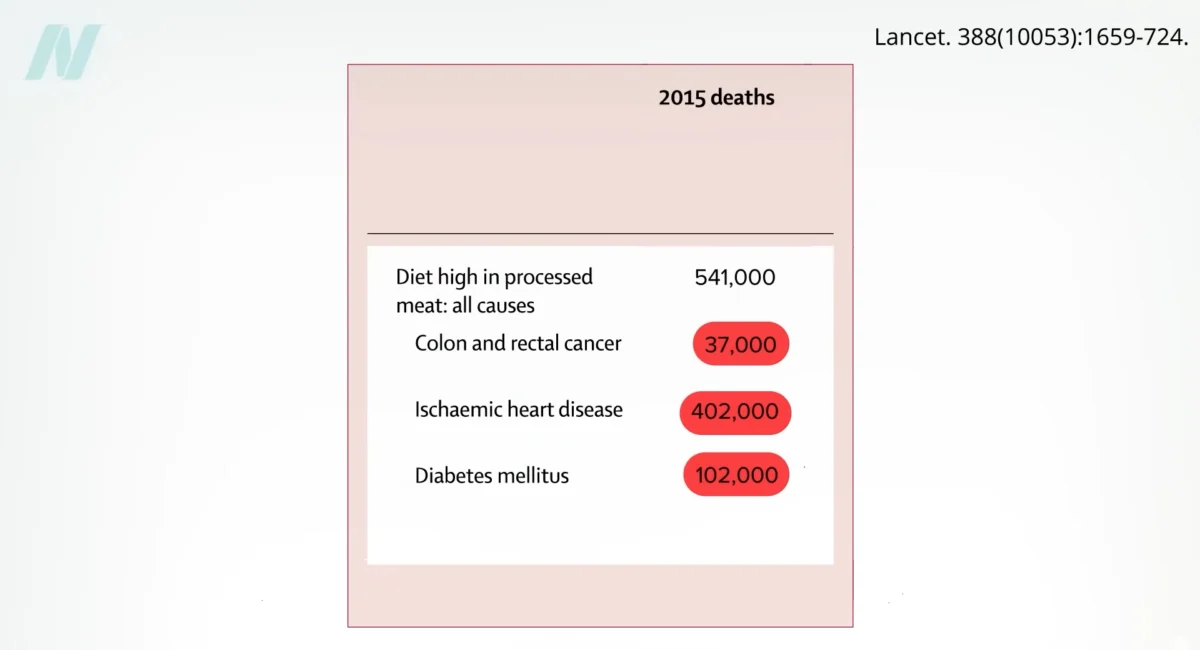
The approximately 37,000 cancer deaths attributed to higher processed meat intake, as cited in some studies, represent only a fraction of the potential health consequences. When considering the links between processed meat consumption and other major chronic diseases, the total health burden becomes significantly larger. Research indicates that processed meat consumption is associated with an increased risk of diabetes (an estimated 100,000 deaths annually) and heart disease (approximately 400,000 deaths annually).
When these figures are aggregated, the total number of deaths potentially attributable to processed meat consumption could approach half a million per year. This broader perspective underscores the critical need for public health action to address the consumption of these products.
Furthermore, emerging research suggests that the carcinogenic effects of processed meats may extend beyond colorectal cancer. Studies published since the IARC decision have indicated potential links between processed meat consumption and an increased risk of prostate cancer, breast cancer, and pancreatic cancer. This expanding body of evidence reinforces the urgency of re-evaluating dietary guidelines and public health messaging surrounding processed meats.
Challenges in Public Health Implementation
Despite growing public health concerns and robust scientific evidence, research indicates a disheartening lack of progress in reducing processed meat consumption in the United States. For the past 18 years, the amount of processed meat consumed by U.S. adults has remained largely unchanged.
This stagnation can be partly attributed to the absence of explicit, science-based guidance in official dietary recommendations. The Dietary Guidelines for Americans, a key resource for public health messaging, has notably failed to prominently feature the carcinogenic nature of processed meats. Publishing a clear and scientifically supported statement on this issue within the next iteration of the Dietary Guidelines would be a crucial step in educating the public and driving behavioral change.
The lack of comprehensive nutrition education for cancer patients also presents a significant challenge. Studies reveal that a substantial percentage of cancer patients do not receive adequate nutritional advice from their healthcare providers during or after treatment. This oversight is particularly concerning given the role of diet in recovery and long-term health outcomes.
The Meat Industry’s Tactics and Reformulation Efforts
The processed meat industry has historically employed strategies to influence public perception and policy, drawing parallels to the tactics once used by the tobacco industry to obfuscate the risks of smoking. Despite these efforts, a growing consensus within the scientific community calls for continued public health action focused on reducing meat consumption.
In response to mounting pressure and evolving research, some segments of the processed meat industry are exploring product reformulation. This approach aims to mitigate the potential adverse health effects by altering processing methods or adding ingredients, such as fiber, to counterbalance risks. While such efforts may offer marginal improvements, critics argue that they do not address the fundamental carcinogenic nature of processed meats and can be likened to adding a secondary drug to counteract the side effects of a primary one. The emphasis, from a public health perspective, remains on reducing or eliminating the consumption of these products altogether.
Leading the Way: Policy and Prevention
Pioneering initiatives are emerging to tackle the issue of processed meat consumption. New York City, for example, has taken a proactive stance by enacting legislation to ban processed meats from school meals. This policy reflects a commitment to protecting children from known carcinogens and fostering healthier eating habits from an early age. The principle of providing children with nutritious meals, free from carcinogens, is a concept gaining traction in public health discussions.
The Path Forward: Education and Policy
The continued scientific investigation into the health impacts of processed meats, coupled with public health advocacy and policy changes, is essential. Educating the public about the nuanced risks, emphasizing the distinction between relative and absolute risk, and advocating for clear, evidence-based dietary guidelines are critical steps. Furthermore, ensuring that healthcare providers are equipped to offer comprehensive nutritional advice to patients, particularly those diagnosed with cancer, is paramount.
The IARC’s classification of processed meats as Group 1 carcinogens serves as a crucial call to action. While the debate surrounding the magnitude of risk continues, the overwhelming scientific consensus points towards a significant association between processed meat consumption and increased cancer risk, as well as other serious health conditions. A concerted effort involving public education, robust policy interventions, and a commitment from the food industry to prioritize public health over convenience will be necessary to mitigate the considerable health burden posed by these widely consumed products.

