

The Zhenguan era of the Tang Dynasty, a period often heralded as a golden age of Chinese history, was also a time when administrative structures were solidifying and cultural exchange was flourishing. It was within this vibrant epoch, roughly corresponding to the early 7th century in the West and the nascent stages of era-naming in Japan, that an intriguing, albeit debated, encounter is said to have taken place. At the heart of this narrative is Lu Qiuyin, a government official whose very existence is subject to historical conjecture, yet whose alleged experiences offer a window into the spiritual and philosophical currents of the time.
Historical Footing: The Elusive Lu Qiuyin
The precise identity and tenure of Lu Qiuyin remain subjects of scholarly debate. While some accounts place him as the Chief Censor of Taizhou, an administrative role equivalent to a prefectural governor, his biography is notably absent from both the old and new compilations of the Tang Book. This omission raises questions about his historical veracity. The administrative hierarchy of the Tang Dynasty was meticulously organized, with China divided into dao (regions), further subdivided into zhou (states) or jun (counties). These were then divided into xian (prefectures), xiang (districts), and finally li (villages). The head of a zhou was known as a cishi, while the administrator of a jun was called a taishou. The discrepancy in official records, coupled with the fact that a Chief Censor of a zhou would typically hold a significant enough position to warrant inclusion in historical biographies, casts a shadow of doubt on Lu Qiuyin’s historicity. Some contemporary scholars, like Mr. Yoshida Tōgo, have even pointed out the improper application of Japanese administrative terms, such as equating ken with xian and gun with jun, highlighting the complexities of cross-cultural historical interpretation. Nevertheless, for the narrative to unfold, the existence of Lu Qiuyin, however shadowy, is presupposed.
A New Appointment and an Unforeseen Affliction
Lu Qiuyin’s story gains momentum upon his arrival in Taizhou, a fertile region of Central China, marking a stark contrast to the dust and muddy waters he had experienced in Chang’an, the Tang capital. The third day of his tenure found him in an exceptionally good mood, invigorated by his new surroundings and the formal audiences with numerous subordinate officials. He relished the palpable authority that came with his position, a sentiment that fueled his exhilaration.
However, his newfound contentment was soon to be tested by an unforeseen ailment. Prior to his departure from Chang’an, Lu Qiuyin had been struck by a severe headache, a condition he attributed to simple rheumatism. Despite taking medication prescribed by his physician, the persistent pain left him contemplating a delay in his journey to Taizhou. It was in this state of discomfort and uncertainty that an unexpected visitor appeared at his gate: a beggar monk, who claimed to have a message for the master of the house.
The Beggar Monk and the Bowl of Water
Intrigued, and perhaps seeking any form of relief, Lu Qiuyin, despite his lack of formal training in Buddhist or Daoist scriptures, harbored a certain respect for religious figures. This respect, described as a "blind respect for something one doesn’t comprehend," led him to grant the monk an audience. The visitor was a tall, unkempt figure, clad in a tattered robe, his long hair obscuring his eyes. He carried an iron bowl, its purpose as yet unknown.
The monk, after a silent appraisal, revealed his intention: to cure Lu Qiuyin’s headache. When Lu inquired about the method, the monk dismissed conventional remedies, stating that bodily ailments were illusions. He proposed to use only a bowl of clean water and "magic" to achieve the cure. Lu, prone to indecisiveness in matters of health and having selected his physician based on convenience rather than expertise, readily agreed. His reasoning was pragmatic: the monk’s distinguished demeanor inspired trust, and a cure involving water, at worst, seemed harmless. This approach mirrored, in the narrative’s analysis, the reliance of some high-ranking officials in Tokyo on less conventional treatments.
A maid was instructed to fetch well water. Upon receiving the bowl, the monk held it aloft, his gaze fixed on Lu. In a sudden, unexpected motion, he took a sip and sprayed the water onto Lu’s head. The shock was immediate; Lu felt a cold sweat break out.
To his astonishment, the headache, which had plagued him, vanished. The monk, without further ado, emptied the remaining water and prepared to depart. Lu, eager to express his gratitude, offered a reward, but the monk declined, stating his alms were for the benefit of all beings and not for personal gain.
Unveiling the Hermits: Fenggan, Shide, and Hanshan
Inquiring about the monk’s origin, Lu learned he hailed from the Guoqing Temple in Tiantai. The monk introduced himself as Fenggan. Lu, feeling a connection, sought to know if there were any notable individuals in Taizhou whom he might benefit from meeting. Fenggan then revealed the presence of two extraordinary figures at Guoqing Temple: Shide, whom he identified as an incarnation of Samantabhadra, and Hanshan, residing in a rock cave known as Cold Boulder to the west of the temple, whom he identified as an embodiment of Manjushri. With this revelation, Fenggan departed, leaving Lu with a profound sense of purpose that propelled his journey to Guoqing Temple.
Philosophical Underpinnings: Attitudes Towards the Way
The narrative pauses to offer a brief philosophical treatise on human engagement with the "Way," or spiritual and religious pursuits. It delineates three categories of people:
- The Indifferent: Those wholly absorbed in their daily professions, lacking concern for spiritual matters, and readers of books who find fulfillment in their studies without necessarily delving into deeper spiritual inquiry.
- The Seekers: Individuals who actively and diligently pursue the Way, either by renouncing worldly affairs or by integrating spiritual practice into their daily lives. This pursuit spans various traditions, including Confucianism, Daoism, Buddhism, and Christianity.
- The Respectful Observers: A middle ground occupied by those who acknowledge the existence of the Way but do not actively seek it. They hold a detached respect for those closer to it, a respect that, if based on incomprehension, is deemed "blind" and ultimately "useless."
This framework serves to contextualize Lu Qiuyin’s own position, suggesting he falls into the category of the "respectful observer" who, through his encounter with Fenggan, begins to bridge the gap towards seeking.
The Pilgrimage to Guoqing Temple
Driven by the encounter with Fenggan, Lu Qiuyin embarked on his journey to Guoqing Temple. Donning fresh robes and assembling a retinue of sixty attendants, he set out in the early winter chill. The journey along the Shifengxi tributary, under a clearing sky and pale sun, was punctuated by the deference of locals. Lu felt a sense of accomplishment, a "kind of exploit," in his mission to formally greet men of wisdom.
The distance from Taizhou to Tiantai was approximately sixty li (about 30 kilometers). Upon reaching Tiantaixian, Lu was welcomed by local officials and hosted at the governor’s residence. It was here he learned that the Guoqing Temple was another sixty li distant, with the terrain becoming increasingly steep. Realizing the impossibility of reaching the temple before nightfall, Lu decided to rest.
The following morning, under similarly fair weather, the arduous journey continued. The famed "Tiantai of eighteen thousand zhang" loomed, a formidable mountain landscape said to be inhabited by tigers. Progress was slow, and lunch was taken en route. It was as the sun began to set that they finally arrived at the imposing gates of Guoqing Temple, a site reportedly established by Emperor Yang of Sui in honor of the Great Teacher Zhiyi.
The Abbot’s Account and the Echoes of the Mystical
Upon his arrival, Lu was received with due ceremony by a monk named Daoqiao, who welcomed him and led him to the guest quarters. After the customary offering of tea and cakes, Lu immediately inquired about Fenggan. Daoqiao confirmed that Fenggan had indeed resided at the temple but had recently departed on a pilgrimage and had not yet returned.
Lu pressed for details about Fenggan’s activities within the temple. Daoqiao described him as a diligent monk who husked rice for his brethren. However, he admitted that over time, Fenggan had come to be regarded as "someone special." The most extraordinary anecdote concerned Fenggan’s departure: he had returned from the mountain one day, "riding a tiger," and entered the temple grounds chanting poetry. This unusual event, coupled with Fenggan’s fondness for poetry, led Lu to conclude that Fenggan was a "living arhat." He then inquired about the fate of Fenggan’s former dwelling.
Daoqiao led Lu to the empty monastery behind the main hall. In the fading light, the room appeared vacant, save for the faint footprints of a tiger on the stone floor. A sudden mountain wind rustling through the leaves outside amplified the eerie silence, sending a shiver down Lu’s spine.
The Lingering Presence of Shide and Hanshan
Emerging from the somber dwelling, Lu’s thoughts turned to the other figures Fenggan had mentioned. He asked Daoqiao if a monk named Shide was still at the temple. Daoqiao, surprised by Lu’s intimate knowledge of their community, replied that Shide had recently been seen warming himself by the kitchen fire with a man named Hanshan. He offered to summon Shide if Lu had business with him.
Lu, now eager to meet Shide and Hanshan, requested to be taken to the kitchen. As they walked, he learned that Shide had been a foundling brought to the temple by Fenggan from the pine woods. Initially tasked with ritualistic duties, Shide had later been reassigned to prepare the monks’ meals in the kitchen after an incident where he was found eating face-to-face with a statue, an act attributed to a lack of understanding regarding the reverence due to Pindola Bharadvaja.
Daoqiao then elaborated on Hanshan’s dwelling: a stone cave west of the temple, known as Cold Rock. Hanshan, it seemed, collected leftover rice and vegetables from Shide’s kitchen preparations in a bamboo tube. Lu, listening to these accounts, mused on the nature of these individuals, comparing their supposed identities as Manjushri and Samantabhadra to a rustic spectator at a play, confused about the actors’ roles.
The Kitchen Encounter and the Unconventional Welcome
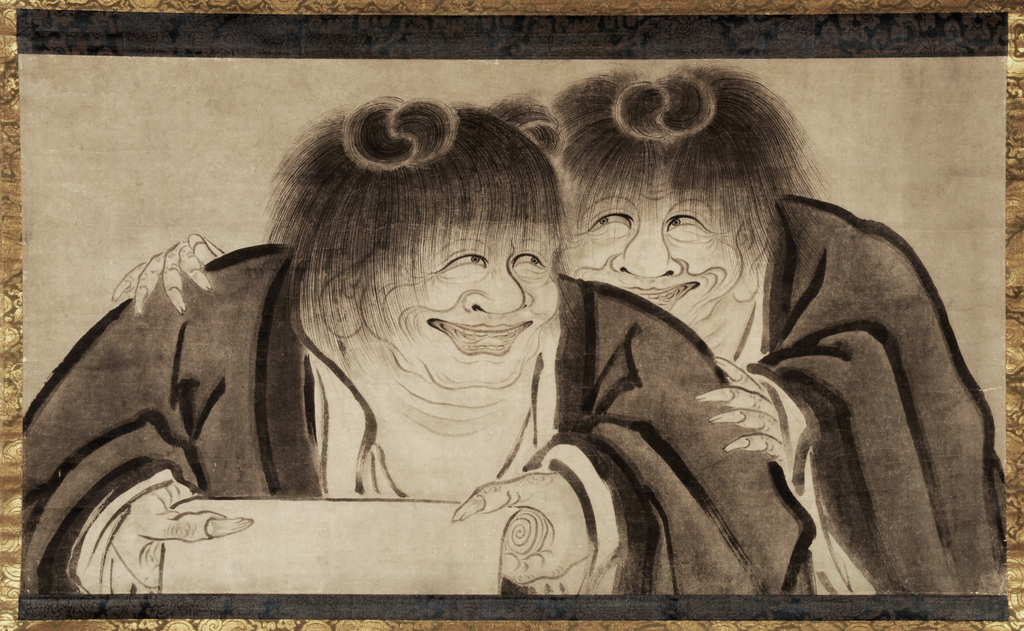
Upon entering the steamy, bustling kitchen, Lu found it difficult to see clearly. Three large ovens glowed with burning wood, and monks were busy preparing meals. Daoqiao called out for Shide, and Lu’s gaze fell upon two figures squatting near the farthest oven. One, bare-headed with short hair, wore straw sandals; the other, with a bark hat and wooden clogs, was the silent Hanshan. Lu surmised that the bare-headed one, who grinned upon being called, was Shide.
Approaching them, Lu formally introduced himself, listing his numerous titles and honors: "Lord Steward of the Imperial Council, Provincial Commander-in-Chief, Chief Censor of Taizhou, Army Chief of Staff, with Emperor-bestowed Scarlet Robe and Fish Tally, and I humbly call myself Lu Qiuyin."
Shide and Hanshan exchanged a look, then burst into spontaneous, hearty laughter. As they rose and fled the kitchen, Lu overheard Hanshan exclaim, "Fenggan prattled!" The monks around Lu, startled, resumed their tasks, while Daoqiao stood pale and bewildered. The narrative concludes with this enigmatic scene, leaving the reader to ponder the true nature of these individuals and the profound, perhaps even spiritual, implications of their unconventional existence. The story, deeply rooted in the historical and philosophical context of the Tang Dynasty, offers a compelling narrative of a bureaucrat’s encounter with figures who transcended conventional societal and religious norms, prompting reflection on the nature of wisdom, respect, and the elusive pursuit of the Way.

