

For decades, the name Yasujiro Ozu has been synonymous with a specific cinematic aesthetic, so distinct that it has spawned its own adjective: "Ozuesque." This term typically conjures images of serene, contemplative, and Zen-like filmmaking, characterized by quiet pacing, understated dramas, and a focus on the minutiae of everyday existence. Films like Late Spring and Tokyo Story have been lauded for their ability to draw viewers into the present moment, prompting a meditation on the often-overlooked aspects of life. Prominent critics such as Donald Richie and Paul Schrader have even posited that Ozu’s work represents Japanese Buddhism translated into cinematic form, capturing transcendence on screen.
However, a closer examination of Ozu’s oeuvre and the socio-historical context in which it was created reveals a more complex and nuanced picture. While overt Buddhist imagery does appear in some of his films, the prevailing interpretation of his work as a direct cinematic manifestation of Zen philosophy is increasingly being challenged by scholars and film theorists who argue it overlooks the profound engagement with Japan’s rapidly changing material and geopolitical realities. This re-evaluation suggests that Ozu’s true cinematic power lies not in a detached spiritualism, but in his acute observation of a nation grappling with its identity through periods of immense upheaval.
Deconstructing the "Ozuesque" Myth
The popular understanding of Ozu’s films often paints him as a meticulous craftsman, a "tofu maker" in his own words, finding solace and purpose in restraint and repetition. This perception is reinforced by the seemingly simple conflicts depicted in his most celebrated works: a young woman contemplating marriage in Late Spring, or an elderly couple facing neglect from their adult children in Tokyo Story. These narratives, when measured against the dramatic conventions of Hollywood, appear small and even mundane. The comparison to meditation arises naturally from the films’ slow tempo and the deliberate focus on the ordinary, inviting viewers to find depth in the seemingly unremarkable.
Yet, Ozu’s filmography spans significant epochs of Japanese history, including periods of war, imperialism, and Westernization. To view his films solely through the lens of timeless Zen concepts like mu (nothingness) and mono no aware (the pathos of things) is, as Ozu scholar Shiguehiko Hasumi argues in his seminal work Directed by Yasujiro Ozu, a failure to look closely enough. Hasumi contends that only by demystifying Ozu’s work and approaching it for what it is—rather than what it has been interpreted to signify—does its genuine, and perhaps more worldly, transcendent quality emerge.
Buddhist Imagery: A Surface or a Symbol?
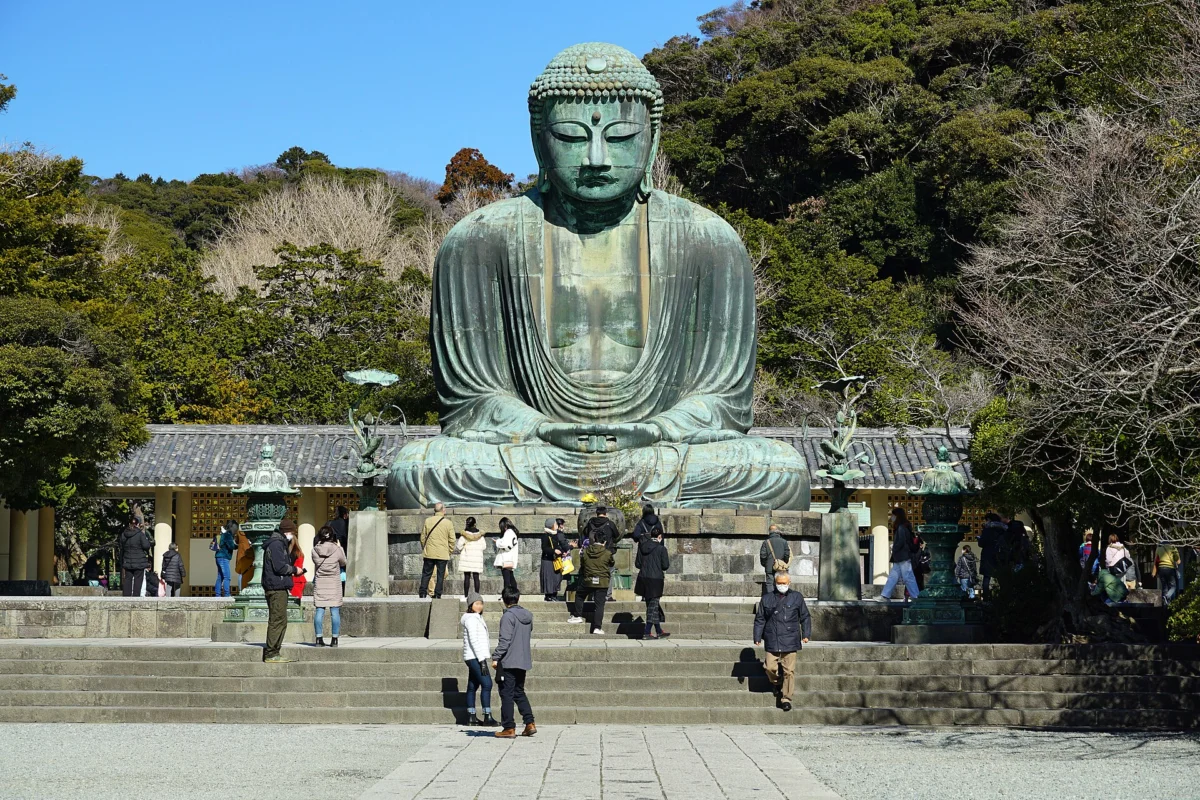
It is undeniable that Ozu’s films do incorporate Buddhist elements. The imposing Great Buddha of Kamakura, a 43.8-foot bronze statue of Amida Butsu at Kotoku-in, makes appearances in Walk Cheerfully (1930), There Was a Father (1942), and Early Summer (1951). Furthermore, A Story of Floating Weeds (1934) prominently features the daruma doll, a symbol of Bodhidharma, the monk credited with bringing Chan Buddhism to China. These are not subtle allusions, lending credence to the idea that Buddhist themes resonate within his work.

Critics like Paul Schrader, in his 1972 book Transcendental Style in Film: Ozu, Bresson, Dreyer, have interpreted these and other visual motifs as direct expressions of Buddhist philosophy. For instance, the rolling waves at the end of Late Spring are seen as an allusion to Buddhist cleansing rituals, and a static shot of a vase in the same film is interpreted as representing stasis amidst worldly change—a formal element that, according to Schrader, "can accept deep, contradictory emotion and transform it into an expression of something unified, permanent, transcendent."
However, the leap from the presence of Buddhist imagery to a deliberate cinematic embodiment of Buddhist doctrine is a contentious one. Some scholars, like Donald Richie, suggest Ozu drew inspiration from his personal life, while others, like Schrader, propose an indirect seep of Zen sensibilities through Japanese culture. Both arguments face considerable scrutiny.
Biographical Clues and Cultural Currents
Evidence of Ozu’s direct engagement with Buddhism is surprisingly sparse. During his military service in Nanjing in 1937, he is said to have received a calligraphic rendition of the Chinese character for "mu" from a monk. This character now adorns his tombstone in Kamakura, near the Great Buddha, though the precise circumstances remain unclear to many outside Japan. This location has become a pilgrimage site, with offerings of sake and beer left for the famously boisterous filmmaker.
Despite this intriguing detail, it’s questionable whether this singular encounter significantly impacted his filmmaking or life. Ozu was known for drawing inspiration from sources other than his direct experiences. His early comedies and crime films were made despite his lack of formal higher education or any brush with the law. More remarkably, given the prominence of family dramas in his oeuvre, he never married nor had children, living with his mother until her death.
Beyond Tradition: Ozu’s Engagement with Modernity and the West
Film theorist David Bordwell, in his 1988 book Ozu and the Poetics of Cinema, argues that Ozu’s films resonate more with contemporary Japanese writers like Toson Shimazaki and Junichiro Tanizaki, who explored the tension between Japan’s past and its rapid modernization. Ironically, given his status as an icon of "Japaneseness," Ozu harbored a deep affection for Western cinema. He was a fan of Hollywood serials and Westerns, and admired directors like Ernst Lubitsch, Frank Borzage, and D.W. Griffith. His early films, such as Days of Youth and I Flunked, But . . ., feature students discussing Hollywood movies, and the gangsters in That Night’s Wife and Dragnet Girl exhibit distinctly American mannerisms and fashion.
Ozu himself consistently downplayed the spiritual or traditional interpretations of his work. He famously remarked that the wide-screen frame reminded him not of traditional Japanese scroll paintings (emaki-mono) but of toilet paper. Regarding foreign critics’ frequent pronouncements of Zen in his films, he stated, "They don’t understand—that’s why they say it is Zen, or something like that." This suggests a profound disconnect between the Western critical gaze and Ozu’s own intentions.

Orientalism and the "Ubiquitous Buddhism" Fallacy
The notion that Ozu’s films are inherently Buddhist due to his Japanese nationality is a perspective that has been widely recognized as reductive and Orientalist within Japan. While Buddhism certainly played a role in Japanese society during Ozu’s lifetime, its character was far from monolithic. It was a dynamic force, adapting to societal shifts, and at times, even aligning with nationalistic agendas.
This becomes starkly evident in There Was a Father (1942). Released during a period when the Japanese government mobilized Buddhist institutions for the war effort, the film, which depicts a teacher’s sacrifice and his son’s continuation of his legacy, has been interpreted as a propaganda piece. Scenes restored in 2023 for a Venice Film Festival presentation showcased patriotic poetry and music that had been cut by occupation censors. The film uses the Great Buddha as a backdrop for students marching in unison, connecting Buddhist imagery to the concept of self-sacrifice for the nation, alongside visits to the Imperial Palace and Meiji Jingu. This is a far cry from the detached spiritualism often attributed to Ozu.
"Japaneseness" as a Construct
The very concept of "Japaneseness" that Western critics often project onto Ozu’s films is itself a complex construct, shaped by both foreign perceptions and Japan’s own self-presentation to the world. Terms like mono no aware, often translated as the "pathos of things" and understood as a wistful appreciation of impermanence, only entered aesthetic discourse in the 18th century and were initially associated with aristocratic refinement rather than spiritual enlightenment.
Furthermore, the commercialization of Zen, which surged in the latter half of the 20th century, was already underway during Ozu’s childhood. Traditional rituals, once significant, had begun to transform into mere hobbies for the elite, as Bordwell notes. Ozu, far from being a traditionalist, often approached customs and heritage, including Buddhist elements, with a tone that oscillated between open provocation and subtle irony.
Satire and Subversion in Ozu’s Early Works
Ozu’s early films often display a satirical edge when engaging with traditional Japanese elements. In Days of Youth (1929), a student disrespectfully places chewing gum on a statue of the 12th-century Buddhist monk Saigyo Hoshi, a symbolic act of defiance against societal norms.
Walk Cheerfully (1930) further exemplifies this subversion. When the protagonist, a reformed gangster, takes his love interest and her sister to Kotoku-in, they playfully mock the Great Buddha’s solemn expression before speeding away, leaving a cloud of dust—a visual statement, as Bordwell observes, of "the superiority of modern life to Japanese tradition."

Similarly, A Story of Floating Weeds (1934) uses the daruma doll, a symbol of resilience, not to endorse perseverance but to highlight characters’ stubborn refusal to evolve. Their inevitable return to the status quo is portrayed as tragic, a subversion of the traditional association of the daruma with unwavering stability.
The Nuance of Late Spring and the Transformation of Self
Even in his more acclaimed later works, Ozu’s portrayal of tradition is rarely straightforward. In Late Spring (1949), the daughter’s decision to marry and leave her widowed father, while seemingly a natural progression, is catalyzed by a Noh play, "Water Iris," which pays homage to Amida Buddha. This ancient performance prompts her reflection on the impermanence of relationships, leading her to embrace a new phase of her life. This subtle interplay between ancient art and personal transformation underscores Ozu’s complex engagement with cultural heritage.
A Formalist Approach: Unveiling the True Ozu
The most compelling argument for a re-evaluation of Ozu’s work comes from Shiguehiko Hasumi’s Directed by Yasujiro Ozu. Originally published in Japanese in 1983 and recently translated into English, Hasumi advocates for a purely formalist approach. He urges viewers to shed preconceived notions about Zen, Japan, and Ozu himself, focusing instead solely on what appears on screen. This methodology, rather than limiting interpretation, reveals a filmmaking style far more versatile and multifaceted than commonly accepted.
Through this lens, Ozu’s films are not mere cinematic equivalents of commercialized "Zen." Instead, they are astute portraits of "conditions, customs, and sensibilities" undergoing rapid transformation, notable for their inherent impermanence. The seemingly gentle gestures often reveal an exaggerated or unusual quality. Early films like Days of Youth exhibit slapstick reminiscent of Chaplin and Keaton, while later films, lauded for their realism, curiously omit staircases in household sets. Shots that appear similar often use that similarity to highlight crucial differences, demanding close attention from the viewer.
Hasumi’s analysis of a vase shot in Late Spring exemplifies this approach. It is not simply a shot of a vase, but a shot of a vase within a room, complete with a floor, walls, shoji screens, illuminated by moonlight and dappled by the shadows of wind-blown plants. As Hasumi eloquently states, "Even a shot of a vase floating in a void, would not be a ‘shot of a vase’ but a shot of a vase floating in a void." This meticulous focus on the concrete reality of the image, stripped of external interpretive frameworks, allows for a deeper appreciation of Ozu’s genius.
Conclusion: A Filmmaker Rooted in His Time
By demystifying the Ozuesque and embracing a formalist appreciation of his craft, one discovers a filmmaker deeply attuned to the social, economic, and geopolitical currents of his era. Yasujiro Ozu’s cinematic legacy is not that of a detached spiritualist offering Zen koans on film, but of a keen observer of human experience in a nation undergoing profound and often tumultuous change. His transcendence lies not in an escape from the material world, but in his unparalleled ability to capture its ephemeral beauty and the quiet dignity of lives lived within its ever-shifting boundaries. His films, when viewed without the superimposed lens of facile spiritualism, offer a more potent and enduring form of insight into the human condition.

