

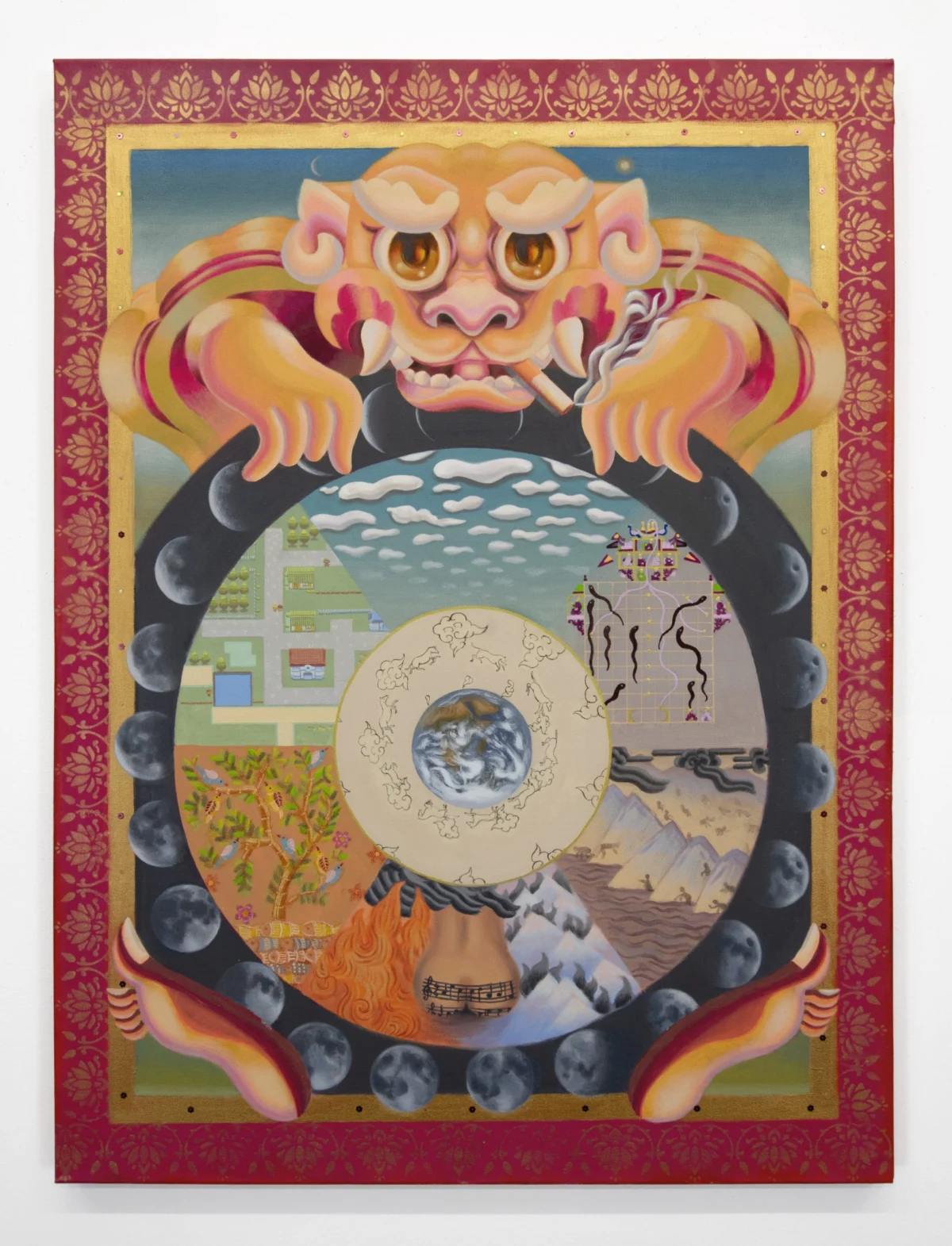
Naomi Basu, a painter born in New Delhi and now a prominent figure in New York’s art scene, is captivating audiences with her unique fusion of traditional Tibetan thangka painting techniques and a distinctly contemporary aesthetic. Her work, characterized by its intricate detail, vibrant palette, and profound spiritual undertones, represents a significant evolution in the way sacred imagery is interpreted and presented to a global audience. Recently featured in the Morgan Lehman Gallery’s exhibition "Twenty by Sixteen," Basu’s pieces, such as Plane and Projection in Yab-Yum and Plane and Depth in Yab-Yum, exemplify her ability to balance devotional depth with decorative appeal.
Basu’s artistic journey is deeply intertwined with her exploration of Tibetan Buddhism, a path that began not through formal religious upbringing but through a childhood familiarity with Buddhist imagery and a grandfather’s thoughtful gifts of Buddha statuettes. This early exposure fostered a sense of comfort and resonance with these visual forms. "It’s always been something that felt very familiar," Basu shared in a recent interview with Tricycle editorial assistant Kami Nguyen. "I’ve been drawn to that imagery for a while just because of that familiarity and the visual richness of it."
The Evolution of an Artistic Voice
The discernible influence of Buddhist iconography began to manifest in Basu’s art around 2022. This period marked a deepening of her interest in Tibetan Buddhism specifically, leading to extensive research and a focused exploration of its rich visual language. Her particular fascination lies with feminine iconography and the feminine principle within Tibetan Buddhist traditions. This desire to understand these aspects on a deeper level, rather than merely adopting their aesthetics superficially, prompted her search for authentic guidance.

Her quest led her to Pema Rinzin, a revered Tibetan thangka master and her eventual mentor. Rinzin, who had previously taught at his New York Tibetan Art Studio, had paused his teaching due to space constraints. Upon discovering him, Basu reached out with a sincere inquiry about learning from him. Rinzin, recognizing her serious commitment after reviewing her artwork, invited her for a conversation. This initial meeting in 2022 proved pivotal, initiating a rigorous apprenticeship.
"So I visited his studio back in 2022 and had a very long chat with him," Basu recounted. "He told me how he teaches, and we went through a lot of his books. He has an amazing rare book collection on Tibetan art and art from that region. He showed me the kinds of pigments he used, and it was something I was super interested in getting to learn more deeply, all of the processes behind it."
Mastering the Foundations of Thangka Art
Basu’s tutelage under Pema Rinzin was characterized by a disciplined, step-by-step approach, deeply rooted in the traditional methods of thangka painting. She attended his studio weekly for several years, meticulously learning the foundational elements of constructing the complex diagrams essential for thangka creation. This process often begins with rendering a simple Buddha diagram, a task Rinzin sometimes requires students to repeat numerous times—even up to forty—before advancing. This emphasis on repetition and precision ensures a profound understanding of the iconography and its underlying structure.
Rinzin also imparted a crucial warning against the proliferation of "tourist art," a phenomenon where thangka paintings are mass-produced, often losing their devotional essence. He stressed that the creation of these sacred artworks should be approached with a mindful, devotional intention, rather than as a purely commercial enterprise. This philosophical underpinning of thangka art—its purpose as a tool for contemplation and spiritual connection—is a principle that continues to inform Basu’s own artistic philosophy.

Bridging Traditional Craftsmanship with Contemporary Discourse
While Basu’s artistic background is one of consistent creative practice, her formal engagement with thangka painting represents a deliberate pivot towards a more spiritually informed genre. Previously, her work focused on observational drawing and painting, multi-portraits, and expressive compositions incorporating fantastical elements. Her immersion in Tibetan Buddhist art, however, emerged organically, fueled by her initial familiarity and an increasing appreciation for its profound visual richness. Visits to institutions like the Rubin Museum (sadly now closed) further solidified her connection to this artistic tradition.
The integration of traditional thangka training into her contemporary practice is evident in works like Plane and Projection in Yab-Yum and Plane and Depth in Yab-Yum. Basu intentionally leaves visible the grid lines and technical markings that form the skeletal structure of these paintings. "That’s very observant of you," she noted when this detail was pointed out. "I wanted to not have those grid lines completely obscured by the layers that went on top because I really wanted to show the process." These grid lines, passed down from Rinzin and his teacher, serve as a foundational layer, meticulously constructed with pencil and then rendered with sumi ink. This deliberate exhibition of the underlying structure serves as a testament to the rigorous training she received and her commitment to transparency in her artistic process.
However, Basu’s intent diverges from creating purely devotional pieces. Instead, she aims to make this rich iconography more accessible and relatable to a contemporary audience, many of whom may have no prior connection to Tibetan Buddhism. Her work seeks to foster a sense of connection to a "higher meaning," a concept that resonates deeply in an era grappling with what some scholars, like Jean M. Twenge in The Anxious Generation, describe as spiritual degradation in modern, technologically saturated societies. Basu articulates this aspiration: "Even though I’m not religious, religion fulfills a very human need, which is this connection to something gracious, something beyond just your daily life, and this feeling of purpose, this feeling of higher meaning." Her art, therefore, becomes a personal exploration of spiritual grounding and connection, aiming to evoke a sense of awe and transcendence in viewers, irrespective of their religious or spiritual affiliations.
Reinterpreting Iconography for a Modern Audience
The question of whether Tibetan art still needs to be "brought to the West" by Tibetan artists, as Pema Rinzin suggested for his own generation, elicits a nuanced response from Basu. While acknowledging Rinzin’s unique position as a Tibetan artist introducing his culture’s art, Basu sees her role as a conduit for a different kind of translation. Her paintings are not direct replicas of traditional thangkas but rather contemporary interpretations that draw from Tibetan iconography as a root. Works like Milk Bath, with its tiger border inspired by Tibetan meditation rugs, and Sky Dancer, referencing Mandarava (Padmasambhava’s consort), demonstrate how subtle, yet significant, references are woven into her broader visual language. These elements are not always overt but serve as the foundation upon which she builds a distinct iconography that, while not overtly religious, aims to evoke a similar sense of spiritual resonance.

A Dialogue of Color and Materiality
Basu’s use of color and materials further distinguishes her work. While she appreciates the vibrant hues of mineral pigments learned from Rinzin, her palette has evolved. She acknowledges a past fondness for fluorescent paints, which she still employs sparingly, recognizing their contemporary feel. However, she is increasingly drawn to more organic materials. "Mineral pigments are what I learned to use with Pema, and those produce super beautiful vibrant colors, but they’re completely natural," she explained. This inclination towards natural materials aligns with a broader appreciation for the inherent beauty of materials, such as the natural wood grain that she sometimes allows to show through her compositions.
Her approach to color is deliberate and often restrained, aiming to imbue her work with a sense of preciousness. The use of gold leaf, particularly raised gold leaf, which she notes is often seen in Indian religious art, adds a textural dimension that feels both ancient and contemporary. This conscious engagement with materials and their cultural associations underscores her thoughtful approach to artistic creation.
Textile Art and Cultural Heritage
Beyond painting, Basu incorporates embroidery into her artistic practice, a medium that holds deep personal significance. While she lacks formal training in textile arts, her Bengali heritage from West Bengal, India, connects her to the tradition of Kantha embroidery. This regional craft, often associated with quilts and repurposed fabrics, feels intrinsically familiar, stemming from childhood experiences of seeing Kantha blankets and her grandmother’s own embroidery. "It feels just so natural in a way," she shared.
The painstaking process of hand-embroidery results in unique pieces that, while time-consuming, offer a comforting and distinctly Indian aesthetic. Basu expresses a desire to further integrate embroidery elements into her paintings in the future, a fusion that promises to add another layer of cultural richness and textural depth to her oeuvre.

Satirizing Modern Spirituality: "Plastic Shaman/American Psycho"
Basu’s recent work, Plastic Shaman/American Psycho, currently on view at GOCA by Garde’s group exhibition "High Visibility," represents a departure from the direct exploration of Tibetan Buddhist iconography. This piece, described as having a more "eerie" tone, satirizes what Basu perceives as the superficial adoption of New Age spirituality in the West. The painting features a stylized, "plastic" figure with a seemingly perfect physique, a "fake chakra diagram," and imagery from the Kama Sutra.
The artwork critiques the commodification of spiritual practices, where elements of Eastern spirituality are packaged and marketed to Western consumers seeking superficial aesthetic appeal. Basu points to phenomena like expensive yoga classes, meditation teacher trainings, and designer athleisure wear as examples of spirituality being transformed into a consumer product. She observes that in the absence of genuine spiritual grounding, individuals may become susceptible to these trends, driven by a deep-seated human need for meaning. "It comes from desperation," she stated, emphasizing that while she is not mocking those who fall prey to these trends, she is critical of those who exploit this need for profit.
This exploration of the commercialization of spirituality marks a new thematic direction for Basu, stemming from her contemplation of contemporary societal trends. While it is her first piece to directly address this theme, she anticipates further investigating this intersection of spirituality, consumerism, and the search for meaning in her future work, exploring both where these connections thrive and where they falter. Her artistic trajectory continues to be defined by a profound engagement with tradition, a keen observation of contemporary culture, and a persistent exploration of the human yearning for connection and purpose.

