

A groundbreaking 2026 PROTECT study, involving 174 older adults, has demonstrated that self-administered fingerprick blood tests for specific biomarkers can serve as a valuable tool for remotely assessing Alzheimer’s disease risk, though not for definitive diagnosis. The research, which focused on the utility of p-tau217 and glial fibrillary acidic protein (GFAP) in capillary blood samples collected at home, establishes a significant step towards more accessible and streamlined early detection pathways for neurodegenerative conditions. The findings indicate that fingerprick p-tau217 levels correlated notably with episodic memory (r = 0.299, p < 0.001), a cognitive domain profoundly impacted in early Alzheimer’s disease, while GFAP correlated with working memory (r = 0.183, p = 0.034). These correlations underscore the potential for these remote tests to facilitate Alzheimer’s risk triage, guiding individuals towards formal clinical evaluation rather than replacing it.
The Evolving Landscape of Alzheimer’s Diagnostics
Alzheimer’s disease (AD) represents a formidable global health challenge, affecting millions worldwide and placing immense burdens on healthcare systems, caregivers, and economies. Projections indicate a substantial increase in AD prevalence in the coming decades, underscoring an urgent need for effective early detection and intervention strategies. Traditionally, diagnosing Alzheimer’s has been a complex, multi-faceted process, often involving extensive clinical evaluations, detailed neuropsychological assessments, advanced brain imaging techniques such as amyloid PET and tau PET scans, and cerebrospinal fluid (CSF) analysis. While these methods offer high diagnostic accuracy, they are often expensive, invasive, time-consuming, and geographically inaccessible for many, particularly those in rural areas or with limited mobility.
The advent of blood-based biomarkers has revolutionized the diagnostic landscape, offering a less invasive, more cost-effective, and scalable alternative. Plasma p-tau217, for instance, has emerged as a particularly promising marker, demonstrating high specificity for Alzheimer’s-type tau pathology and strong correlation with amyloid accumulation in the brain. Similarly, GFAP has gained attention as a marker of astrocyte activation, reflecting neuroinflammation and various forms of brain injury, including those associated with Alzheimer’s disease. While venous blood draws for these markers have already shown superior performance compared to many older dementia-screening tools, the Corbett et al. study pushed the boundary further by exploring the feasibility and efficacy of self-administered capillary blood collection.
The PROTECT Study: Pioneering Remote Biomarker Collection
The 2026 PROTECT study sought to answer a crucial operational question: could older adults successfully collect capillary blood samples at home, and would the biomarker values derived from these samples align meaningfully with cognitive function, overall functional status, and established venous blood measurements? The PROTECT (Prospective Online Test of Cognition and Training) research program, a UK-based initiative, is a large, longitudinal online cohort study dedicated to understanding brain health in aging. This provides a rich context for exploring novel, remote assessment methodologies.
The study initially recruited 226 participants from the PROTECT program, with 174 successfully completing the blood-test kits. The final cohort had a mean age of 66.03 years and was 54% female, comprising 146 individuals with normal cognition and 28 diagnosed with dementia. A key design element was the "low-friction workflow," ensuring that the process of receiving the kit, self-collecting the sample, and returning it was as straightforward and user-friendly as possible. This design choice was paramount for maximizing participant compliance and ensuring the practical viability of remote testing on a larger scale. The overarching practical advantage of such a system is its unparalleled reach. Unlike venous blood testing, which necessitates a clinic visit or phlebotomy service, capillary sampling can be seamlessly integrated with computerized cognitive testing, mailed kits, and remote trial-screening workflows, thereby democratizing access to early risk assessment.
Biomarker Specificity: p-tau217 vs. GFAP
The study meticulously analyzed the associations between the self-collected capillary biomarkers and various cognitive and functional measures. The findings underscored distinct roles for p-tau217 and GFAP:
-
p-tau217: An Alzheimer’s-Specific Signal: Capillary p-tau217 exhibited its strongest cognitive association with episodic memory, which is the memory system most typically and visibly affected in the early stages of Alzheimer’s disease. Beyond episodic memory, p-tau217 also correlated with attention, executive function, and both functional measures assessed (Instrumental Activities of Daily Living – IADL, and the Informant Questionnaire on Cognitive Decline in the Elderly – IQCODE). This pattern of association strongly suggests that p-tau217 derived from capillary blood mirrors its established role as a highly specific marker for Alzheimer’s pathology. The phosphorylation of tau at amino acid 217 is a critical event in the formation of neurofibrillary tangles, a hallmark of AD, and its elevation in blood is tightly linked to the presence of both amyloid plaques and tau tangles in the brain.
-
GFAP: A Broader Marker of Neuroinflammation and Injury: In contrast, GFAP displayed a broader but less Alzheimer’s-specific pattern of association. It correlated with working memory, executive function, and instrumental activities of daily living, but not with the IQCODE functional informant measure. Intriguingly, the researchers also reported a relationship between elevated GFAP positivity and a history of heart disease, lending weight to interpretations that GFAP elevation can reflect vascular injury and general neuroinflammation, in addition to Alzheimer-related glial responses. GFAP, or glial fibrillary acidic protein, is primarily released by astrocytes when they become activated in response to various forms of central nervous system injury or disease. While astrocyte activation is a component of Alzheimer’s pathology, it can also arise from other conditions like stroke, traumatic brain injury, multiple sclerosis, and other neurodegenerative disorders.
These findings align well with adjacent biomarker research. Studies by Palmqvist et al. have demonstrated that plasma p-tau217 can effectively discriminate Alzheimer’s disease from other neurodegenerative disorders, reinforcing its diagnostic precision. Similarly, Ashton et al. have reported high diagnostic accuracy for plasma p-tau217 immunoassays against confirmed Alzheimer’s pathology. This consistent evidence base validates the notion that p-tau217 is a more direct and specific indicator of Alzheimer’s biology, whereas GFAP, while clinically useful, serves as a broader flag for neuroinflammatory or injurious processes within the brain.
Thresholds and Subgroup Identification
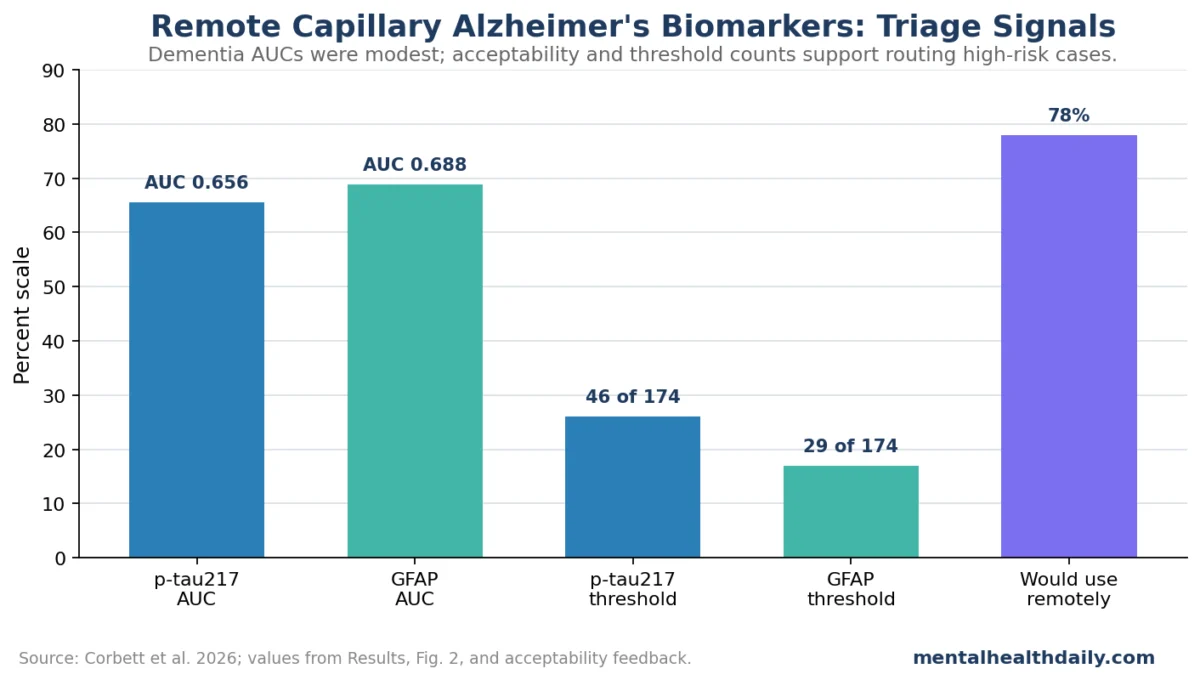
To further explore the clinical utility of these markers, Corbett et al. employed prespecified 85% specificity thresholds: 0.016 pg/ml for capillary p-tau217 and 12.45 pg/ml for capillary GFAP. These thresholds identified distinct subgroups within the study population: 46 participants (26%) with elevated p-tau217 and 29 participants (17%) with elevated GFAP. Critically, individuals exceeding these thresholds consistently performed worse on several cognitive and functional measures. For p-tau217, the memory difference had a Cohen’s d of 0.548 (p = 0.020), IADL d = 0.542 (p = 0.017), and IQCODE d = 0.657 (p = 0.001). For GFAP, the IADL difference was even larger at d = 0.754 (p = 0.004), while executive function showed a difference of d = 0.541 (p = 0.016).
A crucial aspect of validating remote testing is its correlation with established methods. The study confirmed that these capillary biomarker thresholds were recognizable in venous plasma. Plasma p-tau217 discriminated the capillary p-tau217 threshold group with an Area Under the Curve (AUC) of 0.785, and plasma GFAP discriminated the capillary GFAP threshold group with an AUC of 0.895. This strong alignment between capillary and venous blood results is vital, as it demonstrates that the remote kit produces clinically relevant values that map onto established blood chemistry, rather than generating an isolated or artifactual signal.
The Critical Distinction: Triage, Not Diagnosis
Despite the promising correlations, the study’s most emphatic conclusion is the distinction between risk triage and definitive diagnosis. The AUC values for separating dementia vs. non-dementia status were 0.656 for capillary p-tau217 and 0.688 for GFAP. While these values are better than chance, they are explicitly not diagnostic-grade. A diagnostic test typically requires much higher AUCs (e.g., >0.90) to ensure sufficient sensitivity and specificity to confidently rule in or rule out a disease.
The researchers advocate for a combined triage profile: an elevated p-tau217 above the 85% specificity threshold coupled with memory performance low enough to meet age-associated cognitive decline criteria. Such a combination could identify individuals who should be prioritized for formal dementia evaluation more quickly than relying solely on symptom questionnaires. It is imperative that a normal remote biomarker result does not dismiss a caregiver’s report of worsening memory, medication errors, falls, or other concerning changes. While it might narrow the immediate probability of Alzheimer’s-specific pathology, it should keep a broader differential diagnosis open, especially in primary care settings where conditions like depression, sleep apnea, anticholinergic drug effects, alcohol exposure, hearing loss, and cerebrovascular disease can mimic early dementia.
The distinction between risk sorting and diagnosis is not merely semantic; it carries significant clinical and ethical implications. An AUC of 0.656 means there is considerable overlap in capillary p-tau217 levels between individuals with and without dementia. GFAP is even less disease-specific, as astrocyte activation can increase due to various injury pathways. Therefore, the useful application of this test is as a referral aid. The blood result must be interpreted within a comprehensive clinical context, including memory performance, daily function reports, medication review, depression screening, sensory assessment, and vascular-risk history, before determining the need for confirmatory imaging, CSF testing, or specialist evaluation.
Implications for Clinical Practice and Research
The potential impact of remote capillary biomarker testing is multi-faceted:
- Enhanced Access and Equity: Remote testing directly addresses barriers to care such as geographical distance, lack of transportation, limited clinic capacity, and the general burden of attending multiple in-person appointments. By enabling individuals in rural areas or those with mobility challenges to participate, it significantly broadens access to early cognitive assessment pathways, promoting health equity.
- Optimizing Specialist Resources: Memory clinics and specialist neurologists are often overburdened. By providing a pre-screening tool that can identify individuals with a higher biological signal for Alzheimer’s, these tests can help direct scarce specialist appointments towards those most likely to benefit from further, more intensive evaluation. This streamlines the referral process and optimizes resource allocation.
- Accelerating Clinical Trials: This is arguably the most immediate and impactful use case. Alzheimer’s prevention and early-intervention trials often require screening thousands of individuals to identify a smaller cohort with the specific biomarker profile (e.g., amyloid positivity) required for enrollment. This "screen failure" rate is incredibly costly and time-consuming. Fingerprick p-tau217 could significantly reduce these expensive screen failures by pre-identifying individuals more likely to have confirmatory amyloid or tau evidence, thereby accelerating drug development.
- The Essential Confirmatory Pathway: The study unequivocally stresses that capillary biomarkers are only useful when a clear "next step" is planned. A remote positive result must not leave a patient with an unconfirmed label and no clear path forward. Instead, it should trigger a defined sequence of follow-up actions:
- Primary Care Provider: Initial review of results, patient history, and basic cognitive screen.
- Specialized Cognitive Assessment: Referral for comprehensive neuropsychological testing and clinical evaluation.
- Confirmatory Biomarker Testing: Advanced imaging (PET scans for amyloid/tau) or CSF analysis to confirm underlying pathology.
This structured pathway is critical for responsible implementation.
Challenges and Future Directions
While highly promising, the path to routine implementation of remote fingerprick testing for Alzheimer’s risk still faces significant hurdles:
- Longitudinal Validation: The most critical missing link is longitudinal follow-up. The current study establishes cross-sectional correlations. For routine screening, evidence is needed to show that remote biomarker-plus-cognition profiles predict future diagnosis, functional decline, or trial eligibility over several years. This kind of predictive validation is essential before moving from triage research to routine primary care pathways.
- Standardization and Assay Reliability: For widespread adoption, the assays used for capillary blood collection must be robustly standardized across different manufacturers and laboratories to ensure consistent and reliable results.
- Integration into Primary Care: Primary care physicians will require comprehensive training on how to interpret these biomarker results, integrate them with a patient’s clinical picture, and navigate appropriate referral pathways. Guidelines for patient communication, particularly regarding the sensitive nature of Alzheimer’s risk, will also be crucial.
- Managing False Positives and Negatives: The distinction between p-tau217 (Alzheimer-specific) and GFAP (broader neuroinflammatory/vascular risk) is vital. A triage algorithm that treats both markers as interchangeable "Alzheimer positive" would flatten the most useful distinction made by the paper. For instance, a person with elevated GFAP and vascular disease may require aggressive vascular-risk management more urgently than an Alzheimer’s diagnosis. Conversely, a person with elevated p-tau217 and declining memory would likely need a confirmatory Alzheimer’s workup.
- Ethical Considerations and Patient Support: The equity argument for remote testing is strongest when it expands access to follow-up and comprehensive care, rather than replacing it. Providing a potential risk signal remotely necessitates robust support systems, including counseling and educational resources, to manage patient anxiety and ensure appropriate next steps. Marketing home fingerprick testing as a direct-to-consumer Alzheimer’s diagnosis would be premature and potentially harmful.
In conclusion, the 2026 PROTECT study offers compelling evidence for the utility of self-administered fingerprick blood tests as a remote triage tool for Alzheimer’s disease risk. By improving accessibility and streamlining initial risk assessment, these biomarkers hold immense potential to transform early detection strategies, particularly for clinical trial recruitment and optimized specialist referrals. However, their role remains that of a sophisticated screening aid, demanding careful interpretation within a comprehensive clinical context and requiring a robust, planned confirmatory pathway to ensure responsible and ethical patient care. The future of Alzheimer’s diagnostics is undoubtedly moving towards less invasive and more accessible methods, and this study marks a significant stride in that direction, paving the way for further longitudinal research and careful implementation strategies.

