

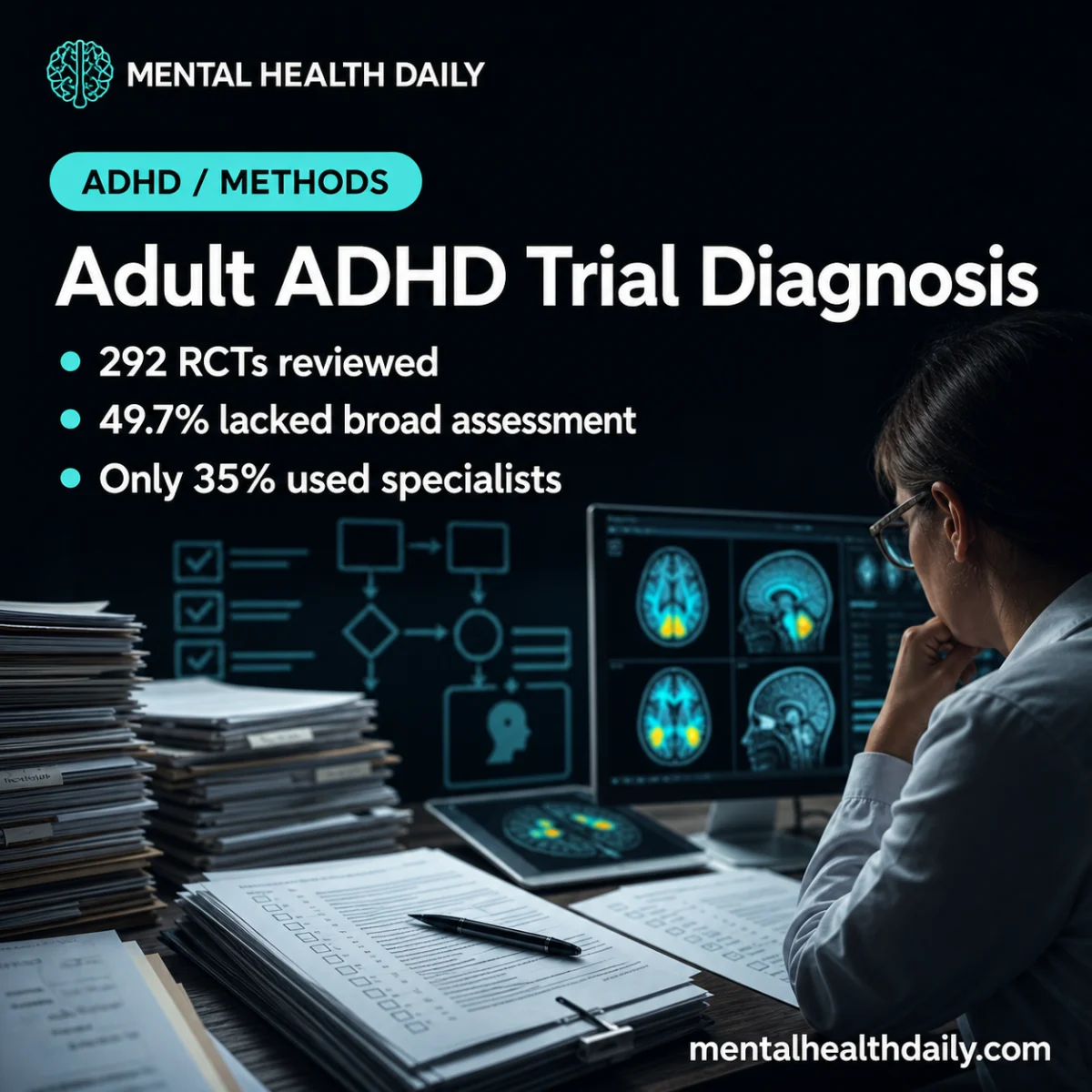
A groundbreaking 2025 scoping review of 292 adult Attention-Deficit/Hyperactivity Disorder (ADHD) randomized controlled trials (RCTs) has revealed significant methodological weaknesses in how participants are diagnosed, raising serious questions about the generalizability and clinical interpretability of existing research findings. Conducted by Studart et al., the comprehensive analysis found that a concerning 49.7% of these trials failed to incorporate a general psychopathology assessment when allocating an ADHD diagnosis, and a mere 35% reported that the diagnosis was assigned by qualified psychiatrists or psychologists. These findings suggest that a substantial portion of the evidence guiding adult ADHD treatment may be based on samples whose diagnostic integrity is compromised, potentially distorting our understanding of treatment efficacy and safety.
The Evolving Landscape of Adult ADHD Diagnosis
For decades, ADHD was predominantly viewed as a childhood disorder, with diagnostic criteria and research primarily focused on pediatric populations. However, increasing clinical recognition and scientific inquiry have firmly established ADHD as a neurodevelopmental condition that persists into adulthood for a significant number of individuals. This paradigm shift has led to a surge in adult ADHD diagnoses and, consequently, a heightened demand for robust evidence on adult-specific treatments.
Diagnosing adult ADHD presents unique challenges compared to its childhood counterpart. While childhood diagnosis often relies on observable behaviors reported by parents and teachers, adult diagnosis frequently necessitates translating retrospective accounts of childhood symptoms into current adult presentations. This process involves careful consideration of current symptom reports, historical information, evidence of impairment across multiple life domains, and, crucially, the exclusion of other conditions that could better explain the symptoms. The complexity of this translation underscores the need for rigorous diagnostic protocols in both clinical practice and research.
The burgeoning awareness of adult ADHD, partly fueled by social media and public discourse, has further amplified the stakes. While increased visibility can empower individuals to seek help, it also risks circulating simplified or generalized symptom lists that could fit a multitude of conditions. Research by Yeung et al. on TikTok content, for instance, highlighted variable quality in ADHD-related information, underscoring the critical role of precise research diagnosis in maintaining the integrity of the scientific understanding of the disorder.
Unpacking the Review’s Alarming Findings
The Studart et al. review meticulously examined the diagnostic methods employed across nearly 300 adult ADHD RCTs, exposing two primary areas of concern:
1. The Critical Absence of General Psychopathology Assessment:
The most striking finding was that nearly half (49.7%) of the reviewed RCTs allocated an ADHD diagnosis without performing a general psychopathology assessment. This figure encompasses studies that relied solely on clinical diagnoses, clinical diagnoses supplemented by ADHD-specific rating scales, or ADHD-specific interviews/scales without a broader psychiatric evaluation.
Differential diagnosis—the process of systematically ruling out other conditions that might explain a patient’s symptoms—is not an optional step in adult ADHD assessment; it is fundamental. Symptoms such as inattention, restlessness, impulsivity, sleep disruption, anxiety, depression, trauma, substance use, and various personality pathologies can significantly overlap with ADHD. For example, chronic sleep deprivation can manifest as severe inattention and irritability. Generalized anxiety disorder can cause difficulties concentrating due to worry. Post-traumatic stress disorder (PTSD) can lead to hypervigilance mistaken for restlessness and executive dysfunction. Bipolar disorder can present with periods of heightened energy, impulsivity, and reduced need for sleep that might be misattributed to ADHD. Substance use disorders can both mimic and exacerbate ADHD symptoms, while also requiring distinct treatment approaches.
Without a comprehensive assessment of general psychopathology, trials risk enrolling participants whose ADHD-like symptoms are, in fact, primarily driven by another underlying mental or physical health condition. This "weak diagnostic gate" can lead to a heterogeneous study sample, making it exceedingly difficult to interpret whether observed treatment effects are genuinely attributable to the ADHD intervention or are confounded by the presence of undiagnosed co-occurring disorders. Such samples are not "clinically interpretable" in the sense that their findings cannot be reliably generalized to carefully diagnosed ADHD populations in real-world clinical settings.
2. Lack of Specialist Diagnostic Allocation:
The review also uncovered a significant deficit in the professional expertise of those making the diagnostic call. Only 35% of the studies reported that a psychiatrist or psychologist assigned the ADHD diagnosis. A staggering 65% either failed to report who conducted the assessment, utilized non-specialist personnel, or even relied on automated computer-based methods.
Psychiatric diagnosis is a complex process that extends far beyond merely counting symptoms against a checklist. A skilled and experienced psychiatrist or psychologist possesses the nuanced understanding to differentiate ADHD from a myriad of conditions that can present with similar symptoms. This includes identifying mania, psychosis, various sleep disorders, the effects of substance use, traumatic stress responses, autism spectrum disorder, specific learning disorders, medication side effects, and cognitive problems stemming from other neurological or medical conditions. These specialists are trained to conduct in-depth clinical interviews, integrate collateral information, consider developmental history, and apply clinical judgment to arrive at an accurate diagnosis, taking into account the full clinical picture and comorbidity.
The implications of non-specialist diagnosis are substantial. For instance, the World Federation consensus statement estimated the prevalence of adult ADHD at 2.5%, while a global meta-analysis estimated symptomatic adult ADHD at 6.75% in 2020. This gap between symptomatic prevalence and actual diagnosis underscores the need for expert evaluation to "hold that line" – to distinguish between general symptoms that might resemble ADHD and a formal, clinically validated diagnosis. When non-specialists or automated systems perform diagnoses, the likelihood of misdiagnosis or inclusion of non-ADHD conditions in a trial sample increases dramatically, further compromising the integrity of the research.
Implications for Treatment Efficacy, Safety, and Clinical Guidelines
The diagnostic weaknesses highlighted by the review have far-reaching implications for the entire ecosystem of adult ADHD care, from research to clinical practice:
Distorted Treatment Effect Estimates: Loose diagnostic criteria can skew the perceived effectiveness of treatments in unpredictable ways.
- Underestimation of Benefit: If a trial includes participants whose attention problems are primarily due to, for example, undiagnosed sleep apnea, major depression, anxiety disorders, or early-stage bipolar disorder, an ADHD-specific medication or psychotherapy might appear less effective than it truly is for individuals with actual ADHD. The intervention is aimed at the "wrong mechanism" for a significant portion of the sample.
- Overestimation of Benefit: Conversely, a trial sample that is inadvertently "filtered" for uncomplicated, highly treatment-responsive patients (perhaps those who score high on a checklist but have minimal comorbidity or confounding factors) might artificially inflate the perceived benefit of an ADHD intervention. Such results would not accurately reflect outcomes in typical clinical populations, where ADHD frequently co-occurs with other complex conditions like trauma, mood disorders, learning disabilities, and substance use.
Compromised Adverse Event Interpretation: The accurate attribution of adverse events is crucial for understanding the safety profile of any treatment. If a trial sample contains undetected bipolar disorder, substance use disorder, severe sleep disorder, or trauma-related hyperarousal, reported stimulant tolerability issues or discontinuation rates might reflect the interplay of mixed pathologies rather than the direct effects of ADHD treatment alone. For example, stimulants can exacerbate manic symptoms in undiagnosed bipolar disorder, or increase anxiety in individuals with underlying anxiety disorders, leading to misinterpretations of the drug’s side effect profile for a true ADHD patient.
Challenges in Generalizability and Guideline Development: Clinical practice guidelines, which inform how healthcare professionals diagnose and treat patients, are built upon the foundation of rigorous research. If a substantial portion of the underlying RCTs suffers from diagnostic imprecision, the resulting guidelines may inadvertently lead clinicians to apply treatments to patient populations for whom the evidence base is weak or inapplicable. This creates a significant disconnect between "evidence-based practice" and the actual clinical needs of diverse adult ADHD populations. When clinicians cannot confidently ascertain "who entered the trial," they struggle to generalize findings to the specific patients they are evaluating.
The Call for Greater Transparency and Rigor
The review’s findings are not an argument against the validity of adult ADHD as a clinical diagnosis; rather, they are a powerful indictment of inconsistent research methodologies. Adult ADHD is a real and impactful condition that requires careful assessment and effective treatment. The review’s practical verdict, however, remains serious because RCTs directly influence clinical guidelines and prescribing practices globally.
To rectify these shortcomings, the research community must embrace a higher standard of diagnostic transparency and rigor. A useful adult ADHD trial report should provide enough detail for readers to reconstruct the "diagnostic gate" used for participant entry. This means moving beyond vague statements like "participants met DSM criteria" to explicitly detailing:
- Who conducted the diagnostic assessment (e.g., psychiatrist, psychologist, trained clinician).
- What specific diagnostic instruments were used (e.g., structured clinical interviews like SCID-5, DIVA-5, Conners Adult ADHD Rating Scales, general psychopathology scales).
- How differential diagnosis was performed, specifically addressing how overlapping conditions like anxiety, depression, bipolar disorder, substance use, sleep disorders, trauma, and autism were evaluated and ruled out or documented as comorbidities.
- Criteria for Inclusion/Exclusion related to comorbidity (e.g., "patients with active substance use disorder were excluded," or "patients with comorbid anxiety were included if ADHD was determined to be the primary diagnosis").
Such transparency allows clinicians and researchers to critically evaluate the evidence. A stimulant trial with a strong diagnostic workup, including specialist assessment and comprehensive differential diagnosis, is more likely to generalize to specialist ADHD clinics. Conversely, a trial relying heavily on scale-based entry with limited comorbidity assessment might still provide valuable insights into medication response in a symptom-defined population, but its clinical meaning and generalizability would be far narrower.
Future Directions: Pragmatic vs. Efficacy Trials
The review does not advocate for an overly strict exclusion of all complicated patients from trials. Indeed, some research should focus on "real-world" ADHD populations with common comorbidities to understand treatment effectiveness in diverse clinical settings. The key, however, lies in transparent reporting. Researchers must explicitly state whether their trial is designed to test efficacy in a "clean", uncomplicated sample or to evaluate pragmatic outcomes in a clinically representative, comorbid population. This clarity ensures that trial results are applied appropriately and that clinicians can match the evidence to the diagnostic complexity and comorbidity burden of their own patients.
In essence, when two adult ADHD RCTs yield conflicting results, discrepancies in their diagnostic entry criteria may explain a significant portion of the conflict. A sample based solely on symptom checklists is inherently different from a sample diagnosed by an experienced specialist after a thorough differential diagnostic process; they are not measuring the same clinical population.
Ultimately, adult ADHD research must cease obscuring complexity behind thin diagnostic labels. High-quality pragmatic trials can, and should, include comorbidity, but they must explicitly document what was present, what was excluded, and how diagnostic uncertainty was managed. This reporting standard is not only crucial for scientific rigor but also for patient fairness. Individuals seeking ADHD care deserve to know whether the trial evidence guiding their treatment decisions came from people with similar diagnostic complexity, medication exposure histories, and comorbidity profiles as their own. Only through such enhanced transparency and diagnostic rigor can the evidence base for adult ADHD truly serve the needs of patients and clinicians alike.

