

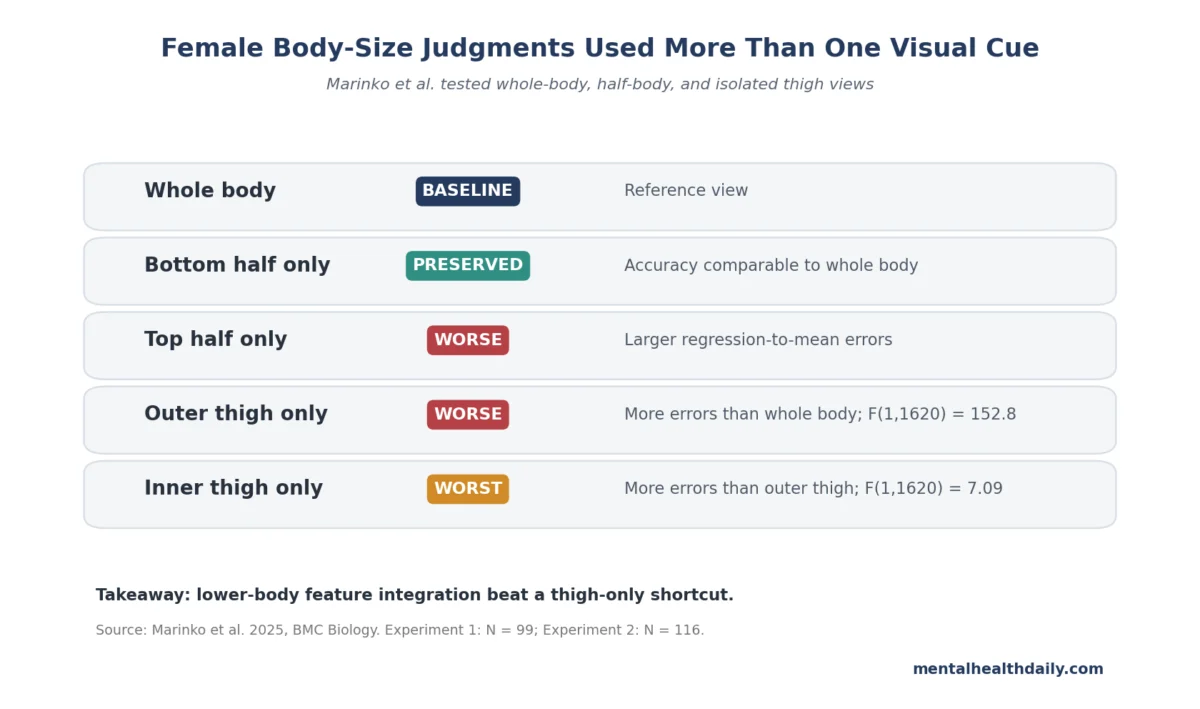
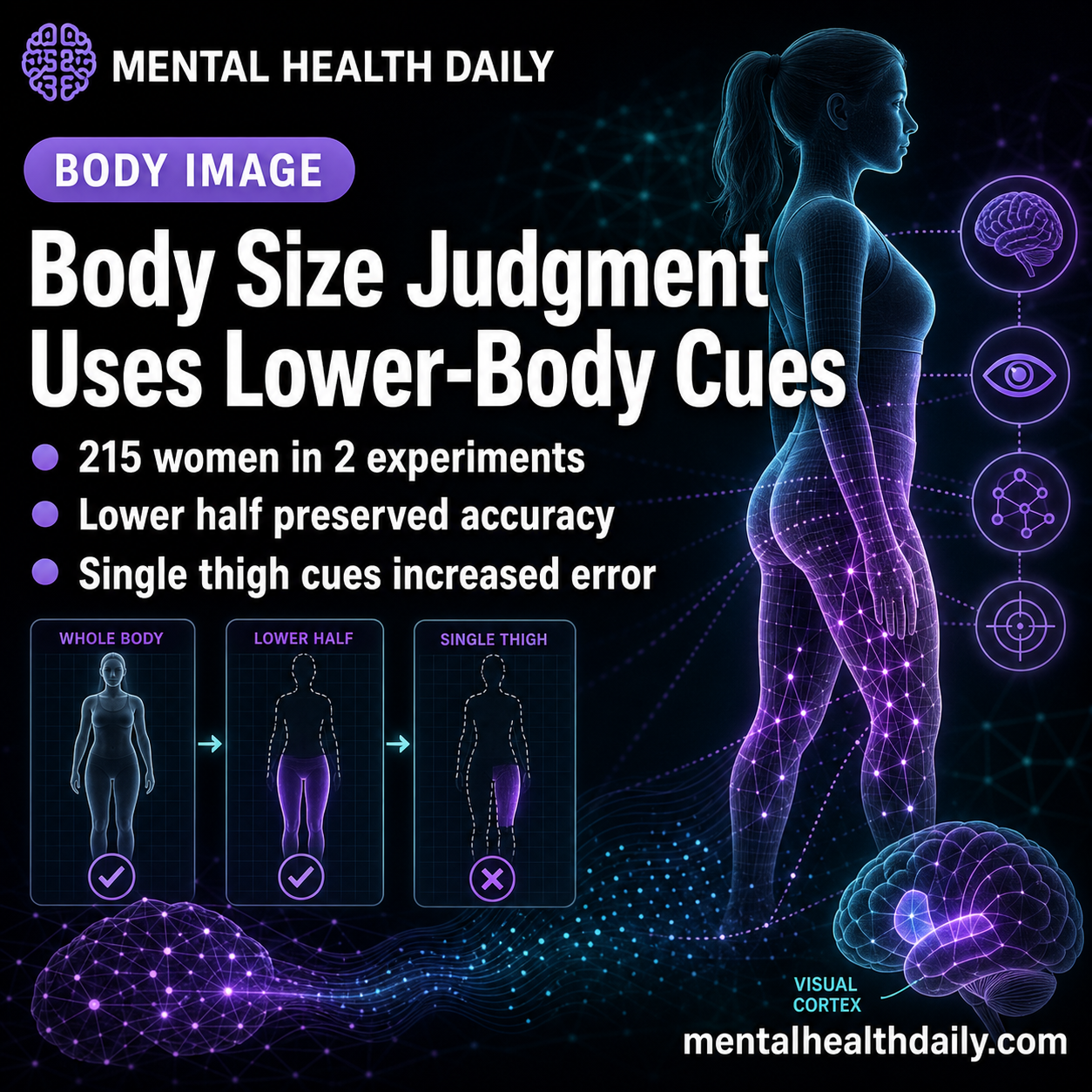
A groundbreaking two-experiment study published in BMC Biology has unveiled that accurate judgments of female body size do not necessitate a full-body view, finding that bottom-half views preserved accuracy in 99 women, while isolated inner- or outer-thigh views significantly increased perceptual errors compared to whole-body views in a subsequent 116-woman experiment. This pivotal finding holds substantial relevance for body-image research, indicating a complex process of lower-body feature integration rather than reliance on a simple, isolated "thigh-only" shortcut in visual perception. The research underscores the sophisticated mechanisms by which the human visual system processes body dimensions, offering a more nuanced understanding of body-size judgment, a core component of body image and its disturbances.
The Intricacies of Body-Size Judgment and Body Image Disturbance
Body-size judgment refers to the cognitive process of estimating a body’s dimensions based solely on visual information. In the broader landscape of body-image research, this perceptual aspect is intrinsically linked to a spectrum of psychological phenomena, including body dissatisfaction, obsessive body checking, active avoidance behaviors, and fear-driven interpretations of one’s own physical shape. These elements collectively contribute to body-image disturbance, a clinically significant feature often observed in individuals grappling with eating disorders such as anorexia nervosa and bulimia nervosa, as well as body dysmorphic disorder. Patients frequently exhibit an overestimation or misinterpretation of their body size, highlighting a breakdown in the perceptual system’s ability to accurately gauge visual cues, assign appropriate weight to them, and mitigate biases from recent visual experiences.
Historically, body-image disturbance was often conceptualized as a vague psychological complaint. However, seminal meta-analyses, such as that conducted by Cash and Deagle, have firmly established it as a measurable clinical feature across diverse eating-disorder populations. This shift in understanding paved the way for more granular investigations into the specific mechanisms underlying these disturbances. Recent advancements in measurement have moved beyond general body dissatisfaction, incorporating visual mapping and objective perceptual markers. For instance, studies by Ralph-Nearman et al. utilizing digital body-image mapping in anorexia nervosa patients have demonstrated that visual disturbance measures correlate directly with illness severity, emphasizing the tangible and measurable nature of perceptual distortions alongside self-reported feelings. The Marinko et al. study significantly contributes to this evolving understanding by dissecting the visual cues essential for accurate body-size perception.
Deconstructing the Perception of Body Size: The Bodyline Task
To meticulously investigate how individuals perceive body size, Marinko etinko et al. employed a specialized tool known as the "bodyline task." This visual-perception task requires participants to view a series of standardized body images and precisely indicate where each body falls on a predefined size scale. The utility of the bodyline task lies in its capacity to disentangle a person’s average judgment from two more specific error patterns: systematic biases (such as over- or underestimation) and the variability or precision of their judgments. This methodological rigor allows researchers to pinpoint not just if errors occur, but how they manifest, providing deeper insights into the underlying perceptual mechanisms.
The research comprised two distinct experiments, each designed to progressively narrow the focus on specific visual cues.
Experiment 1: The Efficacy of Partial Views
The initial experiment sought to determine whether a complete view of the body was indispensable for accurate size judgment, or if partial views could suffice. After an initial screening process that excluded five participants who demonstrated unreliable discrimination of body-size categories, the analysis proceeded with 99 adult women. These participants were tasked with judging body images under three distinct viewing conditions: whole-body, top-half only, and bottom-half only. The images spanned seven different body-size categories, ensuring a broad representation of human forms.
The results from Experiment 1 were compelling. Participants consistently and clearly distinguished between the different size categories, as evidenced by a highly significant main effect (F(2.48, 242.83) = 2164.72, p < 0.001). While the main effect of the view condition itself did not reach statistical significance (F(2, 196) = 2.74, p = 0.067), a crucial interaction between body size and view condition was observed (F(7.28, 713.32) = 37.99, p < 0.001). This interaction indicated that the impact of the viewing condition varied depending on the specific body size being judged.
Practically, the pattern was remarkably direct and insightful. Bottom-half-only views yielded judgment accuracy that was statistically comparable to that achieved with whole-body views. This suggests that the lower half of the body provides sufficient information for the visual system to construct an accurate representation of overall body size. In stark contrast, top-half-only views consistently produced larger "regression-to-the-mean" errors. This particular type of error indicates a tendency to judge extreme body sizes (very thin or very large) as closer to the average, implying a loss of critical discriminatory information when only the upper body is visible.
Experiment 2: Isolated Thigh Cues and Perceptual Distortion
Building upon the findings of Experiment 1, the researchers in Experiment 2 posed a more refined question: if the lower half of the body contains enough information for accurate judgment, could a single, isolated region within the lower body carry this information independently? To address this, 116 women participated in a comparison between whole-body viewing and viewing conditions where only isolated inner-thigh or outer-thigh regions were visible.
The unequivocal answer was no. Both isolated thigh-region conditions resulted in demonstrably worse body-size judgments compared to whole-body viewing. For regression-to-the-mean error, the outer-thigh comparison indicated a model with a shallower slope and significantly greater error (F(1, 1620) = 152.8, p < 0.001). Similarly, the inner-thigh comparison also demonstrated poorer performance than whole-body viewing (F(1, 1620) = 262, p < 0.001). This robust statistical evidence underscores that stripping away contextual information, even from a seemingly informative region, severely impairs perceptual accuracy.
Further analysis revealed subtle but significant differences between the isolated thigh views themselves. Inner-thigh-only viewing performed marginally worse than outer-thigh-only viewing in terms of regression-to-the-mean error (F(1, 1620) = 7.09, p = 0.008). Moreover, the phenomenon of "serial dependence bias" broadened considerably when only a single thigh region was visible. Serial dependence refers to the carryover effect from a previously viewed stimulus, where the judgment of a current stimulus is subtly biased by the characteristics of the one just seen. The estimated serial-dependence amplitude was recorded as A = 0.43 for whole-body viewing, increasing to A = 0.47 for outer-thigh viewing, and further to A = 0.64 for inner-thigh viewing. This increase in amplitude indicates that judgments became more susceptible to the influence of preceding images when visual information was severely limited, suggesting a weakened ability of the visual system to anchor judgments in objective reality.
The Concept of Lower-Body Feature Integration
The central finding emanating from these experiments is the concept of "lower-body feature integration." This means that the human perceptual system appears to actively combine multiple visible cues from the lower body to form an accurate estimate of size, rather than relying on a singular anatomical patch. While a bottom-half view provides a sufficient constellation of information—likely including cues related to overall width, proportion, and specific curvatures—reducing that view to only one isolated thigh region removes critical contextual data that the visual system typically utilizes. This suggests that the brain processes various visual features holistically from the lower body to construct a comprehensive size judgment, rather than singling out one "key" area.
Why This Study Resonates with Body-Image Research
This research by Marinko et al. contributes significantly to the ongoing dialogue in body-image research, not by offering a direct clinical diagnostic tool, but by sharpening our understanding of the fundamental perceptual processes at play. While the study’s participants were not drawn from a clinical eating-disorder sample, and the task involved judging images of other female bodies rather than one’s own, its implications are profound.
The findings challenge simplistic models of body-image perception, particularly those that might assume a global body outline or a single focal point captures the entirety of the perceptual problem. If body-size perception genuinely depends on the integration of multiple lower-body cues, then current and future clinical body-image measures must evolve to reflect this complexity. They should aim to assess not just overall body dissatisfaction, but also the specific visual cues individuals prioritize, how these cues are weighted, and how they are integrated (or misintegrated) in their perception.
This aligns with a growing body of work that seeks to move beyond self-report measures alone. The study does not assert that specific lower-body cue weighting causes eating disorders. Instead, it provides a mechanistic insight: if the perceptual system relies on integrated lower-body cues for accurate size judgment, then disruptions or alterations in this integration process could be a contributing factor to the distorted body perceptions characteristic of conditions like anorexia nervosa.
Prior Studies Paving the Way for Feature Integration
The concept of feature integration in body-size perception is not entirely novel; it builds upon prior research that has increasingly pointed towards the complexity of visual processing. For instance, Irvine et al. utilized eye-tracking technology and a visual masking approach to investigate which cues drive self-assessment of body size. Their crucial insight was that where people visually fixate is not necessarily synonymous with the information their visual system actually employs. Observers might fixate centrally on an image, yet their judgment accuracy could fundamentally depend on peripheral body-edge cues that define overall width and shape.
Further reinforcing this perspective, a 2024 study also by Marinko et al. explored whether internal body features contributed useful information beyond mere silhouette shape. That research demonstrated that removing internal features significantly increased body-size judgment errors and altered serial-dependence patterns, strongly arguing against a simplistic "outline-only" account of body perception.
The current 2025 lower-body study adds a more specific and granular piece to this puzzle. It demonstrates that while full lower-body information can preserve perceptual accuracy, isolated fragments of the lower body cannot. Collectively, this accumulating evidence strongly advocates for a feature-integration model, positing that accurate body-size perception relies on the synergistic processing of multiple visual cues. Consequently, any degradation in accuracy occurs when the visual image is stripped of too much of this essential cue structure.
Dispelling the "Thigh Obsession" Misconception
It is imperative to clarify that this research does not support a simplistic or sensationalized claim that "people judge female body size by looking at thighs" or that "thighs cause body-image problems." Such popular framings oversimplify the nuanced scientific findings. The actual result is far more precise: Experiment 1 showed that comprehensive bottom-half information was sufficient for accurate judgment, but Experiment 2 unequivocally demonstrated that one isolated thigh region was insufficient.
This crucial distinction fundamentally alters the interpretation:
- Evidence Strength: This is a rigorously controlled visual-perception study designed to identify task-specific judgment mechanisms. It is not designed to diagnose body-image disturbance, prove causality in eating disorders, or provide clinicians with direct guidance on which body region to target in treatment. Its power lies in its ability to isolate and measure specific perceptual processes.
- Clinical Caution: Translating these findings directly into eating-disorder care requires extensive further research. Future studies must directly investigate self-body perception in clinical populations, examine the relationship between cue weighting and symptom severity, and assess treatment response. Judging standardized images of other bodies under controlled laboratory conditions is fundamentally different from judging one’s own body under the intense pressures of anxiety, mirror exposure, social comparison, or restrictive-eating behaviors.
The most valuable takeaway from this study is therefore methodological and theoretical. It strongly suggests that body-image research should prioritize the measurement of which specific visual cues individuals utilize and how these cues are integrated into a coherent perception, rather than making assumptions that global dissatisfaction, gaze location, and perceptual accuracy are interchangeable constructs. The weighting of lower-body cues, as identified by this study, may represent one measurable component of this complex, multi-faceted perceptual system. The lower-body signal mattered because it preserved a rich visual structure, not because a single, isolated feature carried the entirety of the judgment.
Future Directions and Broader Impact
This research opens several avenues for future investigation. Researchers could explore whether similar cue integration patterns exist for male body-size judgments, or across different cultural contexts where body ideals may vary. Critically, applying these methodologies to clinical populations with eating disorders or body dysmorphic disorder is essential to determine if their perceptual systems exhibit distinct cue weighting or integration deficits. Such studies could pave the way for more targeted and effective interventions that address the perceptual distortions at the heart of these conditions.
Furthermore, understanding the specific visual characteristics of the lower body (e.g., hip-to-waist ratio, thigh circumference, leg length) that contribute most significantly to size judgment could inform the development of more accurate and sensitive diagnostic tools. For example, therapists utilizing mirror exposure therapy might be able to incorporate insights into specific cue integration to help patients re-learn accurate self-perception.
In a societal context, this study subtly challenges superficial narratives about body image. It moves beyond the idea that societal pressures simply dictate a "focus" on certain body parts, revealing a deeper, more intricate visual processing mechanism. By demonstrating that perception relies on complex integration rather than isolated features, it encourages a more holistic and scientific approach to understanding how we see and evaluate bodies, both our own and others’.
In conclusion, the Marinko et al. study has significantly advanced the perception side of body-image research. It unequivocally demonstrates that female body-size judgment is neither purely holistic nor reducible to a single body part. Instead, accurate perception critically depends on multiple lower-body cues working in concert, underscoring the remarkable sophistication and complexity of the human visual system in processing body dimensions. This finding is a crucial step towards developing more precise and effective strategies for addressing body-image disturbance in clinical and public health contexts.

