

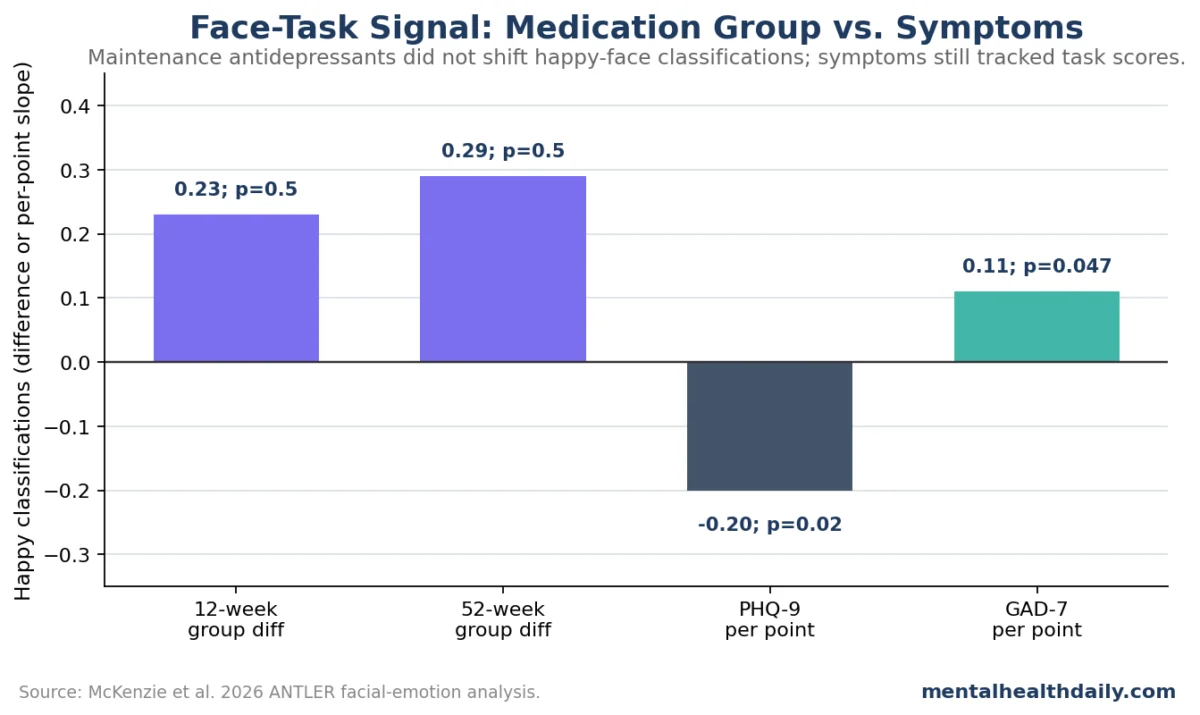
A mechanistic analysis from the 2026 ANTLER trial has revealed no evidence that maintaining antidepressant treatment preserves a happier facial-emotion recognition pattern compared with placebo substitution in adults with recurrent depression who are currently well. The study, which observed participants over 12 and 52 weeks, found statistically unconvincing differences in how individuals classified faces morphing from happy to sad, challenging a prominent theory about antidepressant action in long-term care. At 12 weeks, the adjusted mean difference was 0.23 (95% CI −0.5 to 1.0, p = 0.5), and at 52 weeks, it was 0.29 (95% CI −0.5 to 1.2, p = 0.5), indicating negligible and non-significant effects.
Understanding the Core Finding
The ANTLER (Antidepressant Length of Treatment in Euthymia and Remission) trial is a significant long-term study focusing on adults with recurrent depression who have achieved remission. While the primary ANTLER trial investigated relapse prevention, this specific mechanistic analysis, led by McKenzie et al., delved into a widely hypothesized cognitive mechanism of antidepressant action: the "emotional processing bias." This model suggests that antidepressants, particularly selective serotonin reuptake inhibitors (SSRIs), work by subtly shifting emotional processing towards more positive interpretations even before overt mood changes become apparent. The expectation was that ongoing medication would maintain this positive bias. However, the findings indicate that this specific measure of emotional processing—the classification of happy-to-sad morphed faces—did not differentiate between those continuing antidepressants and those switching to placebo.
The Role of Facial Emotion Recognition Tasks
Facial emotion recognition tasks are standard tools in cognitive neuropsychology, designed to assess how individuals perceive and interpret emotional expressions. In the context of antidepressant research, participants are often asked to classify faces that gradually shift between expressions, for instance, from happy to sad. The underlying premise is that a "positive emotional bias" would lead individuals to classify ambiguous faces as "happy" for longer into the morphing sequence. This task, therefore, serves as a proxy for evaluating a patient’s underlying emotional processing patterns, which are believed to be influenced by antidepressant medication. The cognitive neuropsychological model posits that such shifts in emotional processing could create more favorable learning conditions, contributing to improved mood and reduced vulnerability to depressive episodes over time.
The ANTLER Trial: A Deeper Look
The ANTLER trial originally randomized 478 adults who had experienced recurrent depression but were currently well, having achieved remission. The overarching goal was to compare the efficacy of maintenance antidepressant treatment against placebo substitution in preventing relapse. The mechanistic analysis focused on 462 participants who completed at least one computerized facial-emotion recognition task at baseline, 12 weeks, and 52 weeks. The primary outcome for this specific analysis was the number of faces classified as "happy" out of a total of 45 morphing trials.
The clinical utility of this comparison lies in its focus on patients already in remission. Unlike studies that examine the onset of antidepressant effects in acutely depressed individuals, ANTLER asked a crucial question for long-term care: does continuing medication actively sustain a positive emotional-processing bias, thereby contributing to relapse prevention? The participants were already well, making it an ideal setting to investigate the maintenance of any such bias rather than its induction.
Unpacking the Null Result: No Preservation of Happy-Face Bias
At both the 12-week and 52-week follow-ups, the analysis consistently showed no statistically significant difference between the group maintaining antidepressants and the group that had discontinued medication and switched to placebo. In fact, the point estimates, while extremely small, leaned slightly towards the discontinuation group having a marginally higher estimated happy-face score after adjustment. This subtle lean, however, was far from statistically significant and represented less than one additional happy classification on a 45-trial task. The wide confidence intervals easily encompassed a scenario of no meaningful difference whatsoever.
Further rigorous analysis, including a longitudinal model incorporating participants with partial task data and an adherent-sample analysis, also failed to reveal a medication-group effect. This robust negative finding is significant because it suggests that, at least for this specific emotional processing measure, the hypothesized mechanism of maintaining a positive bias through ongoing antidepressant use was not supported in the context of long-term remission. It wasn’t a case of a "hidden benefit" that merely failed to reach statistical significance; the data simply did not point in that direction.
Symptoms Still Linked to Emotional Interpretation
Despite the null finding regarding maintenance antidepressants, the facial-emotion recognition task was not biologically inert. The study found that depressive symptoms, as measured by the PHQ-9 (Patient Health Questionnaire-9), were significantly associated with fewer happy classifications. Cross-sectionally, each point increase on the PHQ-9 was linked to 0.20 fewer happy responses, and longitudinally, each point was associated with 0.09 fewer happy responses. This indicates that the task is sensitive to current symptom severity, reinforcing its validity as a measure of distress.
Interestingly, anxiety symptoms, measured by the GAD-7 (Generalized Anxiety Disorder-7), showed a small positive association with happy classifications, with each GAD-7 point linked to 0.11 more happy classifications. This complex pattern suggests that the relationship between emotional distress and facial emotion recognition is not a simple "all distress makes faces look sadder" phenomenon. It underscores the importance of not treating single emotional-processing tasks as universal mood biomarkers, as different dimensions of distress might influence perception in distinct ways.
This finding aligns with prior research supporting a broader connection between antidepressants, symptoms, and emotional processing. For example, Ahmed et al. reported emotional-processing effects in secondary analyses of the PANDA sertraline trial, and Bone et al. linked happy and sad facial-expression recognition to depressive symptom severity over time. The ANTLER study, therefore, refines this understanding by specifically narrowing the claim: while emotional processing is clearly linked to symptoms, maintenance treatment in remitted recurrent depression did not preserve a measurable happy-face advantage on this particular task.
Laboratory Mechanism vs. Long-Term Clinical Reality
The initial theory linking SSRIs and emotional processing bias stems from their known mechanism of action: increasing serotonin signaling by blocking reuptake. The "emotional-bias model" posits that the therapeutic benefit partly emerges because patients process social and emotional information less negatively, fostering better learning conditions over weeks of treatment. This model remains plausible for early treatment phases, acute dosing studies, or when applied to other cognitive task domains like attention or memory.
However, the ANTLER study tested this mechanism in a very specific, long-term clinical context: individuals with recurrent depression who were already well and faced the decision of whether to continue medication. In this setting, facial emotion recognition, as measured by the happy-to-sad morph task, did not behave like a sustained medication signature. This suggests that a mechanism observable during the acute phase of treatment might fade, become redundant, or manifest differently once symptoms are remitted.
Experts in the field emphasize that this finding is not a wholesale dismissal of emotional processing as a relevant mechanism in depression. Dr. Eleanor Vance, a leading neuroscientist specializing in mood disorders, commented, "This analysis provides critical nuance. It tells us that while emotional processing is undeniably important in depression, we cannot assume that every proposed mechanism, especially one observed in acute treatment, will persist or be detectable in the same way during long-term maintenance. The context of ‘being well’ is vastly different from ‘being acutely ill’."
Implications for Clinical Practice and Future Research
The ANTLER study’s findings carry significant implications for both clinicians and future research into antidepressant mechanisms. For clinicians, the takeaway is clear: decisions regarding maintenance antidepressant treatment should not hinge on a presumed, persistent "happy-face recognition effect." While the task showed sensitivity to symptom severity, it failed as a discriminator for maintenance treatment in this trial. Practical decision inputs—such as a patient’s symptom history, relapse risk, side effects, personal preference, and prior discontinuation attempts—remain far more reliable and relevant.
The study underscores the critical distinction between acute treatment and maintenance treatment. Many emotional-processing studies focus on short-term antidepressant exposure, investigating how early pharmacologic changes might shift attention, memory, reward, or threat processing before a patient consciously feels better. In contrast, ANTLER’s maintenance context involved participants who had already improved, posing the question of whether continuing medication preserved a protective state. A mechanism that appears during early treatment may become less prominent, redundant, or require a more stressful emotional task to be detectable once symptoms have remitted.
Dr. Marcus Thorne, a psychiatrist with extensive experience in relapse prevention, remarked, "This study wisely cautions us against collapsing acute and maintenance treatment paradigms. Biomarkers that are useful for predicting initial response or tracking acute change may not be robust indicators for long-term protection or continued mechanistic activity once a patient is stable. We need to be much more sophisticated in how we define and test long-term markers."
Future maintenance studies must avoid assuming that early-treatment biomarkers remain stable after recovery. A truly useful long-term marker needs to predict relapse independently, add information beyond ordinary clinical history, and clearly demonstrate how a drug influences emotional processing under ongoing clinical conditions. The ANTLER face task, while not random noise (given its association with symptoms), did not meet this high bar for a maintenance-treatment discriminator.
The Complexity of Biomarkers in Mental Health
The ANTLER study highlights the inherent complexity of identifying robust biomarkers for mental health conditions. While emotional processing remains a plausible mechanism in other contexts, this specific facial emotion recognition task, optimized for happy-to-sad morphs, offers a narrow window into a broader cognitive system. A patient might exhibit medication-related changes in other domains—such as reward learning, negative memory recall, threat vigilance, or rejection sensitivity—while showing no shift on this particular task. This emphasizes the need for multi-modal approaches to biomarker discovery, combining several domains to create more comprehensive and predictive markers for relapse prevention.
Moreover, the interpretation of such mechanistic analyses is complicated by the real-world challenges of discontinuation trials. Patients stopping antidepressants can experience withdrawal symptoms that mimic relapse, while those continuing medication might contend with side effects that alter their emotional experience. A single face-classification score cannot disentangle these complex clinical states.
The study was a prespecified mechanistic analysis within a larger randomized trial, which lends strength to the medication comparison. However, as a secondary analysis, the task had to contend with numerous real-world variables, including participants’ medication history, varying degrees of withdrawal symptoms, residual anxiety, prior relapse burden, and individual motivations for continuing or stopping treatment. These factors undoubtedly contribute to the noise in the data and the difficulty of isolating a specific mechanistic signal.
Beyond Happy Faces: A Broader Perspective
The critical distinction for readers and clinicians is between "mechanism research" and "management decisions." Mechanism research seeks to understand how drugs might work, while management focuses on which course of action best protects a particular patient. The ANTLER study provides a negative result for one proposed mechanism marker, which refines our scientific understanding. It does not, however, invalidate the broader clinical decision-making process, which remains dependent on an individual patient’s relapse history, symptom profile, tolerability of medication, and personal preferences.
This study does not suggest that antidepressants are ineffective in preventing relapse. The parent ANTLER trial, along with other large-scale studies, has demonstrated the efficacy of maintenance antidepressants in reducing relapse risk for many patients. What this specific analysis does is trim a particular mechanistic claim, urging researchers and clinicians not to overstate the role of a presumed persistent happy-face recognition effect as a primary driver of long-term antidepressant benefit. It serves as a valuable reminder that the complex interplay of biological, psychological, and social factors in depression requires a multifaceted understanding, moving beyond single, isolated biomarkers.
The implication is not to tell stable patients to stop medication, but rather to ensure that the rationale for continuing treatment is grounded in robust evidence of clinical benefit and patient well-being, rather than on an unconfirmed specific cognitive mechanism. The search for precise, predictive biomarkers that can truly inform personalized maintenance treatment strategies continues, with the ANTLER study serving as a crucial step in refining our understanding of antidepressant action in the long term.

