

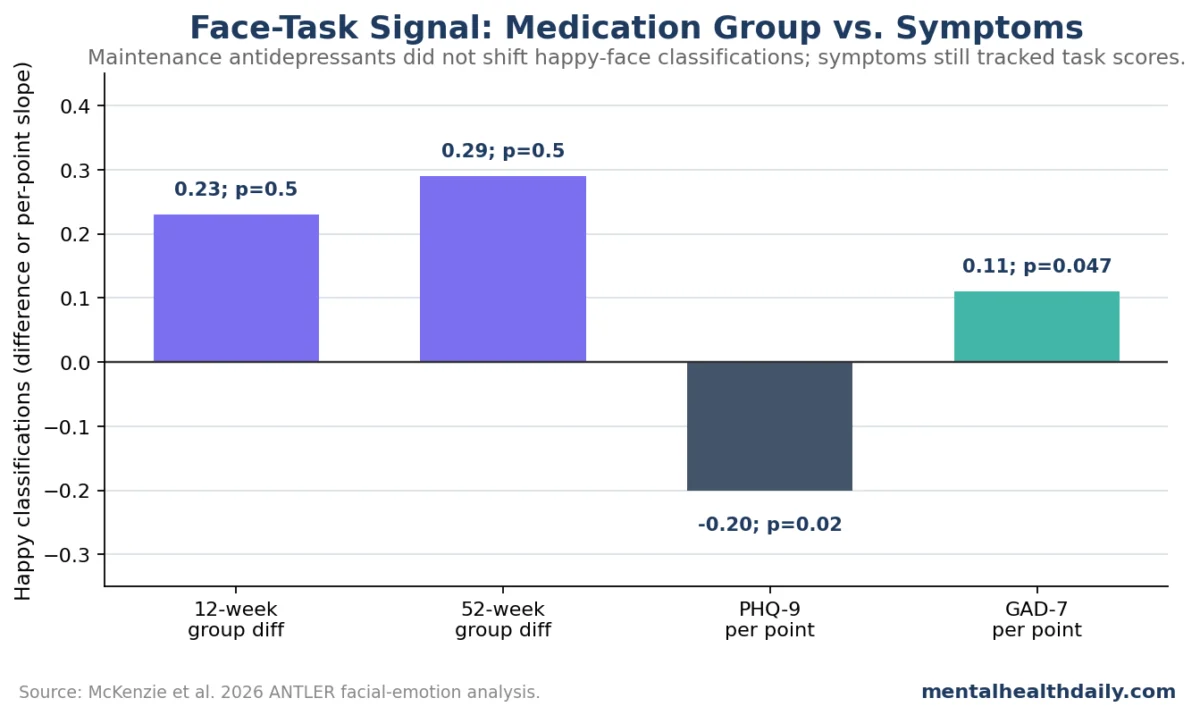
A comprehensive mechanistic analysis from the 2026 ANTLER study has concluded that maintaining antidepressant treatment does not preserve a more positive facial-emotion recognition pattern in individuals with recurrent depression compared to placebo substitution. The study, which followed participants for 12 and 52 weeks, found no statistically significant evidence to support the hypothesis that ongoing medication sustains a "happier" emotional processing bias, a finding that refines our understanding of antidepressant mechanisms in long-term care.
The adjusted mean difference in happy-face classification scores between the maintenance antidepressant group and the placebo substitution group was a negligible 0.23 (95% CI −0.5 to 1.0, p = 0.5) at 12 weeks, and 0.29 (95% CI −0.5 to 1.2, p = 0.5) at 52 weeks. These confidence intervals, which comfortably encompass zero, indicate that any observed differences were minimal and statistically indistinguishable from no effect. This outcome challenges a widely discussed cognitive neuropsychological model of antidepressant action, which posits that medication can subtly shift emotional processing towards more positive interpretations even before overt mood changes become apparent.
The Context: Recurrent Depression and the Emotional-Bias Hypothesis
Recurrent depressive disorder affects millions globally, often requiring long-term treatment strategies to prevent relapse. Antidepressants, particularly selective serotonin reuptake inhibitors (SSRIs), are a cornerstone of both acute and maintenance therapy. Beyond their direct mood-elevating effects, researchers have long explored the underlying mechanisms by which these medications exert their therapeutic benefits. One prominent theory, the emotional-bias model, suggests that SSRIs, by increasing serotonin signaling in the brain, modulate emotional processing at a fundamental level. This modulation is thought to lead to a bias towards interpreting ambiguous or neutral stimuli more positively, or reducing the salience of negative stimuli. This shift in cognitive bias, proponents argue, could create a more conducive environment for psychological recovery and resilience, thereby contributing to sustained mood stability.
Early research supporting this model often involved acute dosing studies or focused on individuals initiating antidepressant treatment. These studies frequently reported that within days or weeks of starting medication, participants exhibited changes in how they processed emotional information, such as enhanced recognition of happy faces, reduced recognition of sad faces, or altered responses to emotionally charged words. These findings led to the hypothesis that this "positive emotional bias" might be a key mechanism by which antidepressants prevent relapse in the long term, acting as a persistent protective factor. The ANTLER mechanistic analysis aimed to test this specific aspect within a long-term clinical context, focusing on individuals who were already well following a depressive episode.
Study Design: Unpacking the ANTLER Mechanistic Analysis
The ANTLER (Antidepressants to Lessen Recurrence of Depression) trial was a large-scale, randomized controlled trial designed to assess the efficacy of maintenance antidepressant treatment versus placebo substitution in adults with recurrent depression who were currently in remission. The mechanistic analysis, a prespecified secondary endpoint of the larger trial, specifically investigated the role of facial emotion recognition.
Participants in the ANTLER trial were adults with a history of recurrent depression who had achieved a stable state of wellness. This specific population is crucial to the study’s implications, as they were not individuals just beginning treatment but rather those considering the continuation or discontinuation of medication. This allowed researchers to probe whether ongoing medication maintained a positive emotional-processing bias, rather than merely initiating one.
The facial emotion recognition task employed in the study involved participants classifying faces that morphed between expressions, specifically from happy to sad. Participants were presented with a series of 45 such morphing faces, and their primary task was to classify each as either happy or sad. The key outcome measure for this analysis was the total number of faces classified as happy. The study assessed these recognition patterns at baseline, 12 weeks, and 52 weeks, providing a longitudinal perspective on the potential effects of maintenance treatment.
A total of 478 adults with recurrent depression were originally randomized in the parent ANTLER trial. For the facial-emotion recognition analysis, 462 participants completed at least one computerized task, ensuring a robust dataset for evaluation. The trial’s design, comparing active antidepressant maintenance with a placebo substitution group, offered a high level of rigor, minimizing confounding variables and allowing for direct comparisons of mechanistic effects.
The Null Finding: Maintenance Antidepressants and Happy-Face Bias
Contrary to expectations derived from the emotional-bias model, the ANTLER mechanistic analysis found no evidence that maintenance antidepressant treatment preserved a happier facial-emotion recognition pattern. At both the 12-week and 52-week follow-ups, the group that had transitioned to placebo substitution actually showed a slightly higher estimated happy-face score than the group continuing antidepressants, after statistical adjustment for confounding factors. However, these differences were exceedingly small, amounting to less than one happy classification out of 45 trials, and were far from statistical significance. The confidence intervals around these point estimates consistently included zero, indicating that the observed differences could plausibly be due to random chance.
This specific direction of the (non-significant) finding is noteworthy. It suggests that the result was not merely a failure to detect a subtle benefit for maintenance antidepressants. Instead, the point estimates leaned, however minimally, in the opposite direction, undermining the idea of a hidden positive effect that simply didn’t reach statistical significance. Further analyses, including a longitudinal model that incorporated participants with partial task data and an adherent-sample analysis focusing on those who consistently followed their assigned treatment, consistently yielded the same practical answer: there was no discernible medication-group effect on happy-face recognition. This robustness across different analytical approaches strengthens the credibility of the null finding for this specific mechanism.
Symptoms Still Linked to Emotional Interpretation: A Nuanced Picture
While maintenance antidepressants did not appear to sustain a positive emotional processing bias, the facial emotion recognition task itself was not biologically inert. The study found that depressive symptoms were indeed associated with fewer happy classifications, suggesting the task retains some clinical relevance as a symptom-linked measure. Cross-sectionally, each point increase on the PHQ-9 (Patient Health Questionnaire-9), a common measure of depressive symptom severity, was linked to 0.20 fewer happy responses. Longitudinally, this association persisted, with each PHQ-9 point corresponding to 0.09 fewer happy responses over time. This indicates that even in a remitted state, fluctuations in depressive symptoms can still influence how individuals interpret emotional cues.
Interestingly, anxiety symptoms, measured by the GAD-7 (Generalized Anxiety Disorder-7) scale, showed a small positive association with happy-face classifications, with each GAD-7 point linked to 0.11 more happy classifications. This complex pattern underscores that emotional processing is not a simple "all distress makes faces look sadder" phenomenon. Different dimensions of distress (depression vs. anxiety) may exert distinct, and sometimes counterintuitive, influences on emotional interpretation. This complexity reinforces the caution against treating any single emotional-processing task as a universal or definitive mood biomarker.

The ANTLER findings, therefore, do not negate prior research that has established broader connections between antidepressants, symptoms, and emotional processing. For instance, Ahmed et al. (2018) reported emotional-processing effects in secondary analyses of the PANDA sertraline trial, while Bone et al. (2016) linked happy and sad facial-expression recognition to depressive symptom severity over time. What ANTLER does, crucially, is narrow the claim: it demonstrates that in the specific context of maintenance treatment for remitted recurrent depression, ongoing medication did not preserve a measurable happy-face advantage using this particular task.
Revisiting the Emotional-Bias Model for Maintenance Care
The emotional-bias model, which suggests that SSRIs improve mood by altering how individuals process social and emotional information, remains a plausible explanation for the early effects of antidepressant treatment. The idea is that by blocking serotonin reuptake and increasing serotonin signaling, SSRIs can create better learning conditions over weeks by reducing negative biases. This model has considerable support from acute dosing studies where participants show rapid shifts in emotional processing shortly after starting medication, often before mood changes are consciously perceived.
However, the ANTLER study tested a distinctly different setting: individuals with recurrent depression who were already well and faced with the decision of whether to continue their medication. In this specific scenario, facial emotion recognition did not behave like a sustained medication signature. This suggests that a mechanism that might be active during the initial stages of treatment, helping to initiate recovery, may not necessarily persist or be detectable in the same way once a patient is in a stable, remitted state. The brain’s adaptive processes, the establishment of new coping mechanisms, or the "normalization" of neural circuits could mean that the initial, medication-driven emotional bias becomes less crucial or simply undetectable after prolonged wellness.
It is also important to acknowledge the limitations inherent in studying such complex mechanisms. This was a prespecified mechanistic analysis within a randomized trial, making the medication comparison strong. However, relying on a single face task provides a narrow window into a broader and highly complex cognitive system. It cannot definitively prove that all antidepressant mechanisms are unrelated to emotional processing, nor can it rule out effects on other emotional processing domains (e.g., reward learning, negative memory recall, threat vigilance, rejection sensitivity) that might not be captured by a happy-to-sad morph task.
Implications for Clinical Practice and Future Research
The ANTLER study’s findings offer valuable insights for both clinical practice and future research directions in depression management.
Clinical Implications:
For clinicians, the most salient takeaway is that decisions regarding maintenance antidepressant treatment should not hinge on a presumed, persistent happy-face recognition effect. The measured task did not differentiate between maintenance and discontinuation over 52 weeks. Instead, clinical decision-making must continue to be guided by a comprehensive assessment of factors such as the patient’s history of relapse, the severity and frequency of previous depressive episodes, the presence of residual symptoms, the patient’s experience with side effects, their personal preference, and their ability to cope with potential withdrawal symptoms or a return of symptoms if medication is stopped. The clinical question in maintenance care is fundamentally about preventing relapse, preserving overall functioning, managing anxiety, ensuring healthy sleep patterns, avoiding withdrawal symptoms, and supporting the patient’s capacity to recover should symptoms recur – none of which are adequately captured by happy-face counts alone.
Research Implications:
The study highlights the critical need for researchers to differentiate between acute treatment effects and maintenance treatment mechanisms. Biomarkers and mechanisms that are relevant and detectable during the initial phases of antidepressant treatment may not remain stable or relevant after recovery. Future maintenance studies should actively seek new, long-term markers that are specifically tailored to predict relapse and elucidate how medications modulate emotional and cognitive processing under conditions of sustained wellness.
Furthermore, the sensitivity of the task itself is a key consideration. The ANTLER face task, optimized for one specific social-emotional judgment (happy-to-sad morphs), might not be sensitive enough to capture other, potentially medication-related, changes in emotional processing. Future research could explore a broader range of tasks that assess reward learning, negative memory recall, threat vigilance, or rejection sensitivity, as these domains might reveal different or more persistent effects of maintenance medication.
The study also implicitly underscores the challenge of disentangling withdrawal symptoms from actual relapse, and the impact of side effects, both of which can influence emotional experience and task performance. A single face-classification score cannot by itself separate these complex clinical states.
Beyond the Happy Face: A Broader Perspective
The ANTLER face-task result weakens one proposed mechanistic explanation for maintenance antidepressant efficacy. However, it does not erase the possibility that antidepressants prevent relapse through other pathways. These could include sleep stabilization, anxiety reduction, changes in rumination patterns, the avoidance of withdrawal symptoms, or other yet-to-be-fully-understood neurobiological adaptations. The ongoing evolution of depression treatment emphasizes personalized medicine, often combining pharmacological, psychological, and lifestyle interventions tailored to individual patient needs.
Ultimately, the distinction between "mechanism research" (how drugs might work) and "management" (which course protects a particular patient) is crucial. ANTLER provides a negative result for a specific mechanistic marker, refining our theoretical understanding. It does not, however, dictate that stable patients should stop their medication. The broader management decision remains dependent on an individual’s relapse history, personal circumstances, and the careful weighing of patient-specific tradeoffs.
This study serves as a valuable reminder that while emotional processing remains a plausible mechanism in other contexts of depression treatment, the "biomarker bar" for a truly useful long-term marker is high. Such a marker would need to not only change with treatment but also predict relapse before symptoms return and add substantive information beyond ordinary clinical history. The ANTLER face-task data, while informative, did not reach that bar.
In conclusion, the ANTLER mechanistic analysis provides a significant refinement to our understanding of antidepressant action in maintenance therapy. It suggests that while antidepressants are effective in preventing relapse, the mechanism does not appear to involve the sustained preservation of a positive facial-emotion recognition bias. This finding encourages a more nuanced approach to both research into antidepressant mechanisms and the clinical decision-making process for individuals managing recurrent depression.

