

Kerman, Iran – A groundbreaking randomized controlled trial conducted in 2026 at Shahid Bahonar Hospital in Kerman, Iran, has demonstrated that both virtual reality (VR) headsets and a simple hand massage administered by a companion effectively eased pain and anxiety during emergency room suturing procedures. The study, involving 87 adult patients, found these non-pharmacological interventions to be significantly more effective than usual care alone, offering promising new avenues for improving patient experience in acute medical settings. The findings underscore the potential of accessible, drug-free methods to enhance comfort and alleviate distress during common, yet often anxiety-inducing, medical procedures.
The Pervasive Challenge of Lacerations in Emergency Departments
Lacerations, commonly known as cuts requiring stitches, represent one of the most frequent reasons individuals seek care in emergency departments worldwide. While local anesthetics like lidocaine are routinely administered to numb the wound area, the experience of receiving stitches can remain profoundly uncomfortable and distressing for many patients. The procedure itself often involves the visual presence of needles, the tactile sensation of tugging, and the inherently bright, busy, and sometimes intimidating environment of an emergency room. Consequently, it is common for patients to arrive at the emergency department already tense, with anxiety levels often escalating before the first stitch is even placed.
This dual burden of pain and anxiety is particularly problematic because these two sensations are intricately linked in a bidirectional relationship. Fear can amplify the perception of pain, making physical discomfort feel sharper and more intense. Conversely, escalating pain levels can exacerbate feelings of fear and apprehension. This feedback loop not only diminishes the patient’s immediate comfort but can also complicate the medical procedure and potentially lead to negative long-term associations with healthcare experiences. Recognizing this interconnectedness, researchers globally have increasingly focused on developing and testing low-cost, drug-free supplementary interventions designed to target the overall procedural experience rather than solely the wound itself. The goal is to break this cycle of pain and anxiety, making emergency care more humane and effective.
Pioneering the Kerman ER Trial: A Three-Pronged Approach
The Iranian trial, spearheaded by Tooba Khajehhasani-Rabori and her team, was meticulously designed to compare the efficacy of VR, companion-administered therapeutic touch, and standard care in mitigating pain and anxiety during suturing. Conducted in the minor procedure room of the emergency department at Shahid Bahonar Hospital, the study included adult patients presenting with cuts requiring stitches, provided the laceration was at least 2 cm in length. Strict exclusion criteria were applied to ensure the homogeneity of the study population and the reliability of results, disqualifying individuals with head or face wounds, those who had recently taken pain or anxiety medication, or patients with serious psychiatric illnesses.
Every participant in the trial received the identical standard of care, which is crucial for isolating the effects of the additional interventions. This standard care package included thorough wound cleaning, the injection of lidocaine for local anesthesia to numb the skin, and the precise application of stitches, all performed by the same experienced emergency physician. Furthermore, a consistent element across all groups was the presence of one companion accompanying each patient, acknowledging the inherent psychological support that a familiar presence can offer. Beyond this universal baseline, patients were then randomly assigned to one of three distinct groups:
- Usual Care Group: These patients received the standard care package as described, with their companion present but without any specific additional intervention or instruction for the companion. This group served as the control to establish the baseline efficacy of current practice.
- Virtual Reality (VR) Headset Group: In addition to standard care, patients in this group wore a VR headset throughout the suturing procedure. The VR content was designed to provide an immersive, distracting experience, aiming to divert the patient’s attention from the medical procedure.
- Companion Therapeutic Touch Group: Patients in this group received standard care, complemented by a structured hand massage delivered by their accompanying companion. This intervention was termed "therapeutic touch" within the study, though it’s important to clarify that, in this context, it referred to a simple, structured physical massage rather than the energy-healing practice sometimes associated with the term in nursing.
To ensure consistency in the therapeutic touch intervention, companions in this group underwent a brief but effective training protocol. This involved watching a concise 3-minute instructional video that demonstrated the massage technique. Following the video, companions practiced the technique under the supervision of a researcher, who provided feedback to ensure proper execution. The hand massage itself was structured into three stages: initial gentle stroking, followed by a period of sustained gentle pressure, and concluding with another phase of gentle stroking. This structured approach aimed to maximize the potential benefits of physical touch and familiar comfort.
The theoretical underpinnings of these interventions are distinct yet complementary. VR operates primarily on the principle of distraction. By providing a full field of immersive sight and sound, a VR headset effectively pulls the patient’s attention away from the immediate environment and the procedural stimuli, leaving less cognitive capacity to focus on the needle, the tugging, or the discomfort. Therapeutic touch, on the other hand, is believed to work through a combination of physiological and psychological mechanisms. Physiologically, gentle pressure signals transmitted from the skin can interact with and potentially dampen pain signals traveling through the spinal cord, a concept rooted in gate control theory of pain. Psychologically, the physical presence and comforting touch of a familiar person can evoke feelings of safety, reassurance, and emotional support, which are powerful anxiety reducers.
The primary outcomes measured in the trial were pain intensity and state anxiety. Pain was assessed using a 0-10 visual analog scale (VAS), a widely accepted and validated tool where patients rate their pain level from "no pain" (0) to "worst possible pain" (10). State anxiety, which refers to how anxious someone feels at a specific moment, was measured using the State-Trait Anxiety Inventory (STAI), scored on a scale of 20-80. Both measures were taken at two critical junctures: five minutes before the administration of the numbing shot and again within two minutes after the last stitch was completed. The change in pain score was designated as the main outcome, providing a direct metric of the intervention’s effectiveness.
Decisive Results: VR and Companion Touch Outperform Usual Care
The findings of the Kerman trial were compelling, clearly demonstrating the superior efficacy of both VR and companion-administered therapeutic touch over standard care in reducing both pain and anxiety during emergency suturing. While pain and anxiety levels naturally decreased across all three groups as the procedure concluded, the reduction was markedly greater in the groups receiving either of the supplementary interventions.
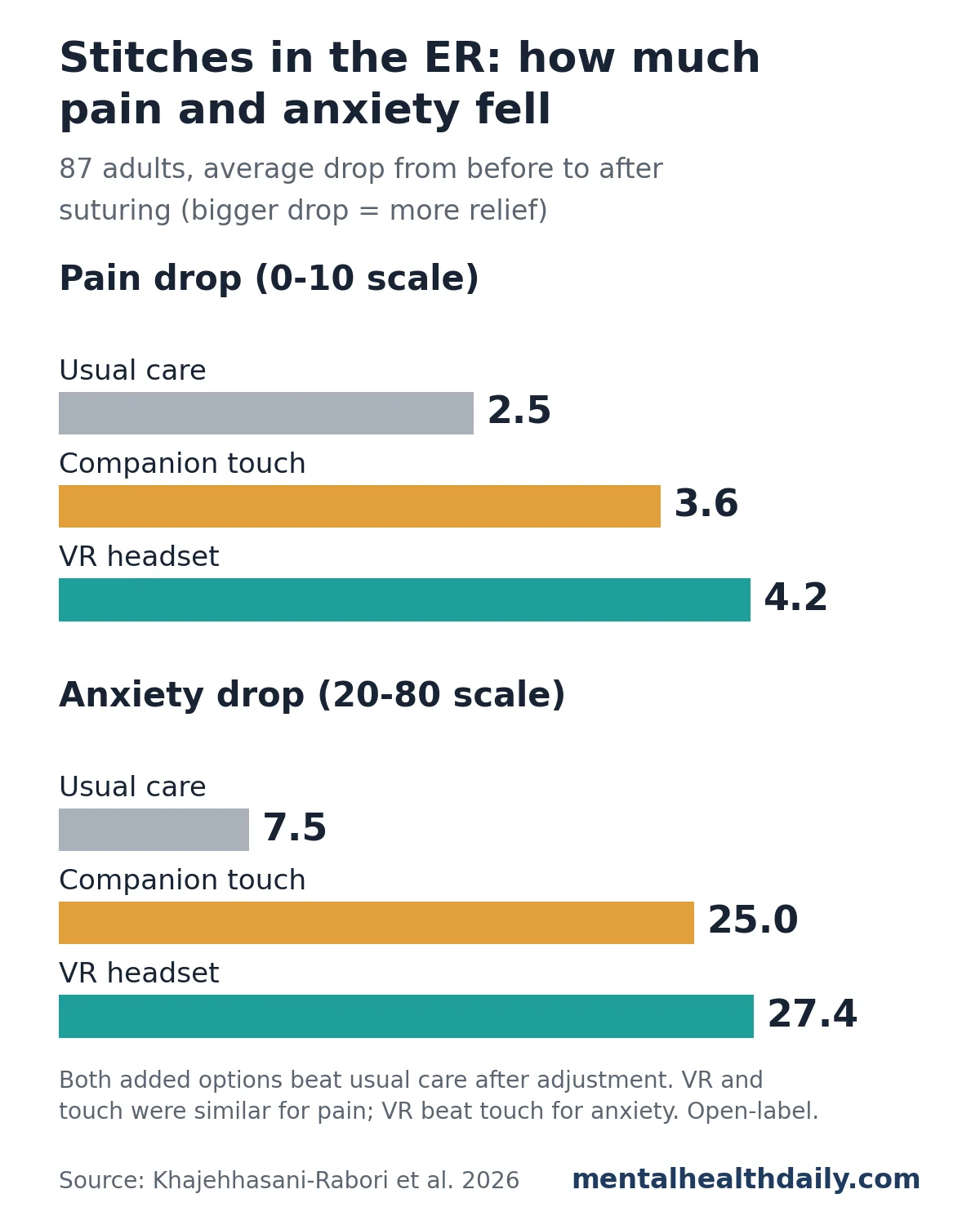
Specifically, the average pain drop on the 0-10 VAS scale was 2.5 points for patients in the usual care group. In stark contrast, patients receiving a companion’s hand massage experienced an average pain reduction of 3.6 points, and those wearing a VR headset reported an average pain drop of 4.2 points. This translates to a 44% greater pain reduction with hand massage and a 68% greater reduction with VR compared to usual care.
The impact on anxiety was even more pronounced. On the 20-80 STAI scale, the usual care group saw an average anxiety drop of 7.5 points. However, patients in the companion touch group experienced a substantial average anxiety reduction of 25.0 points, while those using VR reported an impressive 27.4-point drop. This means anxiety was reduced by over three times as much with either intervention compared to usual care.
To ensure the robustness of these results, researchers carefully accounted for potential confounding factors. It was noted that the usual care group had an older average age (36 years vs. 28-30 years in the other groups) and began the trial with somewhat lower baseline anxiety scores. To address these imbalances, the researchers employed a sophisticated rank-based adjusted analysis (Quade’s nonparametric ANCOVA), which controlled for both starting scores and age. Even after these adjustments, both VR and companion touch continued to show statistically significant lower pain and anxiety scores compared to usual care, with p-values consistently below 0.001, indicating a very high level of confidence in the observed effects.
Head-to-Head: VR Versus Therapeutic Touch
Beyond comparing the interventions to usual care, the study also provided valuable insights into the direct comparison between VR and companion therapeutic touch.
For pain reduction, VR appeared to result in slightly lower pain scores than companion touch, with an average drop of 4.2 points for VR versus 3.6 points for touch. However, this difference was not found to be statistically significant in either the simple comparison (P = 0.317) or the age- and baseline-adjusted analysis (P = 0.096). This suggests that, based on the evidence from this trial, both VR and a companion’s hand massage are approximately equally effective in alleviating pain during emergency room stitches.
For anxiety reduction, VR demonstrated a more distinct advantage. Post-procedure anxiety scores were lower in the VR group (38.1) compared to the companion touch group (41.6). This difference was statistically significant in the unadjusted comparison (P = 0.031) and even more so in the adjusted analysis (P < 0.001). However, the researchers cautiously noted that the adjusted anxiety result was influenced by patients’ initial anxiety levels (a significant interaction effect), advising prudence in interpreting this particular finding without further confirmation.
Notably, the study reported no adverse side effects in any of the groups. Specifically, patients using the VR headset did not experience common VR-related symptoms such as dizziness or nausea. A minor practical challenge arose in the companion touch group, where three companions declined to perform the massage before the procedure began; these patients were subsequently excluded from the analysis to maintain the integrity of the intervention groups.
The Science Behind the Comfort: Distraction and Somatosensory Input
The efficacy of VR and therapeutic touch in this trial can be understood through their distinct yet powerful mechanisms of action. Virtual reality operates primarily as a cognitive distractor. The human brain has a finite capacity for processing sensory information. By immersing a patient in an engaging virtual environment, VR diverds attention away from the noxious stimuli of the medical procedure. The rich visual and auditory input from the VR headset overloads the brain’s sensory channels, leaving less cognitive bandwidth to focus on the pain, the sights of the wound, or the sounds of the procedure. This "attentional gate" theory suggests that if the brain is preoccupied with a virtual world, it cannot fully process the pain signals from the physical world, thereby reducing the perception of pain and anxiety.
Therapeutic touch, specifically a gentle hand massage by a familiar companion, engages both somatosensory and psychological pathways. From a physiological perspective, gentle pressure and tactile stimulation activate large-diameter nerve fibers in the skin. According to the gate control theory of pain, these signals can effectively "close the gate" in the spinal cord, inhibiting the transmission of pain signals carried by smaller-diameter nerve fibers to the brain. This can directly reduce the intensity of perceived pain. Psychologically, the touch of a trusted and familiar person provides immense emotional comfort and reassurance. It signals support, empathy, and safety, which can significantly reduce feelings of anxiety and fear, transforming a potentially isolated and frightening experience into one of shared support and care. The presence of a companion itself can act as a buffer against stress, and the intentional, comforting touch amplifies this effect.
Broader Context and Prior Research: A Consistent Narrative
The results of the Iranian trial are not isolated but rather align with a growing body of evidence supporting the use of VR for pain and anxiety management in various medical contexts. Earlier emergency department research has consistently shown VR’s effectiveness. For instance, studies have demonstrated that VR can significantly reduce pain during venipuncture (blood draws) and in pediatric patients undergoing laceration repair, often making procedures more tolerable for younger individuals who are particularly susceptible to anxiety.
Head-to-head comparisons of VR and therapeutic touch, however, remain relatively rare, making the Iranian study particularly valuable. A previous three-arm trial conducted in Turkey offers one such comparison. This study involved 96 women undergoing intrauterine insemination, comparing VR glasses, therapeutic touch, and standard care. In that context, VR was found to lower procedural pain more effectively than both therapeutic touch and standard care. Both add-ons reduced anxiety compared to standard care, but interestingly, women in the Turkish study reported the highest satisfaction levels with therapeutic touch, highlighting that patient preference and overall experience can sometimes diverge from purely objective pain or anxiety scores.
Across these diverse studies, a consistent pattern emerges: VR generally shows a reliable benefit in pain reduction. The anxiety results, while often positive, tend to be less uniform, possibly due to the multifaceted nature of anxiety and individual patient variations. The Kerman trial thus adds a crucial piece to this puzzle, providing the first direct, randomized comparison of VR against a companion’s touch specifically during emergency suturing, a procedure commonly encountered by a broad patient demographic.
Expert Perspectives and Potential Implications for Emergency Care
The findings of the Kerman trial carry significant implications for the future of emergency medicine and patient care. While formal statements from external medical bodies or experts are not part of the study itself, the logical inferences from such robust results suggest a positive reception from the medical community.
Emergency physicians, facing high patient volumes and the imperative to manage both physical and psychological distress, would likely welcome cost-effective, non-pharmacological tools. Experts in emergency medicine and pain management might emphasize that integrating such interventions could lead to a more patient-centered approach to care. "The ability to offer patients immediate, tangible relief from both pain and anxiety, beyond just medication, is a significant step forward," one might infer a leading emergency physician to state. "These methods not only improve the patient experience but can also potentially streamline procedures by reducing patient agitation and movement."
Hospital administrators and healthcare policymakers could view these interventions as attractive options due to their relatively low cost and minimal risk. VR headsets are becoming more affordable, and companion-administered massage requires only brief training and no specialized equipment beyond the companion’s presence. Implementing these options could be seen as an investment in patient satisfaction scores, which are increasingly important metrics for healthcare facilities. Furthermore, reducing the need for sedatives or additional pain medication could lower pharmaceutical costs and minimize potential side effects associated with pharmacological interventions.
Patient advocacy groups would likely highlight these findings as empowering for patients, allowing them to have a greater sense of control and comfort during vulnerable moments. The option of a companion’s touch, in particular, leverages existing support networks and transforms a passive presence into an active source of comfort.
The broader implication is a paradigm shift towards holistic pain and anxiety management in emergency departments, recognizing that emotional and psychological comfort are as vital as physical treatment. These interventions offer a practical framework for addressing the human aspect of medical care, moving beyond a purely biomedical model to one that integrates psychological well-being.
Navigating Limitations and Charting Future Avenues
Despite its significant contributions, the Kerman trial, like all scientific studies, has inherent limitations that warrant consideration and point towards future research directions. The relatively small sample size of 87 adults, while sufficient for demonstrating statistical significance in this instance, means that the results should be confirmed in larger, multi-center trials to enhance generalizability. A single-center study inherently limits the diversity of patient populations and procedural environments.
Furthermore, the trial design meant that neither the participants, their companions, nor the emergency physician performing the stitches could be blinded to the intervention. Patients knew if they were wearing a VR headset or receiving a massage, and companions knew they were performing one. This lack of blinding could introduce a placebo effect or expectation bias, where participants’ knowledge of receiving an active intervention might influence their perceived pain and anxiety levels. While the objective physiological changes might still occur, the subjective reporting could be swayed.
The potential for companion bias is another factor. Although companions were trained, their individual willingness, enthusiasm, and skill in performing the massage could vary, influencing the effectiveness of the "therapeutic touch" intervention. The study noted that three companions declined to perform the massage, indicating that not all companions may be comfortable or willing to participate, which could impact the feasibility of widespread implementation.
Future research should aim to address these limitations. Larger, blinded, and multi-center trials are crucial to validate these findings across diverse demographics and healthcare settings. Exploring different types of VR content and varying massage techniques could also optimize effectiveness. Additionally, research into patient and companion preferences, cost-effectiveness analyses for broader implementation, and the long-term psychological impact of these interventions would provide further valuable insights. Investigating the potential for these methods in other painful or anxiety-provoking emergency procedures beyond stitches is also a promising avenue.
Empowering Patients: Practical Takeaways for Emergency Care
For individuals who may find themselves or a loved one needing stitches in an emergency department, the findings from the Kerman trial offer clear, actionable insights and a message of empowerment:
Firstly, it is crucial to understand that both VR and companion touch are intended as valuable additions to, not replacements for, standard pain management. Every patient in this trial still received lidocaine to numb the wound. These interventions made the experience less painful and less stressful on top of the essential standard care. They enhance comfort, they do not negate the need for local anesthesia.
Secondly, the trial highlights that a companion’s hand can be an incredibly powerful, readily available tool when a VR headset is not an option. The hand massage intervention required no special equipment, incurred no cost, and needed only a short, easily understandable video for training. Critically, it eased pain about as effectively as VR in this trial. While VR showed a potential edge for anxiety reduction, this specific comparison warrants further confirmation in larger, better-blinded studies. The accessibility and simplicity of companion touch make it an invaluable resource for virtually any emergency department.
Finally, the study suggests that it is entirely reasonable for patients or their companions to advocate for these options. Some progressive emergency departments are already beginning to integrate VR distraction therapies into their practice. If you or someone you are accompanying needs stitches, inquiring whether a companion can stay by your side and hold or gently massage a free hand is a low-risk, potentially high-reward request. This proactive approach can significantly improve the experience of receiving medical care during a vulnerable moment, leveraging the power of human connection and technological innovation to foster comfort and reduce distress.

