

In 2018, a landmark report by the International Agency for Research on Cancer (IARC), a division of the World Health Organization (WHO), placed processed meats—including bacon, ham, hot dogs, sausage, and lunch meats—into the Group 1 carcinogen category, signifying that there is sufficient evidence to classify them as cancer-causing to humans. This classification, while definitive in its evidence of carcinogenicity, has sparked debate and required further clarification regarding the magnitude of risk associated with their consumption. The IARC’s findings, which were published in the journal The Lancet Oncology, led to a swift endorsement from the agency’s director, who stated that these conclusions "further support current public health recommendations to limit intake of meat." However, the implications of this classification have been met with scrutiny, with some critics questioning the comparison of processed meats to substances like asbestos and tobacco, or even mustard gas, in terms of their carcinogenic potential.
Understanding Carcinogen Classifications and Relative Risk
The apparent disparity in public perception versus scientific classification stems from a misunderstanding of how carcinogen categories are determined. The IARC’s Group 1 classification signifies a strong level of evidence that an agent causes cancer in humans, not necessarily the degree of danger it poses. For instance, plutonium and pastrami both fall under Group 1. This means that while both are known to cause cancer, the likelihood and magnitude of harm differ significantly. The key to understanding the true impact of processed meat consumption lies in quantifying the relative risk, which measures how much an individual’s risk of developing a specific cancer increases due to exposure to a particular agent.
The IARC report, and subsequent analyses, have quantified this relative risk for colorectal cancer. The data indicates that for every 50 grams of processed meat consumed daily, the relative risk of developing colorectal cancer increases by approximately 18%. To contextualize this figure, 50 grams is roughly equivalent to one hot dog, two breakfast sausage links, or two slices of Canadian bacon or ham. Therefore, incorporating a daily sandwich with one or two slices of processed lunch meat, such as baloney, into one’s diet could elevate an individual’s colorectal cancer risk by 18%. This stands in contrast to significantly larger portions of less processed, though still potentially concerning, meats. For example, consuming a half-pound of pastrami on rye could elevate the risk by as much as 80%.
Absolute vs. Relative Risk: A Crucial Distinction
To fully grasp the significance of an 18% increase in relative risk, it is essential to differentiate it from absolute risk. The lifetime risk of developing colorectal cancer in the general population is estimated to be around 5%, or one in twenty individuals. An 18% increase in this relative risk translates to a modest increase in absolute risk. If the baseline risk is 5%, an 18% relative increase would raise the absolute risk to approximately 6%. While this is a measurable increase, it highlights that for an individual, the jump from a 5% to a 6% chance of developing colorectal cancer is relatively small.
However, the implications become far more substantial when viewed on a population scale. A widespread reduction in processed meat consumption could lead to a significant decrease in the incidence of colorectal cancer. In the United States, if daily consumption of processed meat, such as a baloney sandwich, were replaced with healthier alternatives like hummus or plant-based options, it could potentially prevent around 25,000 cases of colorectal cancer annually. This translates to thousands of families spared the devastating diagnosis and the subsequent challenges of cancer treatment and recovery.
Colorectal Cancer: A Significant Public Health Challenge
Colorectal cancer remains a formidable public health concern in the United States, ranking as the second leading cause of cancer death for both men and women, surpassed only by lung cancer. For individuals who do not smoke, colon and rectal cancer can represent their most significant cancer-related threat. The good news, however, is that this risk is potentially modifiable through dietary choices. By eliminating just one serving of processed meat from the daily diet, the risk of developing colorectal cancer could be reduced by approximately one-fifth, or 20%. This single dietary adjustment offers a tangible pathway to significantly mitigate a major health risk.
Comparing Risks: Processed Meat vs. Other Behaviors
The magnitude of risk associated with processed meat consumption can be further understood by comparing it to other well-known risky behaviors. During testimony before the Dietary Guidelines Scientific Committee, a compelling analogy was drawn: "We try not to smoke around our kids, why would we send them to school with a baloney sandwich?" This statement, while seemingly hyperbolic, is grounded in scientific data. According to the Surgeon General, prolonged exposure to secondhand smoke increases the risk of lung cancer by approximately 15%. This means that the daily consumption of a serving of processed meat can elevate an individual’s risk of colorectal cancer to a level comparable to the increased risk of lung cancer from daily exposure to secondhand smoke. This comparison underscores the pervasive nature of the risk and the importance of considering processed meats alongside other well-established health hazards.
Industry Responses and the "Benefits" of Processed Meats
The processed meat industry has responded to these health concerns by emphasizing the need to balance risks with benefits. Their argument often centers on the convenience and perceived nutritional value of processed meats. They suggest that consumers should consider these factors before making dietary recommendations. This perspective frames processed meats not solely as a health risk but as a component of a balanced, albeit convenient, diet.
Beyond Colorectal Cancer: A Broader Health Impact
The health implications of processed meat consumption extend beyond colorectal cancer. Emerging research, particularly in the years following the IARC’s 2018 report, suggests potential links between processed meat intake and an increased risk of other cancers, including prostate, breast, and pancreatic cancers. This growing body of evidence suggests that the impact of processed meats on overall health may be more widespread than initially recognized.

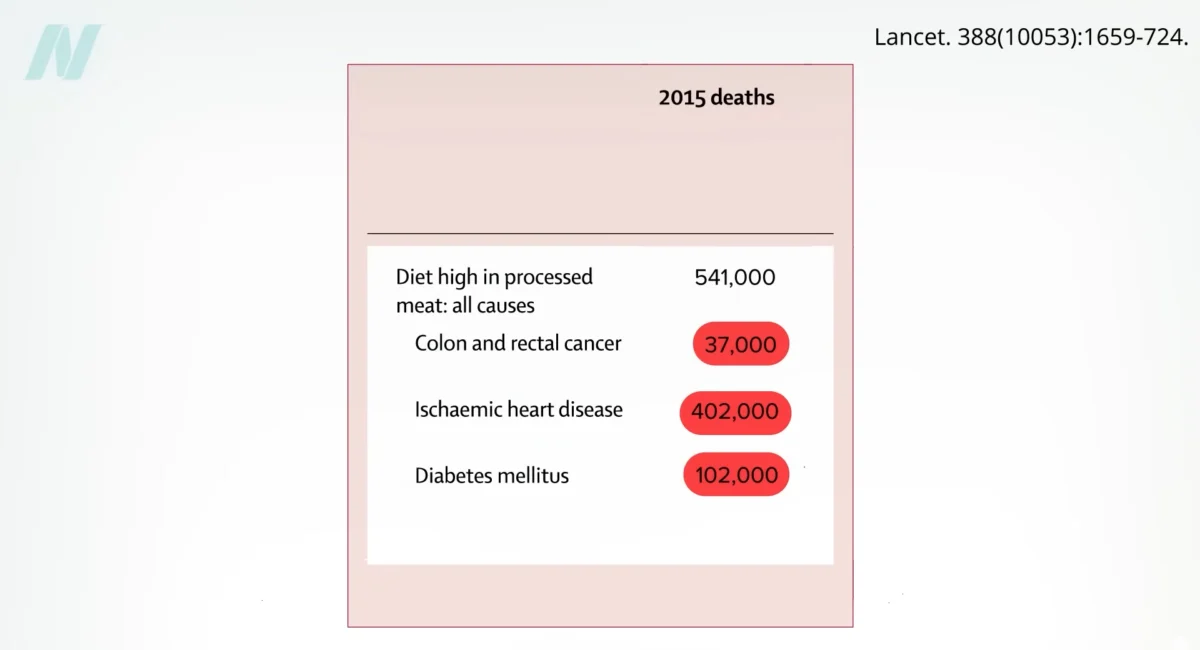
Furthermore, the cumulative health burden attributed to processed meat consumption is significant. While the IARC report focused on the approximately 37,000 cancer deaths globally attributable to processed meat intake, this figure primarily accounted for colorectal cancer. When considering the broader impact on chronic diseases, the numbers escalate dramatically. Studies, including those referenced by the Global Burden of Disease initiatives, indicate that processed meat consumption is also linked to a substantial number of deaths from diabetes and heart disease. When these figures are combined, the total number of deaths potentially attributable to processed meat intake could approach half a million annually worldwide. This broader health impact underscores the systemic risks associated with the widespread consumption of these products.
Public Health Action and the Challenge of Behavioral Change
Despite the growing body of scientific evidence and public health concerns, research indicates a concerning lack of change in processed meat consumption patterns in the United States. Studies have shown that over the past 18 years, the amount of processed meat consumed by U.S. adults has remained largely unchanged. This stagnation in consumption is attributed to several factors, including the lack of explicit guidance in national dietary recommendations and the persistent influence of the meat industry.
The absence of explicit warnings about the carcinogenic nature of processed meats in the Dietary Guidelines for Americans has been a point of contention. Critics argue that the Scientific Committee’s failure to recommend an explicit, science-based statement on processed meat in the latest guidelines is a missed opportunity to inform the public and drive behavioral change. This oversight leaves a critical gap in public health messaging, potentially hindering efforts to reduce the incidence of diet-related diseases.
The challenge of behavioral change is further compounded by the fact that even individuals diagnosed with colorectal cancer often fail to adopt healthier lifestyles post-diagnosis. This is partly due to a lack of comprehensive nutritional counseling. A significant percentage of cancer patients report never receiving nutrition advice from their healthcare providers during or after treatment. This deficit in support can make it difficult for individuals to make informed dietary changes, even when facing a serious health diagnosis.
Industry Influence and the Need for Public Health Intervention
The meat industry has been accused of employing tactics similar to those used by the tobacco industry to obfuscate the health risks associated with their products. A 2015 article published in a scientific cancer-research journal highlighted this ongoing "obfuscation of the issue by the meat industry," emphasizing that meat consumption should remain a focal point of public health action.
Despite these challenges, some cities are taking proactive steps. New York City, for example, has been at the forefront of legislative action by banning processed meats from school meals. This initiative represents a significant step towards protecting children from known carcinogens and setting a precedent for healthier school environments.
In response to public pressure and evolving scientific understanding, the processed meat industry is exploring product reformulation. This approach aims to mitigate potential adverse health effects by altering the processing methods or ingredients. For instance, efforts have been made to add fiber to hot dogs, with the intention of counterbalancing some of the associated health risks. However, critics argue that such reformulations may not fully address the fundamental carcinogenicity of processed meats and that a more comprehensive approach, including significant reductions in consumption or outright bans in certain settings, is necessary. The industry’s focus on reformulation, rather than elimination, can be likened to a pharmaceutical approach, where one drug is prescribed to counteract the side effects of another, rather than addressing the root cause of the problem.
Conclusion: A Call for Informed Dietary Choices
The scientific consensus, as articulated by the IARC, unequivocally classifies processed meats as Group 1 carcinogens. While the debate over the precise magnitude of risk continues, the evidence points to a clear and quantifiable link between the consumption of bacon, ham, hot dogs, sausage, and lunch meats and an increased risk of colorectal cancer. This risk, when viewed in the context of public health and population-wide impact, is substantial.
Beyond colorectal cancer, emerging research suggests potential links to other forms of cancer and significant contributions to deaths from diabetes and heart disease. The continued widespread consumption of processed meats, despite this evidence, highlights the persistent influence of the industry and the challenges in driving public health-informed behavioral change.
As the scientific community continues to refine our understanding of diet and disease, informed dietary choices become paramount. The data suggests that reducing or eliminating processed meats from our diets, particularly for those seeking to mitigate cancer risks, is a critical step towards better health. The public health imperative is clear: to promote greater awareness of these risks and to support individuals in making healthier, more informed decisions about their food consumption. The future of public health policy must grapple with how to effectively translate scientific evidence into tangible improvements in population health, ensuring that crucial health information is not obscured by industry interests and that accessible nutritional guidance empowers individuals to protect themselves from preventable diseases.

