

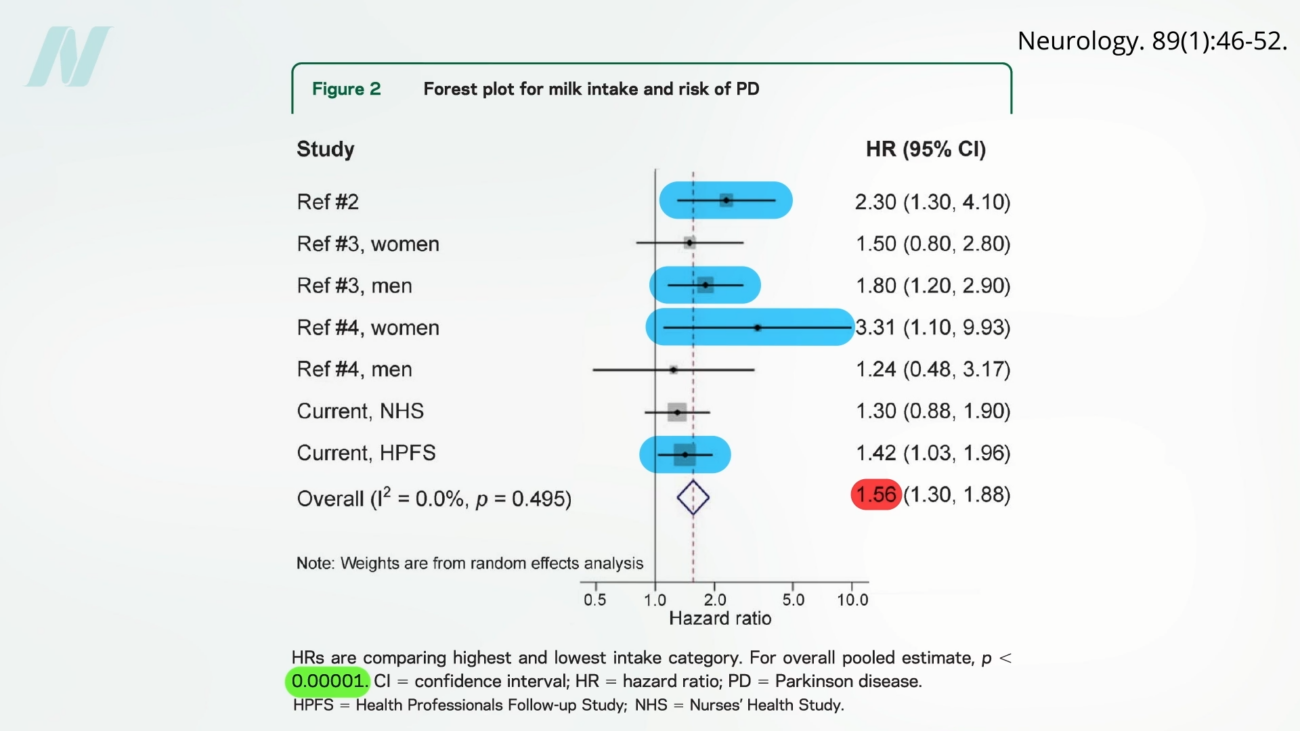
Parkinson’s disease, a relentless neurodegenerative disorder affecting millions globally, has long been a subject of intense scientific scrutiny. While its exact etiology remains elusive, a growing body of research points towards dietary factors as significant contributors to its development. Among these, dairy consumption has emerged as the most consistently identified dietary risk factor, associated with an increased likelihood of developing Parkinson’s disease. This association is not a fleeting observation; it has been substantiated by five substantial prospective studies, including the landmark Harvard cohorts – the Nurses’ Health Study and the Health Professionals Follow-up Study. These combined investigations, following over 100,000 individuals for decades, represent the most comprehensive analysis to date of dairy intake and Parkinson’s disease. The findings are striking: a link between dairy consumption and Parkinson’s was observed across all studies, with a significant correlation reported in most. Individuals consuming the highest amounts of milk exhibited approximately a 50% greater risk of developing the disease compared to those who abstained. The statistical significance of this finding is profound, with a p-value below 0.00001, indicating an exceptionally low probability of such an outcome occurring by chance.
Unraveling the Mechanism: Decades of Investigation
The persistent association between dairy and Parkinson’s has spurred considerable scientific inquiry into the underlying mechanisms. For years, researchers grappled with a lack of a clear, rational explanation for this dietary link. One review, published prior to a significant breakthrough, concluded that "despite clear-cut associations between milk intake and incidence of Parkinson’s, there is no rational explanation." However, a pivotal study a year later offered a crucial insight, examining the relationship between midlife milk consumption and substantia nigra neuron density at the time of death.
Parkinson’s disease is characterized by the progressive loss of dopaminergic neurons in the substantia nigra, a critical area of the brain responsible for motor control. Symptoms typically manifest once a substantial proportion of these neurons have degenerated. This groundbreaking study investigated individuals’ milk consumption habits during their 40s, 50s, and 60s and subsequently analyzed their brain tissue post-mortem to quantify the remaining critical neurons. The results were unequivocal: across all quadrants of the substantia nigra, neuron density was consistently higher in individuals who consumed no milk and progressively lower in those who consumed the most. Even after excluding individuals diagnosed with Parkinson’s, those who consumed as little as two cups (approximately 473 mL) of milk daily exhibited up to a 40% reduction in neuron density in key brain regions.
The Heptachlor Hypothesis: Pesticide Residues in the Brain
This stark correlation between milk intake and neuronal loss immediately raised questions about the potential culprits within milk. One compelling hypothesis emerged from the analysis of pesticide residues found in the brains of the study participants. Among the individuals who reported the highest milk consumption, residues of the banned pesticide heptachlor epoxide were detected in an astonishing 9 out of 10 brains. Heptachlor, a persistent organochlorine pesticide, was widely used in agriculture before being banned in many countries due to its environmental persistence and toxic effects. Heptachlor epoxide is its primary breakdown product, known for its bioaccumulation potential. The presence of these residues, more frequently in the brains of high milk consumers, offered a potential causal link between milk consumption and Parkinson’s disease risk, suggesting that the pesticide, inadvertently ingested through dairy products, could be directly contributing to neurodegeneration.
The Galactose Factor: A Sugar’s Toxic Potential
While the heptachlor hypothesis provided a plausible explanation, it was not the sole contender. Another significant line of research has focused on galactose, a simple sugar derived from lactose, the primary carbohydrate found in milk. When lactose is consumed, it is broken down in the body into glucose and galactose. Emerging evidence suggests that galactose itself may play a detrimental role in brain health, particularly concerning the dopaminergic neurons affected in Parkinson’s disease.
Galactose has been utilized in laboratory settings as a method to experimentally induce aging in the brain. Research indicates that when ingested, galactose is readily absorbed by the brain within a few hours. Doses exceeding 100 mg/kg of body weight have been shown to induce pathological alterations in brain cells that closely resemble those observed in Parkinson’s disease. The daily consumption of just two glasses of milk (approximately 473 mL) can easily reach and surpass this threshold, as milk is a primary dietary source of galactose. Crucially, dopaminergic neurons appear to be particularly vulnerable to galactose-induced damage. These neurons are inherently susceptible to oxidative stress, a cellular process that galactose can exacerbate, leading to their degeneration.
Galactose and Mortality: A Broader Health Concern
The potential neurotoxic effects of galactose extend beyond Parkinson’s disease, offering explanations for broader health correlations observed with high milk consumption. Studies have indicated a link between increased milk intake and higher mortality rates. While saturated fat content in milk has often been cited as a reason for this association, the increased mortality has been observed even with skim milk, which is virtually fat-free but still contains lactose and, consequently, galactose. This suggests that the impact of milk on longevity may be independent of its fat content, further implicating galactose as a key contributing factor.

The Lactose-Free Paradox: A Misleading Solution?
The understanding of galactose’s role has raised questions about the efficacy of lactose-free milk alternatives, such as those treated with the lactase enzyme. While these products aim to reduce lactose content for individuals with lactose intolerance, the lactase enzyme simply breaks down lactose into glucose and galactose. Therefore, even lactose-free milk ultimately delivers the same amount of galactose to the body. This suggests that switching to lactose-free dairy products may not mitigate the potential risks associated with galactose exposure.
Further research has illuminated the broader cognitive implications of galactose consumption. Studies have linked higher milk intake in midlife to a more accelerated rate of cognitive decline. This is consistent with the established use of D-galactose in animal models to mimic cognitive aging through oxidative stress. Individuals who reported drinking more than one glass (approximately 237 mL) of milk per day exhibited a greater likelihood of experiencing a decline in global cognitive function compared to those who rarely consumed milk.
Broader Implications and Future Directions
The scientific evidence linking dairy consumption to an increased risk of Parkinson’s disease, driven by either pesticide residues like heptachlor epoxide or the inherent properties of galactose, has significant implications for public health recommendations. While definitive causal pathways are still being elucidated, the consistency and strength of the observed associations warrant careful consideration by individuals concerned about neurological health.
The U.S. Environmental Protection Agency (EPA) banned the use of heptachlor in 1978 due to its persistence and toxicity, with subsequent restrictions on its derivatives. However, legacy contamination and potential for illegal use in some regions could still contribute to exposure. The dairy industry, a cornerstone of global agriculture and nutrition, faces the challenge of addressing these scientific findings. While industry representatives have historically emphasized the nutritional benefits of dairy, this emerging research necessitates a transparent dialogue and a commitment to further investigation.
Beyond Parkinson’s, the potential role of galactose in broader neurodegenerative processes and cognitive aging suggests a need for a more nuanced understanding of dairy’s impact on long-term brain health. This includes re-evaluating the common assumption that all dairy products are universally beneficial and exploring dietary patterns that may offer protective effects against neurodegeneration.
Continued Research and Public Health Guidance
The ongoing scientific discourse surrounding dairy and Parkinson’s disease underscores the dynamic nature of nutritional science. Researchers continue to explore various contributing factors, including the potential role of other dietary components such as uric acid, which has also been investigated for its complex relationship with Parkinson’s risk.
For the public, this evolving research landscape highlights the importance of staying informed about scientific developments and consulting with healthcare professionals for personalized dietary advice. While dairy remains a source of essential nutrients for many, individuals at higher risk for Parkinson’s or those concerned about cognitive health may wish to consider the extensive research linking dairy consumption to adverse neurological outcomes. The scientific community’s continued commitment to unraveling these complex dietary associations promises to yield further insights into preventing and managing neurodegenerative diseases.

