

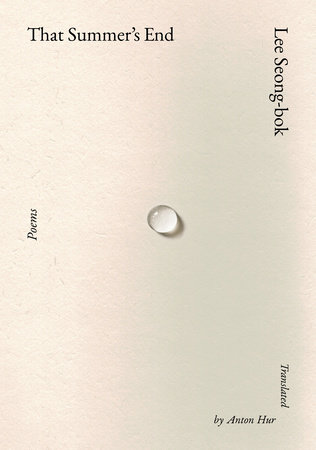
The recent translation of South Korean poet Lee Seong-bok’s collection, That Summer’s End, offers a profound literary event, bringing to a wider global audience a body of work steeped in the contemplative traditions of Seon Buddhism and the evocative imagery of French Symbolism. Published on August 30, 2026, by Alfred A. Knopf, an imprint of Penguin Random House, this collection, translated by Anton Hur, delves into themes of impermanence, sorrow, and the arduous yet ultimately hopeful journey through existence. Lee Seong-bok, a celebrated figure in contemporary Korean poetry, has long been recognized for his distinctive voice, characterized by its introspective depth and its unique synthesis of Eastern philosophical insights with Western literary aesthetics.
The collection’s title poem, "That Summer’s End," encapsulates the overarching mood and thematic concerns that pervade the work. It speaks of resilience in the face of overwhelming natural forces, likening personal despair to the "crimson" eruption of crape myrtle blossoms that endure storms. "That summer the crape myrtle survived… After the storm and the storm after that… it hung on and poured out a hail of red flowers," Lee writes, juxtaposing the destructive power of nature with the tenacious beauty of life. This imagery resonates with the Buddhist concept of anicca (impermanence), a central tenet of Seon (Zen) Buddhism, which posits that all phenomena are in a constant state of flux. Lee’s engagement with this philosophy is not merely intellectual; it is deeply felt, woven into the very fabric of his poetic expression.
Lee Seong-bok’s literary journey is marked by a deliberate and sustained engagement with both philosophical and artistic traditions. His study of French Symbolism, a late 19th-century literary movement that emphasized subjective experience, suggestion, and the use of symbolic imagery to evoke moods and ideas rather than state them directly, has undeniably shaped his poetic technique. Thinkers and poets such as Charles Baudelaire, Arthur Rimbaud, and Paul Verlaine, with their explorations of the subconscious, the irrational, and the symbolic resonance of the mundane, find a contemporary echo in Lee’s verses. This influence is evident in his tendency to employ evocative, often ambiguous imagery, allowing for multiple layers of interpretation and inviting the reader into a participatory act of meaning-making.

The Seon Buddhist underpinnings of his work provide a philosophical framework for understanding his preoccupation with impermanence and the nature of suffering. Seon Buddhism, which emphasizes direct experience and meditation (zazen) as pathways to enlightenment, encourages a mindful observation of reality without attachment or aversion. This approach fosters an acceptance of the transient nature of all things, including emotions, thoughts, and life itself. Lee’s poems often seem to emerge from a meditative state, characterized by careful observation, extended contemplation, and a profound stillness. He frequently revisits themes and images, creating a sense of cyclical exploration rather than linear progression, mirroring the meditative process of returning to an object of focus.
The translator, Anton Hur, plays a crucial role in making Lee Seong-bok’s nuanced and culturally specific poetry accessible to an English-speaking audience. Hur’s translation aims to capture not only the literal meaning of the words but also the rhythm, tone, and emotional resonance of the original Korean. In an interview conducted following the publication, Hur stated, "Seong-bok’s poetry is like a finely tuned instrument. The challenge is to find the equivalent notes in English, to convey the subtle shifts in mood and the profound quietude that underpins his most powerful lines." The successful translation of such complex poetry is a testament to Hur’s deep understanding of both the source and target languages, as well as his sensitivity to the literary and philosophical traditions that inform Lee’s work.
The Rhythm of Mourning and the Spaces of Poetry
Lee Seong-bok himself articulated a powerful metaphor for poetry in his collection Indeterminate Inflorescence, also referenced in the context of That Summer’s End: "The rhythm of poetry is like that of a mourner’s. Two steps forward, one step back… the fluttering funereal banners and the colorful paper flowers… listening to the sad singing and the sound of ghosts." This description is particularly resonant when considering the elegiac quality that permeates his work. There is a sense of lament, of acknowledging loss and the inevitable passing of time, but this lament is not one of despair. Instead, it is a measured, almost ritualistic acknowledgment, a dance with sorrow that allows for a deeper engagement with life’s fleeting beauty.
The concept of "gaps" in poetry is central to Lee’s aesthetic. He writes, "poems are nothing more and nothing less than making gaps. We can breathe as much air as these gaps allow. These gaps are the truest human place." These "gaps," or caesuras, are not voids but rather spaces for contemplation, for the breath between words, for the silence that allows meaning to emerge. In a world often characterized by constant noise and information overload, these poetic silences offer a vital respite, a space for introspection and a connection to the "truest human place" – a space of quiet awareness and existential contemplation. This aligns with Seon Buddhist teachings that emphasize the importance of stillness and mindfulness in understanding the nature of reality.
Exploring Themes of Sorrow and Impermanence
The poems within That Summer’s End consistently explore the complex relationship between the self and the natural world, often using natural phenomena as metaphors for human emotions and experiences. The poem "Feeling" opens with a series of questions that link the emergence of feelings to the blossoming and subsequent falling of blossoms: "How do feelings come / a bough first blossoms / Is that how feelings come / a bough first drops its blossoms / Is that how feelings fall." This cyclical imagery captures the ephemeral nature of emotions, their sudden appearance and inevitable fading. The subsequent lines, "A droplet on a page / lingers long before / drying to a blot / a warp on paper / an indelible trace," suggest that even as emotions fade, they leave a lasting imprint, a testament to their existence and impact.
The poem "Sea" presents a stark and powerful personification of sorrow. The speaker’s interaction with sorrow is not one of avoidance but of acceptance and even companionship: "Sorrow called to me / I didn’t answer. / Sorrow followed me / I didn’t flee / together we went on a long trek." The journey through "pine forests" where sorrow hides and then "stepping forth" is a metaphor for confronting and integrating difficult emotions. The imagery of sorrow’s "back a dark blue bend / in the river and white froth in its mouth" is both vivid and unsettling, conveying the powerful and often overwhelming nature of grief. Yet, even in its turbulent manifestation, sorrow "waved," suggesting a recognition, a form of acknowledgment rather than outright battle.
Navigating the "Pathless Forest" of Existence
Lee Seong-bok’s exploration of the human condition often leads to the metaphor of a "pathless forest," a recurring motif that signifies the uncertainty and challenges inherent in life’s journey. The poem "Mountain Path 2" directly addresses this theme: "On a path barely wide enough for one… The path looked blocked. / Thinking my way lost, / I continued step by step into the pathless forest." The speaker’s continued movement despite the perceived loss of direction reflects a commitment to perseverance, a fundamental aspect of the Seon path. The acknowledgment that "Every time I thought the path was at an end it began / again" underscores the cyclical nature of struggle and renewal, a constant process of facing new challenges.
This sentiment is echoed in "Memories of a Very Overcast Day," where the stark image of "Birds flock by as they cover this place with graves" evokes a profound sense of mortality and the transient nature of human presence. The act of "pushing a coffin lid" while "staring up at the sky" is a powerful, visceral expression of grappling with loss and the existential questions that arise from it.
Broader Impact and Literary Significance
The publication of That Summer’s End in English is significant for several reasons. It introduces a contemporary master of Korean poetry to a global readership, enriching the landscape of international literature. Lee Seong-bok’s unique synthesis of Seon Buddhism and French Symbolism offers a compelling model for cross-cultural artistic dialogue, demonstrating how diverse philosophical and aesthetic traditions can converge to create something entirely new and profound.
The collection’s exploration of universal themes such as sorrow, impermanence, and the search for meaning in a seemingly chaotic world resonates deeply with contemporary concerns. In an era marked by rapid change and persistent global challenges, Lee’s poetry provides a framework for navigating these complexities with a sense of mindful awareness and resilient hope. The quiet power of his verses, with their deliberate pauses and evocative imagery, offers readers an opportunity to engage with these profound themes in a deeply personal and contemplative manner. The critical reception of the collection, as evidenced by its publication by a major literary house, suggests a growing appreciation for poetry that engages with both philosophical depth and aesthetic sophistication.
The timing of this translation also coincides with a burgeoning global interest in mindfulness and contemplative practices, further enhancing the potential impact of Lee’s work. His poems, rooted in centuries-old Buddhist wisdom, offer a contemporary artistic articulation of these enduring principles. The "gaps" Lee speaks of in his poetry can be seen as invitations to pause, to reflect, and to find solace and insight in the quiet spaces of our own lives, mirroring the core practices of mindfulness and meditation.
In conclusion, Lee Seong-bok’s That Summer’s End, through its exquisite translation by Anton Hur, stands as a significant contribution to contemporary poetry. It is a testament to the enduring power of language to explore the deepest aspects of human experience, weaving together the profound insights of Seon Buddhism with the evocative artistry of French Symbolism. The collection offers not only a glimpse into the mind of a celebrated poet but also a timeless meditation on sorrow, impermanence, and the resilient spirit that endures even in the face of life’s most formidable storms. The quiet, measured rhythm of his verse, with its intentional gaps, provides a much-needed space for breath and contemplation, inviting readers to find their own "truest human place" amidst the inevitable flux of existence.

