

A landmark experiment foundational to the widely-cited "scarcity mindset" theory, which posits that poverty inherently narrows cognitive attention, has been re-examined, with a 2026 reanalysis concluding that the original findings were largely attributable to the game’s structural rules rather than a fundamental shift in players’ attention or cognitive capacity. This re-evaluation, published by researchers from the University of Cologne, UC Berkeley, and Stanford, casts significant doubt on a core tenet that has influenced academic thought, popular literature, and international poverty policy, including reports by the World Bank. The original 2012 study, which involved participants playing a computer game, had previously suggested that individuals experiencing "scarcity" exhibited sharper focus in some areas while neglecting others; however, the new analysis argues that game mechanics, specifically the differential opportunities afforded to "poor" versus "rich" players, provided a more robust explanation for observed behaviors like improved aiming accuracy and increased borrowing.
Unpacking the Scarcity Mindset Theory
The "scarcity mindset" theory gained significant traction following its popularization in Sendhil Mullainathan and Eldar Shafir’s influential 2013 book, Scarcity: Why Having Too Little Means So Much. The theory posits that a lack of resources—whether money, time, or food—can fundamentally alter an individual’s psychological processes, independent of their inherent personality traits. It articulates two primary claims: first, that scarcity creates a "tunneling" effect, sharpening focus on immediate, pressing needs; and second, that this intensified focus simultaneously leads to neglect of broader, non-immediate concerns or opportunities. This framework suggests that the cognitive demands imposed by scarcity can deplete an individual’s "bandwidth," making them less effective at tasks requiring planning, self-control, or long-term thinking.
The empirical bedrock for the second claim—that scarcity both sharpens focus and induces neglect—has largely rested upon a specific study: Shah, Mullainathan, and Shafir’s 2012 Science paper titled "Some consequences of having too little." This paper rapidly became a cornerstone of the scarcity literature, widely cited in academic journals, disseminated through mainstream media, and integrated into policy discussions, including critical evaluations of poverty interventions by institutions like the World Bank. Its conclusions offered a compelling psychological lens through which to understand the persistent challenges faced by individuals living in poverty, suggesting that their cognitive processes might be an independent barrier to escaping their circumstances.
The "Angry Blueberries" Experiment: A Closer Look at the Original Design
At the heart of the 2012 Science paper was a computer game experiment, specifically Study 2, often referred to as the "Angry Blueberries" game. In this online task, 68 participants were instructed to shoot blueberries at targets to accumulate points, which would, in turn, increase their chances of winning a raffle. Each level of the game presented 7 targets, with an additional 3 bonus points awarded for successfully clearing all targets within a given level.
The critical manipulation in this experiment involved dividing players into "poor" and "rich" conditions, distinguished by the number of shots they received per level. "Poor" players were allocated a limited budget of 3 shots per level, while "rich" players received a more generous allowance of 15 shots per level. Both groups faced identical challenges regarding target numbers and bonus point structures. Crucially, a borrowing option was introduced, allowing players who ran out of shots but still had targets remaining to take additional shots at a cost—a simulated interest rate that negatively impacted their overall score.
The original analysis of the game’s results appeared to corroborate the "tunneling" hypothesis. "Poor" players, despite their limited shots, exhibited longer aiming times and achieved a higher average points per shot compared to their "rich" counterparts. The original authors interpreted this as evidence of heightened focus and sharpened attention under conditions of scarcity. Furthermore, "poor" players who had access to the borrowing option utilized a significantly larger proportion of their budget through borrowing (an average of 0.24 units borrowed compared to 0.02 for "rich" players). This excessive borrowing, despite its negative impact on overall scores, was interpreted as neglect of the interest rate, indicative of a narrowed focus on immediate needs (taking more shots) at the expense of long-term financial prudence.
The 2026 Reanalysis: Deconstructing the Apparent Effects
The reanalysis, conducted by Fiona tho Pesch, Antonia Langenhoff, and Mahesh Srinivasan, meticulously scrutinized the experimental design and data from the 2012 study. Their core argument is that the observed differences in player behavior were not a reflection of altered cognitive states due to scarcity, but rather an artifact of the game’s rules and the unequal opportunities they presented.
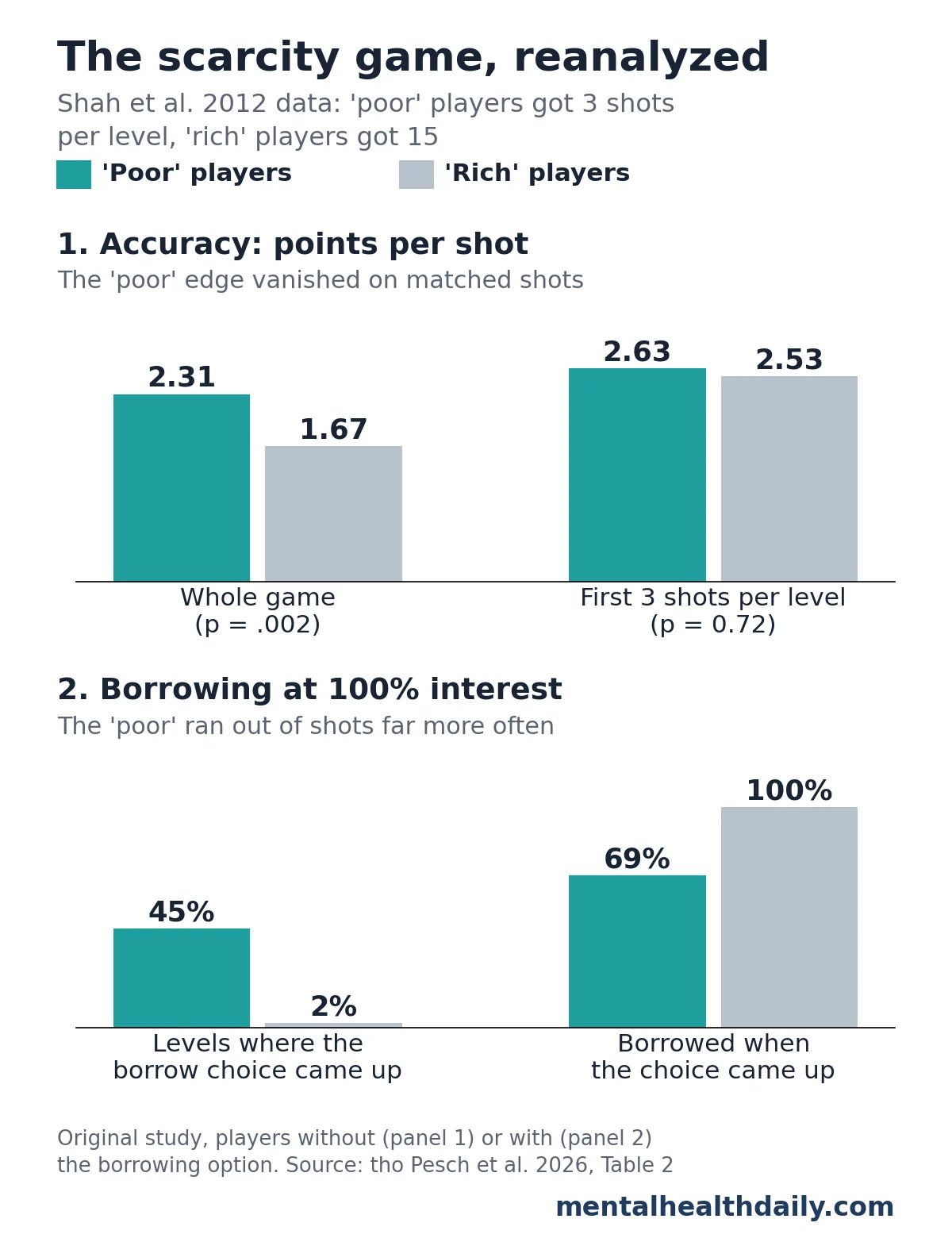
One of the most striking findings of the reanalysis pertained to the perceived accuracy gap. The original study reported that "poor" players earned more points per shot, which was taken as evidence of greater focus. However, the reanalysis highlighted a fundamental structural asymmetry: each level began with 7 targets, meaning early shots inherently had a higher probability of hitting targets and thus yielding more points. Across all players, regardless of their "wealth" condition, the first shot on a level typically scored 2.81 points, decreasing to 1.80 points by the third shot, and plummeting to a mere 0.69 points for a "rich" player’s fifteenth shot on an increasingly empty screen.
Crucially, "poor" players, with their limit of 3 shots per level, were confined to taking only the most profitable shots—the initial ones when targets were abundant. "Rich" players, conversely, averaged about 5.7 shots per level, meaning their overall average points per shot was "dragged down" by later, less productive shots fired at a more depleted target field. When the reanalysis focused solely on the first three shots—the only shots both groups consistently took—the supposed accuracy gap vanished. "Poor" players scored 2.63 points per shot in these initial attempts, while "rich" players scored 2.53 points per shot, a statistically insignificant difference. This re-evaluation strongly suggests that the apparent higher accuracy of "poor" players was a direct consequence of the game’s structure, which restricted them to the most advantageous opportunities, rather than a manifestation of superior focus.
Furthermore, the original study noted that "poor" players spent more time aiming. While this was initially interpreted as enhanced focus, the reanalysis authors point out that longer aiming time did not actually translate into demonstrably better shots when compared on an equal footing. They propose an alternative interpretation: that this extended aiming could equally reflect hesitation or indecision, rather than an intentional, sharpened focus.
Revisiting Borrowing Behavior: Opportunity vs. Neglect
The reanalysis similarly dismantled the original interpretation of borrowing behavior. The 2012 paper presented "poor" players’ higher borrowing rates as evidence of neglecting the negative consequences (interest rates) due to their narrowed attention. However, the reanalysis underscored a critical structural difference in how often each group encountered the borrowing decision.
Borrowing only became an option after a player had exhausted their allotted shots for a level while targets still remained. Given their mere 3 shots per level, "poor" players hit this "wall" and were presented with the borrowing choice on a substantial 45% of their levels. In stark contrast, "rich" players, with 15 shots per level, only reached this juncture on a meager 2% of their levels. The dramatic difference in the frequency of encountering the borrowing decision, the reanalysis contends, is the primary driver behind the observed discrepancy in borrowing rates. "Poor" players borrowed more because they were forced to consider borrowing far more often.
When the choice to borrow actually arose, the reanalysis found that "poor" players chose not to borrow in 31% of cases, while "rich" players, who rarely encountered the option, always borrowed when it appeared (though only 40% of "rich" players ever reached this choice). This finding, though just shy of statistical significance (p = 0.052), points in the opposite direction of the "neglect" hypothesis, suggesting that "poor" players were, if anything, more cautious when faced with the borrowing decision. The reanalysis concludes that borrowing indeed hurt everyone’s score, but it simply arose with far greater frequency for those in the "poor" condition due to the game’s design.
The original paper also posited a correlation between longer aiming times and more borrowing among "poor" players (r = 0.43), suggesting that focus on the immediate task of aiming crowded out attention to the interest rate. The reanalysis demonstrated that this correlation only held true within the specific, narrow subset of levels where "poor" players actually borrowed. When the correlation was examined across all players who could borrow, it essentially disappeared (r = 0.03), and critically, it failed to replicate in a larger 2019 follow-up study conducted by the original authors.
Broader Context and Previous Replication Attempts
The challenges to the 2012 Science paper are not isolated. Supplementary reanalyses performed by tho Pesch, Langenhoff, and Srinivasan on Studies 4 and 5 from the same 2012 paper revealed similar patterns of methodological issues influencing outcomes. Furthermore, Study 1 of the 2012 paper had already failed to replicate in a large-scale 2018 project aimed at retesting social science experiments published in prestigious journals like Nature and Science. This broader context highlights an ongoing discussion within social psychology and behavioral economics regarding the robustness and replicability of certain seminal findings.
The "scarcity mindset" literature, more broadly, has experienced mixed success in replication efforts. A comprehensive 2021 audit that sought to retest 20 different scarcity studies reported "considerable variability in the replicability, with some strong successes and other undeniable failures." This suggests that while the overarching concept of scarcity impacting cognition might hold some truth, the specific mechanisms and empirical demonstrations require rigorous scrutiny and robust replication.
A New Experiment: Equalizing Opportunities
To further validate their hypothesis about the role of game structure, the reanalysis team conducted a new, preregistered experiment involving 174 online participants (91 "poor" and 83 "rich"). This new design aimed to remove the uneven opportunities inherent in the original "Angry Blueberries" game. Instead of a borrowing option, all players were presented with an insurance offer on each of the first 10 levels. Players could spend current shots to insure a separate field of bonus points against a 50% chance of a "drought" (loss of points). Eight of these offers were designed to be good value, while two were "scam" insurance offers, costing more than they could potentially pay back. The rationale was that, similar to borrowing, insurance involves trading something now for something later, making it a suitable proxy for testing the "tunneling" prediction that "poor" players would neglect good long-term deals.
Contrary to the "tunneling" prediction, the players with fewer resources in this new, carefully controlled experiment were, if anything, more careful and discerning with the insurance offers. This finding provides direct experimental evidence that when structural differences in opportunity are removed, the predicted cognitive biases under scarcity do not necessarily manifest, further weakening the original interpretation of the "scarcity mindset."
Implications for Policy and Research: Shifting the Paradigm
The reanalysis by tho Pesch, Langenhoff, and Srinivasan does not invalidate the original game results themselves; it acknowledges that scarce shots still correlated with higher points per shot in the original data, the 2019 replication, and their new experiment, and that more borrowing occurred in datasets offering loans. What it decisively overturns, however, is the explanation for these results—the notion that scarcity inherently makes people more focused in some areas while simultaneously blinding them to costs in others.
This re-evaluation carries significant implications for anti-poverty policy. If the observed behaviors are primarily a function of the structural choices and constraints faced by individuals in poverty, rather than an intrinsic cognitive deficit, then policy interventions should shift accordingly. Instead of focusing on "fixing" the cognitive biases of the poor, the emphasis should move towards restructuring the environment, expanding opportunities, and mitigating the harsh consequences of limited resources. For example, instead of assuming that the poor "neglect" interest rates, the reanalysis suggests recognizing that they are simply confronted with high-interest borrowing options far more frequently due due to their circumstances. This reframes over-borrowing not as a cognitive failing, but as a systemic problem stemming from the limited and often predatory options available to those with scarce resources.
The paper also does not challenge the "bandwidth-tax" claim from the 2013 Science study (a separate paper by Mullainathan and Shafir that investigated the cognitive load of poverty) nor does it argue that poverty leaves thinking entirely unaffected. The authors acknowledge that the experience of poverty is undoubtedly challenging and can have numerous adverse effects. However, their critique targets the specific mechanistic explanation offered by the "scarcity mindset" theory, particularly the "tunneling" and "neglect" components as demonstrated by the "Angry Blueberries" experiment.
The Debate on "Tunneling" Definition and a Structural Alternative
A further point of critique from the reanalysis authors concerns the inherent ambiguity in the definition of "tunneling." They argue that the concept is often too loosely defined to be empirically tested with precision. Without clear, objective criteria for what constitutes behavior "inside" or "outside" the hypothetical tunnel of attention, any observed choice can be retroactively attributed to either heightened focus (if it’s a positive outcome) or neglect (if it’s a negative outcome) under scarcity. This conceptual slipperiness makes the theory difficult to falsify and thus less scientifically robust.
The authors propose an alternative, more structural explanation: that individuals experiencing poverty do not necessarily think differently, but rather confront different choices and different frequencies of those choices. Much like the "poor" players in the reanalyzed game, individuals with limited resources often run short more frequently and are thus disproportionately exposed to high-interest loans, difficult trade-offs, and situations demanding immediate decisions with long-term repercussions. This perspective fundamentally reframes observed behaviors, such as increased borrowing, from being a symptom of a scarcity-induced cognitive "mindset" to a direct, rational response to a constrained and often unforgiving set of structural options.
Limitations and Future Directions
While the reanalysis offers a compelling alternative explanation for the "Angry Blueberries" findings, it is important to acknowledge its own limitations. The study primarily re-examines a specific experiment and its direct interpretations, rather than offering a comprehensive refutation of all aspects of scarcity theory. The nuances of how resource scarcity interacts with decision-making are complex and likely involve multiple psychological and environmental factors.
Future research will need to continue exploring these interactions with rigorous experimental designs that meticulously control for structural confounds. This reanalysis underscores the critical importance of transparency, preregistration, and open science practices in psychological and economic research, allowing for independent scrutiny and re-evaluation of foundational studies. The ongoing dialogue spurred by such reanalyses is vital for strengthening the empirical basis of social science and ensuring that policy interventions are grounded in the most accurate understanding of human behavior and its underlying mechanisms. The scientific process, by its very nature, demands continuous questioning and refinement, and this 2026 reanalysis serves as a powerful testament to that enduring principle.

