

The International Agency for Research on Cancer (IARC), a leading global authority on cancer research and a specialized agency of the World Health Organization (WHO), issued a landmark report in 2018 that classified processed meats, including bacon, ham, hot dogs, sausage, and lunch meats, as Group 1 carcinogens. This classification signifies that there is sufficient evidence to conclude that these products cause cancer in humans. The agency’s findings, published in the journal The Lancet Oncology, emphasized that these conclusions further support existing public health recommendations to limit the consumption of processed meat. However, the IARC’s categorization sparked considerable debate, with critics questioning the equivalence of placing processed meats in the same carcinogenic classification as substances like asbestos and tobacco. Some drew analogies, with a pesticide company suggesting it was akin to equating processed meat consumption with exposure to mustard gas, highlighting the disparity in perceived risk.
Understanding Carcinogen Classification: Evidence vs. Magnitude of Risk
It is crucial to understand that the IARC’s classification system, detailed in its Monographs on the Evaluation of Carcinogenic Risks to Humans, primarily categorizes agents based on the strength of the scientific evidence demonstrating carcinogenicity, rather than the magnitude of the risk posed. This distinction is fundamental to interpreting the implications of the processed meat findings. As the agency itself clarified in its Q&A regarding the 2018 report, a Group 1 classification does not imply that all agents in this category pose an equal level of danger. For instance, while both plutonium and pastrami are classified as Group 1 carcinogens, meaning they are known to cause cancer in humans, the practical risks associated with their consumption or exposure are vastly different. This nuanced understanding is essential for a balanced public health perspective.
Quantifying the Colorectal Cancer Risk
The IARC report, building upon extensive epidemiological studies, estimated the relative risk of colorectal cancer associated with processed meat consumption. Specifically, the research indicated an 18% increase in the risk of developing colorectal cancer for every 50 grams of processed meat consumed daily. To contextualize this figure, 50 grams is roughly equivalent to one hot dog, two breakfast sausage links, or two slices of Canadian bacon or ham. This means that incorporating a daily sandwich with one or two slices of baloney could elevate an individual’s risk of colorectal cancer by 18%. The report also suggested that significantly larger portions, such as a half-pound of pastrami on rye, could elevate this risk to approximately 80%.
Absolute vs. Relative Risk: A Crucial Distinction
Understanding the impact of an 18% relative risk increase requires differentiating between relative and absolute risk. The lifetime risk of developing colorectal cancer in the general population is estimated to be around 5%, or 1 in 20. An 18% increase in this relative risk, when applied to the baseline 5% absolute risk, translates to a modest rise in the absolute risk. For an individual with a 5% lifetime risk, an 18% relative increase would elevate their absolute risk to approximately 6%. While this represents an increase, it is important to consider the scale of this change in the context of the overall population.
On a population level, the implications of reducing processed meat consumption can be substantial. If an 18% reduction in processed meat intake were achieved across the United States, it could potentially prevent around 25,000 cases of colorectal cancer annually. This translates to fewer families facing the devastating diagnosis and subsequent treatment of this disease. Such a reduction could be achieved through simple dietary shifts, such as substituting processed meats in sandwiches with plant-based alternatives like hummus or choosing veggie dogs over traditional hot dogs. The impact, therefore, depends significantly on the perspective from which the data is analyzed – individual risk versus population-wide health outcomes.
Colorectal Cancer: A Significant Public Health Challenge
Colorectal cancer represents a major public health concern in the United States, ranking as the second leading cause of cancer-related deaths for both men and women combined, surpassed only by lung cancer. For individuals who do not smoke, colorectal cancer can be considered their most significant cancer adversary. The good news, however, is that the risk of developing this disease is modifiable. A single dietary adjustment – the elimination of one daily serving of processed meat – has the potential to reduce the risk of colorectal cancer by approximately one-fifth.
Comparing Risks: Processed Meat vs. Secondhand Smoke
To further illustrate the magnitude of the risk associated with processed meat, a comparison can be drawn with other known health hazards. During testimony before the Dietary Guidelines Scientific Committee, a compelling analogy was made: "We try not to smoke around our kids, why would we send them to school with a baloney sandwich?" This statement, while perhaps sounding hyperbolic, is grounded in scientific evidence. According to the U.S. Surgeon General, prolonged exposure to secondhand smoke increases the risk of lung cancer by approximately 15%. This means that daily exposure to secondhand smoke carries a risk comparable to the increased risk of colorectal cancer from consuming a daily serving of processed meat. This comparison highlights that the risks associated with processed meat are not trivial and warrant serious public health consideration.
Industry Responses and the Concept of "Benefits"
The processed meat industry has historically responded to these concerns by emphasizing the need to consider the risks in conjunction with the perceived benefits of their products. Proponents often cite convenience and palatability as key advantages of processed meats, arguing that these factors should be weighed against the potential health risks. This perspective suggests that consumers should have the freedom to choose, even in the face of identified health risks.

Broader Health Implications Beyond Cancer
The health implications of processed meat consumption extend beyond the risk of colorectal cancer. While the IARC report specifically focused on this link, subsequent research has indicated potential associations with other forms of cancer. Studies published since the 2018 IARC decision suggest that processed meat intake may also increase the risk of prostate cancer, breast cancer, and pancreatic cancer.
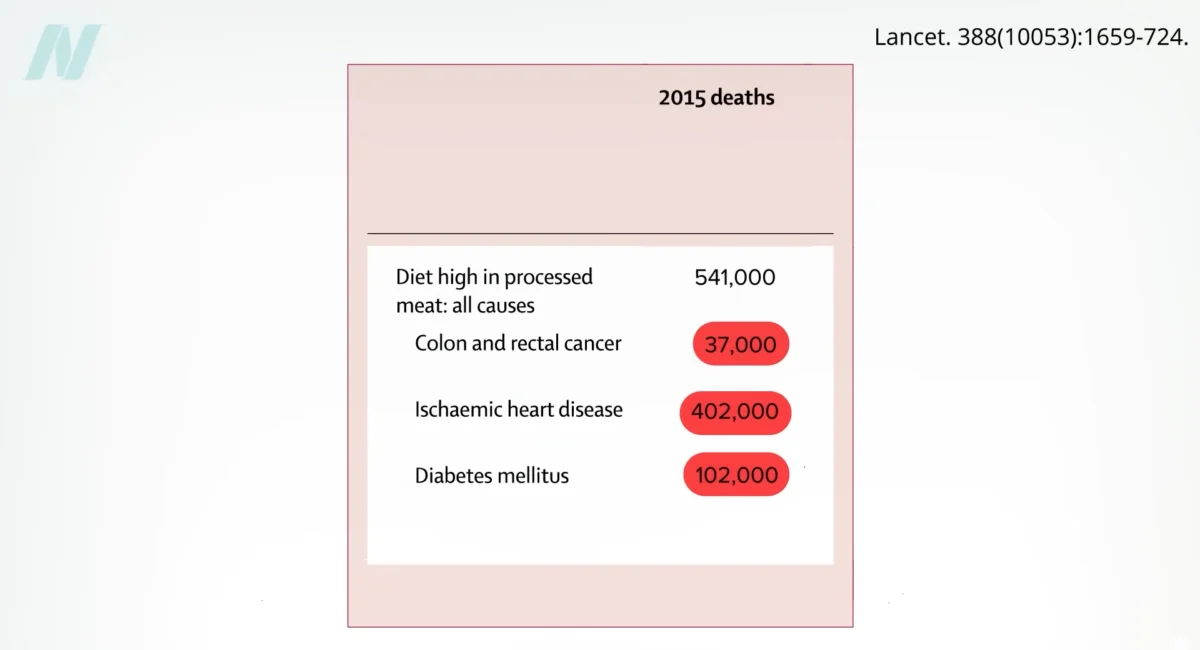
Furthermore, a comprehensive analysis of the Global Burden of Disease studies, often cited in discussions about the impact of processed meat, reveals a much broader health burden than initially reported by some industry critics. While the initial figures might have focused on the approximately 37,000 cancer deaths directly attributable to processed meat intake, a more thorough examination includes the significant contributions to other chronic diseases. These studies indicate that processed meat consumption is linked to an estimated 100,000 deaths from diabetes and 400,000 deaths from heart disease annually. When these figures are aggregated, the total number of deaths attributable to processed meat consumption could approach half a million globally each year. This underscores the systemic impact of processed meat on public health, affecting multiple chronic disease pathways.
Stagnant Consumption and Public Health Messaging
Despite growing public awareness and scientific concerns regarding processed meat consumption, research indicates a persistent trend in dietary habits. Studies have shown that there have been no significant changes in the amount of processed meat consumed by U.S. adults over the past 18 years. This stagnation suggests a gap between scientific findings and public behavior, potentially exacerbated by a lack of explicit guidance from public health institutions.
The omission of a clear, science-based statement on the carcinogenic nature of processed meat in the most recent Dietary Guidelines for Americans has been noted as a missed opportunity. Critics argue that incorporating such information would provide essential guidance to consumers and healthcare professionals alike. The scientific committee responsible for formulating these guidelines did not include an explicit recommendation regarding processed meat, a decision that has drawn criticism from public health advocates.
The Challenge of Lifestyle Changes Post-Diagnosis
The difficulty in altering dietary habits is further highlighted by the behavior of individuals diagnosed with colorectal cancer. Research indicates that a significant portion of these patients do not substantially improve their overall lifestyle after receiving their diagnosis. A contributing factor to this may be the lack of adequate nutritional counseling. Alarmingly, studies suggest that approximately 70% of cancer patients have never received nutrition advice from their healthcare providers during or after their treatment. This deficiency in patient education leaves a critical gap in empowering individuals to make informed decisions about their health and recovery.
Industry Influence and Public Health Action
The influence of the meat industry on public health discourse has been a subject of concern. An article published in a scientific cancer-research journal pointed out the continued "obfuscation of the issue by the meat industry," drawing parallels to the strategies employed by the tobacco industry in the past. This suggests a deliberate effort to downplay or misrepresent the scientific evidence linking processed meats to cancer. In response to these ongoing concerns, some cities are taking proactive measures. New York City, for instance, has taken a lead by enacting legislation to ban processed meats from school meals, a move aimed at protecting children from known carcinogens. This initiative represents a significant step towards prioritizing public health over commercial interests.
Industry Reformulation Efforts and Their Limitations
In response to mounting pressure, the processed meat industry is exploring product reformulation as a means to mitigate potential health risks. These efforts can be likened to pharmaceutical approaches, where additional medications are prescribed to counteract the adverse effects of an initial drug. For example, some manufacturers are investigating the addition of dietary fiber to products like hot dogs. The aim is to potentially reduce the cancer-inducing load by altering the processing methods or ingredient composition. However, this approach focuses on mitigating risks rather than eliminating them altogether, raising questions about whether these modifications adequately address the fundamental carcinogenic properties of processed meats. The core issue remains the inherent nature of processed meat products and their established links to various chronic diseases, which may not be fully resolved through incremental product changes.
Doctor’s Note and Further Resources
For individuals seeking more information on the IARC classification of processed meat and its implications, prior educational resources are available. A previous video titled "IARC: Processed Meat Like Bacon Causes Cancer" provides a foundational overview of the agency’s findings. Additionally, for those interested in the broader context of dietary guidelines and public health policy, a full testimony delivered at the 2020 Dietary Guidelines Hearing, titled "Highlights from the 2020 Dietary Guidelines Hearing," offers in-depth insights into the scientific considerations and policy recommendations. These resources aim to equip the public with a comprehensive understanding of the risks associated with processed meat consumption and the ongoing efforts to promote healthier dietary choices.

