

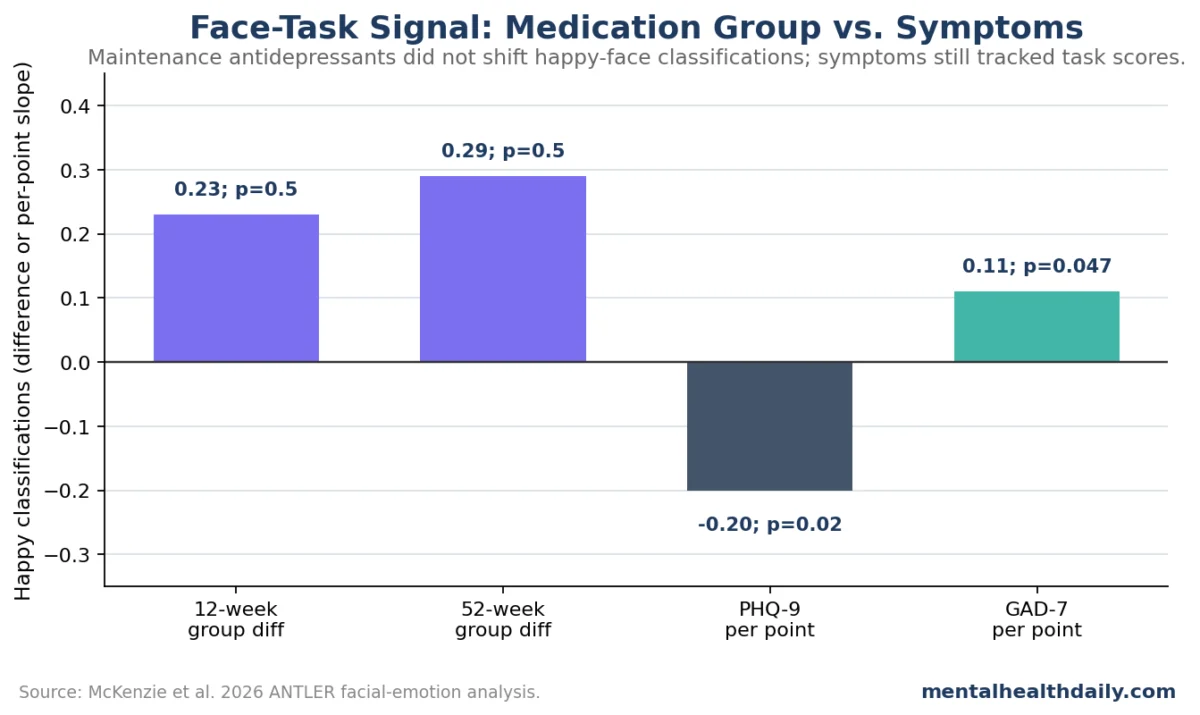
A recent mechanistic analysis, stemming from the comprehensive ANTLER trial, has found no discernible evidence that the maintenance of antidepressant treatment preserves a "happier" facial-emotion recognition pattern when compared to placebo substitution in individuals with recurrent depression. This finding remained consistent across both 12-week and 52-week follow-up periods, challenging a key component of a widely discussed cognitive neuropsychological model of antidepressant action, particularly in the context of long-term care for remitted patients.
The analysis, which rigorously examined data from 462 participants, revealed only marginal and statistically insignificant differences between groups. At 12 weeks, the adjusted mean difference was a mere 0.23 (95% CI −0.5 to 1.0, p = 0.5), and at 52 weeks, it was 0.29 (95% CI −0.5 to 1.2, p = 0.5). These figures suggest that the presumed benefit of ongoing medication in sustaining a positive emotional processing bias, as measured by a specific facial emotion recognition task, was not observed.
Understanding the Cognitive Neuropsychological Model
The cognitive neuropsychological model of antidepressants posits that these medications, particularly selective serotonin reuptake inhibitors (SSRIs), work by subtly shifting emotional processing toward more positive interpretations. This shift, theorized to occur relatively early in treatment, is believed to precede and contribute to the more obvious improvements in mood that patients experience. The hypothesis suggests that by altering how individuals perceive and interpret emotional cues, antidepressants create a more favorable psychological environment, potentially enhancing resilience and facilitating recovery.
One of the key ways this model has been explored in laboratory settings is through facial emotion recognition tasks. These tasks typically involve presenting participants with faces that gradually morph between different expressions, such as happy to sad, and asking them to classify the emotion. The expectation is that individuals on antidepressants might classify more faces as "happy" or take longer to classify a happy face as "sad," indicating a bias towards positive emotional interpretation. This "happy-face bias" was considered a potential biomarker for antidepressant efficacy and a direct measure of their mechanistic action.
The ANTLER Trial: A Rigorous Framework
The ANTLER trial, upon which this mechanistic analysis is based, was a large-scale, long-term clinical study designed to investigate relapse prevention in adults with recurrent depression. Participants in the trial were already considered "well" or in remission, making it an ideal setting to examine whether ongoing medication maintained a protective emotional processing bias, rather than initiating one. This distinction between acute treatment (when symptoms are present) and maintenance treatment (when symptoms are remitted) is critical for understanding the nuances of antidepressant mechanisms.
The original trial randomized 478 adults with recurrent depression. For this specific facial-emotion analysis, 462 participants who completed at least one computerized face task were included. The primary outcome measure for the task was the number of faces classified as happy out of a total of 45 trials, where faces morphed progressively from happy to sad. Participants were allocated to either continue their maintenance antidepressant treatment or undergo a gradual substitution with a placebo. This robust randomized controlled design provided a strong foundation for drawing conclusions about the comparative effects of maintenance treatment versus discontinuation.
No Sustained "Happy-Face Bias" Observed
Contrary to the predictions of the emotional-bias model in a maintenance context, the findings indicated no sustained advantage for the group continuing antidepressant treatment. In fact, at both the 12-week and 52-week follow-ups, the group that had discontinued antidepressants and switched to placebo showed a slightly higher estimated happy-face score, although these differences were very small and statistically unconvincing. This observation is significant because it suggests not merely a lack of positive effect for maintenance antidepressants, but a subtle leaning in the opposite direction, albeit without reaching statistical significance. The confidence intervals for the observed differences comfortably included the possibility of no meaningful difference at all.
Further statistical analyses, including a longitudinal model that incorporated participants with partial task data and an adherent-sample analysis, consistently failed to reveal a medication-group effect. This comprehensive approach reinforces the conclusion that, within the parameters of this study and this specific task, maintenance antidepressants did not preserve a measurable positive emotional processing bias. The absence of a discernible effect challenges the notion that this particular cognitive mechanism is a sustained signature of long-term antidepressant efficacy in remitted patients.
Symptom Linkage: The Task Is Not "Biologically Empty"

Despite the null findings regarding the maintenance antidepressant effect, the facial emotion recognition task itself was not deemed "biologically empty." The analysis revealed meaningful associations between the task performance and participants’ symptom scores, indicating its sensitivity to current psychological states. Depressive symptoms, as measured by the Patient Health Questionnaire-9 (PHQ-9), were consistently associated with fewer happy classifications. Specifically, each point increase on the PHQ-9 was linked to 0.20 fewer happy responses cross-sectionally and 0.09 fewer happy responses longitudinally.
Conversely, anxiety symptoms, assessed by the Generalized Anxiety Disorder 7-item scale (GAD-7), showed a small positive association, with each point linked to 0.11 more happy classifications. This complex pattern underscores that emotional processing is not a simple, monolithic construct where "all distress makes faces look sadder." It highlights the nuanced interplay between different symptom dimensions and emotional interpretation, reinforcing the caution against treating single emotional-processing tasks as universal mood biomarkers. While the task demonstrated sensitivity to current symptom levels, its utility as a direct discriminator of maintenance antidepressant efficacy in this specific context was not supported.
Antidepressant Mechanisms: A Broader Perspective
The cognitive neuropsychological model, particularly regarding the role of SSRIs in modulating emotional processing, remains a plausible framework for understanding antidepressant action in other contexts. SSRIs work by blocking the reuptake of serotonin in the brain, thereby increasing serotonin signaling. The theory suggests that this biochemical change can lead to shifts in how individuals process social and emotional information, creating better learning conditions over weeks and ultimately contributing to mood improvement.
Indeed, prior research has supported broader connections between antidepressants, symptoms, and emotional processing. For instance, Ahmed et al. reported emotional-processing effects in secondary analyses of the PANDA sertraline trial, and Bone et al. linked happy and sad facial-expression recognition to depressive symptom severity over time. These studies, however, often focus on acute treatment phases or different aspects of emotional processing. The ANTLER mechanistic analysis specifically narrows the claim, demonstrating that in the context of maintenance treatment for remitted recurrent depression, the preservation of a measurable happy-face advantage was not evident. This suggests that while emotional processing may be a factor in initial antidepressant response, its role as a sustained mechanism in long-term remission may differ or be less pronounced for this specific task.
Distinguishing Acute Treatment from Maintenance Care
A critical distinction highlighted by the ANTLER findings is the difference between acute and maintenance treatment contexts. Many studies investigating emotional-processing effects of antidepressants examine short-term exposure, exploring how early pharmacological changes might shift attention, memory, reward, or threat processing before a patient consciously feels better. In contrast, participants in the ANTLER trial were already well enough to enter a relapse-prevention trial. The clinical question was whether continuing medication preserved a protective state, not whether it initiated one.
It is plausible that a mechanism prominent during early treatment may fade over time, become redundant once symptoms are remitted, or only be detectable under more specific or stressful emotional tasks in a recovered state. This research implication suggests that future maintenance studies should exercise caution in assuming that early-treatment biomarkers remain stable or relevant after recovery. A truly useful long-term biomarker would need to not only change with treatment but also predict relapse before symptoms return and add information beyond standard clinical history. The ANTLER face-task data, while valuable, did not meet this high bar for a robust maintenance biomarker.
Clinical Implications and Future Directions
The ANTLER analysis offers valuable insights for both clinicians and researchers. For clinicians, the findings suggest that facial emotion recognition, as measured by this specific task, should not be relied upon as a stand-alone indicator of ongoing antidepressant biological activity in maintenance care. Instead, established clinical decision-making factors such as symptom history, relapse risk, side effects, patient preference, and prior discontinuation attempts remain more practical and reliable inputs. The study does not invalidate the effectiveness of antidepressants in preventing relapse, as demonstrated by the parent ANTLER trial, but rather refines our understanding of how they might work in the long term.
For researchers, the study emphasizes the need for a more nuanced approach to biomarker development in maintenance psychiatry. Future studies should explore a broader range of emotional and cognitive tasks, as medication-related changes might manifest in areas like reward learning, negative memory recall, threat vigilance, or rejection sensitivity, even if they don’t appear in a happy-to-sad morphing task. Moreover, the complexity of clinical states during discontinuation—where withdrawal symptoms can mimic relapse, and side effects can alter emotional experience—underscores the need for multi-modal assessments that can differentiate these factors.
The distinction between "mechanism" and "management" is paramount. This research provides a negative result for one specific mechanistic marker, informing our understanding of how drugs might work. However, it does not dictate clinical management decisions, which must always consider a patient’s individual relapse history, preferences, and the broader risk-benefit profile of continuing or discontinuing medication. The study trims a specific mechanism claim; it does not instruct stable patients to stop medication.
The challenges in identifying robust biomarkers for relapse prevention are considerable. A truly strong biomarker would need to demonstrate change with treatment, predict relapse before the re-emergence of symptoms, and offer additional predictive power beyond conventional clinical assessment. While emotional processing remains a plausible mechanism in other contexts, the ANTLER face-task data did not reach this high standard for a long-term maintenance biomarker. The road ahead for relapse prevention markers will likely involve combining several domains, including sleep stabilization, anxiety reduction, rumination changes, and a patient’s overall ability to recover if symptoms return. This comprehensive approach will be essential for advancing personalized and effective long-term care for recurrent depression.

