

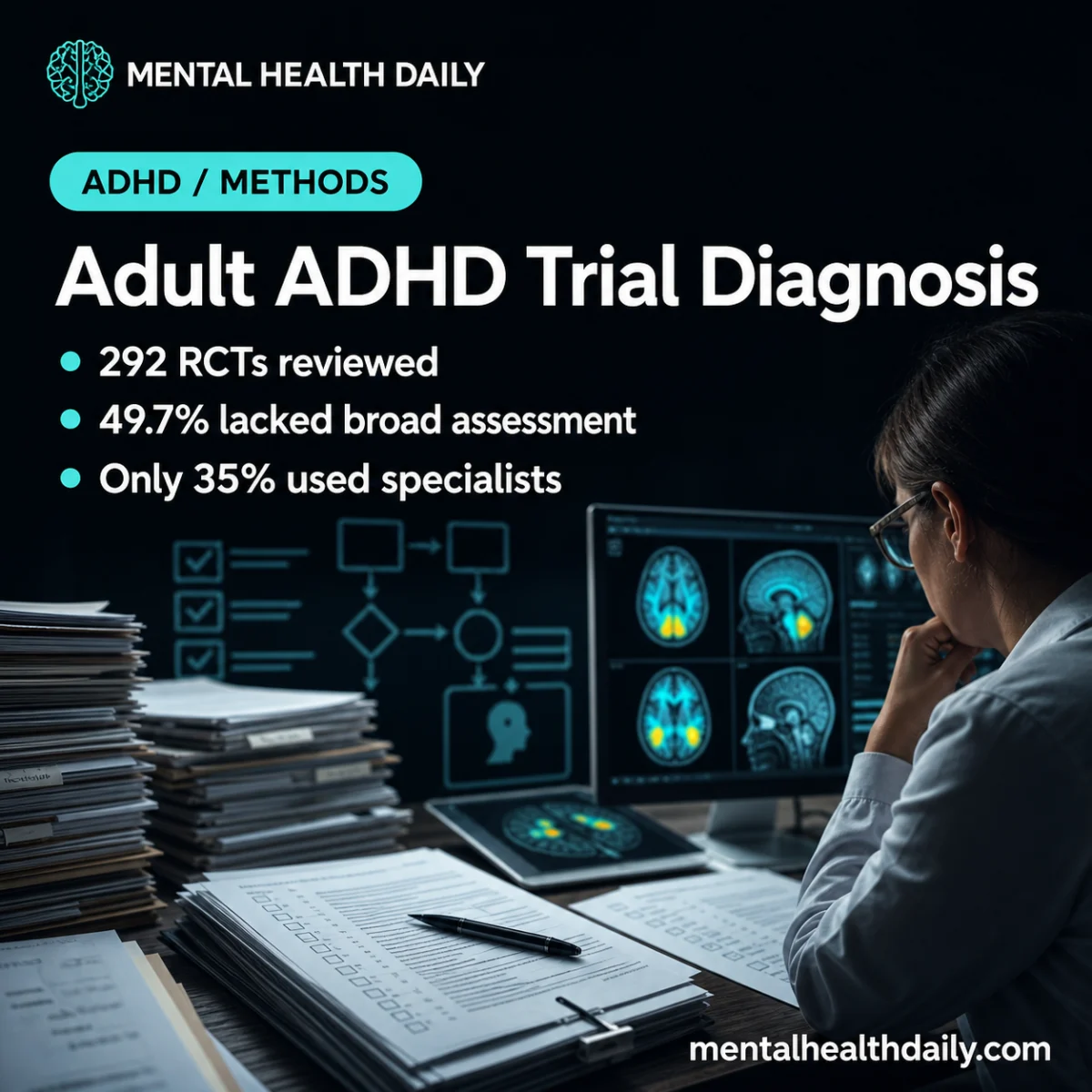
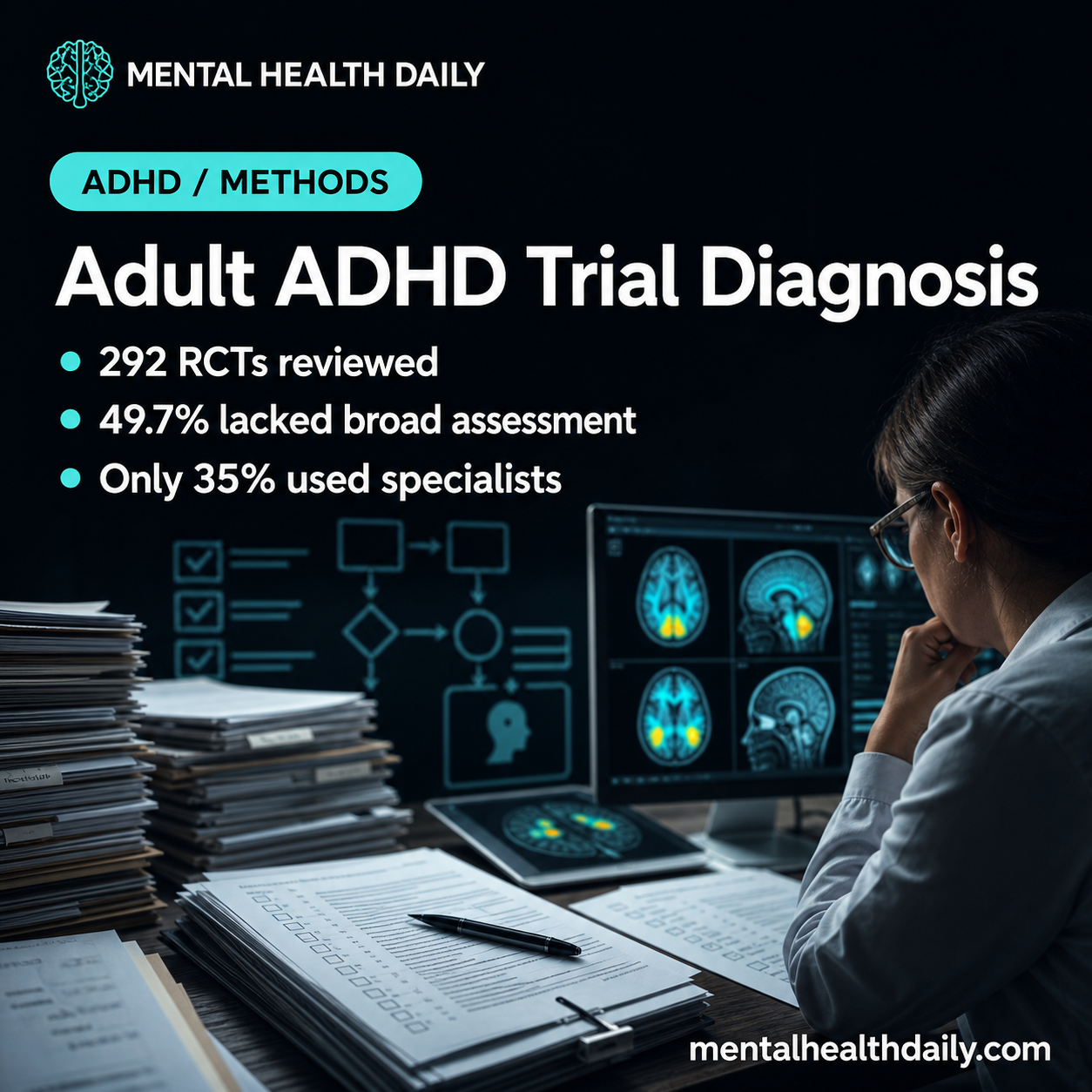
A comprehensive 2025 scoping review of 292 adult Attention-Deficit/Hyperactivity Disorder (ADHD) randomized controlled trials (RCTs) has revealed significant methodological shortcomings in diagnostic allocation, with nearly half of the studies failing to incorporate a general psychopathology assessment and only 35% reporting that qualified psychiatrists or psychologists assigned the ADHD diagnosis. These findings cast a critical light on the robustness and generalizability of the evidence base informing adult ADHD treatments, prompting calls for enhanced diagnostic rigor and transparency in future research.
Understanding the Intricacies of Adult ADHD Diagnosis
The challenge of diagnosing adult ADHD stems from its complex presentation and substantial overlap with numerous other mental health conditions. Unlike childhood ADHD, which is typically defined by observable behaviors, adult diagnosis necessitates a nuanced translation of childhood-observed signs into current adult symptom reports, alongside a retrospective childhood history, evidence of impairment, and crucially, the exclusion of better-explaining conditions. This process is inherently more intricate than simply ticking off checklist items.
Differential diagnosis, the cornerstone of sound psychiatric practice, involves systematically evaluating whether a patient’s symptoms are better accounted for by another medical or psychological condition before settling on a specific diagnosis. For adult ADHD, this step is not merely optional but imperative. Symptoms such as inattention, restlessness, impulsivity, sleep disruption, anxiety, depression, a history of trauma, substance use disorders, and various personality pathologies can all mimic or co-occur with ADHD, making accurate differentiation vital. For instance, chronic sleep deprivation can manifest as significant attentional deficits, while generalized anxiety disorder often involves difficulty concentrating due to worry. Similarly, the impulsivity seen in some personality disorders or the hyperactivity associated with bipolar disorder can be confused with ADHD symptoms. Without a thorough assessment to rule out these confounding factors, a diagnosis of ADHD may be prematurely or inaccurately assigned.
This complexity is underscored by the varying prevalence estimates for adult ADHD. While a World Federation consensus statement estimated the global prevalence of adult ADHD at 2.5%, a more expansive global meta-analysis in 2020 suggested symptomatic adult ADHD could be as high as 6.75%. This discrepancy highlights the critical importance of diagnostic criteria and rigorous assessment in distinguishing actual clinical diagnoses from mere symptom prevalence, a distinction that clinical trials must uphold to ensure their findings are meaningful and applicable.
Alarming Gaps in Diagnostic Rigor: The Review’s Core Findings
The scoping review, conducted by Studart et al., did not assert that participants in these trials were necessarily misdiagnosed. Instead, its focus was on a narrower, yet profoundly impactful, methodological claim: a significant proportion of RCTs do not adequately document diagnostic procedures robust enough to render their samples clinically interpretable.
Nearly Half of Trials Lacked General Psychopathology Assessment: A striking 49.7% of the reviewed RCTs allocated an ADHD diagnosis without incorporating a comprehensive assessment of general psychopathology. This figure combines studies that relied solely on clinical diagnoses, those that used clinical diagnoses supplemented by ADHD-specific rating scales, and those that employed ADHD-specific interviews or scales without a broader evaluation of mental health conditions. While these methods might identify individuals who exhibit ADHD-like symptoms, they are inherently limited in their ability to fully ascertain whether these presentations are, in fact, better explained by another mental disorder.
Mental health experts emphasize that such an omission can severely compromise the internal validity of a trial. If a study population is comprised of individuals whose attention problems stem from undiagnosed anxiety, depression, trauma, or sleep disorders, the observed effects of an ADHD-specific intervention may be diluted or misattributed. This limitation is further amplified by the high rates of comorbidity commonly observed in adult ADHD populations. While trials can and often should include patients with co-occurring conditions like anxiety, depression, or substance use, the critical flaw arises when researchers fail to transparently demonstrate how they distinguished primary ADHD from these overlapping presentations. Without clear documentation of this differentiation, the clinical utility of such trials becomes questionable, as it’s impossible for clinicians to confidently apply the findings to their own diagnostically complex patient populations.
Limited Specialist Involvement in Diagnosis: Further weakening confidence in diagnostic comparability, the review found that 190 studies (65%) either did not report who conducted the diagnostic assessment, used personnel other than a psychiatrist or psychologist, or relied on computer-based diagnostic tools. Only 35% of studies explicitly reported that a psychiatrist or psychologist assigned the ADHD diagnosis.
Psychiatric diagnosis is a specialized skill that transcends simple symptom counting. A skilled clinician brings extensive training and experience to the assessment process, enabling them to identify a wide array of conditions that can mimic or modify ADHD symptoms. These include, but are not limited to, bipolar disorder (particularly hypomania or mania), psychotic disorders, various sleep disorders (e.g., sleep apnea, insomnia), the effects of substance use or withdrawal, traumatic stress disorders (which can cause hyperarousal and concentration difficulties), autism spectrum disorder, specific learning disorders, medication side effects, and cognitive problems stemming from neurological conditions. The absence of a qualified specialist in the diagnostic process introduces a significant margin of error, potentially leading to the inclusion of participants whose primary issues are not ADHD, thereby distorting treatment effect estimates.
The Rising Tide of Adult ADHD Awareness and its Implications for Research
The past decade has witnessed a dramatic surge in public awareness and diagnosis of adult ADHD. This increased visibility, partly fueled by social media platforms, has a dual impact. On one hand, it empowers many adults to recognize legitimate impairment and seek professional help, leading to diagnoses and treatments that can profoundly improve their quality of life. On the other hand, social media can also circulate broad, often oversimplified, symptom lists that resonate with individuals experiencing a wide range of problems, not all of which are ADHD. Research by Yeung et al. (referenced in the original text) on the variable quality of ADHD content on platforms like TikTok highlights this challenge, underscoring why rigorous research diagnosis is more critical than ever.
This growing societal recognition places immense pressure on the scientific community to provide an equally robust evidence base. Adult ADHD diagnosis today carries significant weight, influencing access to stimulant medications, eligibility for workplace accommodations, academic support, disability claims, and even shaping an individual’s self-identity. If the foundational trials informing treatment guidelines cannot clearly demonstrate how they meticulously separated ADHD from its myriad mimics—such as anxiety, depression, bipolar disorder, substance use, chronic sleep debt, trauma, and autism—then the resulting evidence becomes exceedingly difficult to apply with confidence to the diverse and diagnostically complex adults now presenting for evaluation in clinics worldwide.
Broader Implications for Clinical Practice and Treatment Guidelines
The diagnostic weaknesses identified in this review have profound implications for both clinical practice and the development of evidence-based treatment guidelines.
Generalizability of Findings: When an adult ADHD RCT reports medication or psychotherapy effects, clinicians and patients alike need to critically evaluate the composition of the trial’s participant sample. A "weak diagnostic gate," characterized by insufficient psychopathology assessment or non-specialist diagnosis, makes the treatment effects harder to generalize to careful psychiatric practice. A specialist ADHD clinic, which routinely conducts thorough differential diagnoses, may find that the efficacy rates reported in such trials do not accurately reflect the outcomes in their more stringently selected patient population.
Distortion of Treatment Effect Estimates: Loose diagnostic entry criteria can skew treatment effect estimates in various directions. If a trial inadvertently includes individuals whose attention problems are primarily driven by conditions like sleep deprivation, depression, anxiety, stimulant misuse, or undiagnosed bipolar symptoms, the perceived efficacy of ADHD-specific treatments (e.g., stimulants or CBT for ADHD) may appear artificially smaller. This occurs because the intervention is targeting the wrong underlying mechanism in a subset of the participants.
Conversely, a trial sample that is overly filtered—for instance, selecting only uncomplicated, highly treatment-responsive, checklist-positive patients without significant comorbidities—might overstate the benefit of an intervention. This "clean efficacy sample" may not reflect the reality of a typical clinical setting, where ADHD frequently co-occurs with trauma, mood disorders, learning disabilities, and substance use disorders. The efficacy reported in such trials might be significantly higher than what is observed in a real-world, diagnostically complex patient population.
Impact on Adverse Event Interpretation: Diagnostic rigor also critically affects the interpretation of adverse events. If a trial sample includes undetected bipolar disorder, substance use disorder, sleep disorders, or trauma-related hyperarousal, stimulant tolerability and discontinuation rates may reflect the challenges of managing mixed pathology rather than the direct adverse effects or response to ADHD treatment alone. For example, a stimulant might exacerbate an underlying, undiagnosed bipolar disorder, leading to more severe adverse events and higher discontinuation rates that are then incorrectly attributed solely to ADHD treatment.
Clinical professionals widely agree that adult ADHD evidence must be graded, in part, by its diagnostic rigor. Treatment effect size, the incidence of adverse events, and dropout rates are far easier to interpret and apply when the study sample truly resembles the patients clinicians are endeavoring to treat in their daily practice.
A Call for Transparency and Rigor in Future Research
The Studart et al. review is not an argument for gatekeeping adults out of ADHD treatment but a powerful plea for cleaner evidence labels. The minimum standard for a useful adult ADHD trial report is not necessarily a "perfect" interview label, but rather sufficient detail to allow readers to reconstruct the diagnostic gate: who assessed participants, what methods were employed, and crucially, how researchers handled the potential for overlapping conditions.
For adult ADHD research, transparent reporting should explicitly name:
- The qualifications of the professionals who conducted the diagnostic assessment.
- The specific diagnostic tools and criteria used (e.g., DSM-5, specific structured interviews, rating scales).
- The procedures for assessing and ruling out competing explanations for ADHD-like symptoms (e.g., comprehensive psychopathology interviews, medical screenings).
- How comorbidity was identified, managed, and reported (e.g., whether comorbid conditions were allowed, and if so, how they were differentiated from primary ADHD).
These details are paramount for determining how a trial’s findings should be interpreted and applied. A stimulant trial underpinned by a strong diagnostic workup, involving specialist assessment and broad differential diagnosis, can confidently generalize its findings to specialist ADHD clinics. Conversely, a trial relying primarily on scale-based entry with limited comorbidity assessment may still provide valuable insights into medication response within a symptom-defined population, but its clinical meaning and generalizability are significantly narrower.
The review also exposes a critical transparency problem: papers that simply state participants "met DSM criteria" without detailing who assessed them and how competing disorders were evaluated provide a conclusion without the essential methodological context needed for trust and independent appraisal.
Future adult ADHD research does not need to exclude every diagnostically complex patient to be valid. In fact, pragmatic trials designed to study real-world ADHD with comorbidity are highly valuable. The reporting standard, however, remains consistent: researchers must explicitly state what comorbidities were present, what conditions were excluded, and how any diagnostic uncertainty was handled. This level of transparency is also a matter of fairness to patients, who deserve to know whether the trial results guiding their care were derived from individuals with a similar diagnostic complexity, medication exposure history, and comorbidity burden as their own.
In conclusion, the 2025 scoping review serves as a crucial wake-up call for the adult ADHD research community. As public awareness and the complexity of adult ADHD diagnosis continue to grow, the integrity of the evidence base depends critically on the rigor and transparency of diagnostic methodologies in clinical trials. By embracing higher standards for differential diagnosis and detailed reporting, researchers can ensure that treatment estimates are accurate, adverse events are properly understood, and ultimately, that the findings can be confidently and effectively applied to improve the lives of adults living with ADHD and related conditions.

