


A groundbreaking 2026 EEG study has unveiled a critical nuance in how the human brain processes and stores visual information, demonstrating that the inherent memorability of an image can strongly predict later recognition and significantly influence brain signals during encoding. The research, published by Deng et al., challenges a long-held assumption in cognitive neuroscience that brain signals observed during memory encoding, particularly those differentiating between later-remembered ("hits") and later-forgotten ("misses") items, are purely a reflection of the participant’s encoding success. Instead, the study reveals that stable item-level properties, specifically an image’s intrinsic memorability, play a substantial and often overlooked role, reshaping the interpretation of key electrophysiological markers like the N400 and LPC.
Unpacking the "Subsequent-Memory Effect" and Its Hidden Problem
For decades, cognitive neuroscientists have relied on subsequent-memory designs to investigate the neural underpinnings of memory formation. In this paradigm, researchers present a series of stimuli (e.g., images, words) to participants while recording their brain activity, often using electroencephalography (EEG). Later, participants are tested on their memory for these items, and the brain activity recorded during encoding is then sorted based on whether the item was subsequently remembered or forgotten. The differences in brain activity between "hits" (remembered items) and "misses" (forgotten items) are known as subsequent-memory effects (SMEs). These SMEs have traditionally been interpreted as direct indicators of successful encoding — that is, the brain being in a "better" state to process and consolidate information for later recall.
However, the Deng et al. study meticulously addresses a "hidden problem" within this powerful design: the assumption that later-remembered items are random. In reality, some images, words, or scenes possess an intrinsic quality that makes them inherently easier to remember for a majority of people, regardless of individual viewing effort or specific encoding strategies. This stable tendency for certain pictures to be remembered by many people, even across diverse viewers, is termed "image memorability." If a significant portion of "hits" in a memory experiment are simply items that are naturally more memorable, then the observed brain signals could be conflating two distinct ingredients: the participant’s active encoding state and the stimulus’s inherent, built-in memorability. The traditional interpretation, focused solely on the viewer’s encoding success, might thus be incomplete or even misleading.
The Role of Event-Related Potentials: N400 and LPC
To understand the study’s impact, it’s crucial to grasp the basics of Event-Related Potentials (ERPs). ERPs are small, voltage fluctuations in the brain’s electrical activity that are time-locked to a specific sensory, cognitive, or motor event. They are extracted from continuous EEG recordings and offer excellent temporal resolution, allowing researchers to track cognitive processes in milliseconds. Two ERP components were central to the Deng et al. findings:
- The N400: This is a negative-going waveform that typically peaks around 400 milliseconds after a stimulus presentation. It is widely associated with semantic processing, expectancy violations, and the integration of meaning. A more negative N400 often indicates difficulty in semantic processing or an unexpected stimulus. In memory research, changes in N400 amplitude during encoding have sometimes been linked to deeper semantic processing that facilitates later memory.
- The Late Positive Component (LPC): Following the N400, the LPC is a positive-going deflection that typically emerges from around 500-800 milliseconds post-stimulus and can persist for several hundred milliseconds. It is generally thought to reflect memory-related processes such as elaborative encoding, recollection, and evaluative processing, often signifying a greater allocation of attentional resources to a stimulus, particularly those that are novel, significant, or relevant to memory formation.
Deng et al.’s Innovative Approach and Behavioral Anchor
To untangle the intertwined influences of viewer-dependent encoding and item-dependent memorability, Deng and colleagues employed a sophisticated methodological approach. They utilized normed continuous memorability scores for their visual stimuli. These scores, derived from extensive prior research, quantify the intrinsic memorability of individual images across a large population, providing an objective measure of how "easy to remember" each picture is.
The behavioral results of their study unequivocally underscored the power of image memorability. Higher memorability scores strongly predicted later recognition success, with a statistically robust effect (z = 9.17, p < 0.001). Quantitatively, the researchers found that a mere 0.1 increase in an image’s memorability score raised the odds of it being recognized later by approximately 1.4 times. This "1.4x odds figure" serves as a crucial behavioral anchor, demonstrating that the intrinsic properties of the stimulus itself carried a substantial memory advantage, significantly shaping the likelihood of later recognition "hits." This finding alone provided compelling evidence that later remembered pictures are often not random, but rather those predisposed to be memorable.
Statistical Adjustment: Unmasking the True Drivers of Brain Signals
The true innovative thrust of the Deng et al. study lay in its statistical modeling. Recognizing that an EEG contrast between hits and misses could inadvertently mix participant-centered encoding states with image-centered memorability, they designed a model that included both memorability and recognition success as predictors for the observed ERPs. This sophisticated statistical adjustment allowed them to determine which factor — the inherent memorability of the image or the participant’s success in encoding it — was independently driving the neural signals.
The results were striking and profoundly altered the traditional interpretation of encoding-related ERPs:
- N400 Component: When memorability and recognition success were modeled together, the N400 amplitude was significantly predicted by image memorability (t = 5.66, p < 0.001). Crucially, later recognition success itself was not a significant predictor (t = 0.26, p = 0.794). This indicated that the N400 differences traditionally attributed to whether an item would be remembered or forgotten were, in fact, primarily driven by the inherent memorability of the image, rather than the success of the encoding process that would lead to later recall.
- LPC Component: The Late Positive Component followed a similar pattern. Memorability was a significant predictor of LPC amplitude, while recognition success, when considered alongside memorability, was not. This suggests that the processing advantages conferred by memorable images extend beyond initial semantic integration, influencing later, more elaborative memory and evaluative processing stages reflected by the LPC.
Interpretive Consequences for Cognitive Neuroscience
The "interpretive consequence" of these findings is profound: a brain signal measured during encoding can, in part, reflect the intrinsic properties of the item being shown, alongside — or even more strongly than — how successfully the participant encoded it. This necessitates a fundamental re-evaluation of how subsequent-memory effects are interpreted. While SMEs remain useful, their traditional "viewer-centered" interpretation (i.e., the brain was in a better encoding state) needs to be augmented with an "item-centered control."
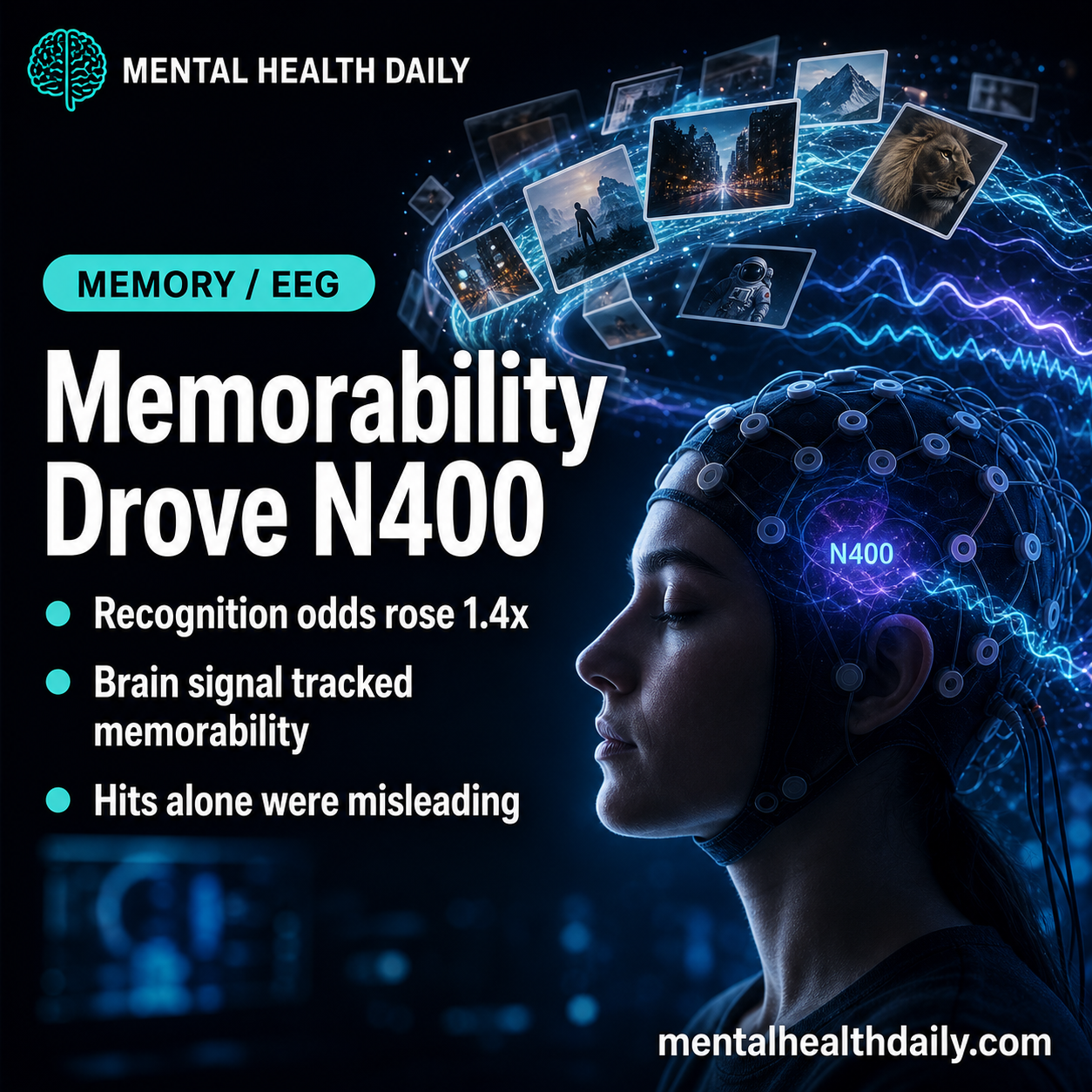
The N400 result is particularly illuminating given its strong association with semantic processing. Highly memorable images might possess inherent characteristics that facilitate semantic processing: they could be easier to label, richer in semantic associations, more visually distinctive, or more congruent with existing knowledge structures. Any of these properties could lead to a reduced N400 negativity during encoding (indicating easier processing) without requiring later recognition success to be the sole causal driver. The finding that the LPC also followed this pattern further strengthens the argument, suggesting that memorable images engage broader, advantageous encoding-stage processing, not just early semantic processing.
Historical Context and Methodological Refinements
The Deng et al. study builds upon existing bodies of work in cognitive psychology and neuroscience. Research into image memorability has a long history, demonstrating that memorability is a stable stimulus property across observers, with some images consistently remembered by nearly everyone. Simultaneously, ERP memory research has a rich tradition of carefully distinguishing neural signals at encoding from later recognition outcomes. The current study effectively bridges these two literatures, demonstrating that if a later "hit" is partly driven by the item’s intrinsic properties, then a simple EEG contrast between hits and misses can indeed overstate the viewer-side encoding explanation.
For future experimental design, the implications are straightforward and pragmatic. Researchers are encouraged to:
- Include item memorability as a predictor in their statistical models.
- Match stimuli across experimental conditions based on memorability norms.
- Utilize mixed-effects models that explicitly account for item-level variance.
These adjustments do not diminish the cognitive aspect of the research; rather, they make memory claims more precise and scientifically robust.
Broader Impact and Practical Applications
The ramifications of the Deng et al. study extend far beyond the confines of the laboratory, influencing fields from education and public health to clinical assessment and digital communication.
Educational Design: The design of educational materials, including textbooks, online learning modules, and infographics, heavily relies on visual aids. If a visual is naturally memorable, it may be retained better by students regardless of their individual encoding effort or attentional state. Conversely, visually flat or semantically thin visuals may be easily forgotten, even by highly attentive learners. This highlights the importance of incorporating principles of visual memorability into pedagogical design to enhance learning outcomes.
Public Health and Safety Communication: Warnings, instructions, and public health campaigns often use visual cues. Safety warnings on hazardous products, medication instructions, or emergency preparedness posters can significantly benefit from being designed with inherent memorability in mind. A memorable visual reminder or warning label can reduce the cognitive burden on the viewer, ensuring critical information is retained even under suboptimal attention levels.
Neuroimaging and Learning Claims: The study serves as a crucial caution for neuroimaging and EEG studies investigating learning. A study might inadvertently attribute a brain signal to factors like attention, motivation, or encoding quality when the underlying stimulus set quietly harbors significant differences in memorability. Images featuring faces, unusual objects, emotionally salient content, or strong scene structures may naturally elicit different ERPs simply because they are richer, more distinctive, and inherently more memorable stimuli. Researchers must therefore carefully consider and control for stimulus properties when drawing conclusions about neural mechanisms of learning.
Clinical Memory Assessment: While the study did not involve a clinical cohort, its findings have indirect but significant implications for diagnosing and understanding memory impairments. Memory concerns in clinical settings often involve patients noticing that some events or images "stick" while routine details vanish. This pattern, the study suggests, doesn’t exclusively prove or rule out a disorder; rather, it underscores that memory performance is always a complex interplay of individual (person), contextual, and stimulus properties. In the design of cognitive tests for memory impairment, it becomes critical to ensure that stimulus sets are balanced for memorability. If a test inadvertently uses unusually memorable pictures in one condition and forgettable ones in another, any apparent patient difference could partly reflect stimulus imbalance rather than a pure cognitive deficit.
Replication and Methodological Rigor: The findings also offer a compelling explanation for why replication studies in memory research sometimes yield conflicting results. If two studies utilize different image sets, the observed contrast between later-remembered and later-forgotten items can change significantly simply because the underlying stimulus pool possesses different memorability characteristics. Stronger experimental designs will either reuse normed stimuli, actively balance memorability across conditions, or treat item identity as a source of variance to be accounted for in statistical models, rather than as mere background noise.
Statistical Adjustment: The Central Contribution
The true genius of the Deng et al. study lies in its statistical methodology. The finding that memorable images were remembered more often is, to some extent, intuitive. However, the stronger, paradigm-shifting claim emerges from their decision to incorporate both image memorability and later recognition success into the same statistical model. By doing so, they could disentangle the unique contributions of each factor to the observed brain signals. The revelation that N400 and LPC effects followed memorability after accounting for recognition success is what transforms this from a restatement of common sense into a pivotal reinterpretation of neural encoding mechanisms.
This research does not diminish the role of individual effort, attention, strategy, sleep, or emotion in memory formation. These participant-centered factors undeniably matter. Instead, Deng et al. provide a crucial calibration: they demonstrate that item-level properties can be sufficiently strong to fundamentally reshape our interpretation of neural activity during memory encoding. Remembered items, they argue, are a product of both the person and what was shown. This holistic view, integrating the brain, the person, and the stimulus, makes neural encoding studies more robust, specific, and ultimately, more accurate in their claims about how memories are formed. It underscores that better stimulus design, whether for educational purposes or health communication, can actively reduce the burden placed on the viewer’s attention and effort alone.

