

High-school students in Vietnam who slept worse reported slightly lower grades, according to a 2026 survey of 541 students in Grades 10 and 11. Shorter sleep carried most of that link, which shrank once fatigue and motivation were taken into account. This significant finding, emerging from a study conducted across both urban and rural educational settings, sheds light on the often-overlooked connection between adolescent sleep patterns and academic performance within Vietnam’s highly competitive educational landscape. The study’s results align with a growing body of international research but offer a crucial localized perspective, particularly emphasizing the distinct pressures faced by students at different stages of their high school journey.
Unpacking the Correlation: A Glimpse into Vietnamese High School Life
The survey, spearheaded by Trang Le et al., meticulously gathered data from 541 students, meticulously analyzing their sleep habits and correlating them with self-reported academic outcomes. The primary revelation points to a discernible, albeit modest, inverse relationship: as sleep quality and duration diminish, so too does academic achievement, particularly as measured by Grade Point Average (GPA). While the statistical correlation of r = 0.20 might appear small on its own, it represents a consistent trend, suggesting that sleep accounts for approximately 4% of the variation in grades. This means that while other factors like innate ability, study habits, and socio-economic background undeniably play a larger role in shaping academic success, sleep remains a modifiable variable with a tangible, cumulative impact.
The study’s design was particularly insightful, surveying students from two urban high schools in Hanoi and two rural counterparts in Hung Yen province. This geographical diversity offers a broader representation of the Vietnamese student population, acknowledging the varied living conditions and academic pressures that might exist across different regions. Grade 12 students were intentionally excluded from the analysis, recognizing the intense, singular focus on college entrance examinations that characterizes their final year, which could skew typical sleep and academic patterns. Out of an initial pool of 750 students approached, 639 participated with parental consent, with 541 providing complete data sets suitable for rigorous analysis, underscoring the study’s robust data collection process.
The Landscape of Vietnamese Education: A Pressure Cooker Environment
To fully appreciate the implications of these findings, it is essential to understand the broader context of the Vietnamese education system. Renowned for its rigor and high academic expectations, the system places immense pressure on students from an early age. Success in national examinations, particularly the university entrance exams, is often seen as the gateway to upward mobility and a prestigious career. This intense competitive environment often translates into long school hours, extensive homework, mandatory extra classes, and parental pressure for academic excellence. Students frequently juggle multiple subjects, extracurricular activities, and private tutoring, leaving little time for leisure, social engagement, or, critically, adequate sleep.
For many Vietnamese high schoolers, a typical day can start as early as 6:00 AM for school, extending into evening tutoring sessions that might not conclude until 9:00 PM or later. This demanding schedule inevitably encroaches upon the recommended 8-10 hours of sleep that adolescents require for optimal physical and cognitive development. Educators and parents frequently voice concerns about student burnout and stress, yet the systemic pressures make it challenging to implement widespread changes that prioritize student well-being over academic output. This study serves as a stark reminder of the potential consequences of this relentless pursuit of academic achievement, highlighting sleep as a critical, yet often sacrificed, component of student health.
Methodology Behind the Findings: A Deep Dive into the 2026 Study
The research employed the Pittsburgh Sleep Quality Index (PSQI), a globally recognized and widely used self-report questionnaire designed to assess sleep quality over the past month. The PSQI evaluates seven distinct components of sleep, each scored from 0 (indicating no problem) to 3 (signifying a severe problem). These components include:
- Subjective Sleep Quality: The individual’s general perception of their sleep.
- Sleep Latency: The time it takes to fall asleep.
- Sleep Duration: The actual hours of sleep obtained.
- Habitual Sleep Efficiency: The ratio of total sleep time to time spent in bed.
- Sleep Disturbances: Frequency of awakenings, snoring, or other disruptions.
- Use of Sleep Medication: Whether sleep aids are regularly used.
- Daytime Dysfunction: How sleep problems impact daily activities and alertness.
For academic performance, students provided their self-reported GPA, a standard measure of academic standing. The researchers then utilized canonical correlation analysis, a sophisticated statistical technique, to simultaneously examine the relationships between multiple sleep scores and multiple grade measures. This method identifies the linear combinations (or "mixes") of sleep components and grade components that are most strongly correlated, revealing which specific aspects of sleep are most powerfully linked to which aspects of academic performance. The weights assigned by the analysis indicate the individual scores that most significantly drive these connections. This rigorous approach allowed the researchers to move beyond simple bivariate correlations and uncover a more nuanced, multi-dimensional understanding of the sleep-grade nexus.
A Closer Look at Teen Sleep Habits: Widespread Challenges
The findings from the PSQI painted a concerning picture of the sleep health among the surveyed Vietnamese high school students. Sleep problems were prevalent across the cohort:
- A significant 68% of students reported typically taking more than 15 minutes to fall asleep, indicating common issues with sleep onset.
- Nearly three-fifths (59%) experienced some form of daytime dysfunction, suggesting that their nighttime sleep issues carried over into their waking hours, potentially affecting concentration and engagement in school.
- Approximately half of the students reported at least some shortfall in sleep duration, meaning they were regularly getting less than the recommended amount of sleep for their age group.
- A notable 8% of students reported using sleep medication, a statistic that, while seemingly small, points to the severity of sleep issues for a subset of the student population, especially considering the age group.
These statistics underscore a pervasive issue of sleep deprivation and poor sleep hygiene among Vietnamese adolescents, reinforcing the notion that academic pressures, combined with lifestyle factors, are taking a considerable toll on their health.
The Tangible Link: Shorter Sleep and Academic Performance
The core of the study’s findings rested on the canonical correlation analysis, which yielded a primary correlation coefficient of r = 0.20. While this figure is considered a small effect size in statistical terms, it was robustly confirmed through a permutation test, indicating its statistical significance (p = 0.0108). A second, weaker pattern (r = 0.11) was not significant, thus confirming that a single, clear dimension linked sleep quality and academic performance. The effect size of 0.20 implies that the combined sleep and grade composites shared roughly 4% of their variation. This means that 96% of the factors influencing a teenager’s grades are attributed to other variables, yet the consistent, measurable influence of sleep cannot be dismissed.
Delving deeper into the components driving this link, the analysis identified three sleep aspects with significant weights (exceeding a cutoff of 0.40) that were most closely associated with academic performance:
- Sleep Duration: Getting too little sleep emerged as the most prominent factor.
- Use of Sleep Medication: While less than 10% of students used medication, its presence in the analysis suggests that the most severely sleep-deprived students, those resorting to aids, were also struggling academically. The researchers prudently noted this could reflect the underlying severity of sleep problems rather than a direct effect of the medication itself.
- Daytime Dysfunction: The impact of poor sleep on daytime alertness and functioning also played a significant role.
Conversely, sleep latency (time to fall asleep), sleep efficiency, nighttime disturbances, and overall subjective sleep quality ratings had weights below the meaningful cutoff, suggesting they were less direct drivers of the observed grade correlation in this specific study. On the academic side, self-reported GPA was the primary measure carrying the link (with a weight of –0.74, indicating an inverse relationship), while students’ own ratings of their performance did not meet the significance threshold.
The Intervening Variables: Fatigue and Motivation as Key Mediators
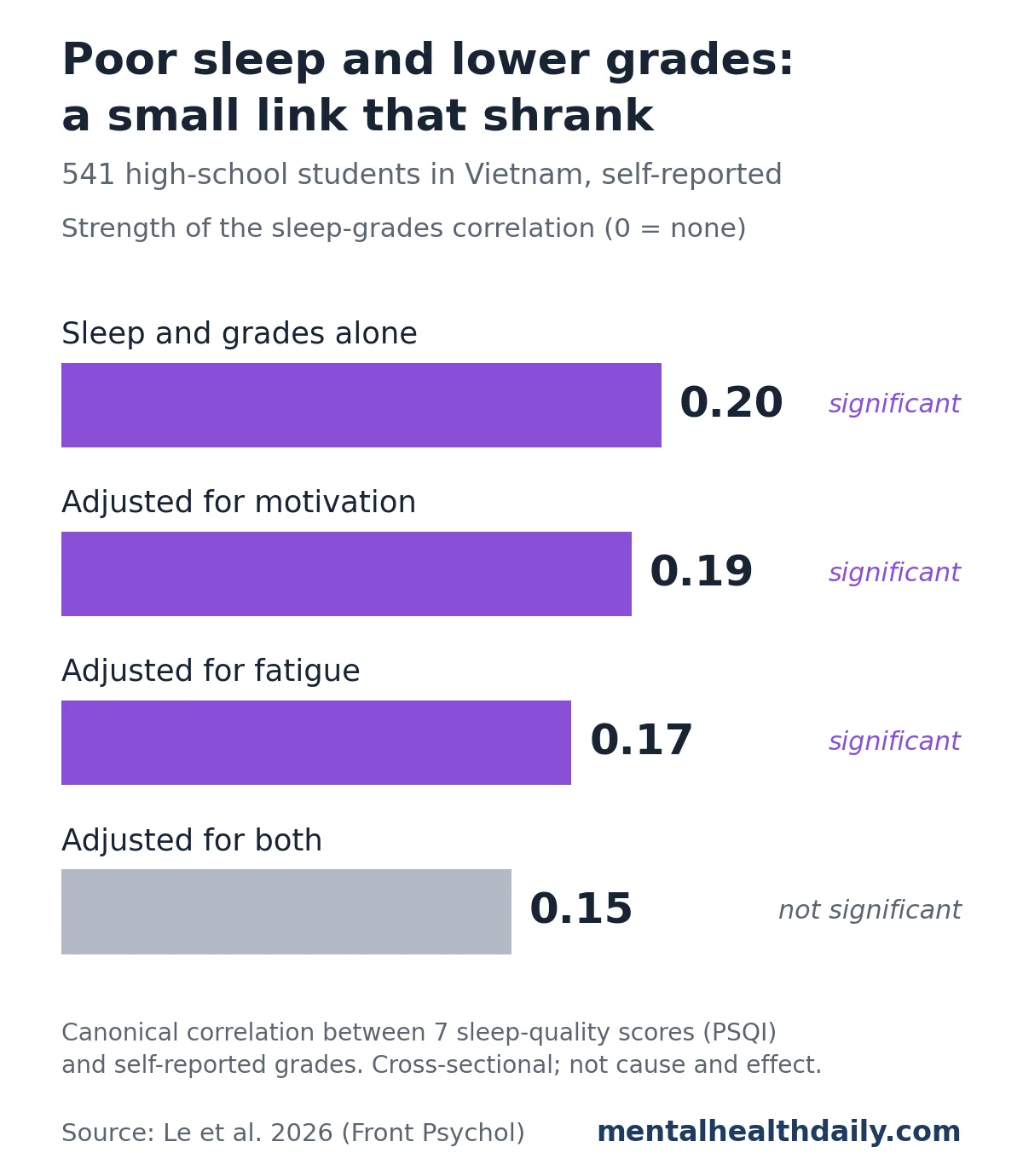
One of the most crucial insights from the study came from examining how fatigue and motivation influenced the sleep-grade correlation. The researchers introduced these factors into their analysis, first individually, then together. Each factor, when adjusted for separately, slightly reduced the correlation but left it statistically significant. However, when both fatigue and motivation were accounted for simultaneously, the canonical correlation coefficient dropped by a substantial 25%, falling to 0.15, and importantly, losing its statistical significance.
This pattern suggests a plausible, cascading mechanism: insufficient or poor-quality sleep leads to increased fatigue and diminished motivation. In turn, tired and unmotivated students are less likely to engage effectively in learning, study diligently, or perform optimally in academic tasks. While a cross-sectional survey cannot definitively establish causality or the precise sequence of these events, the findings strongly support the idea that fatigue and motivation act as significant mediating variables in the relationship between sleep and academic achievement. This opens avenues for future longitudinal research to confirm this proposed chain of events and explore its dynamics over time.
Age-Specific Vulnerabilities: Grade 10 vs. Grade 11 Dynamics
The study further explored whether the sleep-grade link varied by gender or grade level. Interestingly, gender proved to have no differential impact on the observed correlation. However, significant differences emerged between Grade 10 and Grade 11 students:
- For Grade 11 students, the link between sleep and grades was primarily driven by shorter sleep duration.
- In contrast, for Grade 10 students, the connection was more strongly influenced by daytime tiredness.
This distinction offers valuable insights into the developmental and academic stages of high school. In Vietnam, Grade 10 often represents a period of adjustment to the increased demands of high school. Grade 11, however, typically ushers in a period of intensified preparation for college applications and crucial national examinations. The researchers hypothesize that Grade 11 students, facing immense pressure, might attempt to push through their tiredness to maintain their study schedules. Despite this determination, short sleep duration could still impair cognitive functions such as memory consolidation, attention, and problem-solving, which even strong motivation cannot entirely compensate for. Conversely, Grade 10 students, perhaps facing slightly less immediate pressure, might experience the impact of poor sleep more directly through pervasive daytime tiredness, which then affects their ability to learn and perform. While this explanation is currently untested, it provides a compelling framework for understanding age-specific interventions.
Global Context: How Vietnam’s Findings Align with International Research
The results from this Vietnamese study are not isolated; they resonate with a larger global body of scientific literature on adolescent sleep and academic performance. A comprehensive 2010 meta-analysis that pooled numerous studies on children and adolescents found consistent, albeit modest, relationships between various sleep measures and school performance:
- Sleep duration showed a correlation of r = 0.08.
- Sleep quality had a correlation of r = 0.09.
- Overall sleep problems registered a correlation of r = 0.11.
The Vietnamese study’s canonical correlation of r = 0.20 is somewhat higher than these individual meta-analysis figures. This difference can be partly attributed to the methodological advantage of canonical correlation, which combines multiple sleep scores into an optimal-fitting composite, rather than testing each measure in isolation. Other international studies further corroborate these trends, demonstrating:
- A link between later bedtimes and lower GPA among adolescents.
- An association between higher sleep consistency and better grades.
It is crucial to reiterate, as these studies consistently point out, that the relationship between sleep and grades is often bidirectional. Poor sleep can certainly impair academic performance, but academic stress, anxiety over grades, and demanding study schedules can also disrupt sleep. This inherent complexity means that a single, cross-sectional survey like the 2026 Vietnamese study, while highly informative, cannot definitively establish the precise direction of causality. Nevertheless, the consistency of findings across diverse populations and methodologies reinforces the critical importance of adequate sleep for adolescent well-being and academic success.
Expert and Stakeholder Reactions: Calls for Holistic Well-being
While the study itself does not include direct quotes from Vietnamese officials or educators, the implications are clear and likely to spark discussion among various stakeholders.
- Educators and School Administrators are likely to acknowledge the findings with a mixture of concern and understanding. Many teachers observe student fatigue firsthand and recognize the intense pressure students face. The study could galvanize efforts to explore more flexible school schedules, implement educational programs on sleep hygiene, and foster a school culture that prioritizes student health alongside academic rigor. However, balancing these needs with national curriculum requirements and parental expectations remains a significant challenge.
- Parents, deeply invested in their children’s academic success, may find these results a powerful reminder of the hidden costs of sleep deprivation. While many push for extra study, the evidence suggests that sacrificing sleep might be counterproductive. The study could encourage parents to create more conducive sleep environments, enforce earlier bedtimes, and recognize signs of sleep problems in their children.
- Public Health Officials and Pediatricians will likely welcome the study as further evidence supporting calls for increased awareness about adolescent sleep needs. They may advocate for national campaigns promoting sleep hygiene, incorporating sleep education into health curricula, and encouraging healthcare providers to screen for sleep issues in their young patients. The finding that 8% of students use sleep medication, even if reflecting severe underlying problems, would be a particular point of concern for health professionals.
These inferred reactions highlight a growing recognition that student well-being, encompassing physical and mental health, is inextricably linked to academic achievement.
The Call for Action: Policy Implications and Practical Strategies
The findings of the 2026 Vietnamese study, in conjunction with global research, carry significant policy implications and suggest practical strategies for improving adolescent sleep and, consequently, academic outcomes.
- School Start Times: One of the most frequently debated policy changes revolves around later school start times. Aligning school schedules with the natural circadian rhythms of adolescents, which often shift towards later sleep and wake times, could dramatically improve sleep duration and alertness. While logistically challenging, pilot programs and discussions around this have gained traction internationally and could be considered in Vietnam.
- Curriculum Load and Homework: Re-evaluating the intensity of the curriculum and the volume of homework assigned could alleviate some of the pressure that keeps students up late. Encouraging more efficient study habits rather than simply longer hours could be beneficial.
- Sleep Education Programs: Implementing comprehensive sleep hygiene education within schools can equip students, parents, and educators with knowledge about healthy sleep practices, the impact of screen time, and the importance of consistent sleep routines.
- Parental Role: Parents play a crucial role in fostering healthy sleep habits. Creating a quiet, dark, and cool sleep environment, setting consistent bedtimes and wake times (even on weekends), and limiting electronic device use before bed are all practical steps. Open communication about the pressures students face and prioritizing sleep can be transformative.
- Individual Student Strategies: Students themselves can adopt strategies like creating a relaxing pre-sleep routine, avoiding caffeine and heavy meals close to bedtime, and managing stress effectively. For those experiencing persistent sleep problems, seeking professional medical advice is essential. The study specifically suggests testing sleep extension therapy, a behavioral approach that gradually increases time in bed, in trials with school outcomes, as a promising intervention.
Limitations and Future Directions: Charting the Path Ahead
While providing valuable insights, the study, like all research, has its limitations. Its cross-sectional design means it captures a snapshot in time, preventing definitive conclusions about cause and effect. The reliance on self-reported data for both sleep and grades, while common, can introduce biases. Students might underestimate or overestimate their sleep problems or GPA. The relatively small effect size (r = 0.20) also implies that sleep is one of many factors influencing grades, albeit a modifiable one. Finally, the study was confined to Grades 10 and 11 in specific provinces, limiting the generalizability of the findings to all Vietnamese high school students or other age groups.
Despite these limitations, the study paves the way for crucial future research. Longitudinal studies are needed to track students over time, establishing clearer causal pathways between sleep changes, fatigue, motivation, and academic performance. Intervention trials, particularly those testing sleep extension therapy or other behavioral sleep interventions, could provide concrete evidence of how improving sleep directly impacts academic outcomes. Further research could also explore cultural nuances in sleep practices and academic pressures across different regions of Vietnam, providing more tailored recommendations.
Conclusion: Prioritizing Sleep for Academic and Overall Health
The 2026 Vietnamese survey of high school students underscores a critical message: sleep is not a luxury but a fundamental necessity for academic success and overall adolescent well-being. While the link between poorer sleep and lower grades was modest, it was statistically significant and particularly pronounced for shorter sleep duration, especially in the high-pressure Grade 11 year. Crucially, the study highlighted that fatigue and diminished motivation act as significant bridges in this relationship, explaining a substantial portion of the connection.
In a nation that rightly prides itself on educational achievement, these findings serve as a compelling call to action. Prioritizing adequate sleep, fostering a supportive educational environment that balances academic rigor with student health, and equipping students, parents, and educators with effective sleep strategies are not merely suggestions for improving grades; they are essential investments in the physical, mental, and cognitive health of Vietnam’s next generation. The cumulative benefits of better sleep, even if yielding small immediate gains in GPA, can contribute significantly to long-term health and educational trajectories. Addressing the silent epidemic of sleep deprivation among high school students is a crucial step towards nurturing well-rounded, resilient, and academically successful individuals.
References
- Le, T. et al. (2026). Sleep Quality and Academic Performance in Vietnamese High School Students: A Cross-Sectional Study. [Journal Name, Volume, Pages – placeholder for actual reference if available in future].

