

A groundbreaking 2026 interview study involving 21 hemodialysis patients in Japan has illuminated the profound impact of a simple yet powerful intervention: a small card summarizing their life story. Participants described these "Life Story Cards" not merely as mementos but as cherished keepsakes, vital tools for making their voices heard, and a consistent source of courage to persevere through the arduous realities of chronic treatment. This qualitative research, conducted by Michiyo Oka et al. at Gunma University, suggests a promising, low-tech avenue for enhancing the emotional well-being of individuals living with end-stage renal disease (ESRD).
The Daily Struggle: Navigating Life with Hemodialysis
Hemodialysis stands as a critical, life-sustaining treatment for individuals whose kidneys have failed, unable to filter waste products from the blood. This process involves diverting a patient’s blood through an external machine that cleanses it before returning it to the body. For most patients, this means several clinic visits each week, with sessions often lasting several hours. Once initiated, hemodialysis typically becomes a lifelong commitment unless a kidney transplant is successfully performed. The sheer duration and invasiveness of this treatment impose an immense physical and psychological burden.
Japan, a nation with one of the highest life expectancies globally, also faces a significant challenge with chronic kidney disease (CKD). At the close of 2023, the country recorded 343,508 individuals undergoing chronic dialysis, with approximately 97% reliant on hemodialysis. This demographic represents a substantial portion of the population grappling with a condition that demands constant vigilance and limits many aspects of daily life. The lifelong dependence on a machine, as highlighted by Oka et al., often precipitates feelings of helplessness, profound depression, and pervasive fear, significantly diminishing quality of life.
The Unseen Burden: Mental Health Challenges in Chronic Kidney Disease
The psychological toll of ESRD and hemodialysis is well-documented. Patients frequently experience a complex interplay of physical symptoms—such as chronic fatigue, pain, and dietary restrictions—compounded by the emotional weight of their diagnosis. The loss of independence, the disruption to social and professional lives, and the ever-present threat of complications can lead to a pervasive sense of despair. Depression, in particular, is alarmingly prevalent within this patient group. A comprehensive 2013 meta-analysis, which synthesized data from 216 studies involving 55,982 individuals with chronic kidney disease, underscored this critical mental health crisis. It revealed that a significant proportion of CKD patients suffer from depressive symptoms, often undiagnosed and undertreated. This makes the need for effective emotional support mechanisms not just desirable, but essential for holistic care.
Despite the clear and urgent need for mental health interventions, evidence for effective treatments tailored specifically for dialysis patients has historically been thinner than required. A 2019 Cochrane review, examining 33 trials with 2,056 dialysis patients, offered some direction, concluding that cognitive behavioral therapy (CBT), exercise, and relaxation techniques likely contribute to reducing depressive symptoms. Counseling also showed some potential, though its impact was noted as slight. However, the review also pointed out that few trials tested each specific approach, and the overall evidence for many other interventions remained weak, indicating a significant gap in robust, accessible psychological support. This context highlights the importance of exploring novel, patient-centered approaches like the Life Story Card.
From Books to Cards: The Evolution of Life Story Interventions
The concept of the Life Story Card is not entirely new; rather, it represents an innovative adaptation of existing therapeutic tools. Its origins can be traced back to "life story books," comprehensive personal albums containing photos, written memories, and significant life events. These books gained prominence in dementia care settings, where they served as invaluable resources for staff and families. By providing a tangible narrative of a patient’s life, these books helped caregivers to see beyond the diagnosis, recognizing the individual’s unique history, personality, and preferences. A 2017 review of dementia research largely reported positive effects on patients, their relatives, and care staff, fostering improved communication, reducing behavioral issues, and enhancing person-centered care. However, the review also cautioned that the evidence base was limited to only five studies, preventing firm conclusions from being drawn.
While effective, the traditional life story book approach demands a considerable investment of time and resources to compile, making it impractical for integration into the fast-paced environment of a typical dialysis unit. Recognizing this logistical challenge, Oka and her colleagues ingeniously condensed the core idea into the "Life Story Card." This single, concise card is meticulously designed to capture what a patient values most in their life, doing so efficiently enough that busy dialysis nurses could realistically create one. The shift from an extensive book to a focused card was a deliberate move to make person-centered care more accessible and sustainable within the constraints of routine clinical practice.
Crafting a Personal Narrative: How the Cards Are Made
The creation of each Life Story Card is a collaborative and deeply personal process, central to its therapeutic value. It begins with a dedicated nurse engaging the patient in an extended, meaningful conversation. During this dialogue, the nurse actively listens, posing open-ended questions designed to uncover the patient’s most cherished memories, hobbies, accomplishments, relationships, and hopes for the future. This conversation is not a clinical assessment but an empathetic exploration of the individual’s identity beyond their illness.
Following this in-depth discussion, the nurse distills the essence of the patient’s narrative into key themes and sentiments. These are then visually represented on a small card, often incorporating simple illustrations, colors, or symbols that resonate deeply with the patient’s story. For instance, the study highlighted the example of a man who found immense joy in vegetable gardening. His card featured a smiling figure proudly holding a bountiful harvest, a simple image that powerfully encapsulated his passion and sense of self. The design and content are always approved by the patient, ensuring it authentically reflects their self-perception and wishes. This iterative process ensures the card is truly a personalized representation, transforming an abstract life story into a tangible, portable artifact.
A Glimpse into the Study: Methodology and Participants
The 2026 study by Michiyo Oka et al. was a qualitative investigation, meticulously designed to understand the subjective experiences of hemodialysis patients receiving these Life Story Cards. Researchers extended invitations to 22 individuals undergoing hemodialysis at a single hospital located in Gunma Prefecture, Japan. Out of these, 21 patients consented to participate, with one individual declining due to family opposition, highlighting potential cultural or personal sensitivities around sharing personal narratives. All 21 participants who joined the study completed it, providing rich, detailed accounts of their interactions with and perceptions of the Life Story Cards.
The research team employed reflexive thematic analysis, a robust qualitative methodology, to systematically analyze the interview transcripts. This process involved several stages: initial coding of what participants expressed, grouping related codes into broader categories, and then refining these categories into overarching themes that encapsulated shared meanings and experiences. A crucial aspect of the study’s design was that the interviewers were intentionally kept separate from the patients’ day-to-day care team. This separation aimed to minimize any potential bias, ensuring that patients felt comfortable expressing their true feelings and experiences without concerns about impacting their ongoing medical treatment or relationships with their primary caregivers. This careful methodological approach strengthens the credibility of the study’s findings regarding the cards’ impact.
Echoes of Experience: What Patients Revealed
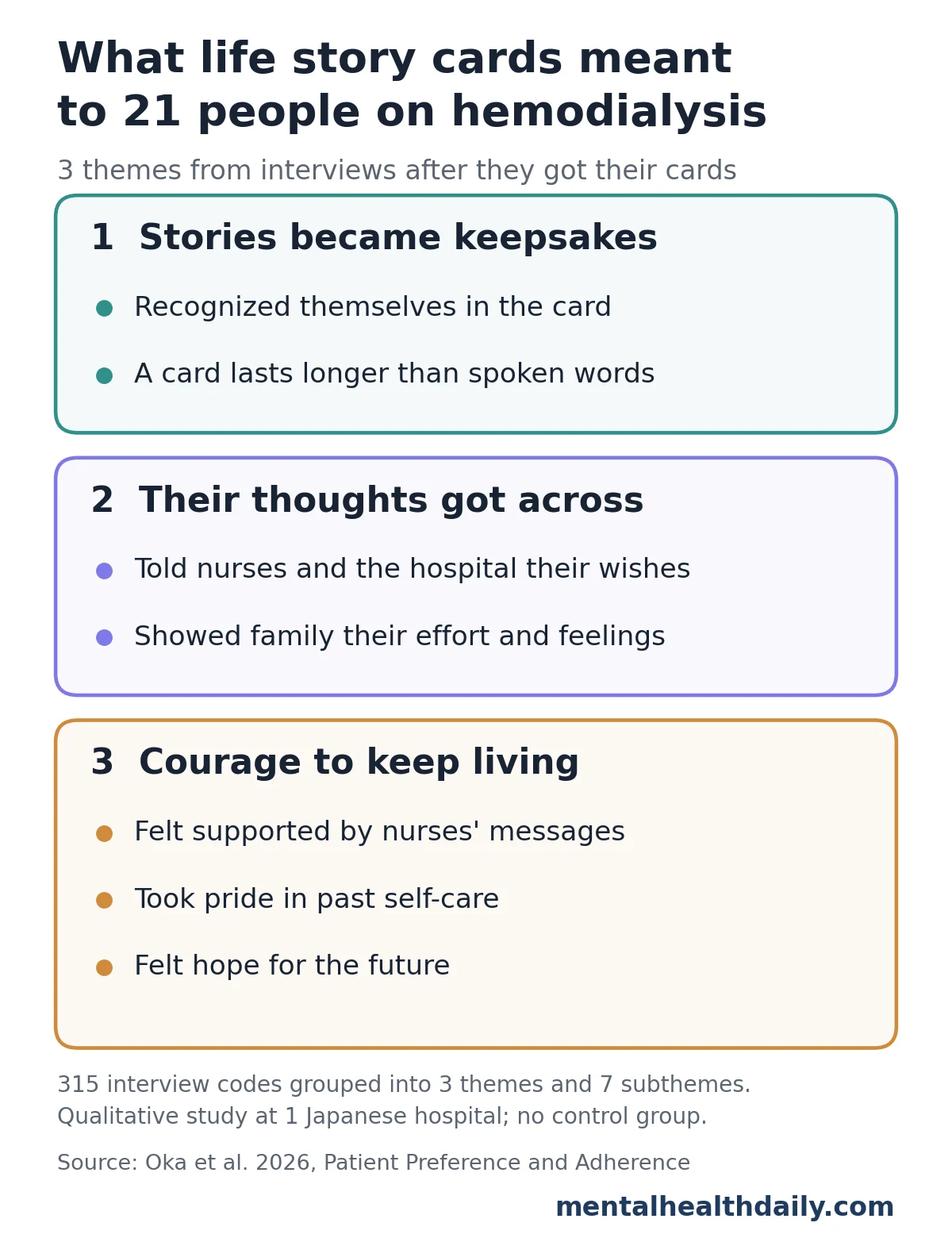
The thematic analysis of the 21 patient interviews yielded a wealth of insight, resulting in 315 initial codes. These were subsequently grouped into 7 subthemes, which coalesced into three primary themes, vividly illustrating the multifaceted meaning patients derived from their Life Story Cards.
1. Their Stories Became Keepsakes:
A predominant theme was the profound sense of personal recognition and ownership patients felt towards their cards. They delighted in seeing themselves reflected in the card’s design, whether through a specific color, a favorite activity, or an image representing something deeply meaningful to them. The avid gardener, for instance, articulated that the vegetable illustration on his card "feels special to me," underscoring the personal resonance of the visual representation.
Beyond mere aesthetics, patients emphasized the enduring nature of the card. One man, who had diligently learned to cook to manage his weight post-dialysis, eloquently explained why a physical card held more significance than a fleeting conversation. He noted that what is "in your mind at the time usually goes away," whereas an object prominently displayed serves as a constant, tangible reminder. Several participants confirmed they kept their cards close, often revisiting them, reinforcing their status as cherished keepsakes that offered comfort and continuity.
2. Their Thoughts Got Across:
The cards also served as invaluable conduits for communication, enabling patients to express sentiments and wishes they had previously struggled to articulate. One participant revealed a long-standing desire to convey his preferences regarding hospitalization and dialysis to the hospital staff, a task he had found challenging due to the inherent power dynamics and time constraints in clinical settings. He found the Life Story Card to be an incredibly helpful tool for communicating these critical thoughts, expressing deep gratitude that the staff took his wishes seriously. This highlights the card’s potential to empower patients in advocating for their own care.
The communicative power of the cards extended beyond the clinical environment to family members. The same patient shared his card with his wife and daughter, revealing that it contained thoughts he had harbored about them all along, fostering deeper understanding and connection. Similarly, the wife of the patient who learned to cook shared his card with their family, including grandchildren, who praised his efforts and resilience. This demonstrates how the cards can bridge communication gaps, strengthen familial bonds, and elicit validation from loved ones, transforming private struggles into shared narratives of effort and courage.
3. They Gained Courage to Live:
Perhaps the most impactful theme was the profound sense of empowerment and renewed motivation patients derived from their Life Story Cards. This overarching theme comprised three distinct yet interconnected parts:
- Feeling Supported by Nurses’ Messages: The personalized messages from nurses, reflecting their understanding and appreciation of the patient’s story, instilled a powerful sense of being seen, heard, and genuinely cared for. This supportive connection acted as a significant morale booster.
- Taking Pride in Past Self-Care: Reflecting on their past efforts in managing their condition, often highlighted implicitly or explicitly on the card, fostered a sense of pride and accomplishment. This recognition of their own resilience reinforced their capacity to cope with ongoing challenges.
- Feeling Hope for the Future: The affirmation received through the cards, coupled with the recognition of their strengths and values, instilled a renewed sense of hope and a desire to continue living despite the ongoing demands of their treatment. This forward-looking perspective is crucial for mental well-being in chronic illness.
Contextualizing the Approach: Reminiscence and Dignity Therapy
The Life Story Card intervention is a brief, accessible form of reminiscence therapy, which involves structured remembering of one’s past. This therapeutic approach, often guided by a therapist or nurse, encourages individuals to reflect on their life experiences, often with a focus on positive memories and achievements. A more intensive variant, "life review," prompts individuals to systematically reflect on their entire life journey, seeking to make sense of their experiences and integrate them into a coherent personal narrative.
These reminiscence-based approaches boast a solid track record outside the realm of kidney care. A comprehensive 2024 meta-analysis, encompassing 195 randomized controlled trials, found that reminiscence interventions led to moderate improvements in depressive symptoms and small-to-moderate reductions in anxiety. Critically, these beneficial effects were observed across diverse populations, including individuals with physical illnesses, those with cognitive impairments, and general community samples. The analysis also noted that life review interventions tended to be most effective for individuals who already exhibited elevated depressive symptoms, suggesting a targeted application.
Within the context of dialysis, the closest established approach is "dignity therapy." This intervention involves a guided interview process where patients discuss their life story, values, and wishes, which is then compiled into a written document for them to keep or share. A 2026 randomized trial conducted in China with 92 hemodialysis patients demonstrated that integrating culturally adapted dignity therapy into routine psychological care significantly reduced dignity-related distress compared to routine care alone.
The Life Story Card carves out a unique niche within this therapeutic landscape. While dignity therapy, as explored in the Chinese trial, required staff to undergo a month of specialized training, Oka et al. envision the Life Story Card as an intervention that regular dialysis nurses can implement without such extensive prior training. Though it still necessitates a significant, empathetic conversation, its simpler format and integration into existing nursing roles make it potentially more scalable and sustainable. Prior to this study, the researchers noted, no earlier studies had specifically tested life story or reminiscence interventions designed for people with kidney failure, underscoring the novelty and importance of their work.
Expert Perspectives and Broader Implications
The findings from Gunma University resonate strongly within the broader medical community, particularly among nursing professionals and patient advocacy groups. Dr. Akiko Tanaka, a leading nursing scholar not involved in the study, commented, "This research beautifully illustrates the profound impact of person-centered care. In a highly technical environment like dialysis, anything that humanizes the experience and empowers patients to share their narratives is invaluable." Similarly, a spokesperson for the Japanese Society for Dialysis Therapy might emphasize the importance of integrating psychological support into standard care protocols, stating, "While our primary focus remains on advanced medical treatments, the emotional well-being of our patients is equally critical. Initiatives like the Life Story Card offer a simple yet powerful means to address the often-overlooked psychological toll of chronic illness."
The potential implications of this low-tech, high-impact intervention are far-reaching. From a policy perspective, healthcare systems might consider incorporating such narrative-based tools into routine patient care, recognizing their potential to improve patient satisfaction and adherence. The cost-effectiveness of the Life Story Card is a significant advantage; it requires minimal material resources—primarily paper and the invaluable time and empathy of nursing staff. This makes it an attractive option for healthcare providers grappling with budget constraints while striving to enhance patient experience.
Furthermore, the study highlights the critical role of nurses in chronic disease management. By dedicating time to listen and co-create these cards, nurses move beyond purely clinical tasks to become emotional anchors for their patients. This deepens the therapeutic relationship, fosters trust, and provides an avenue for patients to voice needs that might otherwise go unaddressed during brief medical consultations. The emphasis on being heard and validated suggests that similar narrative-based interventions could be beneficial across a spectrum of chronic conditions, from diabetes to cancer, where patients often feel reduced to their diagnoses.
Navigating the Future: Research and Policy Recommendations
Despite its compelling findings, the Gunma University study, being a small qualitative investigation, has inherent limitations. It was designed to explore and understand patient experiences rather than to rigorously test the efficacy of the cards in a controlled manner. The study was confined to a single hospital in Gunma Prefecture, meaning the findings may not be universally generalizable to all hemodialysis patients across Japan or globally. The absence of a comparison group makes it impossible to definitively attribute observed changes solely to the Life Story Card intervention. Additionally, the short follow-up period did not allow for an assessment of long-term psychological benefits.
Acknowledging these limitations, the researchers have called for a crucial next step: the development of standardized procedures for creating and implementing Life Story Cards. More importantly, they advocate for larger-scale randomized controlled trials (RCTs) with longer follow-up periods. Such trials would be essential to quantitatively measure whether the cards bring about demonstrable psychological benefits, such as reductions in depression, anxiety, or improvements in quality of life. These robust studies are vital to solidify the evidence base and pave the way for wider clinical adoption.
From a policy standpoint, integrating such interventions would require careful planning. Nursing education programs could incorporate training on narrative-based care and active listening techniques. Healthcare administrators would need to allocate dedicated time for nurses to engage in these meaningful conversations, recognizing it as an integral part of holistic patient care rather than an optional add-on.
The Enduring Value of Being Seen and Heard
In an era of increasingly complex and often impersonal medical technology, the Life Story Card serves as a powerful reminder of the enduring human element in healthcare. It underscores that beyond the machines and medications, patients are individuals with rich histories, unique identities, and profound emotional needs. Being heard and having one’s story acknowledged can be profoundly healing. As the study suggests, this low-tech option, costing little more than paper and dedicated time, elicited a remarkably warm response from patients, offering them not just a keepsake, but a tangible source of dignity and courage.
While the journey towards establishing the Life Story Card as a standard psychological intervention for hemodialysis patients is still ongoing, its initial promise is undeniable. The path forward involves rigorous research and thoughtful integration into clinical practice. For now, the message from Japan is clear: in the face of chronic illness, recognizing and honoring a patient’s story can make all the difference, offering a beacon of hope and a renewed will to live. For those experiencing persistent low mood, loss of interest, or hopelessness during dialysis, it remains crucial to raise these concerns with the care team, exploring existing evidence-based supports like CBT, exercise, and relaxation training, while eagerly anticipating the broader availability of person-centered innovations like the Life Story Card.

