

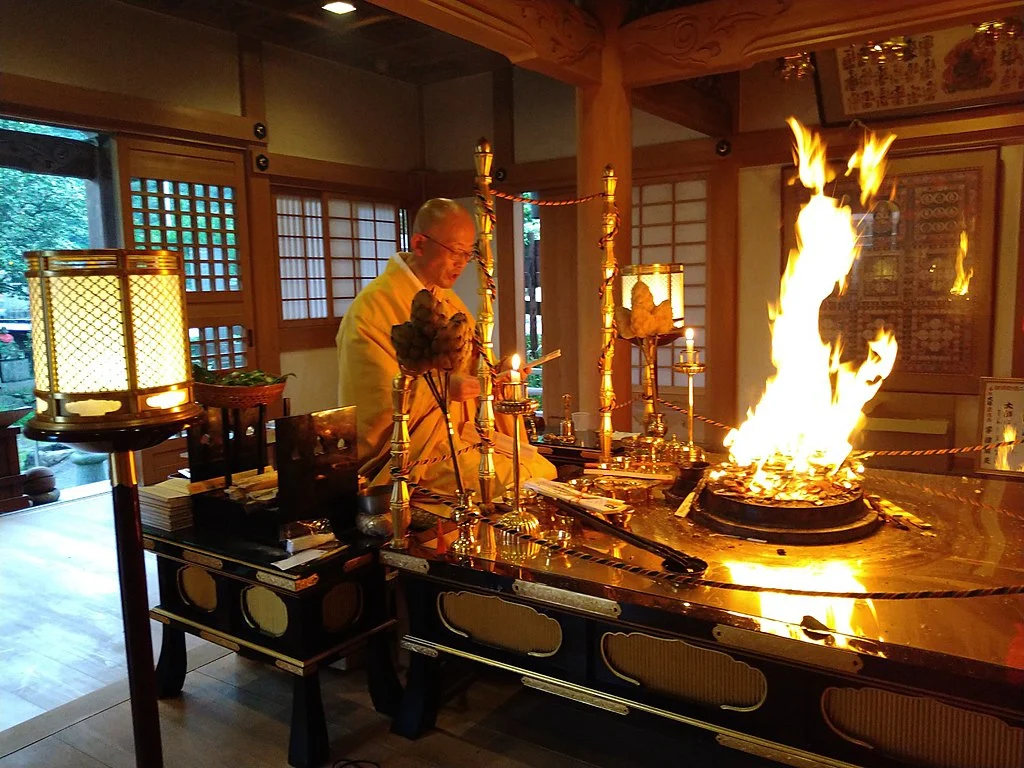
Ritual marks something as meaningful or sacred—an object, a place, or a moment in time. Through symbolic gestures, it sets these things apart from daily life and brings people together in a shared purpose. Rituals usually follow a script, with a beginning, middle, and end. This structure allows communities to pass them down over time and perform them consistently. In this way, rituals deepen a sense of connection to a tradition and to others following in that tradition.
In Buddhist traditions, ritual manifests in a wide array of forms, ranging from simple gestures like bowing or offering food to intricate initiations. These practices often signify an individual’s role within a community or tradition. They frequently serve to reaffirm a vow, honor a teacher, venerate an ancestor, or acknowledge beings such as hungry ghosts. The diversity of Buddhist ritual practices is a testament to the vast cultural landscapes Buddhism has traversed. From the elaborate sand mandalas of Tibetan Buddhism, painstakingly created and then dissolved to symbolize impermanence, to the silent, repetitive prostrations in Zen monasteries, each tradition has developed its unique expressive forms. These variations are not merely aesthetic; they reflect deeply held philosophical understandings and historical trajectories.
The significance of ritual in Buddhism is deeply rooted in its origins. The Buddha himself engaged in ritualistic practices, such as circumambulating stupas and chanting, which were later adopted and adapted by his followers. Early Buddhist communities established monastic rules (Vinaya) that included prescribed ceremonies for ordinations, confessions, and the observance of Uposatha days, underscoring the foundational role of ritual in maintaining the Sangha’s integrity and continuity.
Across different Buddhist cultures, rituals exhibit distinct styles and emphases. Local customs significantly shape a community’s identity and foster a sense of belonging. Even seemingly brief gestures, such as placing the hands together in a gesture of respect (Skt: anjalimudra), chanting, or reciting an aspiration, can serve to reorient the practitioner to the sacred and to help settle the body and mind. These ritualized actions have historically framed and supported practice in numerous Buddhist traditions, providing a tangible anchor for spiritual engagement. For instance, in Theravada Buddhism, the daily chanting of Pali scriptures by monks and lay practitioners is a cornerstone of devotional practice, reinforcing mindfulness and devotion to the Buddha’s teachings. In Mahayana traditions, the recitation of mantras, such as the Om Mani Padme Hum in Tibetan Buddhism, is believed to invoke the blessings and wisdom of specific bodhisattvas, offering a direct channel for spiritual connection.
The Preservation and Adaptation of Ritual
Ritual has always been a critical vehicle for transmitting Buddhist traditions. However, its forms are not static; they evolve over time and across cultures, sometimes subtly and other times dramatically. These changes enable rituals to remain connected to their historical roots while simultaneously addressing new needs in the present. This dynamic interplay between preservation and adaptation is a hallmark of living religious traditions.
A compelling example of this adaptation can be seen in the practice of tree ordinations by Thai monks. In response to growing environmental concerns, some monastic communities have integrated traditional ordination ceremonies to bless and symbolically "ordain" trees. This innovative practice highlights a contemporary imperative to protect the natural world, blending ancient ritualistic forms with urgent ecological awareness. Such adaptations, while demonstrating the vitality of Buddhist practice, are not always without controversy. As with many ritual innovations, the interpretations and meanings attributed to the act can diverge, leading to debates about their appropriateness. These discussions offer a valuable insight into the evolving landscape of Buddhist communities and their engagement with contemporary issues.

The history of Buddhism is replete with instances of such adaptive innovation. When Buddhism spread from India to China, it encountered existing philosophical and cultural frameworks. Monks and scholars adeptly translated Buddhist concepts and practices, often adapting them to resonate with Chinese sensibilities. This process led to the development of uniquely Chinese Buddhist schools like Chan (Zen), which incorporated elements of Taoism and indigenous Chinese philosophies, demonstrating a profound capacity for syncretism and adaptation. Similarly, as Buddhism moved into Tibet, it encountered the indigenous Bön religion, leading to a rich exchange of rituals, symbols, and philosophical ideas that profoundly shaped Tibetan Buddhism.
Harnessing Data for Ritual Efficacy: A Hypothetical Analysis
While the provided text focuses on the qualitative aspects of ritual, future research might explore quantitative methodologies to understand ritual efficacy. For instance, studies could analyze physiological responses (e.g., heart rate variability, cortisol levels) of practitioners during different ritualistic activities to gauge their impact on stress reduction and mindfulness. Furthermore, comparative analyses could examine the correlation between consistent participation in specific rituals and long-term psychological well-being or prosocial behavior within Buddhist communities. Such data, if ethically collected and analyzed, could provide empirical support for the enduring value of these practices. For example, preliminary studies in secular contexts have shown that repetitive, mindful activities, akin to ritual, can improve focus and emotional regulation. Applying such scientific inquiry to Buddhist ritual could offer novel perspectives on its benefits.
Modern Tensions and the Evolving Practitioner
In contemporary society, the adaptation of ritual also manifests in the tensions between traditional practices and modern societal norms. For practitioners in contemporary cultures characterized by egalitarian values, certain traditional rituals may appear hierarchical or rooted in a distant past. New Buddhists in the West, in particular, may encounter unfamiliar or culturally distant rituals as they engage with Buddhist traditions. This can lead to hesitation or skepticism for some, while for others, it opens avenues for unexpected insights and deeper exploration.
The perception of meditation as the central tenet of Buddhist practice in the West often leads to its framing in psychological or scientific terms, detached from its ritualistic origins. However, viewing meditation as a form of ritual can subtly alter one’s relationship with the practice. It introduces elements of structure, repetition, and dedicated space—akin to returning to the same meditation cushion each morning. This shift in perspective can move the emphasis from solely achieving specific results to the simple act of consistent engagement and presence. This re-framing can be particularly beneficial for those who struggle with the pressure to achieve meditative states, encouraging a more patient and accepting approach.
The historical trajectory of Buddhist practice in the West is marked by this ongoing negotiation between inherited traditions and the cultural milieu. Early Western converts often encountered highly formalized and culturally specific rituals that required significant adaptation to be accessible. This led to various approaches, from direct adoption of Asian forms to more radical reinterpretations. The result is a diverse landscape of Buddhist practice in the West, with some communities maintaining strict adherence to traditional rituals and others developing innovative forms that resonate with contemporary life.

The Role of Institutions and Teachers
The evolution of Buddhist rituals is not a spontaneous occurrence but is often shaped by established institutions and influential teachers. Monasteries, Buddhist centers, and recognized lineage holders play a crucial role in preserving, transmitting, and sometimes adapting ritual practices. Their decisions regarding the curriculum, the interpretation of texts, and the organization of ceremonies have a profound impact on how rituals are understood and performed. For instance, the establishment of Western Buddhist monastic orders has led to the development of new liturgical forms that blend traditional elements with Western musical and architectural styles.
Furthermore, the authority of teachers in Buddhist traditions lends weight to the rituals they endorse or adapt. A respected lama or roshi can introduce new practices or modify existing ones, and their followers are likely to adopt them based on trust and perceived benefit. This dynamic highlights the crucial role of leadership in the ongoing life of ritual traditions.
Rituals in Transition: Continuity and Change
As Buddhism continues to journey into new cultural settings, its ritual forms are undergoing adaptation. Generally, these adjustments occur gradually, influenced by institutions, teachers, and practitioners alike. The resulting expressions reflect both continuity with the past and the necessity of change. In the West, Buddhist rituals are still in a formative stage and may diverge significantly from their historical precedents. However, even as new forms emerge, ritual fundamentally continues to pose the question: What do we value enough to preserve, repeat, and pass on to future generations?
The future of Buddhist ritual will likely be characterized by an ongoing dialogue between tradition and innovation. As global connectivity increases and cross-cultural exchange becomes more fluid, the potential for both greater standardization and more radical experimentation exists. The challenge for Buddhist communities worldwide will be to navigate these currents in a way that honors the wisdom of the past while remaining relevant and accessible to practitioners in the 21st century and beyond. The enduring power of ritual lies in its capacity to create meaning, foster community, and guide individuals on their spiritual paths, regardless of the specific cultural or historical context. The ongoing evolution of these practices underscores their vital role in the continuing vitality of Buddhism.

