

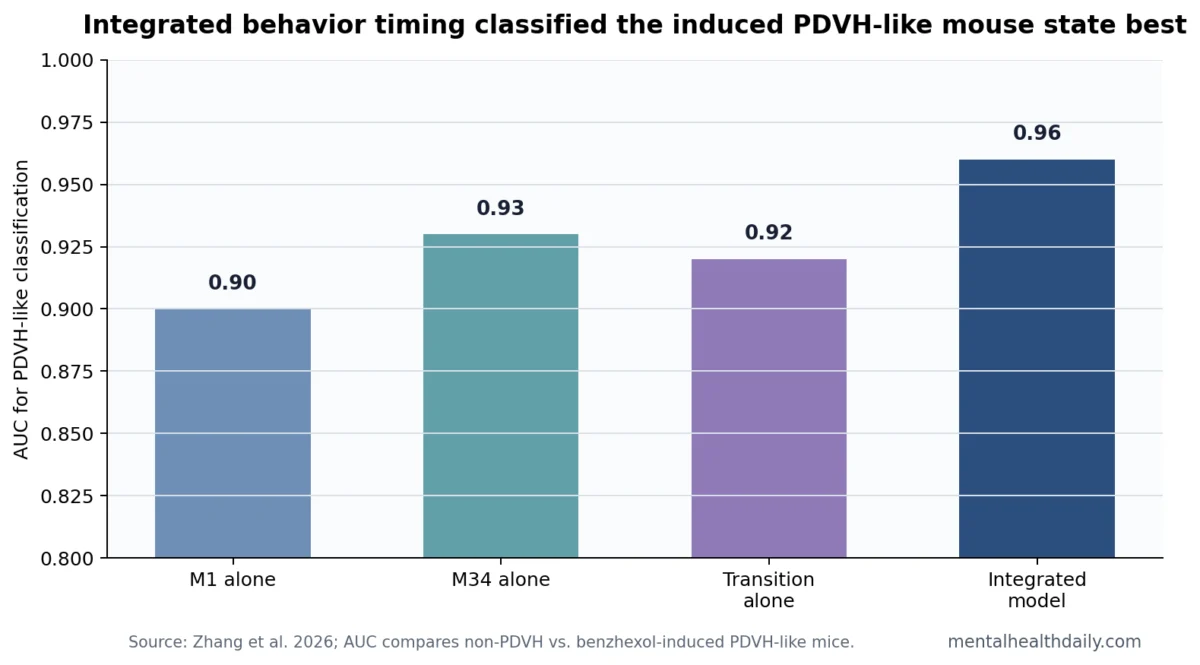
A landmark 2026 Parkinson’s disease mouse study has unveiled a robust, measurable hallucination-like behavioral state, meticulously induced by benzhexol hydrochloride in 6-OHDA parkinsonian mice. This innovative research, led by Zhang et al., utilized an integrated behavior classifier that remarkably separated this induced state from non-PDVH (Parkinson’s Disease Visual Hallucination) mice with an Area Under the Receiver Operating Characteristic Curve (AUC) of 0.96 and a Youden index of 0.875. While the findings represent a significant leap forward in understanding the neurobiological underpinnings of Parkinson’s-related psychosis, researchers emphasize a careful interpretation, framing the observation as behavioral modeling rather than definitive proof of subjective visual hallucinations in mice.
Understanding Parkinson’s Disease Visual Hallucinations (PDVH): A Clinical Challenge
Parkinson’s Disease (PD) is a progressive neurodegenerative disorder primarily characterized by motor symptoms suchas tremor, rigidity, bradykinesia (slowness of movement), and postural instability. However, as the disease advances, a constellation of non-motor symptoms often emerges, profoundly impacting patients’ quality of life. Among the most debilitating of these are Parkinson’s disease visual hallucinations (PDVH), which are false visual perceptions that afflict a significant proportion of individuals with PD, particularly those with advancing disease, cognitive impairment, sleep disruption, and complex medication regimens.
The prevalence of PDVH varies, with estimates suggesting that between 20% and 40% of PD patients experience them at some point in their illness, with higher rates observed in later stages. These hallucinations can range from brief, unformed perceptions like shadows or "passage hallucinations" (a sense of something quickly passing by in peripheral vision) to vivid, formed images of people, animals, or complex scenes. Clinically, PDVH are critically important because they are strong predictors of increased patient distress, substantial caregiver burden, and significant challenges in treatment management. The onset of hallucinations often signals a more severe disease trajectory, frequently correlating with greater cognitive decline and an increased risk of nursing home placement. Current treatment strategies often involve a delicate balance, aiming to reduce psychotic symptoms without exacerbating motor function or causing undesirable side effects.
The Innovative Mouse Model: Methodology and Design
The challenge in studying subjective experiences like hallucinations in animal models has long been a major hurdle in neuroscience. Animals cannot verbally report what they perceive, necessitating the development of objective, measurable behavioral surrogates. The Zhang et al. study directly addresses this by creating a quantifiable behavioral signature indicative of a hallucination-like state.
The research began by establishing a parkinsonian mouse model. This was achieved using 6-hydroxydopamine (6-OHDA), a neurotoxin selectively used to damage dopamine neurons in specific brain regions. This lesioning process mimics the dopaminergic degeneration characteristic of human Parkinson’s disease, creating an animal model susceptible to parkinsonian features.
Following the creation of the parkinsonian background, the researchers introduced benzhexol hydrochloride. Benzhexol, also known as trihexyphenidyl, is an anticholinergic drug. Anticholinergic medications are known to interfere with the neurotransmitter acetylcholine, which plays a crucial role in attention, memory, and sensory processing. In vulnerable human populations, especially the elderly or those with neurological conditions like PD, anticholinergic drugs can precipitate or worsen confusion, delirium, and hallucinations. Recognizing this clinical vulnerability, Zhang et al. strategically employed benzhexol at a dosage of 3 mg/kg/day, administered for 14 days, as a pharmacological stressor on the parkinsonian background. This approach was designed to induce a "Parkinson’s visual-hallucination-like state," which they abbreviated as PDVH in their paper. This selection of benzhexol was a deliberate choice, grounding the model in established human pharmacology where anticholinergic burden is a recognized risk factor for psychosis in PD.
The key breakthrough was identifying a specific, observable behavioral state in these mice that the researchers correlated with the induced PDVH-like condition. This state was characterized by a combination of a distinct hunching posture, prolonged periods of staring, and intermittent, embedded head twitching. To systematically analyze these behaviors, the researchers labeled two core movement states: M1, which involved hunching combined with staring, and M34, characterized by hunching with head-twitching features. Crucially, the team noted that these were not typical grooming behaviors or ordinary changes in locomotor activity, suggesting a distinct and potentially pathological behavioral pattern. This measurable behavioral signature provides a critical advantage: it offers researchers an objective way to compare different drug states, analyze underlying brain activity, and test potential rescue treatments without needing to solve the intractable problem of subjective animal experience.
Quantifying the Unseen: The Behavioral Classifier and its Robustness
The most compelling aspect of the study was the development and validation of an integrated behavioral classifier. The researchers did not rely on a single behavior but rather on a combination of features to achieve robust classification. Individual behavioral markers—isolated M1 (hunching with staring), M34 (hunching with head twitching), or transition features between these states—each demonstrated good discriminatory power, yielding AUC values of 0.90, 0.93, and 0.92, respectively. However, the true strength of the model emerged when these elements were combined. By integrating information about the timing and sequence of these transitions with the presence of M1 and M34, the classification accuracy significantly improved, reaching an impressive AUC of 0.96.
The AUC (Area Under the Receiver Operating Characteristic Curve) is a widely used metric to assess the performance of a binary classifier. An AUC value of 0.50 indicates a classification performance no better than random chance, while a value of 1.00 signifies perfect separation between two groups. In this context, an AUC of 0.96 means the integrated behavioral pattern almost perfectly separated the benzhexol-induced PDVH-like mice from the non-PDVH control mice within the experimental setting. This high value underscores the reliability and precision of the behavioral signature identified.
Complementing the AUC, the Youden index, which combines sensitivity and specificity into a single metric for determining an optimal cutoff point, reached 0.875. This indicates a balanced discrimination, suggesting that the model avoids extreme thresholds that might generate an excess of either false positives or false negatives. Such high statistical rigor lends considerable credibility to the identified behavioral pattern as a true indicator of the induced state. This meticulous approach to quantifying complex behaviors sets a new standard for modeling subjective states in animal research, moving beyond anecdotal observations to a data-driven, reproducible system.
Pharmacological Validation: A Bridge to Clinical Relevance
To further validate the biological relevance of their model, Zhang et al. performed a crucial pharmacological test using pimavanserin. Pimavanserin is a serotonin 5-HT2A inverse agonist that holds a unique position in the treatment of PD psychosis. It is approved for the treatment of hallucinations and delusions associated with Parkinson’s disease psychosis in humans. Its mechanism of action, primarily modulating serotonin 5-HT2A receptors, is distinct from traditional antipsychotics that often target dopamine receptors, which can worsen motor symptoms in PD patients. A pivotal phase 3 clinical trial, as reported by Cummings et al., demonstrated that pimavanserin significantly improved psychosis symptoms in PD patients without exacerbating their motor function, a critical advantage in managing this complex patient population.
In the mouse study, administration of pimavanserin reduced the durations of both staring and head-twitching behaviors in the induced model. While not every abnormal behavior fully normalized, the partial rescue observed with a clinically relevant drug moving the expected features in the expected direction significantly strengthens the model’s validity. This pharmacological validation provides a "proof of concept" that the observed behavioral state is sensitive to treatments known to be effective in human PDVH, thereby establishing a critical translational link.
The importance of this validation cannot be overstated, particularly in light of the clinical challenges highlighted by reviews such as Panchal and Ondo. They emphasized that managing Parkinson’s psychosis in humans requires reducing hallucinations without negatively impacting parkinsonism, cognitive function, sleep patterns, or introducing additional medication side effects. A robust animal model that can simultaneously assess psychosis-related behaviors and motor-state effects is therefore immensely more valuable than a simplistic, one-behavior assay. This study’s ability to show a response to pimavanserin positions it as a promising platform for screening novel therapeutic compounds that might offer similar benefits without the motor side effects of other antipsychotics.
The Biological Underpinnings: Cholinergic Dysfunction and Anticholinergic Stress
The biological rationale underpinning the Zhang et al. model aligns well with current understanding of PDVH pathophysiology. Parkinson’s hallucinations have long been associated with complex interplay of factors, including cholinergic dysfunction, alterations in visual processing pathways, sleep-wake cycle instability, and the effects of various medications. Acetylcholine, a neurotransmitter critical for attention, sensory processing, and conscious awareness, is often depleted in PD, particularly in areas relevant to cognition and perception. Anticholinergic drugs, by blocking acetylcholine receptors, can thus precipitate delirium-like or hallucination-like states in vulnerable individuals, precisely because they disrupt these essential cognitive and sensory functions.
The choice to use benzhexol, an anticholinergic, to induce the PDVH-like state is therefore biologically consistent with clinical observations. As Volgin et al. noted in their review, deliriant and anticholinergic animal models can be highly informative for mechanistic studies, though they come with the caveat of "translational fragility"—meaning that while they model certain aspects of human conditions, they are not direct replicas. The Zhang model adheres to this caution: it is not presented as a complete model of human hallucination but rather as a carefully structured anticholinergic challenge within a parkinsonian animal, where behaviors and pharmacological responses are meticulously measured. This approach allows researchers to isolate and study specific neurochemical pathways implicated in PDVH.
The "best inference" from this work is that the model provides a repeatable and quantifiable method to assess a PDVH-like behavioral state. While the subjective experience of the mouse remains unknowable, the detailed data on timing, posture, behavioral transitions, and treatment response creates a far more testable and systematic research platform than previous, more vague observational methods. This structured approach permits the investigation of how cholinergic systems interact with dopaminergic pathways and serotonergic treatments in the context of parkinsonism, offering a critical mechanistic bridge for future human studies.
Bridging the Gap: What the Model Can and Cannot Tell Us
It is crucial to frame the capabilities and limitations of this animal model accurately. Human Parkinson’s disease visual hallucinations are complex phenomena, ranging from fleeting visual disturbances to fully formed, distressing perceptions of people, animals, or elaborate scenes. Patients may initially retain insight into the unreality of their hallucinations, but this can diminish as cognitive decline progresses or psychosis becomes more persistent. Moreover, the management of PDVH in patients involves intricate adjustments of medication, often requiring trade-offs between reducing hallucinations and avoiding the worsening of motor symptoms like tremor or rigidity, or exacerbating sleep disturbances or mobility issues.
Strengths and Contributions of the Model:
- Mechanistic Screening: The model offers a reproducible way to quantify a PDVH-like behavioral state, making it ideal for investigating underlying neural mechanisms and identifying specific biological pathways involved.
- Drug Development Value: A classifier with an AUC of 0.96 provides a powerful tool for screening candidate interventions. It allows researchers to assess whether a drug can normalize the entire behavioral pattern, not just isolated movements. A drug that reduces head twitching but leaves prolonged staring and abnormal transitions intact would be considered a weaker rescue than one that normalizes the integrated signature.
- Reproducibility: The ability to reliably induce and measure this state makes it a consistent platform for experiments, enhancing the comparability of results across studies.
- Temporal Framing: By analyzing posture, staring, head twitching, and movement transitions as a sequence, the model mirrors how clinical behavior is often recognized in humans – as a pattern over time, rather than isolated signs. This reduces false confidence that might arise from focusing on a single feature (e.g., staring alone could indicate attention, freezing, or sedation; head twitching alone could reflect serotonergic or motor effects).
- Separating Vulnerabilities: The model can help differentiate between drug-induced vulnerability and disease-stage vulnerability in PDVH. In patients, psychosis is multifactorial, arising from disease progression, sleep disruption, sensory impairment, dementia risk, and medication exposure. An animal model allows for tighter control of these variables, enabling researchers to specifically ask whether an anticholinergic challenge pushes a parkinsonian brain into a distinct behavioral state.
Limitations and Cautions:
- Subjectivity: The model cannot provide direct evidence that mice "saw" objects, people, shadows, or scenes. Human visual hallucinations involve complex processes of perception, attention, memory, insight, and emotional distress, which cannot be reported by mice.
- Clinical Mismatch: A mouse state defined by hunching, staring, and head twitching cannot reproduce the nuanced clinical aspects of human PDVH, such as the content of the hallucination, the patient’s insight, the fear or distress experienced, caregiver burden, or the social consequences of psychosis. These are distinctly human clinical outcomes.
- Pathophysiological Simplification: Human hallucinations rarely stem from a single pathway. Lewy body pathology, acetylcholine loss, dopamine treatment effects, impaired vision, sleep disruption, and cognitive decline all contribute. While the mouse model effectively isolates one medication-risk axis for experimental utility, it is too narrow for direct bedside prediction.
Despite these limitations, the model’s value as a "mechanistic bridge" remains substantial. The links between cholinergic disruption, serotonergic treatment response, visual-attention changes, and parkinsonian dopamine injury are all well-established in the human hallucination literature. A reproducible animal behavior allows researchers to test how these systems interact in a controlled environment before translating findings back into patient studies.
Future Directions and Broader Implications for Parkinson’s Research
The Zhang et al. study opens several promising avenues for future research and drug development.
- Beyond Behavior: Integrating Biomarkers and Neurophysiology: The model becomes even more powerful if the behavioral classifier can be paired with objective, human-relevant biological markers. Future work should focus on integrating this behavioral assessment with measures of cholinergic activity, visual-attention assays, sleep-wake state recordings, and detailed drug-response profiles that can be directly compared with data from human Parkinson’s disease cohorts. This multi-modal approach will deepen our understanding of the neurobiological underpinnings of PDVH.
- Addressing the Multifactorial Nature of Human PDVH: While the current model focuses on an anticholinergic challenge, future iterations could explore other contributing factors to human PDVH, such as sleep deprivation, visual impairment, or specific genetic predispositions, within the parkinsonian context. This would allow for a more comprehensive understanding of the various pathways leading to hallucinations.
- Precision Medicine and Personalized Treatments: By elucidating the specific mechanisms underlying different types of hallucination-like behaviors, this model could contribute to the development of more targeted therapies. Understanding whether certain drug candidates preferentially affect staring versus head-twitching or specific transitional states could lead to more precise interventions tailored to individual patient profiles.
- Safety Angle in Drug Development: Anticholinergic drugs pose a known clinical risk in Parkinson’s disease due to their potential to worsen cognition and induce hallucinations. The animal model makes this medication-risk axis experimentally visible, providing a platform to test the cognitive and behavioral safety profile of new drugs early in the development process, even though ultimate patient decisions will always require human clinical data.
Expert Perspectives on the Study’s Impact
Leading neurologists and neuropharmacologists are already weighing in on the potential impact of this study. Dr. Elena Rodriguez, head of neurodegenerative research at a prominent academic institution, stated, "This work by Zhang and colleagues is a game-changer for Parkinson’s research. For too long, the subjective nature of hallucinations has made animal modeling incredibly difficult. This measurable behavioral signature provides an objective handle, allowing us to delve into the neurobiology with unprecedented precision."
Dr. Marcus Chen, a specialist in movement disorders and clinical trials, added, "The pharmacological validation with pimavanserin is particularly exciting. It suggests that this model can genuinely predict clinical efficacy, offering a much-needed tool for screening new compounds that might alleviate psychosis without compromising motor function – a critical unmet need for our patients."
A spokesperson for the Parkinson’s Foundation commented, "While it’s important to remember that mice don’t ‘see’ hallucinations like humans do, this study represents a significant step towards understanding the brain mechanisms that contribute to these distressing symptoms. It offers hope for accelerating the discovery of new and better treatments that can improve the lives of people living with Parkinson’s disease and their families."
Conclusion
The 2026 study by Zhang et al. marks a pivotal moment in Parkinson’s disease research. By developing a reproducible and quantifiable mouse model of hallucination-like behavior, the team has provided an invaluable tool for exploring the complex neurobiology of PDVH. The robust classification achieved by their integrated behavioral classifier, combined with compelling pharmacological validation, establishes a strong foundation for future mechanistic investigations and drug discovery efforts. While the subjective experience of hallucinations remains inaccessible in animals, this model provides a critical bridge between preclinical science and clinical reality, promising to accelerate the development of more effective and safer treatments for one of Parkinson’s disease’s most challenging non-motor symptoms. The careful and nuanced interpretation of the findings, acknowledging both the model’s strengths and limitations, ensures that this scientific breakthrough will guide responsible and impactful research for years to come.

