

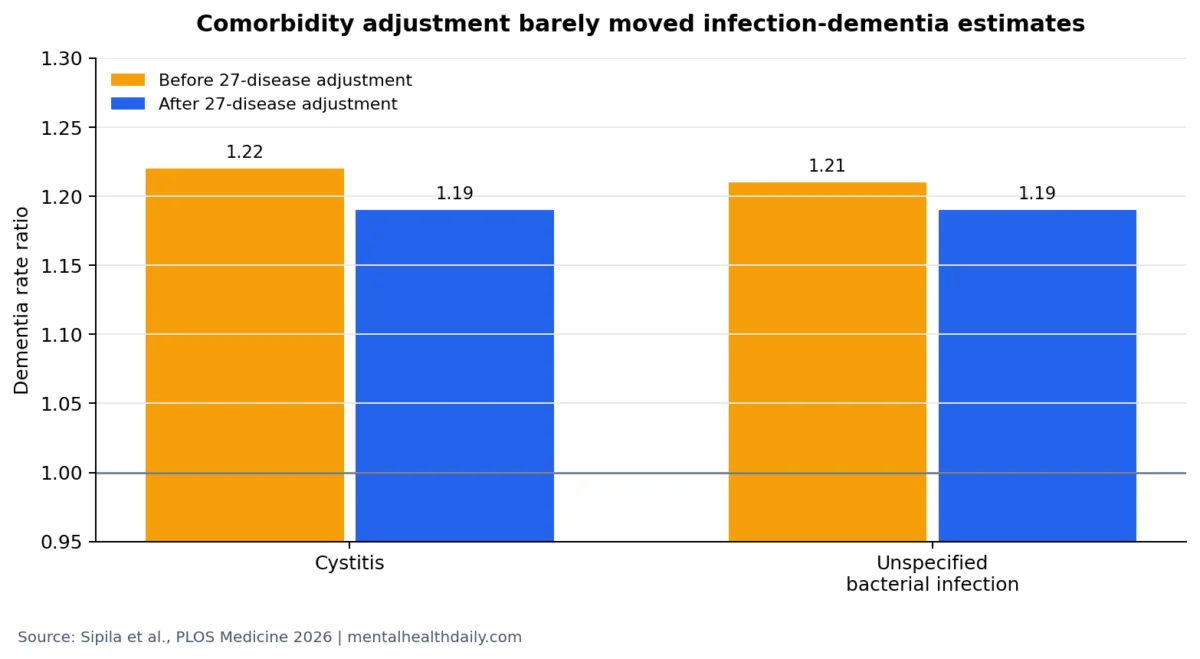
A comprehensive nationwide Finnish registry study has revealed that two specific categories of severe infections, namely cystitis and bacterial infection of an unspecified site, consistently predicted an increased risk of dementia, even after rigorous adjustment for an extensive panel of 27 non-infectious comorbid diseases. This robust finding, published recently, underscores the persistent association between severe infections requiring hospital treatment and the later development of dementia, suggesting that this link is not merely an artifact of other co-occurring health conditions prevalent in older adults. Both cystitis and bacterial infection of an unspecified site exhibited adjusted rate ratios of 1.19 after controlling for a broad spectrum of prior hospital-treated illnesses, indicating that the infection-dementia association remained statistically significant and largely undiminished despite accounting for major confounding factors.
This research marks a significant step forward in understanding the complex interplay between systemic health events and long-term brain health. For years, the scientific community has grappled with the question of whether infections directly contribute to dementia pathology or merely serve as markers for an individual’s overall frailty and susceptibility to various diseases. By meticulously modeling 27 non-infectious conditions known to be linked to dementia risk, the Finnish study provides compelling evidence that the association between these specific severe infections and dementia is more independent than previously understood, reinforcing the idea that such infections may play a distinct role in the trajectory towards cognitive decline.
The Global Burden of Dementia and the Quest for Risk Factors
Dementia represents one of the most pressing global health challenges of the 21st century. Affecting over 55 million people worldwide, a number projected to nearly double every 20 years, the condition imposes immense burdens on individuals, families, and healthcare systems. Alzheimer’s disease is the most common form, but various other types exist, often with overlapping pathologies. The vast majority of dementia cases are late-onset, developing in individuals aged 65 and older. With no definitive cure yet available, research efforts are intensely focused on identifying modifiable risk factors and early indicators to facilitate prevention or delay onset.
Among the myriad potential risk factors under investigation, infections have emerged as a recurring theme. The hypothesis posits that systemic infections, particularly severe ones, can trigger inflammatory responses that extend to the brain, disrupt the blood-brain barrier, or exacerbate pre-existing neuropathological processes, thereby accelerating cognitive decline. However, teasing out a causal link has been notoriously difficult. Older adults, who are most susceptible to dementia, also tend to accumulate multiple chronic health conditions, often referred to as comorbidities. These conditions, such as diabetes, cardiovascular disease, and depression, are themselves risk factors for dementia and can also increase vulnerability to severe infections. This intricate web of interconnected health issues has made it challenging to ascertain whether infections are truly independent predictors of dementia or simply "travel with" other illnesses that are the primary drivers of cognitive impairment.
The Finnish study directly addressed this critical methodological challenge. Its value, therefore, lies not in being the first to identify an infection-dementia link, but in its robust contribution to disentangling potential alternative explanations, particularly the role of co-existing non-infectious diseases. By demonstrating that the association persists after accounting for a substantial comorbidity burden, the research strengthens the argument for a more direct, albeit complex, relationship.
Methodological Rigor: A Deep Dive into the Finnish Registry Data
The study, conducted by Sipila et al., leveraged Finland’s comprehensive national health registries, which provide an invaluable resource for large-scale, long-term epidemiological research. Researchers identified a substantial cohort of 62,555 individuals aged 65 or older who received a diagnosis of late-onset dementia between 2017 and 2020. This extensive dataset allowed for a statistically powerful analysis. To ensure the robustness of their findings, each dementia case was meticulously matched to five dementia-free controls, resulting in a total of 312,772 control participants. The matching process carefully considered key demographic variables, including year of birth, sex, and follow-up period, thereby controlling for fundamental age and gender-related influences. Beyond this matching, the researchers further adjusted their models for socioeconomic and geographic covariates, such as education level, marital status, employment status, and area of residence, to minimize the impact of these potential confounders.
A crucial aspect of the study’s design was its extensive look-back period. The researchers retrospectively analyzed health data spanning 1 to 21 years prior to the dementia diagnosis date for cases, or the equivalent index date for controls. This long observational window allowed for the identification of remote infection events that could precede dementia onset by many years. Furthermore, a mandatory one-year lag period was implemented between the last observed infection and the dementia diagnosis. This methodological safeguard is vital for mitigating reverse causation – a common pitfall in observational studies where early, undiagnosed symptoms of dementia might lead to increased medical encounters or a higher susceptibility to infections, thus creating a spurious association. By requiring this lag, the study aimed to ensure that the detected infections truly preceded and potentially influenced the dementia process, rather than being a consequence of incipient cognitive decline.
The true strength of this study lies in its comprehensive screening for comorbid diseases. The researchers established a robust threshold for prior association with dementia, identifying 29 distinct hospital-treated disease categories that met this criterion. Out of these 29, only two were infection-related categories, while the remaining 27 comprised a wide array of non-infectious conditions. These included mental and behavioral disorders, digestive system diseases, endocrine and metabolic disorders (like diabetes), cardiometabolic conditions (such as heart disease and stroke), neurological disorders, eye diseases, and various injury-related conditions. This broad spectrum of comorbidities reflects the reality that older adults frequently accumulate multiple health issues. Diabetes, vascular disease, depression, and conditions leading to delirium-prone hospitalizations, injuries, and infections often cluster together, making it challenging to isolate the independent effect of any single factor. By meticulously adjusting for such a comprehensive set of non-infectious conditions, the study significantly advanced beyond simpler models that might inadvertently exaggerate a causal interpretation by allowing infection to merely "tag" a broader pattern of frailty.
Specific Infections Emerge: Cystitis and Unspecified Bacterial Infections
The detailed analysis revealed that two specific infection categories maintained their predictive power for dementia even after the extensive comorbidity adjustment. These were cystitis and bacterial infection of an unspecified site.
Cystitis, which refers to inflammation of the bladder typically caused by a urinary tract infection (UTI), showed a statistically significant association with dementia. Prior to adjustment for the 27 non-infectious comorbid diseases, cystitis was associated with a rate ratio of 1.22 (95% Confidence Interval [CI] 1.17-1.27; p < 0.001). This means that individuals who experienced hospital-treated cystitis had a 22% higher rate of developing dementia compared to those who did not. Crucially, after the comprehensive adjustment for comorbidities, the rate ratio for cystitis remained remarkably stable at 1.19 (95% CI 1.14-1.24; p < 0.001). The minimal drop from 1.22 to 1.19 indicates that the vast majority of the association between cystitis and dementia was not explained by the measured burden of other non-infectious diseases. A rate ratio of 1.19 implies a 19% higher incidence rate of dementia in the group exposed to severe cystitis after accounting for the modeled adjustments.
Similarly, bacterial infection of an unspecified site followed a very similar pattern. Before comorbidity adjustment, its rate ratio was 1.21 (95% CI 1.16-1.28). Following adjustment for the 27 non-infectious conditions, the rate ratio remained 1.19 (95% CI 1.13-1.25). The consistency of this finding across two distinct infection categories, and the minimal attenuation after rigorous adjustment, lends significant credibility to the study’s conclusions.
The confidence intervals (e.g., 1.14 to 1.24 for adjusted cystitis) are crucial for interpreting the results. Because these intervals did not cross 1.00, it confirms that the observed associations were statistically significant and not due to random chance, even after the extensive comorbidity adjustment. While the effect size of a 19% higher rate is modest and not "dramatic" for an individual, its public health implications are substantial. Given the high prevalence of severe infections, particularly in older populations, even a modest increase in dementia risk at the population level can translate into a significant number of additional dementia cases. This underscores the potential importance of infection management and prevention strategies in the broader context of brain health.
Unresolved Questions and Plausible Biological Pathways
Despite its robust methodology, the study acknowledges inherent limitations common to observational registry-based research. While it effectively narrowed confounding due to coded comorbidities, it does not, and cannot, definitively prove causality in an experimental sense. A key area that remains unresolved concerns factors not directly measurable through registry data. These include the precise biological mechanisms of inflammation, the severity and duration of delirium episodes (an acute confused state often triggered by infection and independently linked to cognitive decline), specific medication exposures (e.g., antibiotics, anticholinergics), an individual’s cognitive reserve, the extent of social isolation, sleep disruption, alcohol consumption, smoking intensity, and individual health-seeking behaviors. All these factors could potentially influence both infection risk and dementia development, and their unmeasured presence constitutes residual confounding.
Nevertheless, several plausible biological pathways could explain the observed link. A severe infection can initiate a cascade of physiological responses, including systemic inflammation that can penetrate the blood-brain barrier, leading to neuroinflammation. Infections can also trigger delirium, which is increasingly recognized as a significant risk factor for subsequent cognitive decline and dementia. Other potential mechanisms include vascular events (such as strokes or transient ischemic attacks) precipitated by infection, changes in medication regimens that may affect cognition, prolonged immobility during recovery, sleep disruption, and a general functional decline that can contribute to a downward spiral in overall health and cognitive resilience. While registry codes may capture some instances of delirium, they may not fully account for milder or short-lived episodes that could still impact long-term brain health.
Furthermore, while the one-year lag period significantly reduces the likelihood of reverse causation, it cannot entirely abolish it. It is conceivable that very early, subclinical stages of dementia might subtly alter an individual’s hygiene practices, hydration status, medication adherence, or willingness to seek medical help, thereby increasing their vulnerability to infections even before a formal dementia diagnosis. The study mitigates this concern, but it remains a consideration in interpreting the ultimate causal inference.
Reinforcing a Broader Scientific Consensus
The findings of this Finnish study are not isolated but align with a growing body of evidence from adjacent research. Sipila et al. themselves had previously reported a general association between hospital-treated infectious diseases and later dementia in large multicohort data. The current study specifically followed up on that work by rigorously testing whether non-infectious comorbid diseases could explain the signal.
Beyond this, other significant studies have pointed in the same direction. A systematic review by Muzambi et al. examined common bacterial infections and their link to dementia or cognitive decline, concluding that such associations appear across various settings but are indeed vulnerable to confounding and reverse-causation concerns. More recently, Richmond-Rakerd et al. conducted a comprehensive nationwide 30-year analysis, also finding that hospital-treated infections were associated with a higher risk of later dementia. Collectively, these studies paint a consistent picture: severe infections can either mark an underlying vulnerability or directly contribute to an increased long-term risk for brain health issues after the acute phase of illness has resolved.
Clinical and Public Health Implications: A Call for Vigilance, Not Panic
The implications of this research are primarily prevention-focused rather than alarmist. For public health, the findings underscore the importance of strategies aimed at infection prevention, appropriate vaccination for older adults, vigilant management of urinary tract infections, and proactive measures to prevent delirium during hospitalization. Post-infection cognitive monitoring also emerges as a plausible priority.
It is crucial, however, to avoid overreach in interpreting these findings for individual patients. Telling every older adult who has experienced cystitis that they are now "likely" to develop dementia would be inaccurate and unnecessarily frightening. The observed 19% relative rate increase is a population-level statistic. An individual’s risk for dementia remains a complex interplay of numerous factors, including age, baseline cognitive function, vascular health, genetic predispositions, the specific severity of the infection, whether delirium occurred, and many other unmeasured variables. Therefore, a severe infection history should be integrated as one more signal in a holistic dementia-risk assessment, not as a standalone predictor.
Operationally, the study supports a more proactive approach to follow-up care for older adults after severe infections. Such an event could serve as a trigger for a comprehensive review that includes medication reconciliation, assessment of fall risk, support for adequate sleep and hydration, checks for hearing and vision impairments, screening for depression, and cognitive follow-up after recovery. None of these steps require the definitive claim that the infection alone caused dementia; rather, they recognize that a severe infection represents a significant physiological stressor that can reveal or exacerbate underlying vulnerabilities.
For future research, a critical next step involves disaggregating the various components of a "severe infection." This means trying to separate the impact of the infection itself from the effects of hospitalization, the inflammatory burden it creates, exposure to antibiotics, and the post-acute functional decline that often accompanies severe illness. Each of these pieces may present different targets for prevention or intervention, even when they are bundled under a single registry infection code.
At the patient level, clinical interpretation must be finely calibrated. A patient who fully returns to their prior level of function and cognition after an episode of cystitis is distinct from a patient who experiences prolonged delirium, develops new falls, suffers weight loss, struggles with sleep disruption, or loses independence following a severe infection. The registry estimate averages across these very different clinical paths. Therefore, the study strongly supports enhanced follow-up after severe infections, focusing on the individual’s recovery trajectory. It does not support a fatalistic outlook. A modest population-level association is most valuable when it prompts targeted efforts to prevent delirium, manage vascular complications, avert recurrent infections, and mitigate functional decline.
For health systems, the period of transition out of the hospital presents a critical opportunity. Discharge plans that prioritize hydration, promote mobility, protect sleep quality, include thorough medication reviews, and incorporate cognitive reassessment could potentially reduce some of the downstream risk, even if infection biology is only one part of the overall pathway to dementia. The practical target is not a permanent dementia label after a single hospitalization, but rather the identification and modification of reversible risk factors. Delirium, polypharmacy, dehydration, untreated pain, sensory loss, poor sleep, immobility, and vascular instability can all acutely worsen cognition after an infection. Many of these problems are modifiable and are often missed if the clinical record treats hospital discharge as the definitive end of the episode. This distinction helps keep the infection signal calibrated: a 19% adjusted increase is significant enough to warrant public health attention, but too small to be a standalone dementia predictor for an individual patient. The most useful response is targeted reassessment in higher-risk older adults, asking key questions: Did thinking return to baseline? Was delirium present? Did medications change? Has new functional decline appeared since the hospital stay? By focusing on these actionable insights, clinicians can translate population-level evidence into individualized, preventative care.

