

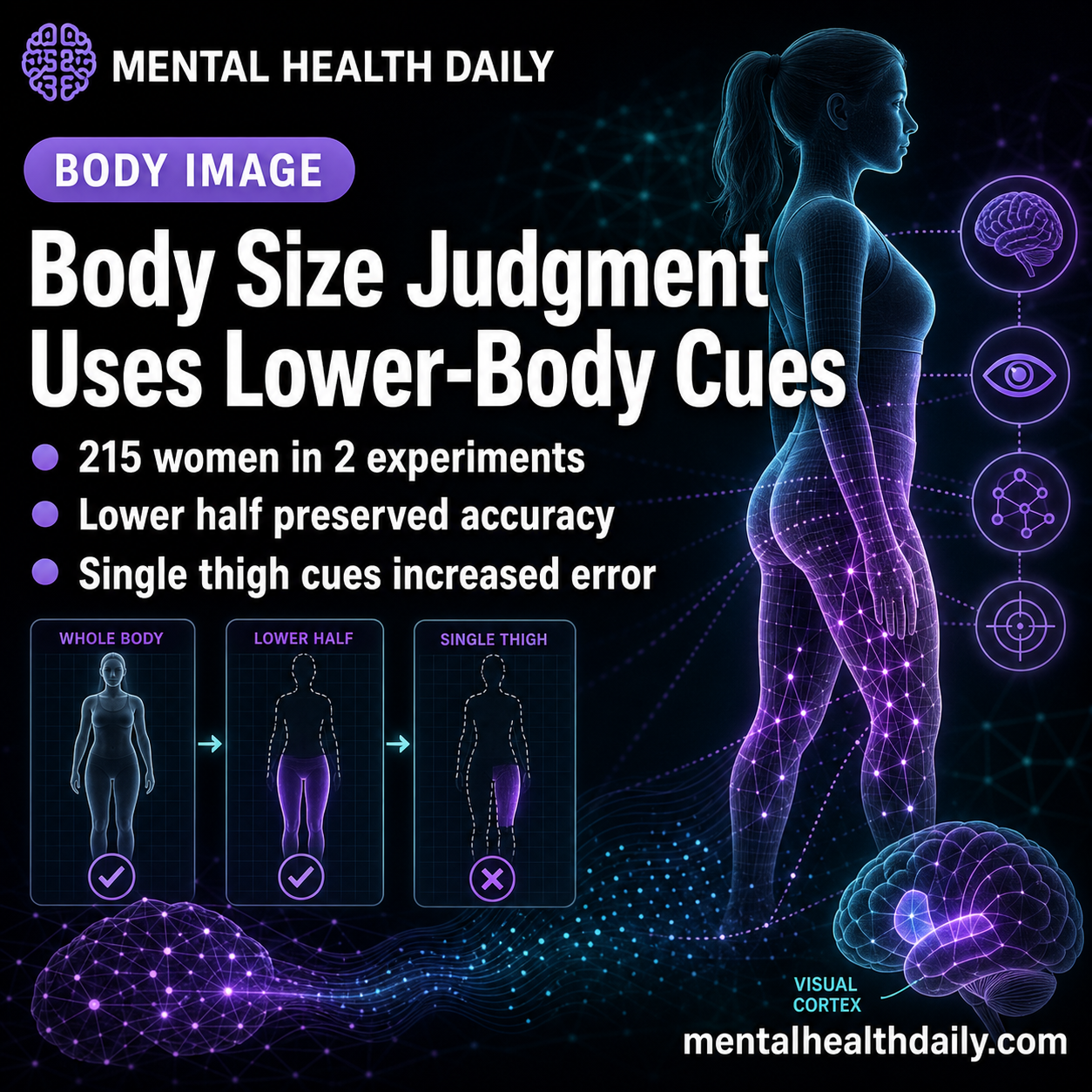
A groundbreaking study published in BMC Biology has unveiled critical insights into how individuals perceive female body size, demonstrating that accurate judgments do not necessarily require a full-body view but rather depend on the integrated information from the lower half of the body. The two-experiment study, involving 215 women in total, challenges simplistic assumptions about visual perception in body image, pointing towards a sophisticated process of "lower-body feature integration" rather than a reliance on isolated body parts or a holistic, full-body assessment. This research holds significant relevance for the burgeoning field of body-image research, particularly concerning body dissatisfaction and eating disorders, by illuminating the precise perceptual mechanisms at play.
The study’s central finding underscores that while the lower half of the body provides sufficient cues for accurate size estimation, isolating specific regions, such as the inner or outer thigh, significantly degrades perceptual accuracy. This nuanced understanding moves beyond the notion of a simple "thigh-only" shortcut in body-size perception, instead positing that the visual system integrates multiple pieces of information from a broader lower-body context.
The Broader Context of Body Image and Its Clinical Significance
Body image, a multifaceted construct encompassing how individuals perceive, feel, and think about their bodies, profoundly impacts mental health and well-being. Disturbances in body image are not merely cosmetic concerns; they are clinically recognized features of serious mental health conditions, most notably eating disorders such as anorexia nervosa and bulimia nervosa. Patients experiencing body-image disturbance often exhibit an overestimation or misinterpretation of their body size, contributing to a vicious cycle of dissatisfaction, body checking, avoidance behaviors, and fear-driven interpretations of their own physical shape.
Globally, body image concerns are pervasive, affecting individuals across genders, ages, and cultures. Surveys consistently show high rates of body dissatisfaction, particularly among women. For instance, data from various international studies indicate that a significant majority of women report dissatisfaction with their appearance, with specific body parts, including thighs and abdomen, frequently cited as areas of concern. This widespread societal preoccupation with body shape and size forms the backdrop against which scientific inquiry into the mechanisms of body perception becomes critically important. Understanding the perceptual side of body image—how the visual system processes cues, assigns weight to them, and how recent visual experiences bias subsequent judgments—is a foundational step towards developing more effective prevention and intervention strategies.
The historical trajectory of body image research has evolved from broad, subjective self-reports of dissatisfaction to more granular, objective measures of visual perception. Early research, exemplified by meta-analyses like that of Cash and Deagle, established body-image disturbance as a measurable clinical feature across eating-disorder samples, moving it beyond a vague personality complaint. More recent advancements, such as digital body-image mapping used by researchers like Ralph-Nearman et al. in studies on anorexia nervosa, have begun to correlate visual disturbance measures with illness severity. This shift highlights the growing recognition that perception plays a crucial, measurable role alongside subjective feelings and thoughts about one’s body. The BMC Biology study by Marinko et al. represents a significant stride in this evolving understanding, offering a precise investigation into the specific visual cues that inform body-size judgments.
Unpacking the Methodology: How Perception Was Probed
To dissect the complexities of body-size judgment, Marinko and colleagues employed a specialized visual-perception task known as the "bodyline task." This task requires participants to view a series of standardized body images and accurately place them on a continuous size scale. The utility of the bodyline task lies in its ability to differentiate a person’s average judgment from two more specific patterns of error: "regression-to-the-mean" errors and "serial dependence." Regression-to-the-mean refers to the tendency to judge extreme body sizes (very thin or very large) as closer to the average, indicating a loss of discriminative accuracy. Serial dependence, on the other hand, describes the carryover effect where the perception of a current stimulus is subtly biased by the characteristics of the immediately preceding stimulus—for instance, if the previous body image was larger, the current one might be judged slightly larger than its true size. By meticulously analyzing these error patterns, researchers can gain a deeper understanding of the underlying perceptual processes.
The study was structured into two distinct experiments, each designed to test specific hypotheses about the necessary visual information for accurate body-size perception.
Experiment 1: The Power of the Lower Half
The initial experiment aimed to determine whether a full-body view was indispensable for accurate body-size judgments or if partial views could suffice. Ninety-nine women participated in this phase, carefully screened to ensure they could reliably discriminate between different body-size categories. Participants were presented with images under three viewing conditions: whole-body, top-half only, and bottom-half only. These images spanned seven distinct body-size categories, ranging from very thin to very large.
The results of Experiment 1 were compelling. Participants consistently demonstrated a clear ability to distinguish between the different size categories, reflected in highly significant statistical findings (F(2.48, 242.83) = 2164.72, p < 0.001). Crucially, the main effect of view condition itself did not reach statistical significance (F(2, 196) = 2.74, p = 0.067). However, a significant interaction between body size and view condition (F(7.28, 713.32) = 37.99, p < 0.001) revealed a nuanced pattern of perceptual accuracy.
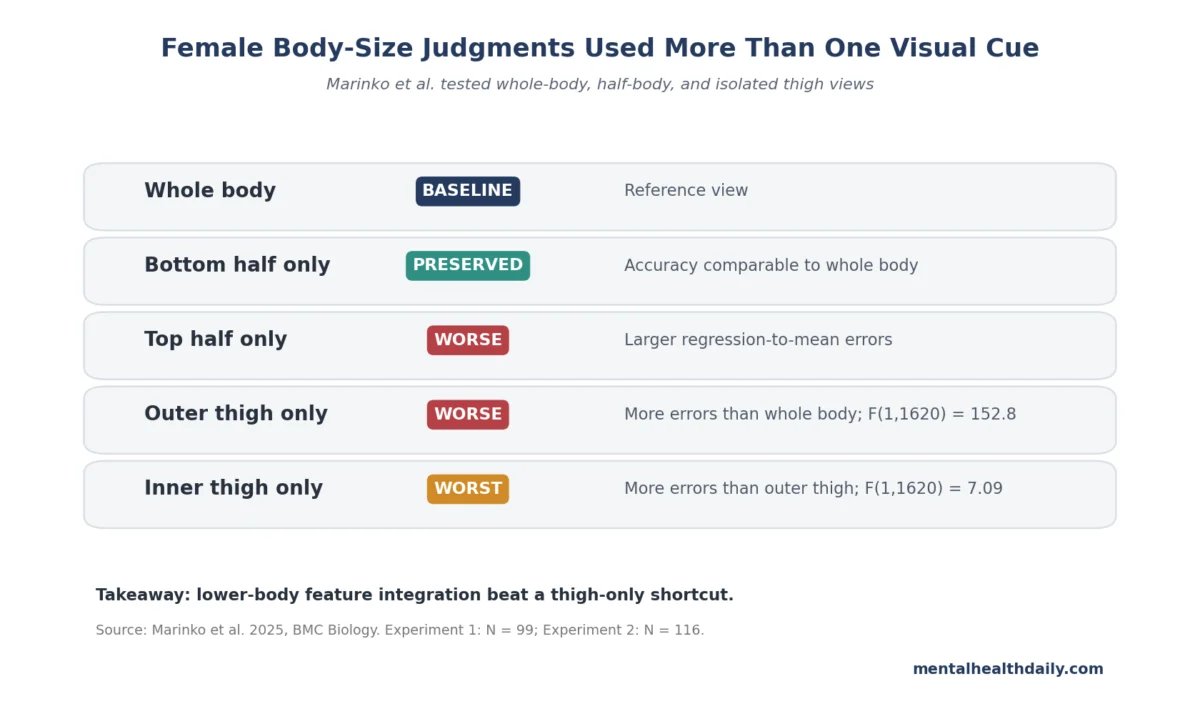
The practical implication of this interaction was striking: judgments made from bottom-half-only views were remarkably comparable in accuracy to those made from whole-body views. This suggests that the lower half of the body provides a rich enough set of visual cues to infer overall body size effectively. In stark contrast, top-half-only views led to a notable increase in regression-to-the-mean errors. This effect was particularly pronounced at the extreme ends of the body-size spectrum, meaning very thin and very large bodies were more frequently misjudged as closer to an average size when only the top half was visible. This indicates a significant loss of critical size-defining information when the lower body is obscured.
Experiment 2: Beyond Isolated Cues
Building on the revelation that the lower half of the body is highly informative, Experiment 2 posed a more refined question: could a single, isolated region within the lower body carry sufficient information for accurate size judgment on its own? This experiment involved 116 women and compared whole-body viewing with isolated views of either the inner-thigh or outer-thigh regions.
The answer was unequivocally negative. Both isolated thigh-region conditions resulted in significantly worse body-size judgments compared to whole-body viewing. For regression-to-the-mean error, the outer-thigh comparison indicated a model with a shallower slope and greater error (F(1, 1620) = 152.8, p < 0.001). Similarly, the inner-thigh comparison also demonstrated significantly worse performance than whole-body viewing (F(1, 1620) = 262, p < 0.001). These statistical outcomes firmly establish that stripping away context from the lower body drastically impairs perceptual accuracy.
Furthermore, a subtle but significant difference emerged between the two isolated thigh views: inner-thigh-only viewing performed slightly worse than outer-thigh-only viewing in terms of regression-to-the-mean error (F(1, 1620) = 7.09, p = 0.008). The study also observed that serial-dependence bias broadened when only a single thigh region was visible. The estimated serial-dependence amplitude, a measure of how strongly previous stimuli influence current judgments, increased from A = 0.43 for whole-body viewing to A = 0.47 for outer-thigh viewing, and further to A = 0.64 for inner-thigh viewing. This suggests that with less reliable visual information, the perceptual system becomes more susceptible to biases from prior observations, further compromising judgment stability.
The Feature Integration Model: A New Paradigm
The combined findings of both experiments strongly support a "lower-body feature integration" model for female body-size perception. This model posits that the perceptual system does not rely on a single, isolated anatomical patch but rather combines multiple visible cues from the entire lower body to construct an accurate estimate of size. A full bottom-half view provides enough contextual information for this integration process to function effectively. However, when that view is reduced to just a single, isolated region like the inner or outer thigh, crucial contextual information that the visual system normally uses for calibration and integration is lost. This loss leads to increased perceptual error, as the system struggles to make accurate judgments based on incomplete data.
This research aligns with an evolving understanding in cognitive psychology that human perception is often a process of integrating various sensory inputs rather than passively receiving information. In the context of visual perception, the brain actively constructs a representation of the world by combining edges, textures, shapes, and proportions. When these elements are fragmented, the reconstructive process is hampered, leading to less accurate or more biased perceptions.
Historical Precedent and Evolving Understanding
The current BMC Biology study by Marinko et al. does not exist in a vacuum but rather builds upon a growing body of research emphasizing the nuanced nature of visual cue processing in body perception. Prior studies have already begun to dismantle the idea of a simple, monolithic "body image" perception.
For instance, earlier work by Irvine et al. utilized eye-tracking and visual masking techniques to investigate which cues truly drive self-assessment of body size. Their key insight was that where people fixate their gaze is not necessarily the same as the information their visual system actually processes for judgment. Observers might look centrally at a body, but the accuracy of their size judgment might depend more critically on peripheral body-edge cues that define width and overall shape. This demonstrated that the visual system can be remarkably efficient at extracting relevant information from less obvious sources.
Further reinforcing the "feature integration" model, a 2024 study also by Marinko et al. explored whether internal body features (like musculature or fat distribution within the silhouette) added valuable information beyond just the silhouette shape itself. That study concluded that removing these internal features increased body-size judgment errors and altered serial-dependence patterns, directly arguing against a simplistic "outline-only" account of body perception.
The 2025 lower-body study then adds a more specific and granular piece to this puzzle. It confirms that while comprehensive lower-body information can preserve accuracy, fragmented, isolated lower-body cues cannot. Taken together, this accumulating evidence strongly favors a sophisticated feature-integration model, where body-size perception relies on the synergistic processing of multiple visual cues. When too much of this cue structure is removed or fragmented, the accuracy of perception inevitably declines.
Implications for Clinical Practice and Future Research
While the BMC Biology study was conducted on a non-clinical sample of women judging standardized images of other female bodies, its implications for both clinical practice and future research in body image are substantial, albeit indirect. The authors are careful to note that their findings do not prove that lower-body cue weighting causes eating disorders, nor do they provide a direct clinical test or treatment target. However, the contribution is methodologically and theoretically profound.
For body-image research, the study offers a crucial methodological takeaway: future investigations should move beyond simply assuming that a global body outline or a person’s gaze location fully captures the complexity of the perceptual problem. Instead, researchers should meticulously measure which specific visual cues people utilize and how those cues are integrated into a coherent size judgment. This means developing more sophisticated assessment tools that can differentiate between various perceptual strategies. For example, researchers could investigate whether individuals with different forms of body dissatisfaction or eating disorder symptoms exhibit distinct patterns of cue weighting or integration deficits. Do individuals with anorexia nervosa, for instance, hyper-focus on specific cues while ignoring others, leading to systematic biases in their self-perception?
For clinical practice, particularly in the treatment of eating disorders and body dysmorphic disorder, these findings suggest a potential refinement in therapeutic approaches. While not a direct guide, understanding the perceptual mechanisms could inform the design of interventions like exposure therapy. If therapists know that integrated lower-body cues are critical, they might adapt mirror exposure exercises to ensure patients attend to and process broader regions of their body rather than fixating on isolated "problem areas." The study underscores that perception is not monolithic; it is a dynamic process of information processing. Therefore, therapeutic strategies aimed at correcting distorted body image might benefit from targeting these specific perceptual pathways. However, this translation requires further clinical studies directly testing self-body perception, symptom severity, and treatment response in clinical populations.
Challenging Simplistic Narratives: More Than a "Thigh Obsession"
One of the most crucial aspects of this research is its ability to challenge and refine popular, often oversimplified, understandings of body image concerns. It would be an easy misinterpretation for popular media to frame this paper as simply confirming that "people judge female body size by looking at thighs." The actual result, however, is far more nuanced and cautious. The distinction between the sufficiency of bottom-half information in Experiment 1 and the insufficiency of one isolated thigh region in Experiment 2 is critical.
This distinction profoundly changes the interpretation: it’s not about a single "thigh obsession" but about the complex interplay of visual information. The lower-body signal mattered because it preserved a robust visual structure and context, allowing for accurate integration, not because one isolated feature unilaterally carried the entire judgment. This underscores the need for media literacy and careful communication of scientific findings to prevent misrepresentation that could inadvertently fuel body image anxieties or reinforce problematic stereotypes.
The Road Ahead: Refining Body Image Assessment and Intervention
The BMC Biology study by Marinko et al. serves as a significant milestone in sharpening the perception side of body-image research. It unequivocally demonstrates that female body-size judgment is neither purely holistic (requiring a full-body view) nor simplistically reducible to a single body part. Instead, accuracy is profoundly dependent on multiple lower-body cues working together in an integrated fashion.
The ongoing questions stemming from this research are numerous and exciting. Researchers must now investigate whether these findings generalize to male body-size perception, cross-cultural contexts, and most importantly, to individuals experiencing clinical body-image disturbance. Do people with anorexia nervosa, bulimia nervosa, or body dysmorphic symptoms show different patterns

