

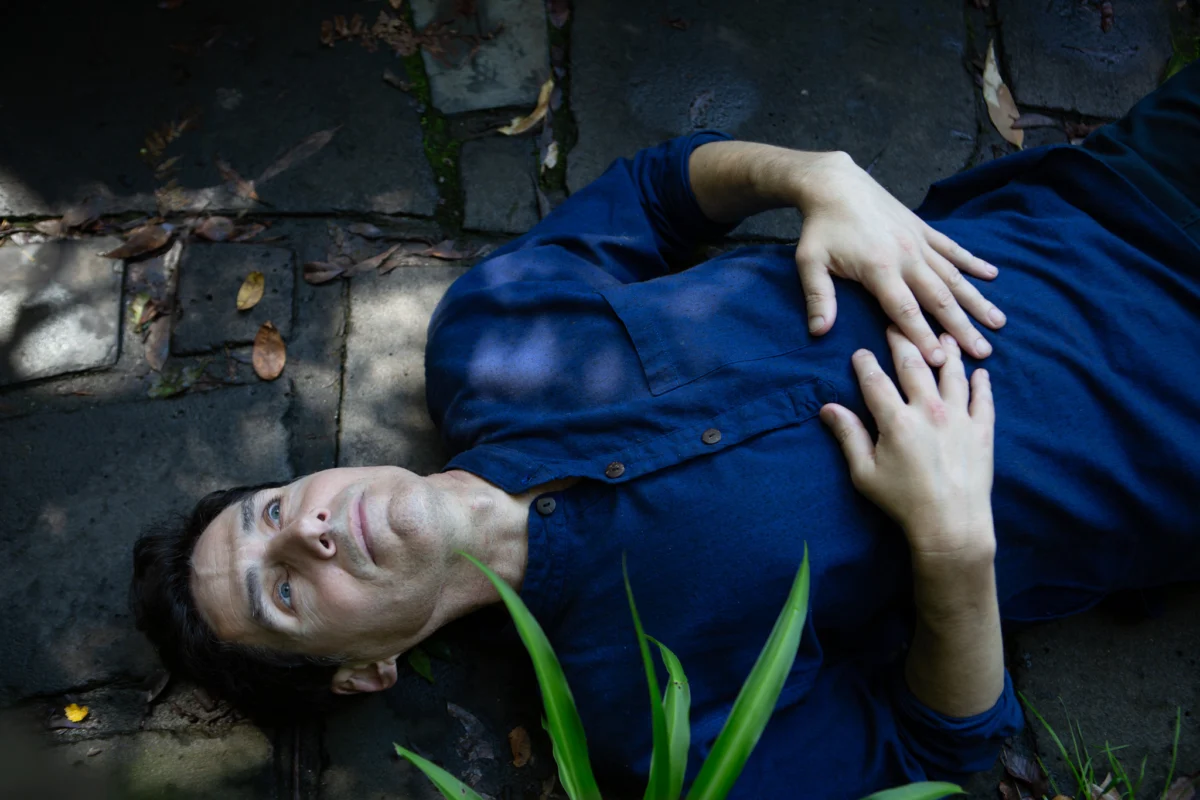
Experimental composer David Shea, once a fixture of New York City’s avant-garde music scene, is now captivating electronic and ambient music audiences worldwide with his distinctive sonic tapestries. His journey, which began in the early 1990s as a turntablist and sample manipulator within the orbit of legendary saxophonist John Zorn, has evolved into a deeply personal exploration of cultural intersections, spiritual practice, and the boundless potential of sound. Shea’s work, characterized by its seamless integration of classical, avant-garde, jazz, pop, and folk elements, consistently bridges the perceived divide between high and lowbrow culture.
Born from a deep appreciation for electroacoustic pioneers like John Cage, Iannis Xenakis, Morton Feldman, and György Ligeti, Shea’s compositions are often described as postclassical sampling collages. These intricate soundscapes are frequently imbued with references to East Asian culture, drawing inspiration from Hong Kong cinema and classical Chinese literature. This engagement with East Asian arts, including martial arts, has been a lifelong pursuit for Shea, dating back to his youth in the 1970s. His commitment to this cultural dialogue extends to his ongoing collaborations with local folk musicians, a testament to his dedication to preserving and reinterpreting traditional sounds within contemporary contexts. At the time of this interview, he was engaged in intensive recording sessions with a group of traditional Vietnamese instrumentalists, a project that exemplifies his cross-cultural approach.
A Life Intertwined with Practice and Sound
Shea’s lifelong dedication to Buddhism has profoundly shaped his artistic output. His spiritual journey is a palpable undercurrent in works such as the critically acclaimed "Towers of Mirrors" (1995), and more recent explorations like "Rituals" (2015) and "Meditations" (2025). He observes a growing societal openness to integrating artistic expression with spiritual practice, a trend he views with optimism. "The past four or five years, there seems to be more of an openness to looking at the arts as a central part of practice," Shea remarks, highlighting this positive shift.
Having resided in Melbourne for over a decade, Shea’s musical evolution has seen him move from early avant-garde labels like Sub Rosa and John Zorn’s Tzadik to a new home with the acclaimed ambient label Room40, curated by Australian musician and field recordist Lawrence English. His characteristic dry wit was on display when responding to an interview request from Tricycle contributor Stephan Kunze: "We are ten hours ahead of European time," Shea quipped, adding pragmatically, "Not that I believe in time or anything."
Navigating Buddhist Traditions and Musical Expression
Shea’s approach to Buddhism is characterized by an inclusive and exploratory spirit, transcending rigid sectarian boundaries. While his formative experiences were rooted in Mahayana traditions, evident in the temples he frequents in Melbourne, he emphasizes the value of learning from all Buddhist groups. He acknowledges the common human tendency towards internal divisions, even within spiritual communities, likening it to the rivalries seen in other religions. "We have to accept that the Nikayas are translations of translations of translations," Shea states, suggesting that this inherent fluidity allows for diverse interpretations and expressions, including his own musical translations.
For Shea, Buddhist practice is not confined to formal meditation sessions but permeates every aspect of life. "I’m not sure there’s anything that the practice doesn’t entail," he asserts. This holistic view encompasses writing music, teaching at universities, casual conversations, and even confronting anger. His early experiences with martial arts as a teenager led him to believe meditation occurred in idyllic, serene settings. However, he soon discovered the true challenge and profundity of finding balance and equanimity amidst chaos, conflict, and the demands of daily life.
Shea’s path has consistently involved active engagement within artistic and cultural spheres. He likens his approach to the ancient practice of monastic alms rounds, where monks would go into villages to offer teachings and receive sustenance. This metaphor underscores his belief in making spiritual practice useful and effective within its immediate context. For Shea, this context has been deeply intertwined with media culture and technology. He notes a remarkable receptiveness from traditional folk musicians from various cultures—China, Indonesia, Italy—who readily accept his use of samplers and electronics as simply another form of instrumentation. This contrasts with the more rigid perceptions often encountered within jazz and classical circles, where such technology might be viewed with skepticism.
The Sonic Landscape of "Rituals" and "Meditations"
Shea’s recent works, "Rituals" (2015) and "Meditations" (2025), directly engage with the realities of meditative practice. He observes that typical "New Age" or meditation music often presents an idealized, comforting soundscape, failing to capture the full spectrum of inner experience. Shea’s compositions, conversely, aim to reflect the inherent dissonance and flux of meditation. "Nonharmony is a part of harmony, and we live with that every day," he explains, referencing the unexpected thoughts and emotions that arise during practice. He aims to capture this dynamic, where moments of profound concentration are punctuated by mundane distractions, much like sunlight breaking through clouds.
His collaborations with musicians who have a background in meditation, particularly from China, have facilitated a natural resonance with this approach. Shea emphasizes that meditation is not a purely cosmic or idealized process but an integrated part of daily life, encompassing both sacred moments and the mundane realities of answering emails or preparing a morning beverage. Both "Rituals" and "Meditations" are described as attempts to "be in the experience, not trying to describe the experience."
This compositional approach distinguishes Shea’s work from the more functional, sonic backdrop often provided by conventional meditation music. While acknowledging the value of creating a peaceful atmosphere, Shea prioritizes an artistic exploration of the meditative process itself. He likens his teaching at Melbourne University to demystifying meditation for students who initially struggle with the perceived requirement of a "clear mind." He teaches that focus and attention, rather than the elimination of thought, are key, and that mantras serve as tools for directing the mind.
Origins in the Downtown Music Scene
Shea’s formative years were shaped by the vibrant and experimental Downtown music scene in New York City. Leaving home at a young age, he briefly attended the Oberlin Conservatory of Music before immersing himself in the city’s burgeoning experimental arts landscape. John Zorn, a central figure in this scene, became a significant mentor. Shea joined Zorn’s ensembles in the late 1980s, initially as a turntablist and sample manipulator. He describes Zorn as a demanding but supportive figure, emphasizing Zorn’s commitment to community over individual stardom.
"Besides being a taskmaster, he was an older brother who was very kind and supportive," Shea recalls. "For him, it really was about community, even though the world doesn’t like that. They want the hero." This period provided Shea with an invaluable education, leading him to form his own ensembles and embark on extensive international tours in the mid-1990s.

A Self-Taught Prodigy and Cultural Synthesizer
Despite his deep immersion in institutional music settings, Shea’s musical training was largely unconventional. He cultivated a voracious curiosity, spending countless hours in libraries and attending every concert he could. His early influences were diverse, ranging from the contemporary classical composers like Karlheinz Stockhausen, Iannis Xenakis, and György Ligeti to his deep engagement with Daoism, Buddhism, and martial arts. He found the traditional academic institutions to be too insular and detached from the broader cultural landscape.
His early interest in experimental music at a young age, while his peers gravitated towards pop and rock, stemmed from a fundamental lack of distinction between genres. "I knew the distinctions, but they just weren’t very important," he explains. This open-mindedness allowed him to absorb influences from a wide array of sources, including computer music from the Princeton-Harvard Lab, which he found initially jarring but ultimately fascinating.
The cultural milieu of the 1970s, where Eastern philosophies and practices were becoming more accessible in the United States, played a significant role in shaping Shea’s worldview. Growing up in a working-class Irish and Sicilian family, he was not part of a "hippie" enclave, yet he actively sought out lectures and information on transcendental meditation. Hong Kong films and other media also provided a rich source of inspiration. He encountered figures like John Cage, whose influence was profound, and realized the deep connections between many of the 20th-century artists he admired and Zen Buddhism. This realization marked a significant shift, prompting him to look beyond superficial stylistic differences and explore the underlying currents connecting diverse traditions. His meeting with John Cage, whom he describes as one of the kindest people he had ever met, further solidified his commitment to exploring these connections.
The Genesis of Plunderphonics and Collaborative Creation
Shea’s early use of turntables as a primary instrument was born out of necessity. After leaving conservatory with no instruments and living as a squatter in the East Village, he believed a true composer should be able to create with minimal resources. His initial experiments involved using his voice, multiphonic techniques, and found objects like a discarded police megaphone. Cassette tape collages followed, where he would meticulously cut and loop snippets of music, including Koto performances, to create live performances.
The acquisition of turntables opened up new possibilities. Shea would use three turntables simultaneously, layering disparate musical sources—Swedish death metal, tango, and Schubert—to discover emergent harmonic or rhythmic connections. This practice was not about the conceptual appeal of vinyl but about uncovering inherent links between musical traditions, harmonies, and disharmonies. He describes his music as "hybrid connective tissue music," a synthesis of recorded material, live players, acoustics, and electronics.
Shea was aware of the pioneering work of John Oswald and his concept of "plunderphonics," a term that predates and informs much of modern sampling. He also knew Christian Marclay, another influential turntable artist who was part of Zorn’s ensembles. Marclay’s innovative techniques, involving physically altering records, demonstrated a unique fusion of visual art and music. The early 1980s New York scene, characterized by improvisational performances in galleries and cinemas, fostered a spirit of uninhibited exploration. Shea credits this environment, along with the influence of free improvisation and the work of Pauline Oliveros and the minimalist movement, with cultivating his deep appreciation for active listening.
The Art of Listening and Interconnectedness
Shea’s participation in Derek Bailey’s "Company" in 1992, a week-long improvisation workshop bringing together musicians from diverse backgrounds, was a pivotal experience. He recalls playing turntables alongside Bailey, a titan of free improvisation, and finding himself soloing with unexpected brilliance. He attributes this to Bailey’s profound ability to teach the art of listening and situational awareness. "The secret to being a good musician is being a great listener," Shea emphasizes, distinguishing between a cosmic understanding of listening and the practical, active awareness of one’s musical environment. This experience further fueled his desire to understand and dissolve the artificial divisions between musical genres, advocating for a more layered and integrated approach to music-making.
Redefining "Experimental" in the Digital Age
Shea challenges the traditional notion of academic "experimental" music, suggesting that contemporary popular music often exhibits a more genuinely exploratory spirit than established avant-garde traditions that might be seen as re-treading old ground. He views genre labels, such as "ambient," as largely marketing tools that can be transcended. "I don’t fight it. As long as we can see them as meaningless, I don’t mind the categories," he states, emphasizing that these divisions, created for convenience, can also be dismantled by listeners and creators.
He finds the burgeoning landscape of digital music platforms, despite the sheer volume of daily uploads, to be an exciting development. Drawing a parallel to the introduction of synthesizers, which many feared would render orchestras obsolete, Shea asserts that technology, while transformative, does not negate the enduring value of human artistry. "I think good artists will work with technology and machines in interesting ways," he posits. He encourages his students to embrace all tools, including AI, but to question their purpose and application. His own experiments with AI involve improvising with the technology to co-compose, often resulting in unexpected and generative sonic ideas.
Shea views computers and samplers as extensions of musical instruments, akin to a tuba or a crystal singing bowl. He acknowledges that the perceived primitiveness of some technologies, like a crashing computer, can be frustrating, but he believes that the ongoing evolution of these tools in the hands of skilled artists will yield significant and positive outcomes. The development of AI-composed Eurovision songs, however bizarre, demonstrates that technology in itself is neutral; its impact is determined by the human intention and creativity behind its use.
The Role of Sound in Meditation
Shea’s recent album "Meditations" is a testament to his belief that music can support, rather than detract from, the meditative experience. He acknowledges that music is not essential for meditation, as natural sounds are always present. His field recordings, captured with specialized microphones that mimic the human ear, capture the ambient soundscapes of Australian natural environments. These recordings are woven into his compositions, creating what he calls "bush concerts."
He questions the notion of absolute silence, referencing John Cage’s assertion that sound is omnipresent. For Shea, the key lies in choosing sounds that enhance, rather than distract from, the practice. He likens this to the dual nature of a candle flame: it can be a focal point or a distraction if one becomes too engrossed. Similarly, the attachment to a mantra can, paradoxically, lead one away from the core purpose of meditation. "The response to that is going to generate a lot of great work," Shea concludes, expressing optimism about the future of art and technology, and the continuous exploration of sound and consciousness.

