

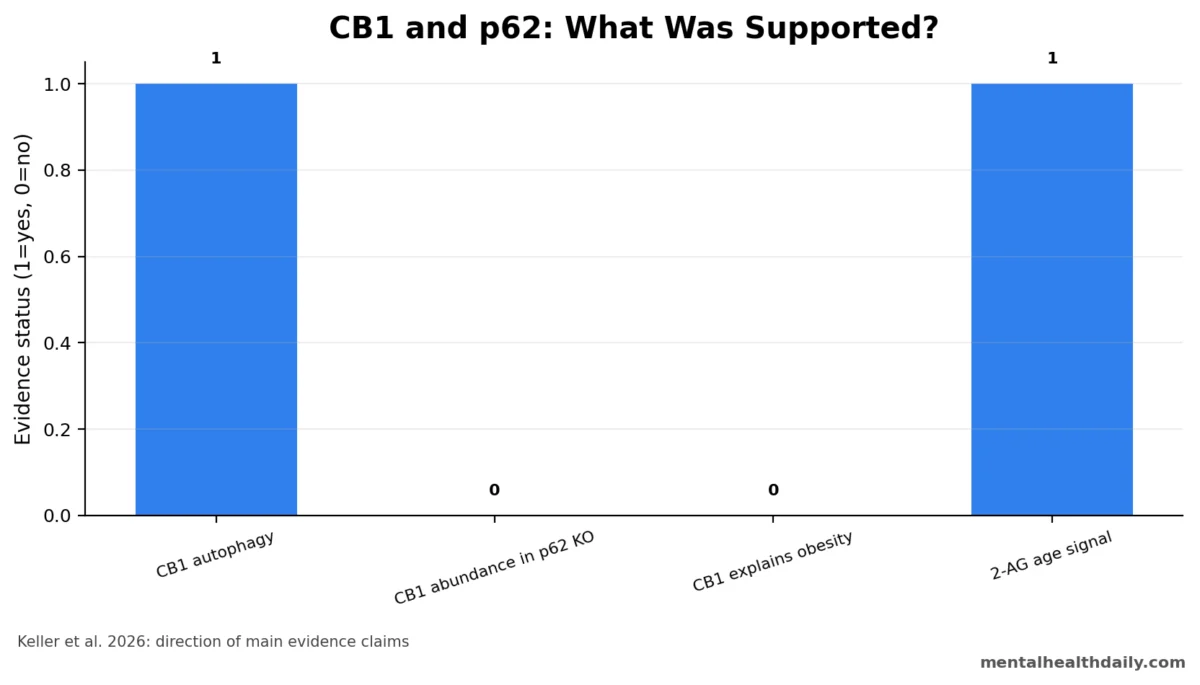
A landmark 2026 neuron and mouse study by Keller et al. has significantly refined our understanding of cannabinoid receptor 1 (CB1) metabolism and its relationship to p62-related obesity. The research, published in a leading scientific journal, found that CB1 receptors demonstrably accumulate when autophagic flux is blocked in primary cortical neurons. However, a crucial distinction emerged at the organismal level: p62 deficiency did not lead to a significant increase in steady-state CB1 receptor abundance in the brain or hypothalamus of mice, nor did it establish CB1 signaling as the primary explanation for the observed late-onset obesity in p62 knockout models. This finding critically separates two concepts often blurred in scientific discourse: the cellular mechanism by which CB1 receptors can be processed through autophagy, and the broader metabolic pathways through which p62-related obesity arises, suggesting the latter is not predominantly driven by CB1 receptor accumulation.
Unpacking the Intersections: CB1, Autophagy, and p62 in Metabolism
To fully appreciate the implications of the Keller et al. study, it is essential to understand the intricate biological systems at play. CB1 receptors are G-protein-coupled receptors widely distributed throughout the central and peripheral nervous systems, with particularly high expression in the brain. They are integral to regulating a vast array of physiological processes, including synaptic release, appetite control, reward pathways, stress response, pain perception, and crucial aspects of energy balance. Their central role in metabolism has long made them a subject of intense scientific interest, particularly in the context of obesity and metabolic disorders.
Autophagy, literally meaning "self-eating," is a fundamental cellular process responsible for the orderly degradation and recycling of cellular components. This sophisticated cellular recycling system moves damaged proteins, aggregates, and organelles towards lysosomes for degradation, thereby maintaining cellular homeostasis, preventing the accumulation of toxic materials, and playing a vital role in cellular adaptation to stress and nutrient deprivation. Disruptions in autophagic flux have been implicated in various pathologies, including neurodegenerative diseases, cancer, and metabolic dysfunction.
p62, also known as sequestosome 1 (SQSTM1), is a multifaceted protein that acts as a selective autophagy receptor. It plays a pivotal role in linking ubiquitinated cargo to the autophagic machinery, essentially tagging specific cellular components for degradation via the autophagy-lysosome pathway. The protein p62 is a central player in cellular stress responses, inflammation, and metabolic regulation. A compelling observation from previous research is that p62 knockout mice develop obesity with age, suggesting a critical role for p62 in metabolic regulation. This established link between p62 deficiency and obesity formed the core hypothesis for Keller et al.: could a disruption in CB1 receptor handling, potentially mediated by p62, explain this metabolic phenotype?
This research question strategically positions itself at the confluence of three distinct, yet often interconnected, scientific literatures: studies focusing on CB1 receptor metabolism, papers investigating p62-autophagy’s role in obesity, and broader receptor-trafficking research. Historically, the insights from these fields have sometimes been collapsed into a single narrative. The Keller et al. study, however, advocates for a more nuanced and specific interpretation. While CB1 signaling undeniably exerts potent metabolic effects, and p62 loss unequivocally induces an obesity phenotype in various mouse models, this new study meticulously adds a critical piece to the puzzle regarding receptor turnover, without asserting that p62-driven obesity is primarily a consequence of CB1 receptor abundance dysregulation.
Cellular Insights: CB1 Receptors Utilize Autophagic Pathways
The initial phase of the Keller et al. investigation focused on the cellular mechanics of CB1 receptor degradation. Researchers utilized primary cortical neurons derived from wild-type mouse embryos at embryonic days 15.5-16.5. This in vitro model allowed for precise manipulation of cellular degradation pathways. A key experimental intervention involved treating these neurons with Bafilomycin A1, a potent lysosomal inhibitor. By blocking the final stage of lysosomal degradation, Bafilomycin A1 effectively halts the autophagic flux, causing proteins destined for this pathway to accumulate.
The results were unequivocal: Bafilomycin A1 treatment led to a substantial accumulation of CB1 receptors within the neurons. This finding strongly supports a fundamental cell-biology claim: CB1 receptors can indeed be degraded through an autophagy-dependent route. This "turnover claim" posits that a receptor’s abundance at any given moment is a dynamic reflection of its production, signaling activity, internalization, recycling, and ultimately, its degradation. Blocking a specific degradation pathway, such as autophagy, can illuminate its involvement even if it isn’t the sole or dominant driver of a whole-animal phenotype.
Further experiments explored the influence of CB1 receptor activation on this turnover. Stimulation with the CB1 agonist HU-210 partially mitigated the receptor accumulation induced by autophagy blockade, suggesting that receptor activation itself can influence the degradation process. Conversely, the antagonist SR141716A, more famously known as rimonabant in the context of obesity drug development, exhibited only a weak antagonistic effect in this specific cellular setup.
The researchers interpreted these drug patterns with appropriate caution, acknowledging the inherent complexity of receptor trafficking. They noted that CB1 internalization, recycling, endosomal degradation, and autophagic processing likely all contribute to the receptor’s overall turnover, and the experimental design was not intended to comprehensively map every single trafficking branch. Nevertheless, the study significantly strengthens the argument that CB1 receptors are substrates for an autophagy-linked degradation pathway. This does not, however, imply that autophagy is the exclusive disposal route for CB1. Broader research into G-protein-coupled receptors (GPCRs) has already demonstrated that these receptors can be sorted towards endolysosomal destruction through multiple ubiquitin-linked pathways, highlighting the redundancy and robustness of cellular degradation systems. Consequently, the Keller et al. study adds CB1 to the growing list of autophagy substrates, while leaving questions regarding receptor pool location and precise cell-type specificity open for future investigation.
Mouse Data Unveils a More Complex Picture of p62 Obesity
While the cellular findings established a clear link between CB1 and autophagy, the whole-animal mouse data presented a more complex interpretation regarding p62-deficient obesity. Contrary to the initial hypothesis that p62 deficiency might lead to CB1 receptor accumulation and thus explain the obesity phenotype, the study found no significant alteration in CB1 receptor protein abundance in the brain or hypothalamus of p62 knockout mice. Furthermore, hypothalamic ERK1/2 signaling, a downstream effector of CB1 activity, was only modestly attenuated, and direct CB1 receptor antagonism in these mice failed to uncover a receptor-dependent explanation for their obesity.
This negative finding is particularly significant because p62 knockout mice undeniably manifest a distinct metabolic phenotype. These mice exhibit late-onset obesity, notably without hyperphagia (increased food intake), but with early hypoactivity, elevated hypothalamic levels of 2-arachidonoylglycerol (2-AG) with age, and altered fasting-refeeding behaviors.
A detailed examination of the weight data provides a clear chronological progression of the obesity. At 12 weeks of age, male wild-type and p62 knockout mice showed virtually identical body weights, averaging 31.2 g and 31.0 g, respectively. However, by 18 weeks, the p62 knockout mice were significantly heavier, weighing an average of 32.9 g compared to 28.3 g for their wild-type counterparts. This divergence continued to widen, with the genotype gap exceeding 6 g by 21 weeks. Critically, the researchers confirmed that food intake did not increase sufficiently in the p62 knockout mice to account for this substantial weight gain, thereby challenging a simplistic "ate more, gained more" interpretation.
The activity data provided a more plausible behavioral explanation for the weight discrepancy. A reduction in voluntary locomotion was observed around 15 weeks of age in the p62 knockout mice, roughly three weeks before the onset of significant weight separation. This temporal relationship suggests that reduced physical activity is a substantial contributor to the obesity phenotype. By one year of age, p62 knockout males weighed an average of 18 g more than controls and were active for approximately 1.7 minutes per hour during their active phase, a stark contrast to the 3.6 minutes per hour observed in wild-type mice. While this does not definitively prove hypoactivity as the sole cause of obesity, it positions it far closer to the observed phenotype than changes in steady-state CB1 receptor abundance.
Despite the lack of significant CB1 receptor accumulation, the study’s finding of elevated hypothalamic 2-AG in p62 knockout mice suggests that the endocannabinoid system, of which CB1 receptors are a part, remains relevant. 2-AG is an endogenous cannabinoid, a lipid signaling molecule naturally produced by the body that can activate cannabinoid receptors. Its elevation in the hypothalamus indicates an altered endocannabinoid tone, even if the primary driver of obesity isn’t simple CB1 receptor upregulation. The tissue specificity of this finding is also important: elevated 2-AG was confined to the hypothalamus, while anandamide (AEA) and arachidonic acid (AA) levels remained unchanged, and endocannabinoid measures in white adipose tissue and liver did not show the same broad genotype difference. This pattern lends stronger support to a central signaling hypothesis rather than a generalized, body-wide endocannabinoid excess.

P62 Obesity: A Broader Metabolic Narrative
The finding that p62 deficiency does not primarily drive obesity through CB1 receptor accumulation becomes more understandable when viewed in the context of prior research on p62. A seminal 2006 study published in Cell Metabolism had already reported mature-onset obesity and insulin resistance in p62-deficient mice, firmly establishing p62’s role upstream of broad metabolic regulation long before the specific question of CB1 involvement was posed by Keller et al. Subsequent research further elucidated p62’s intricate connections to beta-adrenergic input, mitochondrial function, and thermogenesis – pathways that offer more direct routes into energy expenditure and overall metabolic balance than receptor abundance alone.
Adding another layer of complexity, a separate 2021 study focusing on adipocytes pushed the interpretation even further. This research highlighted the role of NBR1 (neighbor of BRCA1 gene 1), another selective autophagy receptor with cargo-handling roles overlapping with p62. NBR1 was identified as a key player in repressing thermogenesis in p62-deficient adipocytes, acting through PPARγ (Peroxisome Proliferator-Activated Receptor gamma) signaling. PPARγ is a nuclear receptor crucial for regulating adipocyte differentiation and lipid storage.
These adjacent research findings collectively reinforce the notion that p62 deficiency leads to a multifaceted metabolic disturbance. If the absence of p62 can disrupt adipocyte thermogenesis, impair mitochondrial function, and alter compensatory selective autophagy mechanisms, then the observation of normal bulk CB1 receptor abundance in the brain is not a paradox. Instead, it suggests that the p62-driven obesity phenotype arises from a broader dysregulation of energy balance and cellular metabolism, where CB1 receptor levels are not the primary bottleneck. The obesity phenotype remains robust, but the initial suspected molecular bridge involving CB1 receptor accumulation in the hypothalamus or whole brain does not hold true.
The practical synthesis derived from these findings is not to dismiss the relevance of CB1 altogether. CB1 biology undeniably influences appetite, locomotion, and lipid storage. Rather, the Keller et al. study provides a more specific clarification: while CB1 can be processed via autophagy, the clean molecular link from p62 loss to increased CB1 receptor accumulation, as a direct driver of obesity in the hypothalamus or whole brain, was not found.
The Endocannabinoid System and the Cautionary Tale of Rimonabant
The endocannabinoid system, despite the specific findings of the Keller et al. study, continues to be recognized as a credible and powerful metabolic target. CB1 receptor activation is known to increase food intake, modulate reward-related eating behaviors, and influence energy expenditure. The historical context of human pharmacology provides a compelling illustration of this biological relevance. Rimonabant, a CB1 antagonist, was developed and marketed with the aim of reducing weight and improving metabolic outcomes in overweight and obese patients.
Early mechanistic literature, such as the work by Cota et al., elegantly demonstrated that endogenous cannabinoid signaling profoundly impacted energy balance by influencing both central orexigenic drive (appetite stimulation in the brain) and peripheral lipogenesis (fat storage). Subsequent comprehensive reviews solidified the view of the endocannabinoid system as a major orchestrator of obesity and metabolic disease, not merely a minor pathway.
However, the clinical translation of this mechanistic understanding revealed a significant hurdle. Trials like the RIO-Europe study confirmed that rimonabant indeed produced measurable weight loss and cardiometabolic improvements in overweight or obese patients. Yet, the broader clinical development program for rimonabant was ultimately deemed unacceptable due to severe psychiatric adverse effects, including depression, anxiety, and other mood disturbances. These were not minor side effects but critical safety concerns for a centrally acting appetite-suppressing drug that directly modulated brain activity. The drug was subsequently withdrawn from the market.
This cautionary tale from rimonabant’s history underscores a vital "mechanistic bottom line" for the Keller et al. study: their findings serve to refine our understanding of molecular mechanisms rather than to revive simplistic drug development ideas. Their data firmly support the concept of CB1 autophagic turnover in neurons, while simultaneously arguing against a direct, CB1-centered explanation for p62 knockout obesity. This distinction is particularly important for interpretations related to cannabis or human weight loss: a mechanistic mouse autophagy result does not automatically translate into advice regarding cannabis use, CB1 blockade, or immediate human obesity treatment strategies.
Summary of Claims and Limitations
The 2026 mouse study by Keller et al. provides a clear delineation of its strongest supported claims and its strongest negative claims.
Strongest Supported Claim (Cellular): CB1 receptor protein accumulated significantly when autophagic degradation was experimentally blocked in primary cortical neurons derived from mice. This establishes autophagy as a viable pathway for CB1 receptor turnover.
Strongest Negative Claim (Whole-Animal): p62 deficiency did not lead to a significant increase in the bulk abundance of CB1 receptors in either the brain or the hypothalamus of mice. Furthermore, CB1 receptor antagonism did not uncover a direct receptor-dependent mechanism to explain the obesity observed in p62 knockout mice.
The ability of both these statements to be true lies in the complex, multi-layered nature of biological systems. A specific receptor, like CB1, can indeed utilize autophagy for its cellular turnover and degradation, even if a broader, whole-organism metabolic phenotype, such as p62-driven obesity, is predominantly governed by other, more encompassing metabolic pathways. Cellular degradation routes and organism-level metabolic phenotypes do not always exhibit a simple one-to-one mapping.
Several important constraints ensure that the conclusions drawn from this study remain appropriately narrow:
- This was a mechanistic study conducted on mice and isolated cells.
- It aimed to clarify receptor biology and the interpretation of the p62 phenotype.
- It cannot provide guidance to cannabis users regarding how CB1 affects weight.
- It cannot predict the psychiatric side effects of potential CB1-targeting drugs in humans.
- It does not define or suggest new human obesity treatments.
The evidence strength of this research lies in its ability to clarify intricate receptor biology and refine the interpretation of the p62 phenotype. It is not intended, nor does it provide, direct clinical advice for cannabis use, CB1-targeting drug development, or human obesity management. The study reinforces the importance of meticulous mechanistic investigation to disentangle complex biological interactions, ultimately contributing to a more precise and nuanced understanding of metabolic health and disease.

