

A recent U.S. insurance-claims study involving 1,467 adults diagnosed with bipolar I disorder revealed a significant improvement in medication coverage over a six-month period for patients who switched to a two-month aripiprazole injection. The retrospective analysis indicated that these individuals experienced more days covered by their prescribed medication in the six months following the switch, compared to the six months prior. Concurrently, the study observed a decline in hospital stays and overall medical costs. While these findings suggest promising real-world benefits for this long-acting injectable (LAI) antipsychotic, the study’s design, which lacked a comparison group and was funded by the drug’s manufacturers, necessitates careful interpretation of its causal implications.
Understanding Bipolar I Disorder and the Critical Role of Adherence
Bipolar I disorder is a complex and chronic mental health condition characterized by distinct episodes of mood disturbance, ranging from periods of elevated mood (mania or hypomania) to episodes of profound depression. The diagnostic hallmark of bipolar I is the occurrence of at least one full manic episode. These episodes can significantly impair an individual’s functioning, leading to hospitalization, legal issues, financial difficulties, and severe distress. The global prevalence of bipolar disorder is estimated to be around 1-2% of the population, with bipolar I representing a substantial portion of these cases.
Effective management of bipolar I disorder hinges critically on consistent medication adherence. Mood stabilizers and antipsychotics are the cornerstones of treatment, primarily used as maintenance therapy to prevent the recurrence of mood episodes. However, medication non-adherence is a pervasive challenge across chronic conditions, and it is particularly pronounced in mental health disorders. Factors contributing to non-adherence in bipolar I include the episodic nature of the illness (patients may stop medication when feeling well), side effects, complex dosing regimens, lack of insight during manic phases, stigma, and practical barriers like forgetting doses or difficulty accessing pharmacies. Poor adherence directly correlates with higher rates of relapse, hospitalization, increased healthcare costs, and a diminished quality of life. Studies have shown that non-adherence rates in bipolar disorder can be as high as 50-70%, making interventions that improve adherence crucial for better patient outcomes.
The Evolution of Long-Acting Injectables in Psychiatry
The development of long-acting injectable antipsychotics represents a significant advancement in addressing the adherence challenge in chronic mental illnesses like bipolar disorder and schizophrenia. Unlike daily oral pills, LAIs are administered via injection, typically into a muscle, and slowly release medication over weeks or months. This sustained release mechanism ensures consistent drug levels in the body, bypassing the need for daily pill-taking and reducing the risk of missed doses.
The concept of LAIs in psychiatry dates back to the 1960s with the introduction of first-generation antipsychotic injectables. Over time, second-generation (atypical) antipsychotics were developed into LAI formulations, offering a more favorable side-effect profile and broader efficacy. Aripiprazole, a widely used atypical antipsychotic, first became available in an oral form (Abilify) in 2002. Its unique mechanism as a dopamine D2 partial agonist made it a valuable treatment option. Recognizing the benefits of LAIs, aripiprazole was subsequently developed into a long-acting injectable formulation.
In the U.S., aripiprazole is available in two LAI forms:
- Aripiprazole Lauroxil (Aristada): This prodrug formulation is available in various dosing frequencies, including monthly (often referred to as AOM or Aripiprazole Once Monthly), and the newer every-2-months (Aristada Initio for initiation, followed by Aristada or Aristada Extended-Release for maintenance) version, referred to as Ari 2MRTU in the study.
- Aripiprazole Monohydrate (Abilify Maintena): This formulation is typically administered monthly.
The appeal of the two-month version of aripiprazole lauroxil, which provides comparable drug exposure with half the injection frequency of its monthly counterpart, is clear: enhanced convenience for patients and caregivers, potentially fewer clinic visits, and reduced logistical burdens. The core question this new claims study sought to answer was whether this theoretical advantage translates into tangible improvements in real-world medication use and patient outcomes.
The Nag et al. Claims Study: Methodology and Patient Cohort
The study, led by Nag et al., utilized a comprehensive U.S. claims database, encompassing data from both commercial insurance plans and Medicaid beneficiaries. This real-world evidence approach is invaluable for understanding how treatments perform outside the controlled environment of clinical trials. The researchers identified adults with bipolar disorder diagnosis codes who initiated treatment with Ari 2MRTU between April 2023 and September 2024. The total cohort comprised 1,467 individuals.
A key methodological aspect of this study was its "before-and-after" design. Each participant served as their own control; their medication adherence, healthcare utilization, and costs in the six months following their first two-month injection were directly compared to their own historical data from the six months immediately preceding the switch. This within-subject comparison helps to account for individual patient characteristics that might influence treatment outcomes, though it does not eliminate all confounding factors.
The study stratified the patient cohort into two distinct groups based on their prior medication regimen:
- Pill-switch group: 371 individuals who transitioned directly from daily oral antipsychotics to the two-month aripiprazole injection.
- Monthly-shot group: 1,096 individuals who switched from a monthly aripiprazole injection (AOM) to the two-month formulation.
The analysis focused on estimating medication adherence through pharmacy and injection records, as claims data cannot directly verify whether an oral pill was ingested. Two standard measures were employed:
- Share of Days Covered (SDC): This metric calculates the proportion of days within a specified period that a patient had medication available based on prescription fills or injection dates.
- Proportion of Days Covered (PDC): Similar to SDC, PDC assesses the percentage of days a patient had medication on hand, often used with a threshold (e.g., PDC ≥ 80%) to define "adherent" status.
Significant Gains in Medication Coverage and Adherence
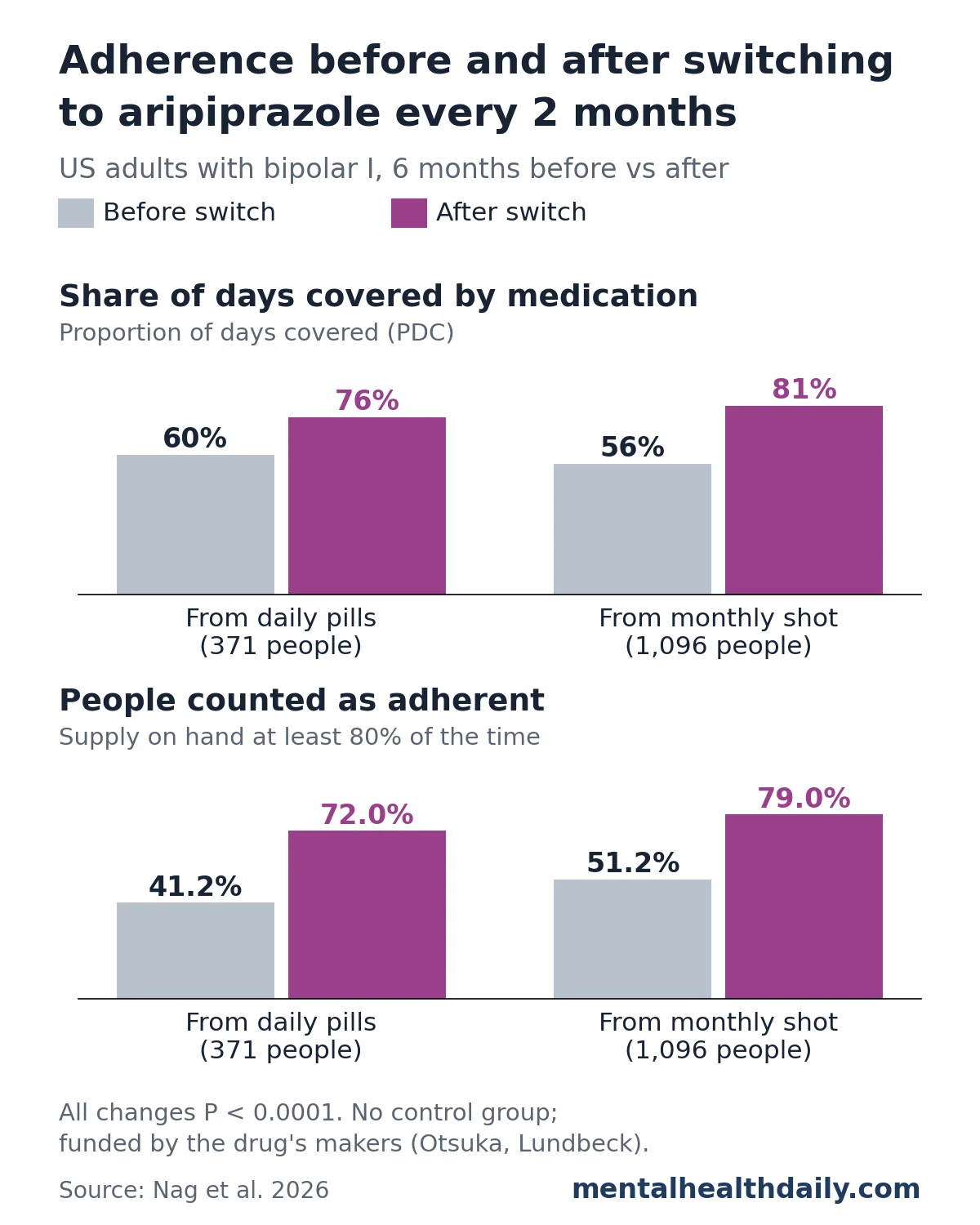
The study’s findings on medication adherence were robust and consistent across both patient groups, demonstrating a statistically significant improvement (P < 0.0001 for all measures).
For the Pill-switch group (371 people):
- The mean Share of Days Covered (SDC) surged from 60% in the six months before switching to 76% in the six months after. This represents a substantial increase in the proportion of time patients were covered by their medication.
- The percentage of individuals classified as adherent (typically defined as PDC ≥ 80% or similar) rose from 41.2% before the switch to 72.0% after. This nearly doubled the proportion of patients consistently taking their medication.
For the Monthly-shot group (1,096 people):
- The mean Share of Days Covered (SDC) improved from 56% to 81%. Notably, the baseline adherence in this group, who were already on an LAI, was surprisingly low—even lower than the pill-switch group. This suggests that late or missed monthly injections were a common issue, potentially indicating that the practical burden of even monthly clinic visits was a barrier for some. The researchers hypothesized that poor adherence to the monthly injection itself might have prompted some of these switches, meaning this subgroup might not be representative of all patients on monthly LAIs.
- The percentage of individuals counted as adherent saw a significant jump from 51.2% to 79.0%.
After the switch to the two-month formulation, both groups achieved comparable levels of medication coverage, hovering between 76% and 81% of days. This convergence suggests that the longer interval between injections may effectively mitigate some of the adherence challenges faced by both oral and monthly LAI users.
Tangible Reductions in Healthcare Utilization and Costs
Beyond adherence, the study also meticulously tracked changes in healthcare utilization and all-cause medical costs, reported per patient per year in 2024 dollars. These costs encompassed inpatient, outpatient, and emergency department (ED) spending, though pharmacy spending on the medications themselves was not reported in detail.
For the Pill-switch group (371 people), comparing the six months before vs. after the switch:
- Hospital stays: The percentage of patients with at least one hospital stay decreased from 19.4% to 8.9%, a reduction of over 50%.
- Hospital days: The average number of hospital days per patient fell from 4.8 to 1.7.
- ER visits: The percentage of patients with at least one emergency room visit dropped from 34.2% to 22.1%.
- All-cause medical costs: The average annual medical costs per patient saw a substantial decrease from $32,605 to $19,576.
For the Monthly-shot group (1,096 people), comparing the six months before vs. after the switch:
- Hospital stays: The percentage of patients with at least one hospital stay decreased from 8.8% to 4.7%. This group started with a much lower baseline hospitalization rate compared to the pill-switch group, indicating less room for a dramatic drop.
- Hospital days: The average number of hospital days per patient fell from 1.5 to 0.7.
- ER visits: The percentage of patients with at least one emergency room visit dropped from 24.3% to 19.3%.
- All-cause medical costs: The average annual medical costs per patient decreased from $19,534 to $15,108.
These reductions in hospitalizations, ER visits, and overall medical costs are highly significant. Given that hospitalizations for psychiatric crises are a major driver of healthcare expenditures, any intervention that can safely reduce these events has profound economic and clinical implications. The findings suggest that improved medication adherence, facilitated by the two-month injection, directly translates into a more stable disease course and less need for acute care services.
Contextualizing the Findings: Prior Research on LAIs
The results of the Nag et al. study align with a broader body of evidence supporting the benefits of long-acting injectable antipsychotics in bipolar disorder. A 2026 meta-analysis, which pooled data from 17 observational studies comparing LAIs with oral antipsychotics in bipolar disorder, concluded that LAIs were associated with:
- A lower risk of relapse.
- Fewer hospitalizations.
- Reduced all-cause discontinuations.
This consistency strengthens the general argument for LAIs as a valuable therapeutic strategy. However, the meta-analysis also highlighted a critical limitation prevalent in much of this research: before-and-after studies tended to show a larger perceived benefit than more robust cohort studies, and the advantage often faded in studies deemed to be of higher quality. This underscores the need for caution when interpreting observational data, especially in the absence of a control group. The current claims study shares this inherent weakness, meaning the observed associations, while compelling, do not definitively prove that the switch to the two-month injection caused the reductions in hospitalizations and costs.
Expert Perspectives and Stakeholder Reactions
The implications of these findings resonate across various stakeholders in the mental healthcare ecosystem.
Clinicians and Psychiatrists are likely to view the two-month aripiprazole injection as a valuable addition to their therapeutic arsenal, particularly for patients who struggle with adherence to daily oral medications or even monthly injections. The convenience factor can improve patient engagement and reduce the burden on caregivers. However, they would also emphasize the importance of shared decision-making, ensuring that the patient’s individual needs, preferences, and potential side effects are considered. The study’s limitations would also prompt clinicians to maintain a critical perspective, advocating for more rigorous comparative studies.
Patients and Advocacy Groups would likely welcome any innovation that simplifies treatment regimens and improves quality of life. Reduced injection frequency can lessen the psychological burden of treatment, decrease the number of required clinic visits, and potentially reduce the stigma associated with frequent medical appointments for a mental health condition. Improved adherence translates directly into greater mood stability, fewer relapses, and a better overall prognosis, offering hope for a more fulfilling life.
Healthcare Payers and Insurers would find the observed reductions in hospital stays and overall medical costs particularly compelling. While long-acting injectables often carry a higher upfront cost than generic oral medications, the potential for significant downstream savings from avoided hospitalizations and emergency care could make them a cost-effective choice in the long run. These findings provide data points that support coverage decisions and potentially influence formulary design.
The Pharmaceutical Industry (in this case, Otsuka and Lundbeck, the drug’s makers) would see these results as validation of their investment in developing extended-release formulations. Real-world evidence, even with limitations, helps to demonstrate the practical utility and economic value of their products, supporting market adoption and continued research into similar innovations.
Acknowledging Study Limitations and Future Research Needs
While the adherence gains were substantial and consistent, and the reductions in hospitalizations and costs were noteworthy, it is crucial to reiterate the study’s limitations:
- Lack of a Control Group: The most significant limitation is the absence of a control group. Without a concurrent comparison group of similar patients who did not switch to the two-month injection (or who switched to a different treatment), it is impossible to definitively conclude that the observed improvements were solely caused by the switch. Other factors, such as regression to the mean (patients are often switched when their condition is worse), increased clinical attention around the time of the switch, or inherent differences in the motivations of patients who opt for LAIs, could have contributed to the positive outcomes.
- Funding by Drug Manufacturers: The study was funded by Otsuka Pharmaceutical Development & Commercialization, Inc., and Lundbeck, LLC, the makers of aripiprazole. While this does not automatically invalidate the findings, it introduces a potential for bias and underscores the importance of independent replication.
- Claims Data Limitations: Claims data provides an administrative record, not a clinical one. It cannot confirm actual pill ingestion, distinguish between voluntary and involuntary hospitalizations, or capture the nuances of symptom severity, side effects, or quality of life changes. It also cannot fully account for the reasons behind a patient’s decision to switch treatments.
- Selection Bias: Patients who switch to a new medication, especially a long-acting injectable, may be inherently more motivated to adhere to treatment or may have been identified by their clinicians as particularly needing an adherence-improving strategy. This selection bias could inflate the observed benefits.
- Short Follow-up Period: A six-month follow-up, while useful, is relatively short for a chronic illness like bipolar I disorder. Longer-term studies are needed to ascertain sustained adherence benefits and clinical outcomes.
These limitations highlight the need for future research, particularly prospective, randomized controlled trials (RCTs) comparing the two-month aripiprazole injection against other LAIs, oral antipsychotics, or standard care. Such studies would provide more definitive evidence regarding causality and comparative effectiveness. Research into patient-reported outcomes, caregiver burden, and the specific factors driving adherence improvements would also be valuable.
Implications for Clinical Practice and Patient Care
Despite its limitations, this real-world evidence offers valuable insights for clinicians and patients. The substantial improvement in medication coverage strongly suggests that the two-month aripiprazole injection can be a highly effective strategy for improving adherence in adults with bipolar I disorder, both for those transitioning from oral medications and those struggling with monthly injections. For patients and their care teams, this offers a viable option to reduce the frequency of medical interventions while maintaining therapeutic drug levels.
The potential for reduced hospitalizations and ER visits implies a more stable disease course, which can significantly enhance a patient’s overall quality of life, functional capacity, and engagement in daily activities. It also presents a compelling argument for healthcare systems to consider broader access and coverage for such extended-interval LAIs. Shared decision-making between patients and their healthcare providers will be paramount, allowing for a personalized approach to treatment selection that considers individual adherence challenges, lifestyle factors, and treatment goals.
Looking Ahead: The Future of Bipolar I Treatment
The findings from this study underscore a continuing trend in psychiatric pharmacology: the development of increasingly patient-friendly formulations designed to optimize adherence and real-world effectiveness. The move towards longer-acting injectables, with extended dosing intervals, represents a significant step forward in simplifying treatment regimens for chronic mental illnesses. As research continues to evolve, the integration of real-world evidence with traditional clinical trial data will provide a more holistic understanding of treatment efficacy and impact. The ultimate goal remains to empower individuals with bipolar I disorder to achieve sustained mood stability, prevent relapses, and lead fulfilling lives, and innovations like the two-month aripiprazole injection are contributing to that critical objective.

