

A mechanistic analysis from the 2026 ANTLER study has revealed that continuing antidepressant medication does not maintain a more positive facial-emotion recognition pattern compared to placebo substitution in adults with remitted recurrent depression. The findings, published after a comprehensive evaluation at both 12 and 52 weeks, indicate no statistically significant difference in participants’ ability to classify happy faces, challenging a key hypothesis within the cognitive neuropsychological model of antidepressants regarding sustained emotional processing benefits. This analysis, based on a rigorous randomized controlled trial, contributes crucial insights into the nuanced mechanisms of antidepressant action, particularly in the context of long-term maintenance treatment.
Understanding the Core Mechanism and the ANTLER Study
The cognitive neuropsychological model of antidepressants posits that these medications can induce a shift towards more positive emotional processing, even before overt mood improvements become apparent. This "emotional-bias model" suggests that by altering the way individuals perceive and interpret emotional stimuli, antidepressants create a more conducive environment for therapeutic gains and symptom reduction. Selective serotonin reuptake inhibitors (SSRIs), a common class of antidepressants, work by increasing serotonin signaling in the brain, a mechanism believed to underpin these emotional processing shifts. Researchers hypothesize that this shift helps patients interpret social and emotional information less negatively, fostering better learning conditions over time.
To test this mechanism in a long-term clinical setting, McKenzie et al. utilized data from the ANTLER trial. The ANTLER study was a landmark randomized controlled trial designed to compare maintenance antidepressant treatment with placebo substitution in adults who had a history of recurrent depression but were currently well (in remission). The primary goal of the parent ANTLER trial was to assess relapse prevention, a critical aspect of managing chronic depression. However, this specific mechanistic analysis delved deeper, examining whether ongoing medication actively preserved a positive emotional-processing bias, as measured by a facial emotion recognition task. This was particularly relevant because participants were not initiating treatment from a state of acute depression but rather were stable, offering a unique perspective on the sustained effects of medication.
Methodology: A Glimpse into Emotional Perception
The facial emotion recognition task employed in the ANTLER analysis is a standard tool in neuropsychological research. Participants were asked to classify faces that dynamically shifted between expressions, specifically morphing from happy to sad. The primary outcome measure for this analysis was the number of faces classified as happy out of a total of 45 trials. This specific design was intended to capture subtle biases in emotional interpretation, with the expectation that individuals maintaining antidepressant treatment would classify more faces as happy, reflecting a sustained positive emotional bias.
The original ANTLER trial randomized 478 adults with recurrent depression. For the facial-emotion analysis, a robust sample of 462 participants who completed at least one computerized task was included. The study design meticulously tracked participants at three key intervals: baseline (before placebo substitution for the discontinuation group), 12 weeks, and 52 weeks. This longitudinal approach allowed researchers to observe any potential divergence in emotional processing patterns between the maintenance and placebo substitution groups over an extended period, providing a comprehensive view of the mechanism in question. The fact that participants were already well enough to enter a relapse-prevention trial made this comparison clinically valuable, as it directly addressed whether ongoing medication maintained a protective cognitive state, rather than establishing one from scratch.
Key Findings: A Lack of Sustained Happy-Face Bias
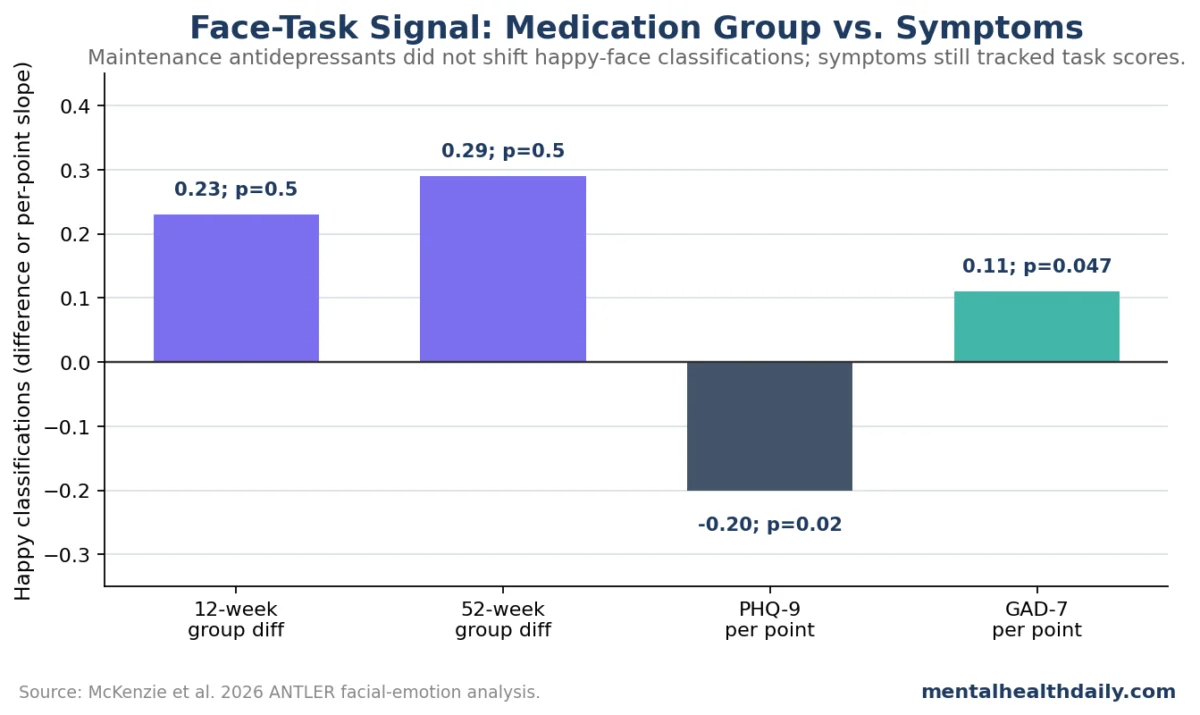
Contrary to the predictions of the emotional-bias model in a maintenance context, the ANTLER mechanistic analysis found no evidence that continuing antidepressants preserved a happier facial-emotion recognition pattern. At 12 weeks, the adjusted mean difference between the maintenance antidepressant group and the placebo substitution group was a negligible 0.23 (95% CI: -0.5 to 1.0, p = 0.5). This indicated that, on average, participants continuing medication classified only 0.23 more faces as happy out of 45 trials compared to those on placebo, a difference that was neither statistically significant nor clinically meaningful.
The pattern remained consistent at the 52-week follow-up, reinforcing the initial observation. The adjusted mean difference was 0.29 (95% CI: -0.5 to 1.2, p = 0.5), again demonstrating no significant advantage for the maintenance group. In fact, the point estimates, though tiny, surprisingly leaned in the direction of the discontinuation group having a slightly higher estimated happy-face score, albeit by less than one classification on a 45-trial task. The wide confidence intervals at both time points, which easily included zero, further solidified the conclusion that there was no meaningful difference attributable to ongoing antidepressant treatment.
The researchers employed a longitudinal model to account for participants with partial task data, but even this advanced statistical approach failed to reveal a medication-group effect. Furthermore, an analysis restricted to adherent samples (participants who strictly followed their assigned treatment regimen) also did not rescue the emotional-bias prediction. This comprehensive scrutiny suggests that the null result was robust across different analytical approaches, making it a powerful statement against the hypothesis of a sustained happy-face bias in maintenance care.
Nuances: Symptoms Still Linked to Emotional Interpretation
While the study found no direct effect of maintenance antidepressants on facial emotion recognition, it did not render the task biologically irrelevant. Intriguingly, the analysis revealed that depressive symptoms were still significantly associated with fewer happy classifications. Cross-sectionally, each one-point increase on the PHQ-9 (Patient Health Questionnaire-9, a common depression severity scale) was linked to 0.20 fewer happy responses. Longitudinally, each PHQ-9 point was associated with 0.09 fewer happy responses. This suggests that even in a remitted population, subtle shifts in depressive symptoms can still influence emotional perception, validating the task’s sensitivity to internal states.
Anxiety symptoms, as measured by the GAD-7 (Generalized Anxiety Disorder 7-item scale), presented a more complex picture. Each GAD-7 point was linked to 0.11 more happy classifications. This counterintuitive finding challenges a simplistic "all distress makes faces look sadder" narrative and underscores the complexity of emotional processing. It also reinforces the idea that single emotional-processing tasks should not be treated as universal mood biomarkers, as different emotional states might interact with perception in distinct ways.
These symptom-linked associations are important because they confirm that the facial emotion recognition task was not merely measuring random noise. It was sensitive enough to detect changes related to participants’ current psychological state. The null finding for the treatment group, therefore, highlights a specific absence of medication effect on this particular mechanism in a maintenance context, rather than a general failure of the task itself.
Broader Implications for Antidepressant Mechanisms
The ANTLER study’s findings necessitate a re-evaluation of how the emotional-bias model applies across different phases of antidepressant treatment. The model remains plausible for early treatment, acute dosing studies, or when examining other task domains (e.g., reward learning, memory recall, threat vigilance). Many earlier emotional-processing studies indeed focused on short-term antidepressant exposure, investigating whether early pharmacological changes shift attention, memory, or threat processing before a patient consciously feels better.
However, the ANTLER trial tested a fundamentally different setting: individuals with recurrent depression who were already well and contemplating whether to continue medication. In this "maintenance context," where participants had already improved significantly, facial emotion recognition did not behave like a sustained medication signature. This distinction between acute and maintenance treatment is critical. A mechanism that appears during the early, acute phase of treatment may fade over time, become redundant as other adaptive processes take over, or only be detectable under more stressful or specific emotional tasks once symptoms have remitted.
This prespecified mechanistic analysis within a randomized trial provides strong evidence regarding the medication comparison. It cannot, however, definitively prove that all antidepressant mechanisms are unrelated to emotional processing. As the researchers acknowledge, one face task is a narrow window into a broader and highly complex cognitive system. Other emotional processing domains, such as word recall, reward learning, attention, threat processing, or social evaluation tasks, might yield different results and could still be influenced by long-term antidepressant use. The study’s strongest conclusion is against a broad claim that long-term maintenance treatment visibly sustains positive facial-emotion interpretation as measured by this specific task.
Clinical Relevance and Future Directions
For clinicians and patients, the ANTLER face-task result weakens one proposed mechanism for maintenance antidepressants. It does not, however, negate the overall efficacy of antidepressants in preventing relapse through other pathways. Relapse prevention is a multifaceted endeavor, and medication may still exert its protective effects through sleep stabilization, anxiety reduction, changes in rumination patterns, avoidance of withdrawal symptoms upon discontinuation, or enhancing a patient’s capacity to recover if symptoms re-emerge.
The clinical question in maintenance care extends far beyond a person’s ability to classify more faces as happy. It encompasses critical outcomes such as changes in relapse risk, overall functioning, sleep quality, anxiety levels, the presence of withdrawal symptoms, and the patient’s resilience in the face of returning symptoms. Therefore, while the face task proved informative as a symptom-linked measure (given its associations with PHQ-9 and GAD-7 scores), it failed as a maintenance-treatment discriminator in this particular trial.
Future research into relapse-prevention markers will likely need to combine several domains, moving beyond single-task assessments. A more robust biomarker for long-term maintenance would ideally need to:
- Change measurably with treatment.
- Predict relapse before overt symptoms return.
- Add prognostic information beyond standard clinical history.
The ANTLER face-task data, while valuable, did not meet this high bar. Its findings serve as a crucial reminder that future maintenance studies should avoid assuming that early-treatment biomarkers remain stable or relevant after recovery. A truly useful long-term marker must predict relapse and demonstrate how a drug influences emotional processing under real-world clinical conditions.
Expert Perspectives and Concluding Thoughts
Researchers involved in the ANTLER study emphasize that this finding is not a signal for stable patients to immediately stop their medication. Instead, it refines our understanding of how antidepressants might work. The study trims a specific mechanistic claim without undermining the broader clinical utility of maintenance treatment for individuals with recurrent depression. The decision to continue or discontinue medication remains a complex one, dependent on a patient’s individual relapse history, symptom burden, side effects experienced, personal preferences, and prior discontinuation attempts.
The analysis highlights the complexity of disentangling treatment effects from other clinical realities. People discontinuing antidepressants can experience withdrawal symptoms that mimic relapse, while those continuing medication can experience side effects that influence emotional experience. A simple face-classification score, by itself, cannot differentiate these nuanced clinical states.
Ultimately, the ANTLER face-task data underscores the distinction between "mechanism research" and "management decisions." Mechanism research seeks to understand how drugs might work, whereas management focuses on which course of action best protects a particular patient. This study provides a negative result for one specific mechanism marker, leaving the broader management decision dependent on a holistic assessment of individual patient needs and clinical tradeoffs. While emotional processing remains a plausible mechanism for depression in other contexts, this study clearly indicates that maintenance antidepressant decisions should not rely on a presumed persistent happy-face recognition effect, as the measured task did not differentiate maintenance from discontinuation across 52 weeks.

