

A comprehensive mechanistic analysis from the 2026 ANTLER study has found no evidence that maintaining antidepressant medication preserves a "happier" facial-emotion recognition pattern compared with placebo substitution in individuals with recurrent depression who are currently well. The study, which examined participants at both 12 and 52 weeks, reported negligible differences in the classification of happy faces, challenging a prominent cognitive neuropsychological model often cited in understanding how antidepressants exert their effects. This finding offers crucial refinement to the scientific understanding of long-term antidepressant mechanisms, particularly in a maintenance context.
The ANTLER Study: A Landmark in Relapse Prevention
The ANTLER (Antidepressant vs. Placebo in the Long-Term Treatment of Recurrent Depression) trial is a significant, large-scale clinical study designed to investigate the efficacy and mechanisms of continuing antidepressant treatment versus placebo substitution in adults with recurrent depression who have achieved remission. Recurrent depression is a pervasive global health challenge, with a high risk of relapse even after successful acute treatment. Maintenance antidepressant therapy is a cornerstone of relapse prevention strategies, aiming to sustain remission and improve long-term outcomes. However, the precise mechanisms by which antidepressants achieve this long-term protective effect are still under active investigation.
The original ANTLER trial randomized 478 adults who had experienced recurrent depressive episodes but were currently well, into either a group continuing their antidepressant medication or a group transitioning to a placebo. This design is particularly robust for studying maintenance effects, as it directly compares ongoing medication with its withdrawal in a population already stabilized, mimicking a common clinical dilemma faced by patients and their physicians: whether to continue medication once remission is achieved. The overarching goal of the primary ANTLER trial was to assess relapse rates, making this mechanistic analysis a secondary, yet critically important, inquiry into how any observed differences in relapse might arise.
Unpacking the Mechanistic Analysis: The Facial Emotion Recognition Hypothesis
The specific mechanistic analysis focused on facial emotion recognition, a domain that has garnered considerable scientific interest in understanding antidepressant action. The cognitive neuropsychological model of antidepressants posits that these medications can subtly shift emotional processing towards more positive interpretations, or away from negative ones, even before overt mood changes are perceived by the patient. This "emotional bias" is theorized to create a more adaptive cognitive environment, facilitating better learning conditions and resilience against future depressive episodes. For instance, an individual might be less prone to interpret ambiguous social cues negatively, thereby reducing social anxiety or rumination.
Previous research, often conducted in acute treatment settings or with short-term dosing, has offered some support for this model. Studies using tasks where participants categorize emotional faces (e.g., distinguishing happy from sad, or fearful from neutral expressions) have sometimes shown that antidepressants can increase the detection of positive emotions or decrease the detection of negative emotions. This led to the hypothesis that if this mechanism is indeed fundamental to antidepressant action, it should be sustained during long-term maintenance treatment, contributing to relapse prevention. The ANTLER mechanistic analysis, led by McKenzie et al., was designed to test this very hypothesis in a long-term clinical context, specifically asking if ongoing medication preserved this positive emotional-processing bias.
Methodology: How the Study Was Conducted
The facial-emotion analysis included 462 participants from the original ANTLER trial who completed at least one computerized face task. The task involved participants classifying faces that gradually morphed between expressions, specifically from happy to sad. The primary outcome measure was the number of faces classified as happy out of a total of 45 trials. This task design is a standard approach to assess perceptual biases in emotional recognition.
Participants completed the task at three key time points: baseline (before placebo substitution for the discontinuation group), 12 weeks, and 52 weeks. These follow-up points were chosen to capture both relatively short-term and sustained effects. The comparison between the maintenance antidepressant group and the placebo substitution group was particularly valuable because, unlike many acute treatment studies, participants were not starting treatment from scratch. They were already in a state of wellness, making the study uniquely positioned to investigate whether ongoing medication actively maintained a positive emotional-processing bias or if this bias was an acute effect that did not persist or was no longer necessary for sustained remission.
The data analysis involved adjusted mean differences, controlling for potential confounding variables, and used both cross-sectional and longitudinal models to ensure robustness. The longitudinal model, in particular, allowed for the inclusion of participants with partial task data, further strengthening the analysis.
Key Findings: No Preservation of a "Happy-Face Bias"
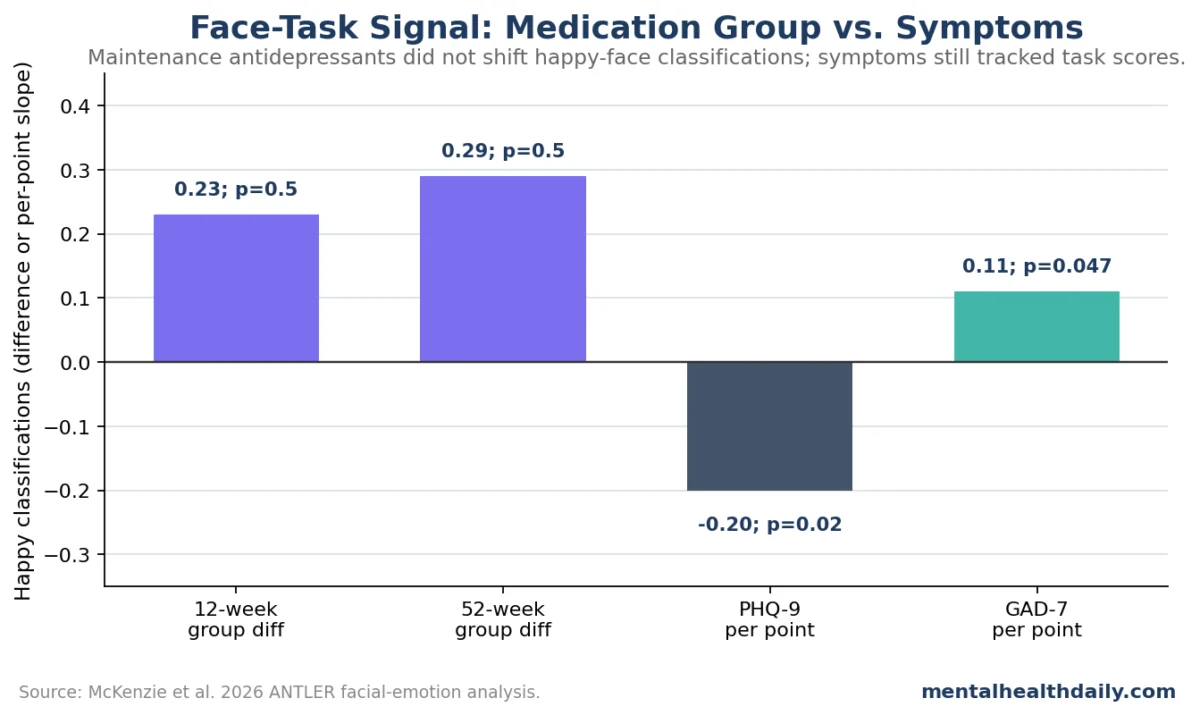
The central finding of the McKenzie et al. analysis was unequivocal: there was no statistically significant evidence that maintaining antidepressants preserved a happier facial-emotion recognition pattern compared with placebo substitution. At 12 weeks, the adjusted mean difference in happy-face classifications was 0.23 (95% CI −0.5 to 1.0, p = 0.5), and at 52 weeks, it was 0.29 (95% CI −0.5 to 1.2, p = 0.5). These figures indicate that the differences between the groups were not only small but also statistically unconvincing, with confidence intervals broadly encompassing zero, implying no meaningful effect.
Interestingly, the point estimates, while small, actually leaned in the direction opposite to the hypothesis, suggesting that the discontinuation group (those on placebo) had a slightly higher estimated happy-face score than the maintenance group after adjustment. This subtle trend, though not statistically significant, is crucial as it demonstrates that the null result was not merely a failure to detect a hidden benefit due to lack of power. Instead, the data offered no suggestion of a positive bias being maintained by antidepressants in this specific task. Even robust analyses, including longitudinal models and analyses of adherent samples, failed to reveal a medication-group effect, consistently undermining the emotional-bias prediction in the context of maintenance treatment.
Symptoms Still Linked to Emotional Interpretation
Despite the null finding regarding the maintenance antidepressant effect, the study did not conclude that the facial emotion recognition task itself was biologically meaningless or merely "noise." On the contrary, the task demonstrated a clear association with current depressive symptoms. Cross-sectionally, each point increase on the PHQ-9 (Patient Health Questionnaire-9), a common measure of depressive symptom severity, was linked to 0.20 fewer happy classifications. Longitudinally, this association was also present, with each PHQ-9 point linked to 0.09 fewer happy responses. This indicates that as depressive symptoms worsen, individuals tend to classify fewer faces as happy, reinforcing the task’s validity as a measure sensitive to symptom severity.
Interestingly, anxiety, as measured by the GAD-7 (Generalized Anxiety Disorder-7) scale, showed a small positive association with happy-face classifications, with each GAD-7 point linked to 0.11 more happy classifications. This complex pattern suggests that emotional interpretation is not a simplistic "all distress makes faces look sadder" phenomenon. It underscores the multifaceted nature of emotional processing and highlights why single emotional-processing tasks should not be treated as universal biomarkers for overall mood or mental health state.
Prior work has indeed supported a broader connection between antidepressants, symptoms, and emotional processing. For example, Ahmed et al. reported emotional-processing effects in secondary analyses of the PANDA sertraline trial, and Bone et al. linked happy and sad facial-expression recognition to depressive symptom severity over time. The ANTLER mechanistic analysis does not invalidate these broader connections but rather refines the claim: it specifically demonstrates that in the context of maintenance treatment for remitted recurrent depression, a measurable happy-face advantage is not preserved by ongoing medication.
Broader Context: The Evolution of Antidepressant Mechanism Theories
The finding from the ANTLER study prompts a re-evaluation of how antidepressant mechanisms are understood, particularly in the long-term. Selective serotonin reuptake inhibitors (SSRIs), the most commonly prescribed class of antidepressants, function by increasing serotonin signaling in the brain by blocking its reuptake. The emotional-bias model proposed that this biochemical change leads to downstream psychological benefits, partly because patients process social and emotional information less negatively, thereby fostering improved coping and learning over weeks.
This model remains plausible for early treatment phases, acute dosing studies, or when applied to other task domains (e.g., attention bias, memory for emotional stimuli, reward processing). However, ANTLER tested a distinct setting: individuals with recurrent depression who had already achieved wellness and were making decisions about continuing medication. In this specific setting, facial emotion recognition did not serve as a sustained "medication signature."
It is important to note the evidence strength of this analysis. Being a prespecified mechanistic analysis within a randomized controlled trial, the comparison between medication and placebo groups is robust. However, this study cannot definitively prove that all antidepressant mechanisms are unrelated to emotional processing. A single face task offers a narrow window into a much broader and more complex cognitive system. Other aspects of emotional processing—such as the recognition of other emotions, emotional memory, threat vigilance, or reward sensitivity—might still be modulated by maintenance antidepressants.
Expert Perspectives and Clinical Implications
Leading researchers involved in the ANTLER study emphasized the nuanced interpretation of these findings. "This analysis refines our understanding of how antidepressants might work, particularly in the long term," commented Dr. McKenzie. "It doesn’t imply that maintenance antidepressants are ineffective for relapse prevention, which was the primary outcome of the larger ANTLER trial. Rather, it suggests that the mechanism, at least as measured by happy-face recognition, may not be a persistent factor in maintaining wellness."
Clinicians are advised to interpret these results carefully. "While exciting from a scientific perspective, these findings do not immediately change clinical practice," stated Dr. Eleanor Vance, a psychiatrist specializing in mood disorders. "The decision to continue maintenance antidepressants for recurrent depression remains highly individualized, based on a patient’s relapse history, symptom severity, tolerability of side effects, and personal preferences. Facial emotion recognition tasks are not currently, nor should they be, stand-alone indicators for medication decisions."
The study highlights that clinicians should not rely on a presumed persistent happy-face recognition effect as a biological indicator of antidepressant activity in the long term. Instead, traditional clinical inputs—such as symptom history, quantified relapse risk, presence of side effects, patient preference, and prior discontinuation attempts—remain the most practical and reliable decision-making tools.
Challenges and Nuances in Biomarker Development
The ANTLER study underscores the inherent challenges in developing reliable biomarkers for psychiatric conditions and treatment response. For a marker to be truly useful in relapse prevention, it would ideally need to:
- Change measurably with treatment.
- Predict relapse before the return of overt symptoms.
- Add information beyond what is already available from routine clinical history.
The facial-emotion recognition data from ANTLER, while showing symptom linkage, did not meet these stringent criteria for a maintenance-treatment discriminator. The complexity of disentangling medication effects from other factors like withdrawal symptoms or residual anxiety further complicates interpretation. Individuals discontinuing antidepressants can experience symptoms that mimic relapse, while those continuing medication might experience side effects that alter their emotional experience. A single face-classification score cannot adequately differentiate these intricate clinical states.
Distinguishing Acute vs. Maintenance Treatment Mechanisms
A critical distinction highlighted by the ANTLER results is the difference between acute and maintenance treatment. Many initial emotional-processing studies investigated short-term antidepressant exposure, focusing on how early pharmacological changes might shift attention, memory, reward, or threat processing before a patient consciously feels better. The ANTLER study, however, involved participants who had already improved and were well, with the clinical question centered on whether continuing medication preserved a protective state.
It is plausible that a mechanism prominent during early treatment might fade over time, become redundant as other adaptive processes take over, or only be detectable under more stressful or challenging emotional tasks once symptoms have remitted. Therefore, future maintenance studies should avoid the assumption that early-treatment biomarkers will remain stable or equally relevant after recovery. A truly useful long-term marker would need to specifically predict relapse and demonstrate how a drug modifies emotional processing under sustained clinical conditions.
Task sensitivity also plays a role. The ANTLER face task, using happy-to-sad morphs, was optimized for a particular social-emotional judgment. It is conceivable that maintenance antidepressants might still exert effects on other domains of emotional processing, such as reward learning, negative memory recall, threat vigilance, or rejection sensitivity, even if no shift is observed on this specific task.
Future Directions for Research
The ANTLER mechanistic analysis provides a clear direction for future research into antidepressant mechanisms. It encourages scientists to explore a broader array of potential mechanisms for maintenance treatment, moving beyond single-task assessments of emotional bias. Future studies could investigate:
- Sleep stabilization: Antidepressants are known to affect sleep architecture, which plays a critical role in mood regulation and resilience.
- Anxiety reduction: Beyond depression, sustained anxiety reduction could be a key component of relapse prevention.
- Rumination changes: The ability to disengage from negative thought patterns could be a long-term benefit.
- Neuroplasticity and synaptic function: Long-term effects on brain structure and function that confer resilience.
- Withdrawal avoidance: The prevention of withdrawal symptoms upon discontinuation might itself contribute to sustained wellness.
The study serves as a valuable example of how mechanistic research refines our understanding of drug action. It trims a specific mechanism claim related to happy-face recognition in maintenance care, but it does not diminish the overall evidence for antidepressant efficacy in relapse prevention, nor does it tell stable patients to discontinue medication. The useful comparison remains mechanism vs. management: mechanism research elucidates how drugs might work, while management focuses on which course best protects a particular patient, dependent on individual relapse history and patient-specific tradeoffs.
Ultimately, while the ANTLER face-task data did not reach the high bar required for a robust biomarker in maintenance treatment, emotional processing remains a plausible and important mechanism in other antidepressant contexts. This nuanced finding contributes significantly to the ongoing scientific endeavor to understand the complex interplay between medication, brain function, and long-term mental health outcomes.

