

A groundbreaking 2026 study published in PLOS Biology has unveiled a nuanced understanding of subjective sleep depth, demonstrating that immersive dreaming during NREM2 sleep is a significant predictor of feeling deeply rested, while reflective thought leads to the opposite perception. This research, utilizing advanced 256-electrode EEG technology and an unprecedented 1,024 NREM2 awakenings, directly challenges conventional wisdom that often equates dreaming with lighter sleep, particularly outside of the REM stage.
Redefining Sleep Depth: Beyond the EEG Waves
For decades, the scientific community has largely relied on physiological markers to define sleep depth. Electroencephalography (EEG) patterns, arousal thresholds, and the presence of slow-wave activity have been the primary tools for classifying sleep into stages like NREM1, NREM2, NREM3 (deep sleep), and REM sleep. However, this objective "sleep architecture" often fails to align with an individual’s personal experience of sleep quality. The Michalak et al. study directly addresses this discrepancy, probing how mental experiences during sleep shape an individual’s subjective perception of rest.
NREM2 sleep, a non-rapid-eye-movement stage, constitutes a substantial portion of a typical night’s sleep, acting as a bridge between the lighter NREM1 and the deeper NREM3 stages. Traditionally, NREM2 has not been considered a primary "dream-rich" stage, a designation usually reserved for REM sleep. Yet, previous research has indicated that mental activity, including dream-like experiences, can indeed occur and be recalled when individuals are awakened from NREM2. This study leveraged this understanding to explore the quality and impact of such experiences.
Methodology: A Deep Dive into the Sleeping Mind
The research involved 44 healthy adults participating in 196 overnight recordings, each equipped with a sophisticated 256-electrode high-density EEG system. This advanced setup allowed researchers to capture intricate brain activity patterns across the entire scalp, offering a far more detailed view than standard polysomnography. The core of the methodology involved repeatedly awakening participants from NREM2 sleep throughout the night. Upon awakening, participants were immediately asked about their prior mental activity, their perceived depth of sleep, and their level of sleepiness. This meticulous design yielded an impressive 1,024 subjective reports, providing a rich dataset for analysis.
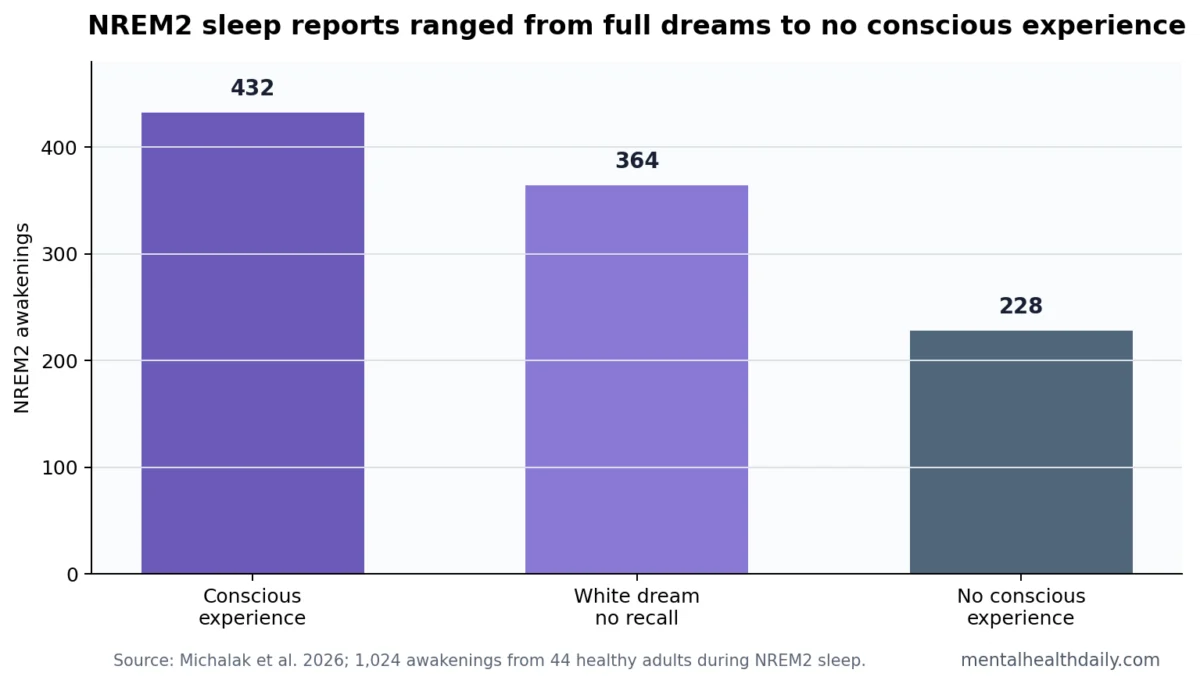
The collected reports of conscious experience were categorized into three broad groups: 432 awakenings involved conscious experiences with recallable content, indicating vivid dreams or coherent thoughts. In 364 awakenings, participants reported conscious experiences but without specific recall of content, a phenomenon often referred to as "white dreams." The remaining 228 awakenings reported no conscious experience at all. The inclusion of "white dreams" is particularly significant, as it acknowledges that the absence of detailed recall does not necessarily equate to an absence of consciousness during sleep, offering a more nuanced understanding of mental states.
Key Findings: Immersive Dreams vs. Reflective Thought
The most compelling revelation from the study centered on the quality of the reported conscious experience. Through principal component analysis, the researchers distilled various dream ratings into two primary dimensions: "Perceptual Immersion" and "Reflective Thought."
Perceptual immersion encompassed qualities such as vividness, sensory richness, duration, emotional intensity, bizarreness, and overall REM-like dream quality. This dimension strongly predicted deeper subjective sleep, with a robust beta coefficient of 0.277 (95% confidence interval: 0.208 to 0.346, p < 0.00001). A positive beta value indicates a direct relationship, meaning as perceptual immersion increased, so did the reported feeling of deep sleep.
In stark contrast, "Reflective Thought" captured more abstract, thinking-like mentation. This dimension predicted shallower subjective sleep, with a negative beta coefficient of -0.195 (95% confidence interval: -0.287 to -0.102, p = 0.00004). This inverse relationship suggests that when mental activity leaned towards abstract reflection, participants perceived their sleep as less deep.
These findings directly contradict the oversimplified notion that "dreaming means light sleep." Instead, the study posits that the type of conscious experience is paramount. Vivid, immersive dreaming, even during NREM2, can contribute to a profound sense of deep rest. Conversely, minimal conscious presence or fragmented, thought-like mentation often resulted in the lowest depth ratings. Interestingly, complete unconsciousness also contributed to a feeling of deep sleep, but it was not the sole pathway to achieving this perception.
EEG Activation: A Complex Relationship with Consciousness
High-density EEG, with its capacity to record scalp electrical activity from numerous electrodes, allows for a more granular mapping of frequency patterns across the brain. The study explored how these physiological markers correlated with subjective sleep depth. Generally, higher gamma activity and a higher gamma-to-delta ratio are associated with lighter perceived sleep, reflecting more wake-like cortical activation. However, the presence of conscious experience significantly altered this mapping.
When participants reported dreaming, the typical inverse relationship between high-frequency activity (like gamma waves, often linked to alertness and cognitive processing) and deep-feeling sleep was attenuated. This suggests that during immersive dreaming, the brain can exhibit wake-like activation without necessarily disrupting the subjective experience of deep sleep. This finding aligns with earlier work by Nir et al. and Siclari et al., who demonstrated that dream reports can be predicted by local EEG patterns within specific posterior cortical "hot zones," rather than solely by global sleep stages. This points towards a more localized and dynamic understanding of consciousness during sleep, rather than a simple global on/off switch.
The Evolving Perception of Sleep Overnight
The study also revealed an intriguing trajectory of subjective sleep depth throughout the night. As the night progressed, participants reported feeling increasingly deeper sleep (beta = 0.127, CI 0.103 to 0.151, p < 0.00001). This pattern runs counter to the typical physiological expectation, where homeostatic sleep pressure gradually declines overnight, leading one to anticipate a feeling of lighter sleep.
However, subjective sleepiness followed a different path. The interaction between time and measurement indicated that sleepiness increased less steeply than perceived sleep depth (beta = -0.166, CI -0.277 to -0.056, p = 0.00325). This counterintuitive divergence suggests that perceived sleep depth can rise in parallel with increasingly immersive dream experiences, even as the physiological "need" for sleep dissipates. This has significant clinical implications, suggesting that complaints about "light sleep" may not solely reflect sleep stage architecture or total sleep duration, but rather the quality of conscious experience, awakenings, and memory for mentation.
Sleep Perception vs. Sleep Architecture: A Critical Distinction
One of the most profound takeaways from the Michalak et al. study is the direct measurement of the gap between objective sleep architecture and subjective sleep perception. Sleep architecture, the objective distribution of sleep stages (NREM1, NREM2, NREM3, REM), provides a valuable framework for understanding sleep physiology. However, it does not fully encapsulate the individual’s lived experience of sleep.
The study provides a compelling explanation for why two individuals with seemingly identical polysomnography results might report vastly different sleep quality. A sleeper awakening from NREM2 with an immersive dream might rate their sleep as profoundly deep, while another, experiencing only a vague sense of presence, fragmented thoughts, or partial awareness, might describe their sleep as shallow. This distinction highlights that subjective sleep quality cannot be reduced to simple metrics like total sleep time or the percentage of time spent in a particular stage. A comprehensive model of sleep perception must integrate at least three layers: objective physiology, the timing and context of awakenings, and the specific conscious or near-conscious experience immediately preceding awakening.
This revelation has direct implications for the burgeoning market of consumer sleep trackers. While these devices can estimate movement, heart rate, breathing, or even rudimentary EEG-like signals, they are fundamentally unable to discern the qualitative content of a sleeper’s conscious experience – whether it was an immersive dream, abstract thought, minimal presence, or true unconsciousness. Consequently, subjective reports can frequently diverge from device-generated scores, leading to user dissatisfaction or confusion.
Implications for Insomnia and Sleep Quality Research
Insomnia, a pervasive sleep disorder, often manifests as a significant mismatch between objective sleep measurements and an individual’s perception of their sleep. While the Michalak study focused on healthy adults, its findings offer a plausible mechanism for this common disconnect. It suggests that the form and content of mental activity leading up to an awakening could profoundly influence whether sleep feels deep, fragmented, or even absent, regardless of the objective sleep stages recorded. Future research could investigate whether individuals with insomnia disproportionately experience thought-like, less immersive mentation during NREM2, contributing to their perception of poor sleep.
The study’s serial-awakening method is a powerful tool for this line of inquiry, as it minimizes memory delay, providing a more immediate and accurate capture of the experience preceding the sleep-depth rating. Morning dream recall, by contrast, can be susceptible to forgetting earlier mentation or distorting it through subsequent sleep cycles and waking interpretations. However, this method’s strength is also its limitation; repeated awakenings, by design, fragment sleep, making the sleep less natural. Therefore, the results are best interpreted as a controlled map of sleep perception rather than a perfect mirror of an uninterrupted night.
This necessitates a more careful and nuanced use of sleep-depth language. When a person reports "light sleep," they might be describing physiological stage structure, frequent awakenings, a low arousal threshold, unpleasant thought-like mentation, or even a memory of being partly aware. These are distinct, though often overlapping, phenomena. The 2026 data underscore the critical importance of considering the latter two possibilities.
Broader Scientific Context and Future Directions
The Michalak et al. study builds upon a rich history of sleep and consciousness research, integrating insights from neurophysiology and subjective phenomenology. The concept of minimal conscious experience, as articulated by researchers like Windt et al., is crucial here; it posits that consciousness can exist without full narrative content. This helps to interpret the lowest-depth category in the Michalak study – a vague sense of presence that is neither restful unconsciousness nor immersive dreaming, leading to a shallow perception of sleep.
The study is correlational, meaning it establishes associations rather than direct causation. While it shows that immersive NREM2 dreaming is linked to deeper perceived sleep, it cannot definitively prove that dreams cause improved sleep quality. Experiments designed to manipulate dream immersion or sensory input during sleep would be necessary to establish causality. Furthermore, the very act of serial awakenings and repeated questioning could subtly alter participants’ subsequent sleep perception.
Nevertheless, the "best inference" from this work is clear: subjective sleep depth is a multi-layered construct. While the brain’s electrical state (as measured by EEG) is undoubtedly important, the form of conscious experience occurring within that state is equally critical. This does not diminish the reliability of subjective reports; rather, it highlights that they measure a distinct, yet equally vital, layer of sleep experience. Polysomnography can classify stages and arousal, but an immediate awakening report captures whether the individual experienced immersion, thought-like content, vague presence, or no memory of consciousness. The scientific challenge lies not in choosing between these sources but in understanding how they combine to shape the overall sleep experience.
For researchers and clinicians working on insomnia and broader sleep quality, this combination is the ultimate target. A patient might exhibit adequate NREM2 time on an EEG, yet still report shallow, fragmented, or semi-aware experiences. Conversely, deeply immersive mentation could make sleep feel profoundly restorative, even as conventional physiological sleep pressure declines throughout the night.
The next critical research step involves pairing objective sleep measurements with richer, immediate subjective reports in populations who complain of poor sleep despite objectively adequate sleep, particularly those experiencing repeated brief awakenings and gaps in morning recall. Such studies could provide invaluable insights into the mechanisms underlying chronic sleep dissatisfaction and pave the way for more personalized and effective interventions. The 2026 PLOS Biology study thus represents a significant leap forward in understanding the intricate relationship between our sleeping minds and our waking perception of rest.

