

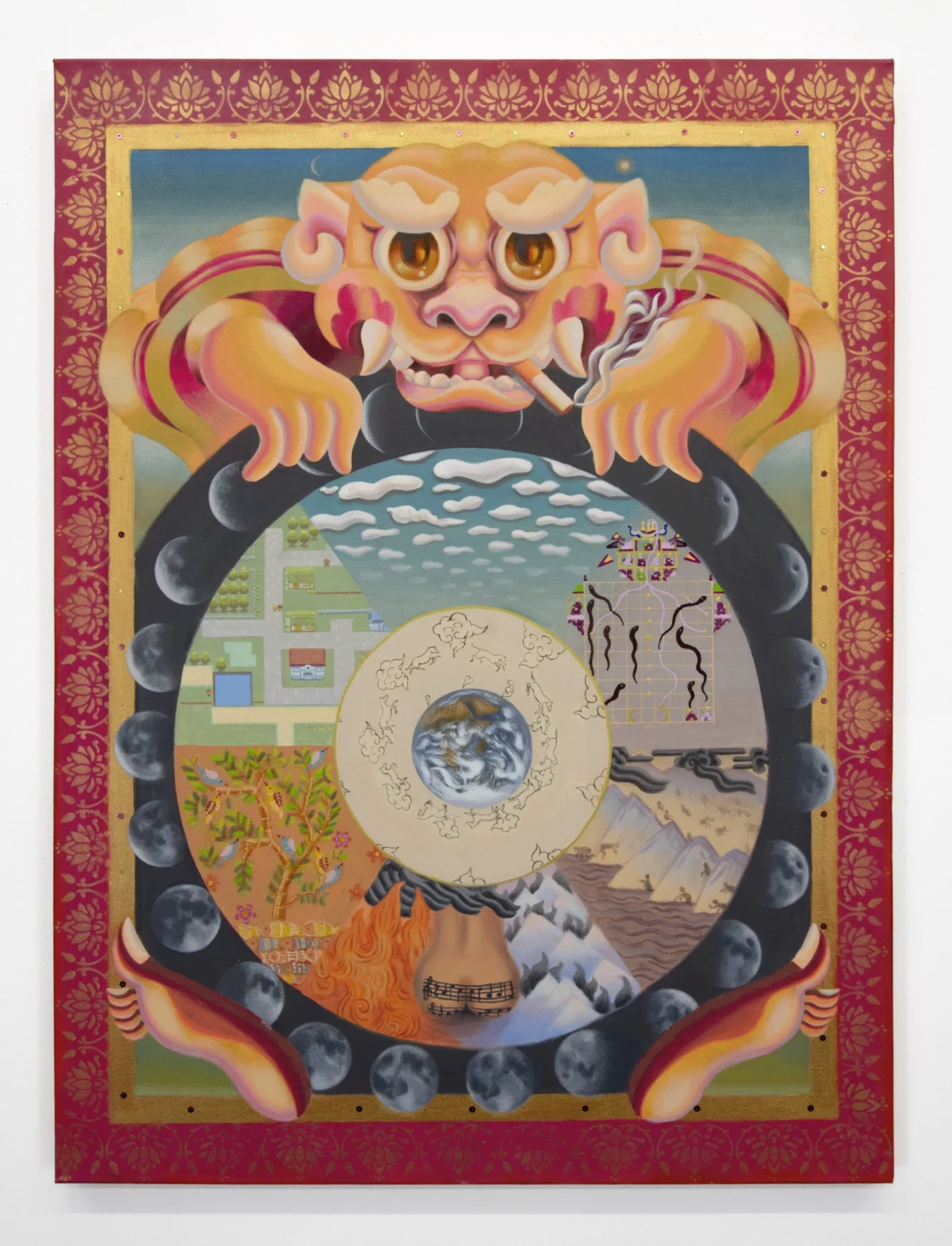
The Morgan Lehman Gallery in Manhattan recently showcased the compelling work of Naomi Basu, a New Delhi-born painter whose artistic journey is deeply intertwined with the rich traditions of Tibetan Buddhist art. Two of Basu’s pieces, Plane and Projection in Yab-Yum and Plane and Depth in Yab-Yum, were featured in the gallery’s exhibition "Twenty by Sixteen." These works represent a masterful fusion of Menri-style thangka painting techniques with a distinct contemporary aesthetic, creating a dialogue between spiritual devotion and decorative artistry. Basu’s artistic presence has been felt across several New York City galleries, including Kate Oh Gallery, LAS Contemporary, and Visionary Projects. Her latest work, Plastic Shaman/American Psycho, is currently on view at GOCA by Garde’s group exhibition "High Visibility," which runs until August 22.
Basu’s engagement with Tibetan art is not a fleeting trend but a deeply considered exploration, influenced by her upbringing and guided by her mentor, the renowned Tibetan thangka master Pema Rinzin. Tricycle previously interviewed Rinzin in 2018, where he detailed his transition from a traditional Asian art background to the contemporary Western art scene. Eight years later, Basu, who spent her formative years in the UK, sat down with Tricycle‘s editorial assistant, Kami Nguyen, to discuss her unique path into Tibetan art, a journey marked by intellectual curiosity and a profound respect for tradition.
The Evolution of Artistic Vision and Buddhist Influence
Basu’s artistic trajectory reveals a gradual yet deliberate integration of Buddhist iconography into her work. "My grandpa was Buddhist, so my brother and I grew up being familiar with some of the imagery," Basu explained. "And he would frequently gift us Buddha statuettes, things like that. So it’s always been something that felt very familiar. I’ve been drawn to that imagery for a while just because of that familiarity and the visual richness of it."
This deep-seated familiarity began to manifest visibly in her art around 2022. Since then, her interest in Tibetan Buddhism has intensified, leading to extensive research and study. She has developed a particular fascination with feminine iconography and the feminine principle within Tibetan Buddhism, a focus that guided her artistic development in 2022. Basu emphasized her commitment to avoiding superficial appropriation of aesthetics: "My art has a very solid grounding in Tibetan Buddhist iconography because I didn’t want to take from its aesthetics in a superficial way."

Her search for resources to deepen her knowledge led her to Pema Rinzin, now her mentor. Rinzin, who had previously established and then paused operations at the New York Tibetan Art Studio due to space constraints, recognized Basu’s earnest interest in the subject. "He explained that he doesn’t really do it anymore, but he saw some of my art and could tell that I was seriously interested in it. So he said, ‘Come have a chat, and then we’ll see from there.’"
A Mentorship Rooted in Tradition
Basu’s formal training under Pema Rinzin began in 2022 with a pivotal visit to his studio. This initial meeting involved extensive discussions and an immersion into Rinzin’s impressive collection of rare Tibetan art books. She was captivated by the intricate processes and the specific pigments used in thangka painting. "He showed me the kinds of pigments he used, and it was something I was super interested in getting to learn more deeply, all of the processes behind it. From then on, he was willing to teach me."
Her tutelage involved weekly sessions over several years, focusing on the foundational elements of thangka construction. Rinzin’s pedagogical approach is rigorous, often requiring students to meticulously replicate fundamental Buddha diagrams multiple times before progressing. "He starts out with just a relatively simple Buddha diagram. And he makes you do it many times. He’s made some students do it forty times before they can move on to something else, and then, eventually, you can move on to other things. That’s how it started. That’s one of the big ways I learned about the iconography."
Rinzin also instilled in his students a crucial warning against the commercialization of sacred art. "He also warned me against getting sucked in by what he called tourist art," Basu recalled. "There are a lot of these thangka paintings that are sold in Nepal and other places where they’re kind of just churned out like a workshop. Like a factory line. Which kind of defeats the whole purpose of the paintings since they’re devotional, and that’s the way you’re supposed to approach creating them." This emphasis on the devotional aspect of thangka creation underscores the spiritual core of the tradition, a principle Basu clearly respects and seeks to uphold in her own practice.
From Observation to Iconography: A Natural Progression
Basu’s artistic journey began long before her formal engagement with Tibetan art. "I was always making art, painting and drawing," she stated. For several years, her practice centered on observational drawing and portraiture. However, her creative interests evolved, leading her to explore art less tethered to strict realism. "My work started getting a little bit more expressive and incorporating more fantastical or mythological elements." This shift naturally led her toward Tibetan Buddhist painting, a genre she found increasingly compelling due to its inherent visual richness and her existing familiarity. Her frequent visits to the Rubin Museum of Art further fueled this burgeoning interest, a loss she deeply regrets following its recent closure.

Technical Foundations and Contemporary Interpretation
Basu’s recent works, particularly the Yab-Yum series exhibited at Morgan Lehman Gallery, showcase a deliberate integration of traditional thangka techniques with her contemporary artistic voice. Her observation about the visible grid lines in these paintings reveals a conscious choice to highlight the underlying structure. "That’s very observant of you," she remarked. "I wanted to not have those grid lines completely obscured by the layers that went on top because I really wanted to show the process."
These grid lines, meticulously drawn with pencil and then reinforced with sumi ink, are not merely technical guides but carry a lineage. "The two paintings were heavily based on these thangka grids that were given to me by Pema. And he got them from his teacher, so they’re very specific and special to him, and to me and his students. That was layer one of the painting. I constructed the grid with pencil, and drew the deity out in pencil first and went over it with sumi. Those steps were all very much grounded in what Pema taught me. There was no difference there."
However, Basu distinguishes her contemporary practice from creating purely devotional works. "If I just stopped there, it would have been like something I created with him. But in my contemporary practice, I’m not looking to create devotional paintings." Her objective is to make this rich iconography more accessible to a contemporary audience unfamiliar with Tibetan Buddhism, aiming to foster a sense of connection to something profound and meaningful.
This pursuit is informed by broader societal observations. Citing Jonathan Haidt’s "The Anxious Generation," Basu reflects on the perceived spiritual void in modern society, particularly in the age of digital immersion. "Even though I’m not religious, religion fulfills a very human need, which is this connection to something gracious, something beyond just your daily life, and this feeling of purpose, this feeling of higher meaning." Her art practice serves as a personal exploration of this need for spiritual grounding and connection. Ideally, she hopes her paintings will evoke a sense of awe and a connection to something greater in viewers, regardless of their background in Tibetan Buddhism.
Reinterpreting Iconography for a Modern Audience
The question of whether Tibetan art still needs to be "brought to the West" by Tibetan artists, echoing Pema Rinzin’s sentiment from 1989, elicits a nuanced response from Basu. While acknowledging Rinzin’s unique position, she sees her own role as distinct. "For him, since he is Tibetan, it makes sense for him to be bringing Tibet to the West. For me, I think the two paintings that you saw in particular are very heavily grounded in Tibetan iconography, but in general, my paintings are more loosely based in Tibetan iconography."

She points to works like Milk Bath, where the tiger border is inspired by a Tibetan meditation rug, or Sky Dancer, which references Mandarava, a consort of Padmasambhava known in some myths to manifest as a tigress. These are subtle nods, "little kinds of snippets that show up in my work that aren’t so overt." The core intention remains to use Tibetan iconography as a foundation for creating a distinct visual language that, while not religious, aims to evoke a similar sense of profound connection.
A Vibrant Palette: Tradition Meets Innovation
Basu’s use of color is a striking element in her work, often blending traditional techniques with contemporary sensibilities. While she previously embraced fluorescent paints for their vibrant energy, her practice has evolved. "I find myself being more drawn to organic-feeling materials," she stated. The mineral pigments learned from Pema Rinzin offer "super beautiful vibrant colors, but they’re completely natural."
Despite this shift towards natural materials, Basu’s appreciation for bright color remains. In her more recent works, she opts for a more restrained application of color, allowing the natural beauty of the wood grain to emerge. This approach reflects a newfound preciousness with color, a sentiment amplified by her appreciation for the contemporary feel of fluorescent hues. "I like that it’s a small way to contemporize some of the imagery that I have, because fluorescent colors just feel very contemporary."
The use of raised gold leaf, another distinctive element, also carries historical weight. "It’s interesting because the gold is gold leaf, and that raised gold leaf is more seen in Indian religion," she noted, highlighting another layer of cultural confluence in her art.
Textile Arts: A Familiar Thread
Basu’s incorporation of embroidery into her work stems from a deeply personal connection. While she lacks formal training in textile arts, the practice feels intrinsically familiar due to her Bengali heritage. "My family’s Bengali. They’re from West Bengal in India, and kantha embroidery originates from that region," she explained. Kantha, often associated with quilts and repurposed fabrics, is historically viewed as a craft, but for Basu, it is a direct link to her ancestral roots. "It feels just so natural in a way. And it was something that I was drawn to because I grew up seeing a lot of kantha blankets from my grandma. My grandma used to embroider a lot as well."

This personal resonance drives her to create embroidery art, which often possesses a distinct character from her paintings, feeling more "Indian" and comforting. The meticulous, handmade nature of kantha embroidery makes these pieces time-consuming to produce, but Basu expresses a desire to create more and potentially integrate embroidery elements into her paintings in the future.
Critiquing Consumer Spirituality: Plastic Shaman/American Psycho
Basu’s piece Plastic Shaman/American Psycho, currently exhibited at GOCA by Garde, marks a departure from the more overt Tibetan Buddhist iconography seen in her Yab-Yum works. This painting offers a satirical commentary on the commodification of spirituality in the West. "It’s not as heavily grounded in Tibetan Buddhist iconography," Basu acknowledged, though she noted the subtle inclusion of a tiger meditation rug motif.
The painting satirizes "new age kind of spirituality" through a "fake chakra diagram" and a hyper-idealized, "plastic" figure. The border incorporates Kama Sutra positions, symbolizing the superficial engagement with Eastern spiritual practices that often appeals to Western audiences based solely on aesthetics. Basu views this trend as a form of consumerism where spirituality is packaged into aesthetically pleasing, often expensive, offerings. "It’s like now there are these $35 yoga classes that are offered, or several-thousand-dollar meditation teacher trainings that you can sign up for, and expensive matching yoga sets."
She connects this phenomenon to the human yearning for higher meaning, particularly when individuals lack spiritual grounding. "When you don’t have some sort of structure to that part of your life or a feeling of spiritual grounding, I think people can be more susceptible to getting sucked into those kinds of spiritual trends. It comes from desperation." While not intending to mock individuals seeking spiritual fulfillment, Basu highlights the potential for exploitation by those who profit from this need.
This critical examination of consumer spirituality is a relatively new theme in Basu’s oeuvre, representing an initial exploration. "It’s the first piece I’ve explored with this theme just because I’ve been mulling over this idea for some time." She anticipates further exploration of this theme, alongside other contemporary issues, as she seeks to connect her art to modern experiences and investigate the points where such connections falter or go awry. Her work continues to evolve, pushing boundaries and engaging in vital dialogues between tradition, modernity, and the enduring human search for meaning.

