

The well-intentioned mandate for calorie labeling on restaurant menus, implemented across national chain restaurants in 2017, was designed to empower consumers with the information needed to make informed dietary decisions. The logic was straightforward: transparent calorie counts would guide individuals towards healthier choices, thereby aiding in the management of daily energy intake and promoting overall well-being. However, empirical evidence has revealed a surprising and counterintuitive reality. Far from driving significant shifts towards healthier eating, these labels have, on average, resulted in a mere reduction of eight calories per meal, a statistically insignificant impact on consumer behavior. This outcome points to a deeper, more complex interplay between human psychology, environmental cues, and decision-making processes, particularly within the context of food consumption.
The Genesis of Menu Labeling and Its Limited Impact
The push for mandatory menu labeling in the United States gained momentum in the early 2010s. The Affordable Care Act of 2010 included a provision requiring chain restaurants with 20 or more locations to disclose calorie information for standard menu items. This move was lauded by public health advocates as a crucial step in combating the escalating rates of obesity and diet-related diseases. The rationale was rooted in the economic principle of providing consumers with greater information to make rational choices.
However, the effectiveness of such labeling had been questioned even before its nationwide implementation. For instance, a study examining the impact of calorie labeling in New York City, one of the first jurisdictions to enact such a policy, found no significant overall effect on consumer purchasing habits. This early indication foreshadowed the broader national outcome. McDonald’s, a prominent player in the fast-food industry, voluntarily began posting calorie information nationally in 2012, following the New York City experience. While this move was framed as a proactive measure to promote consumer health, research suggests that such initiatives, while potentially bolstering a restaurant’s image as being concerned for consumer welfare, may not fundamentally alter deeply ingrained eating habits. The ease with which some of these regulations were passed, contrasted with the robust industry opposition to other, more impactful labeling systems like front-of-pack traffic light labeling, also hints at the limited perceived threat these calorie disclosures posed to existing business models.
The Paradox of "Healthy" Options: Vicarious Goal Fulfillment
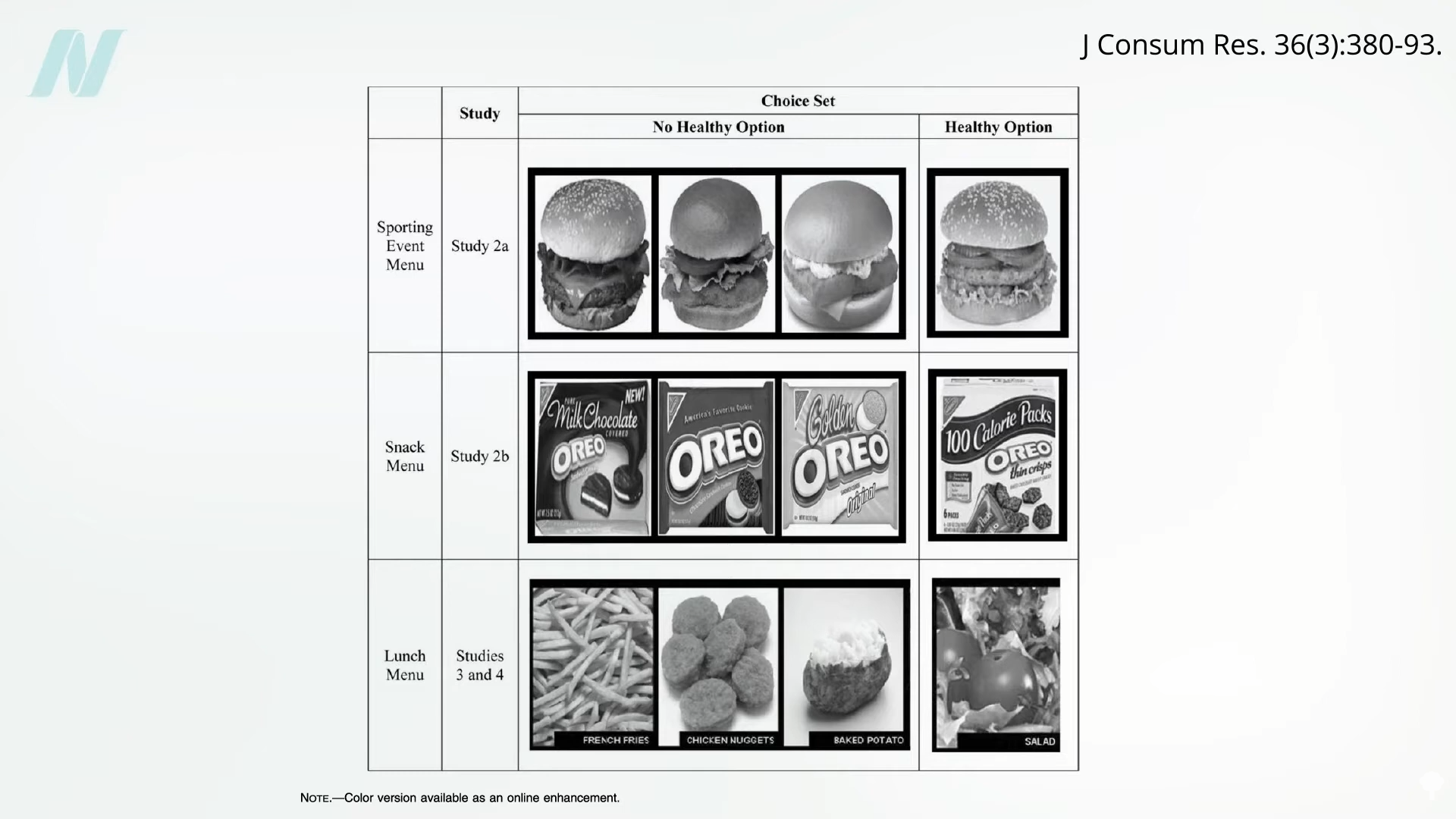
The true complexity of consumer choice emerged when researchers began to explore the unintended consequences of introducing "healthy" options into environments that traditionally offered more indulgent fare. A pivotal series of experiments, detailed in the paper "Vicarious Goal Fulfillment: When the Mere Presence of a Healthy Option Leads to an Ironically Indulgent Decision," revealed a startling phenomenon. When individuals were presented with a choice of side dishes, such as French fries or a baked potato, a relatively small percentage, around 10%, would opt for the fries. However, when a third, even healthier option, such as a side salad, was introduced, a significant shift occurred. Instead of a straightforward choice between indulgence and moderation, the presence of the salad seemed to create a psychological buffer. The most striking finding was that the preference for fries didn’t decrease; it actually tripled, with 33% of participants choosing them. This suggests that the mere contemplation of a healthy choice, like the salad, allowed individuals to feel as though they had already fulfilled a health-related goal, thereby liberating them to indulge in the less healthy option.
This principle extends beyond side dishes. When participants were offered a choice between a bacon cheeseburger, a chicken sandwich, or a veggie burger, the introduction of the veggie burger as a healthy alternative paradoxically doubled the likelihood of selecting the bacon cheeseburger compared to a scenario without the veggie option. This phenomenon is not about a direct trade-off; it’s about the psychological licensing that occurs when a healthy choice is present. The reasoning, as hypothesized by researchers, is that individuals might mentally "check off" the healthy option for a future occasion, thereby rationalizing the indulgence in the present. This "vicarious goal fulfillment" allows for a temporary reprieve from dietary aspirations.
Self-Licensing and the "What the Hell Effect"
This psychological quirk is closely related to the concept of "self-licensing." This occurs when individuals, after performing an action that aligns with their goals, feel justified in subsequently engaging in behaviors that detract from those same goals. For example, someone who has recently lost a small amount of weight might feel entitled to indulge in a calorie-laden dessert, viewing it as a reward for their progress. This "reward" then effectively negates the progress made.

The implications of self-licensing are far-reaching and have been observed in various contexts. In a study involving smokers, participants who were given what they believed to be vitamin C supplements (but were actually identical sugar pills) subsequently smoked significantly more cigarettes than those who were told they received placebo pills. The subconscious thought process might be: "I’ve just done something good for my health by taking this supplement, so I can afford to smoke more." This seemingly minor action of taking a supplement, intended to be health-conscious, inadvertently led to increased unhealthy behavior.
Further research has demonstrated similar effects in relation to diet and exercise. When individuals were given placebo pills they believed to be dietary supplements, they not only expressed less desire to exercise but also actually reduced their physical activity. They were also more likely to opt for a buffet meal over a "healthy, organic meal." A seminal study, "The Liberating Effect of Weight Loss Supplements on Dietary Control," directly tested this. Participants who believed they were taking a weight-loss supplement (even though it was a placebo) consumed more food at a buffet, selected less healthy items, ate significantly more candy in a subsequent taste test, and ordered more sugary drinks. The investigators concluded that reliance on dietary supplements might come with a "hidden price: the curse of licensed self-indulgence."
This concept is also encapsulated by the "what the hell effect." This psychological phenomenon describes the tendency for individuals, once they have strayed from their intended path, to abandon all restraint. The presence of a "lower-calorie" Oreo option, for instance, was found to double the likelihood that participants would opt for the most indulgent chocolate-covered version. The logic is that if one has already deviated from a strict dietary plan, even by a small margin, the psychological barrier to further indulgence is lowered. The thought becomes, "I’ve already broken my diet with this one cookie, so I might as well eat the whole bag."
The Health Halo Effect: Warping Perceptions
Beyond the direct licensing effect, the mere presence of healthy foods can also warp perceptions of less healthy items, creating a "health halo." In one experiment, participants were shown a burger and asked to estimate its calorie count, averaging around 734 calories. However, when the exact same burger was presented alongside three celery sticks, the estimated calorie count dropped to 619 calories. This suggests that the juxtaposition of a healthy item, even one with negligible calories, can make the accompanying less healthy item appear significantly more appealing and less calorically dense, despite participants’ awareness that celery contains calories.
This effect has been observed across various food pairings. The addition of an apple to a bacon-and-cheese waffle sandwich, a side salad to beef chili, or carrots next to a cheesesteak all led to a perceived reduction in the calorie count of the main item, often by around a hundred calories. This perceptual distortion can influence choices, leading consumers to underestimate the true caloric impact of their meals.
The health halo effect may also explain why consumers sometimes opt for seemingly "healthier" options that, in reality, are not as beneficial as perceived. For example, a study indicated that customers were more likely to order dessert and sugary drinks with a "healthier" sub from Subway compared to a Big Mac at McDonald’s, even when the Subway sandwich in question was higher in calories due to its fillings. The perception of the sub as a healthier choice created a license for further indulgence.
Even a simple textual reference to healthy foods can trigger this perceptual bias. When shown an advertisement for a Big Mac, people estimated its calorie count at 646 calories. However, when the same advertisement included the text "For your health, eat at least five fruits and vegetables per day," the estimated calorie count for the burger dropped to 503 calories. This demonstrates how the mere promotion or presence of healthy food options, even without a direct pairing, can influence perceptions and potentially lead to less healthy choices. For restaurants like McDonald’s, this can result in positive consumer perception and loyalty without necessarily translating into improved public health outcomes.
Implications for Public Health Initiatives and Consumer Behavior
The findings from these studies present a significant challenge for public health initiatives aimed at promoting healthier eating habits. While transparency through calorie labeling is a foundational step, it is evidently insufficient on its own. The psychological mechanisms at play, such as vicarious goal fulfillment, self-licensing, and the health halo effect, suggest that interventions need to be more nuanced and consider the complex cognitive processes that influence food choices.
From a policy perspective, this research raises questions about the efficacy of current regulations and the potential need for more comprehensive strategies. Simply providing information may not be enough to counteract deeply ingrained habits and psychological biases. Future interventions might need to focus on behavioral economics principles that go beyond mere information provision, such as choice architecture that nudges consumers towards healthier options without relying solely on their ability to process and act upon nutritional data.
For consumers, a greater awareness of these psychological pitfalls can be empowering. Understanding that the mere presence of a healthy option can sometimes lead to unhealthier choices, or that a perceived healthy choice can license indulgence, can help individuals make more deliberate and aligned decisions with their health goals. It underscores the importance of mindful eating and resisting the impulse to use one healthy action as an excuse for subsequent unhealthiness.
The food industry, while often resistant to measures that might impact sales, could also leverage this understanding. Instead of solely focusing on adding "healthy" options that may inadvertently drive indulgence, a more effective strategy might involve redesigning menus to prioritize healthier choices and making them the default, or subtly shifting the perception of existing items to be perceived as less indulgent through strategic presentation and framing.
Ultimately, the journey towards healthier populations requires a multi-faceted approach that acknowledges the intricate relationship between our psychology, our environment, and our food choices. The counterintuitive findings from research into calorie labeling and the introduction of healthy options highlight that promoting well-being is not simply a matter of providing information, but of understanding and working with, rather than against, the complexities of human behavior.

