

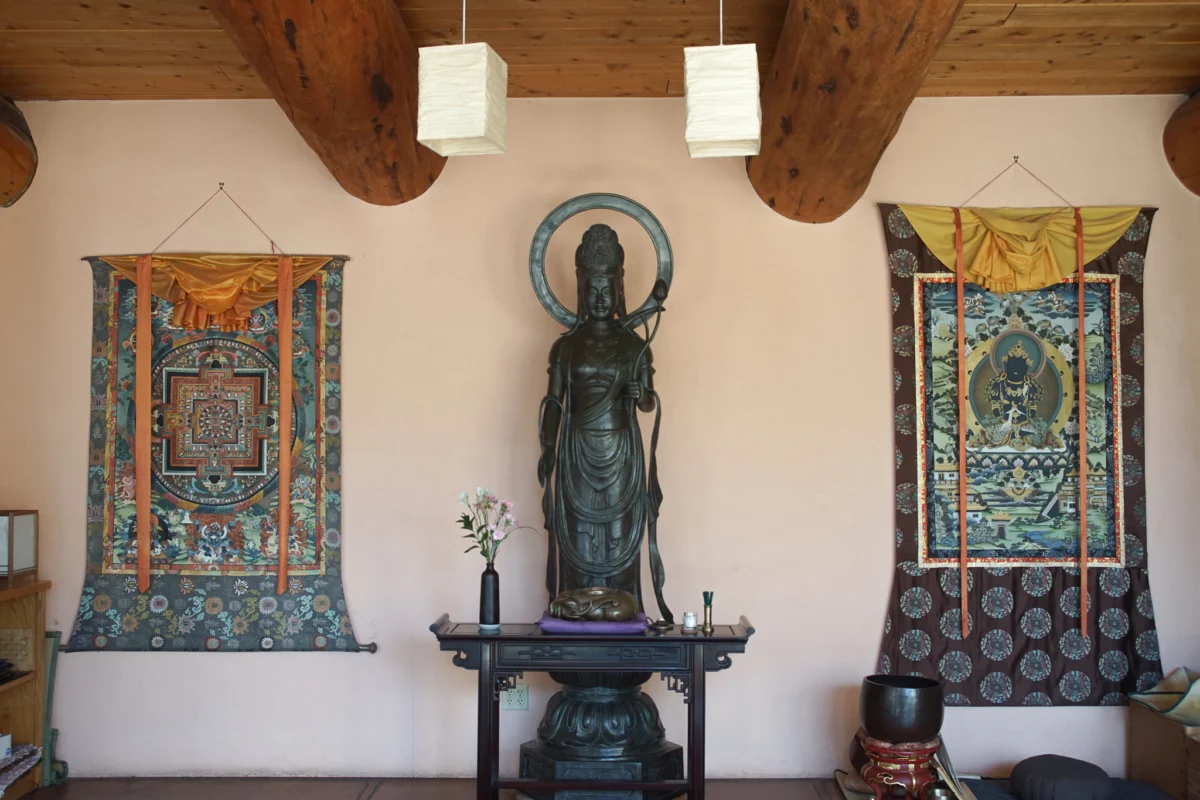
At the first hint of dawn in Colorado’s secluded San Luis Valley, a wooden han reverberates, its resonant tones cutting through the crisp, thin air that blankets the mountain-rimmed landscape of Crestone Mountain Zen Center. Within the meditation hall, a profound stillness descends as practitioners, seated on traditional tatami mats, settle into their practice. This same ancient ritual, a beacon of mindful discipline, unfolds simultaneously thousands of miles away at the Zen Buddhist Center Schwarzwald in Germany. From bustling urban centers to remote natural havens, individuals across geographical divides now participate in these seated meditations, bridging physical distances through both in-person gatherings and increasingly sophisticated online platforms. As the fading echo of the bell signifies the commencement of practice, a palpable stillness emerges, unfolding not just within each individual but also somatically, palpably, and mutually, creating a mysterious connective tissue that spans space and, remarkably, even time.
The Bedrock of Shared Practice: Trust as the Foundation of the Heart
While monastic life is often synonymous with stillness, its true strength lies in an underlying current of profound trust. This is not a superficial accord based on shared opinions or fleeting agreements, but rather a deeper, more robust sense of reliability. It is the unwavering certainty that each individual, with their unique set of challenges, internal struggles, and ongoing questions, will consistently show up. This commitment to appearing, to refining one’s conduct, to confronting the self, and to immersing one’s mind collectively forms the essential framework upon which Zen communities are built.
This cultivated trust is not an abstract philosophical concept; it is a living entity that emerges and is nurtured through direct, embodied encounters. One such transformative moment occurred during an ango, a rigorous ninety-day intensive practice period, at the Crestone Mountain Zen Center. The author recounts experiencing what felt like a "dark morning of the soul," a profound sense of fragility and being "unmade," where the immediate future seemed insurmountable. In this state of acute vulnerability, a nascent thought arose: "I wish there were someone, anyone, who could take this pain away from me." The immediate recognition of the impossibility of such a wish only deepened the internal struggle.
As the practitioner transitioned to kinhin, a form of walking meditation, their gaze met that of another practitioner. In a departure from the usual averted glances, this individual held their gaze, offering a moment of sustained presence. Their eyes conveyed warmth, a gentle smile, and a small, affirming nod. No words were exchanged, no explicit acknowledgment of the internal turmoil was made, yet this silent encounter held immense significance. The author describes this moment as having "meant the world," having "changed the world," and ultimately "turned the world around." It was a profound revelation of the true nature of a monastery: a dedicated field of shared attention, a sanctuary of trust. This shared attention, the author posits, cultivates a form of sanity that cannot be artificially manufactured through solitary effort.
Zen as Embodied Culture, Not Mere Content
In Western discourse, Buddhism, and specifically Zen, is frequently characterized as a philosophical system or a collection of practical techniques. However, Zen transcends this categorization; it is not a set of doctrines to be learned and memorized, but rather a dynamic "way of being together" that is transmitted through cultural immersion, much like language or tradition.
Culture operates on a subtler, more pervasive level than explicit instruction. It shapes our very comportment – how we walk, how we gesture, how we think, and how we perceive the world. This cultural transmission is not acquired through the study of texts alone but is absorbed through active participation and developing intimacy with the practice. As the author observes, the culture doesn’t merely reside outside us; it actively inhabits us. The synchronized act of forty bodies turning, bowing, and chanting together in response to the bell for sutra recitation, each finding their unique "tune" within the collective, exemplifies this embodied cultural transmission. Quoting the revered Zen master Suzuki Roshi, "Don’t chant with your mouth. Chant with your ears!" the article suggests this advice extends far beyond mere auditory perception. It points to the release of the individual self into a shared field of aliveness, thereby discovering one’s authentic voice within that collective resonance.
Monasteries, with their meticulously structured forms and intricate rhythms, therefore, retain their crucial importance. They serve as laboratories for embodied culture, where the dharma is not just preached but lived. Elements such as the precise form of a bow, the drape of a robe, or the intentional placement of a teacup are not mere aesthetic choices; they are embodiments of the dharma. When these forms are practiced within a community built on trust, they transmit a depth of understanding that language often fails to convey.

The Liberating Embrace of Form
To modern eyes, Zen practices can appear unconventional: shaved heads, traditional Japanese robes, and the unfamiliar choreography of rituals. While some find these elements aesthetically compelling, others may perceive them as austere or inaccessible. In response, many contemporary Zen centers have streamlined their formalities to appear more welcoming. However, for practitioners like the author, these forms remain a vital pathway to participating in the "body of the Buddha."
The physical body itself is viewed as a mudra, a gesture of awakening. Forms such as wearing robes and bowing are interpreted as gestures that embody connection. Zen rituals are inherently a path of gestures, a sequential unfolding of one movement after another, punctuated by moments of stillness. During kinhin, the synchronized breathing of practitioners is often observed, where inhalation corresponds with the lifting of heels, and exhalation with the shuffling of feet. In such moments, the step ceases to be solely an individual act and becomes part of the shared field of practice. This shift from mental continuity to wholehearted living moment by moment allows for the embodiment and clarification of each situational experience.
Initially, these forms may feel restrictive. However, with sustained practice, they paradoxically unlock a profound sense of freedom. This freedom arises from surrendering to the inherent rhythm of the practice and allowing each gesture to ground the practitioner within the living field of relationships. Over time, bowing can begin to feel more natural than a handshake, not merely due to familiarity with an unfamiliar custom, but because a deeper form of meeting has been discovered – one rooted in interconnectedness rather than separation.
The Enduring Anchor: The Monastery as an Inner Landmark
As Zen Buddhism established its presence in the West, its practice evolved, extending outward into lay life and deepening inward within monastic settings. The establishment of practice centers, regardless of their scale or frequency of attendance, invariably led to a deepening of practice for all involved. This principle remains true today. The monastery functions as a vital "inner landmark." Even for lay practitioners who live at a distance, the mere knowledge that a place exists where silence, discipline, and trust are meticulously cultivated profoundly alters the texture of their own lives.
In the contemporary era, the influence of this inner landmark has been amplified by the internet. Students who have trained in person and subsequently returned to their homes report that joining zazen sessions online, hearing the familiar bell, and sensing the quiet settling of the hall, triggers a powerful "whole body memory." One practitioner described this experience as, "When I hear the bell, I can smell the incense," illustrating the potent sensory and emotional recall that online practice can evoke, bridging the gap between physical distance and lived experience.
Shifting the Address: Transforming the Inner Landscape
Zen monasticism fundamentally relocates the mind from its habitual dwelling in the "address" of personal identity – our stories, roles, and ego-driven narratives – into its fundamental nature. This fundamental nature is characterized by a feeling body existing within a living world. When an individual enters a monastery, they not only change their external physical location but also undergo a profound transformation of their inner address.
From this newly established inner address, the world begins to appear porous and interconnected. The subtle rise of steam from a cup of tea, the resonance of the evening bell accompanied by a breeze drifting through an open door – these everyday occurrences become profound encounters. Everything is perceived as meeting everything else, with the mind and the world greeting each other in a shared, harmonious rhythm. This transformed inner address is open, responsive, and capable of receiving the myriad greetings the world offers. To live from this awakened, embodied, and undefended place is, in essence, the practice itself.
The Unfolding Practice: Continuity Through Connection
The shared stillness that exists between the striking of the bells carries a charge as potent and penetrating as a perfectly articulated line of Dogen’s teachings – exact, alive, and deeply insightful. Today, the possibility of practicing together, to a significant extent, transcends even vast geographical distances. As the han sounds at dawn, a resonant call striking wood in the darkness, it summons all to zazen. Across minds connected through screens and across the enduring physical spaces of practice centers, stillness unfolds, and in its unfolding, it connects. This enduring practice, cultivated through shared intention and embodied ritual, continues to foster trust, transmit culture, and forge deep connections across the globe.

