

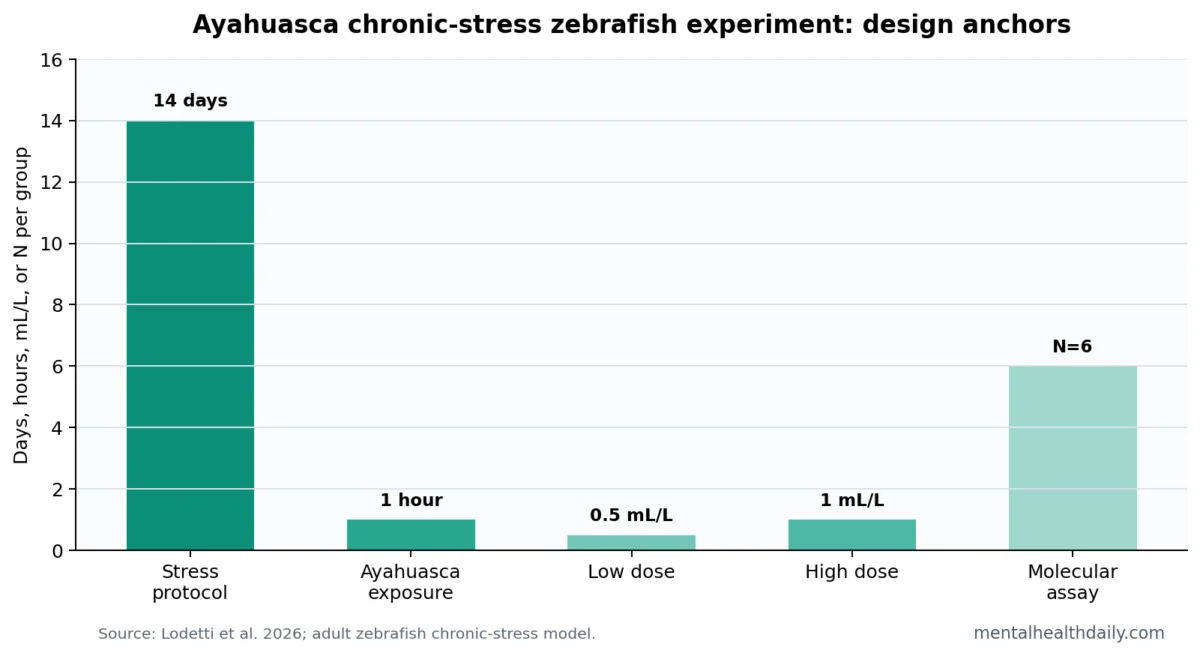
A recent groundbreaking experiment conducted on zebrafish has unveiled that a single, brief 1-hour exposure to ayahuasca remarkably reversed several detrimental effects induced by 14 days of unpredictable chronic stress. The profound reversal encompassed impaired sociability, significant anxiety-like behavior, stress-related hyperlocomotion, elevated cortisol levels, and a reduction in whole-brain Brain-Derived Neurotrophic Factor (BDNF). This compelling outcome, detailed by Lodetti et al. and published in the scientific literature, represents crucial mechanistic animal evidence, providing a foundational understanding of ayahuasca’s biological impact within a controlled system. It is imperative to underscore that these findings do not constitute a clinical trial for human depression or anxiety and therefore cannot be translated into treatment recommendations for people. Instead, the research offers a valuable lens through which to explore the complex neurobiological pathways influenced by this potent psychoactive brew.
The Ayahuasca Enigma: A Blend of Tradition and Science
Ayahuasca, a psychoactive brew steeped in centuries of Amazonian spiritual and medicinal traditions, has increasingly captured the attention of the scientific community. Traditionally consumed in ceremonial contexts by indigenous groups in South America, the brew is typically made from the bark of the Banisteriopsis caapi vine and leaves of the Psychotria viridis shrub. The Psychotria viridis contains N,N-dimethyltryptamine (DMT), a potent psychedelic compound that is orally active when combined with the monoamine oxidase inhibitors (MAOIs) found in B. caapi. These MAOIs, primarily beta-carbolines like harmine, harmaline, and tetrahydroharmine, prevent the breakdown of DMT in the gut and liver, allowing it to reach the brain and exert its effects on serotonin signaling.
The historical and cultural significance of ayahuasca often overshadows its pharmacological complexity in public discourse. However, for scientific inquiry, the relevant question shifts from ceremonial use or psychotherapy to the fundamental biological interactions of its constituent compounds. The Lodetti experiment precisely exemplifies this shift, aiming to discern whether a single exposure to the brew could instigate measurable changes in stress-linked behavior and biomarkers within a rigorously controlled animal model, independent of the elaborate set and setting of traditional use. This approach helps to isolate the neurobiological effects from the psychological and contextual variables inherent in human studies.
Zebrafish: A Microcosm for Stress Biology Research
Zebrafish (Danio rerio) have emerged as an invaluable model organism in neurobiological and stress research, offering a unique blend of experimental advantages. Their genetic homology with humans, transparent embryos allowing for easy observation of neural development, rapid reproductive cycle, and the ease with which large cohorts can be maintained and manipulated in a laboratory setting make them ideal for studying complex behavioral and physiological responses. For stress research specifically, zebrafish offer the capability for controlled exposure to stressors, rapid and quantifiable behavioral testing, and whole-body biochemical assays, providing a comprehensive snapshot of an organism’s stress response.
Previous studies have extensively utilized unpredictable chronic stress (UCS) paradigms in zebrafish to reliably induce a range of anxiety-like and depression-like behaviors, coupled with corresponding changes in stress hormones such as cortisol. These models have proven robust in mimicking aspects of chronic psychological stress observed in mammals, including alterations in locomotion, social interaction, and exploratory patterns. However, it is crucial to understand the conceptual limitations: behavioral labels like "anxiety-like" or "depression-like" in fish are model terms, not clinical diagnoses. Zebrafish do not experience human emotions such as worry, hopelessness, rumination, or suicidal ideation. Researchers infer these "like" behaviors from observable metrics such as movement patterns, avoidance, time spent in specific areas of a tank (e.g., bottom dwelling in a novel tank test), and social interaction preferences. While useful for identifying candidate biological pathways, these inferences require careful translation and do not equate to human symptomology.
The Lodetti Experiment: A Detailed Chronology of Stress and Reversal
The study by Lodetti et al. meticulously established a protocol to investigate ayahuasca’s effects on chronic stress. Adult zebrafish were subjected to a rigorous 14-day unpredictable chronic stress (UCS) protocol. This involved exposing the fish to a variety of mild, unpredictable stressors, such as changes in water level, temperature fluctuations, tank rotation, or temporary isolation, designed to induce a state of chronic physiological and psychological stress. This period effectively created a model of sustained adversity, leading to observable behavioral and biochemical alterations.
On day 15, following the chronic stress period, a critical intervention occurred: the stressed zebrafish were exposed to ayahuasca for a single hour. The brew was introduced into their tank water at concentrations of either 0.5 or 1 mL/L. This aquatic exposure method allowed for a controlled and consistent administration of the compounds. The relatively short exposure time was chosen to assess rapid-acting effects, bypassing the complexities of prolonged drug presence or repeated administration.
The following day, day 16, served as the evaluation phase. The fish underwent a series of behavioral tests designed to quantify their responses to the previous stress and the ayahuasca exposure. These included sociability tests, which measure a fish’s preference for associating with other fish, a proxy for social interaction often impaired by stress. Additionally, novel-tank tests were conducted to assess anxiety-like behavior. In this test, fish are introduced to an unfamiliar environment, and their exploration patterns—such as time spent in the bottom vs. top areas of the tank, and overall locomotion—are meticulously recorded. Stressed zebrafish typically exhibit increased thigmotaxis (hugging the walls) and spend more time in the bottom portion of the tank, indicative of heightened anxiety. Following behavioral assessments, biochemical assays were performed to measure whole-body cortisol levels and whole-brain BDNF concentrations, providing crucial physiological biomarkers.
Converging Evidence: Behavioral and Biochemical Reversal
The results of the Lodetti experiment presented a remarkably coherent picture of stress reversal. Prior to ayahuasca exposure, the 14 days of unpredictable chronic stress had indeed induced the expected alterations:
- Reduced Sociability: Stressed zebrafish showed a significant decrease in their preference for interacting with conspecifics, indicating impaired social behavior.
- Increased Anxiety-like Behavior: In the novel-tank test, stressed fish spent more time dwelling in the bottom zones and exhibited altered locomotion patterns, consistent with heightened anxiety.
- Stress-Induced Hyperlocomotion: Paradoxically, alongside anxiety, chronic stress also led to an increase in overall movement, a phenomenon sometimes observed in stress models that can reflect a restless or agitated state.
Following the single 1-hour ayahuasca exposure, these stress-induced behavioral deficits were significantly reversed:
- Ayahuasca exposure effectively restored social interaction to levels comparable to non-stressed control groups.
- The anxiety-like profile was markedly reduced, with fish exploring more of the tank and spending less time in the bottom area.
- The stress-induced hyperlocomotion was attenuated, bringing activity levels back towards a baseline.
The biochemical results paralleled these behavioral improvements, strengthening the interpretation of a holistic stress recovery:
- Chronic stress had led to a significant increase in whole-body cortisol, the primary stress hormone in fish, reflecting a hyperactive stress response system. Ayahuasca exposure dramatically reversed this elevation, bringing cortisol levels closer to those of non-stressed controls.
- Conversely, chronic stress caused a decrease in whole-brain BDNF, a protein vital for neuronal plasticity and survival. Ayahuasca exposure reversed this reduction, restoring BDNF levels towards baseline.
The coordination across these different levels – observable behavior, stress hormone regulation, and neurotrophic factor expression – is a key strength of the study. A behavioral-only result might be dismissed as non-specific arousal, and a biomarker-only result could be challenging to interpret without behavioral correlates. The synchronized movement of behavior, cortisol, and BDNF provides robust evidence for a genuine stress-recovery interpretation within the confines of the zebrafish model.

Unpacking the Biomarkers: BDNF and Cortisol in Context
The two primary biochemical markers assessed, BDNF and cortisol, offer distinct yet complementary insights into the biological underpinnings of stress and recovery.
Brain-Derived Neurotrophic Factor (BDNF) is a crucial growth-supporting protein widely recognized for its pivotal roles in synaptic plasticity, neuronal survival, and stress adaptation. It is intricately involved in learning, memory, and the biology of antidepressant action. A reduction in BDNF is frequently observed in models of chronic stress and in clinical depression, while its upregulation is often associated with therapeutic interventions. However, the interpretation of BDNF levels is nuanced. While often discussed as if "higher is automatically better," its biology is context-specific, varying by brain region, type and duration of stress exposure, developmental timing, sex, specific receptor signaling pathways, and behavioral state. Therefore, whole-brain BDNF measurements in zebrafish, while a useful indicator of overall plasticity-linked signaling, provide a broad signal rather than a precise map of which neural circuits have recovered or adapted. Despite this limitation, the observation that chronic stress reduced whole-brain BDNF and ayahuasca reversed this reduction is a significant finding, suggesting a beneficial impact on fundamental neuroplastic processes. The honest interpretation is that the treatment shifted a plasticity-linked marker in the expected direction of recovery.
Cortisol, the primary glucocorticoid in fish (analogous to cortisol in mammals), is a major stress hormone. Its elevation is a hallmark of an activated stress-response system. In the context of a stress model, the finding that chronic stress elevated whole-body cortisol and ayahuasca attenuated this elevation is more directly interpretable than BDNF alone. It signifies a direct impact on the organism’s physiological stress axis. However, it is important to note that whole-body cortisol in a fish does not equate to the intricate, timing-sensitive profile of the human hypothalamic-pituitary-adrenal (HPA) axis. The HPA axis involves a complex interplay between the hypothalamus, pituitary gland, and adrenal glands, orchestrating cortisol output in response to stress. Human studies would require precise, timing-sensitive cortisol measurements, alongside symptom scales, adverse-event monitoring, and a comprehensive understanding of psychological context, set, and setting.
Bridging the Gap: Animal Models to Human Health
The utility of zebrafish evidence lies primarily in its capacity to clarify biological mechanisms, not to prescribe human treatment. While the study provides compelling mechanistic insights, it is crucial to maintain a clear distinction between these findings and direct clinical applicability. This adult zebrafish experiment effectively supports a hypothesis about stress recovery, cortisol regulation, and BDNF modulation. However, it cannot, in any way, estimate human antidepressant response, anxiety reduction, dose safety, the psychological experience of ayahuasca, or long-term outcomes in humans.
Existing human ayahuasca research, which includes small clinical trials and naturalistic observational studies—suchs as a randomized placebo-controlled trial investigating its effects on treatment-resistant depression—addresses fundamentally different questions. These human studies meticulously account for human expectations (placebo effects), the therapeutic setting, vigilant adverse-event monitoring, the profound psychological content elicited by the experience, and the use of standardized clinical symptom scales. These elements are inherently absent and irrelevant in a controlled zebrafish experiment.
The Lodetti experiment’s true value lies in its ability to narrow the biological inquiry: can an ayahuasca-like exposure rapidly reverse stress-linked behavioral and biochemical changes within a controlled, living system? The answer, within the confines of the model, was unequivocally yes. This positive answer paves the way for the next critical question: which specific compounds within ayahuasca, which receptors, and which downstream plasticity pathways are responsible for orchestrating this observed reversal?
The Crucial Caveats: Safety, Dose, and Specificity
Ayahuasca, by virtue of its potent pharmacological effects, firmly belongs within the realm of drug science. This classification is not an endorsement for unsupervised use, a usage recommendation, or a claim that it is inherently safe. Human ayahuasca exposure carries significant risks, including acute psychological distress (sometimes referred to as a "bad trip"), cardiovascular effects (such as transient increases in heart rate and blood pressure), severe vomiting, and potential drug interactions. These risks are amplified in individuals with pre-existing psychiatric conditions (e.g., psychosis, bipolar disorder) or medical vulnerabilities. People concurrently taking serotonergic medications (like SSRIs), stimulants, other monoamine oxidase inhibitors, or multiple psychiatric drugs require especially careful medical oversight due to the high risk of adverse reactions, including serotonin syndrome. None of these critical safety questions can be addressed or answered by studying zebrafish behavior. The mechanistic discipline of this study, for scientific purposes, is its greatest value, providing specific, bounded claims about its effects in a fish model, leaving everything beyond that to human evidence.
Furthermore, the concept of dose translation from this study is entirely inappropriate and potentially dangerous. The experiment utilized ayahuasca concentrations of 0.5 and 1 mL/L in tank water for 1 hour. These values cannot be casually or directly converted into a human oral dose. The route of administration (aquatic exposure vs. oral ingestion), absorption kinetics, body size differences, metabolic pathways, and the precise compound mixture all differ drastically between fish and humans. This is not a mere technicality; psychedelic research is particularly susceptible to dose-story overreach, as the public often seeks practical numbers or immediate applications. This paper provides none. It provides a controlled exposure condition that yielded measurable reversal of a stress phenotype in fish.
The scientifically responsible follow-up to this work involves pharmacological decomposition. Researchers must systematically test whether the observed effects depend specifically on DMT-like serotonergic signaling, on the monoamine oxidase inhibition properties of the beta-carbolines, on downstream BDNF pathways, on cortisol regulation, or on a synergistic effect of the combined mixture. Without this granular work, the statement "ayahuasca reversed stress" remains a headline, not a precise scientific mechanism.
Beyond the Headline: Future Directions in Psychedelic Science
The Lodetti study is strongest when interpreted as a convergence result within a single, well-controlled model. Chronic stress consistently shifted social behavior, anxiety-like behavior, locomotion, cortisol levels, and BDNF concentrations in a direction indicative of stress. Crucially, a single ayahuasca exposure consistently moved these same physiological and behavioral layers back toward control patterns. This pattern of multi-layered coherence is far more compelling than an isolated behavioral change, but it still does not establish receptor-level causality.
To advance the understanding of the precise mechanisms, several follow-up tests would be invaluable for making the mechanistic claims cleaner and more specific. Researchers would need to systematically separate and manipulate candidate pathways rather than treating the full brew as a single "black box":
- Isolating Active Compounds: Test pure DMT alone, beta-carbolines alone, and specific combinations to identify which components are essential for the observed effects.
- Receptor Antagonism: Use pharmacological antagonists to block specific serotonin receptors (e.g., 5-HT2A, 5-HT1A) or monoamine oxidase enzymes to determine if the effect is dependent on these pathways.
- BDNF Pathway Manipulation: Directly manipulate BDNF signaling, for example, by administering exogenous BDNF or blocking its receptors, to ascertain whether BDNF is a causal driver of behavioral recovery or merely a marker of plasticity. If blocking BDNF signaling prevents the behavioral recovery, the causal link becomes stronger. If behavior still recovers while BDNF signaling is blocked, BDNF may be a crucial marker rather than the primary driver.
- Genetic Manipulation: Employ genetic tools in zebrafish to knock down or overexpress specific genes related to stress response or neuroplasticity, further elucidating the molecular pathways involved.
If the same recovery pattern persists and can be attributed to specific compounds and their interactions with defined pathways, the claim would evolve from "ayahuasca exposure reversed a stress phenotype" to a more precise account of which pathway mattered, how, and why.
Until such work is completed, the boundaries of the article’s interpretation must remain narrow. The zebrafish data robustly support a specific stress-biology hypothesis. They emphatically do not inform a reader whether human ayahuasca use is safe, whether one session is sufficient for therapeutic effect, whether the psychological setting is a necessary component, or whether similar biomarker changes would manifest in individuals experiencing clinical depression, anxiety disorders, trauma, or substance-use disorders. This study represents a significant, yet early, step in the scientific exploration of a complex traditional medicine.

