

The landscape of functional magnetic resonance imaging (fMRI) research in addiction may be on the cusp of a significant re-evaluation, following a landmark multi-cohort study published in 2026. Researchers have traditionally viewed certain widespread physiological fluctuations within fMRI data as "noise," diligently removing them to isolate localized neuronal activity. However, new findings from Welsh et al. suggest that one such signal, known as systemic low-frequency oscillation (sLFO), carries crucial, addiction-relevant information, challenging conventional fMRI preprocessing methods. This discovery could pave the way for a more comprehensive understanding of the physiological underpinnings of substance use disorders.
A Paradigm Shift in fMRI Analysis: Unmasking Addiction’s Hidden Signals
The core revelation of the 2026 study is that sLFO, a slow, brainwide physiological fluctuation typically attributed to non-neuronal sources, is deeply intertwined with various facets of nicotine dependence. Specifically, the research demonstrated that sLFO amplitude tracked nicotine dependence scores, cue-induced craving levels, physiological states of abstinence and nicotine satiety, and even the effects of psychostimulants like methylphenidate. This challenges the long-held assumption that such global signals are merely confounding factors that obscure the true neural responses to stimuli.
fMRI is a non-invasive technique that measures changes in blood-oxygen-level-dependent (BOLD) signals, which are indirectly related to neural activity. Standard fMRI data analysis often involves sophisticated preprocessing steps designed to remove various sources of "noise," including head motion, cardiac pulsations, respiratory cycles, and global physiological signals like sLFO. The rationale behind this removal is to enhance the signal-to-noise ratio and facilitate the interpretation of localized brain network activity. Welsh et al., however, posed a critical question: what if some of this "noise" is, in fact, a meaningful physiological signal? Their extensive investigation across multiple cohorts and conditions provides compelling evidence that this is indeed the case for sLFO in the context of addiction.
Systemic Low-Frequency Oscillations: From Noise to Insight
Systemic low-frequency oscillation (sLFO) refers to slow, widespread fluctuations observed across the entire brain in fMRI data. These oscillations are not primarily driven by local neuronal firing but are largely influenced by broader physiological processes, including vascular dynamics, respiratory patterns, cardiac rhythms, and arousal-related states. In prior research, lower sLFO amplitude has often been interpreted as an indicator of higher physiological arousal. The Welsh et al. study leverages this interpretation, suggesting that changes in sLFO amplitude reflect critical shifts in an individual’s physiological state, particularly in response to addiction-related cues or drug exposure.
The methodological implications are profound. If a signal consistently filtered out of fMRI data is demonstrably linked to key addiction phenomena, then current analytical pipelines might be inadvertently discarding valuable insights. This necessitates a re-evaluation of preprocessing strategies, particularly in studies investigating conditions where systemic physiological states, such as arousal, stress, or withdrawal, are central to the pathology, as is often the case in addiction.
Nicotine Dependence and Cue-Induced Physiological Responses
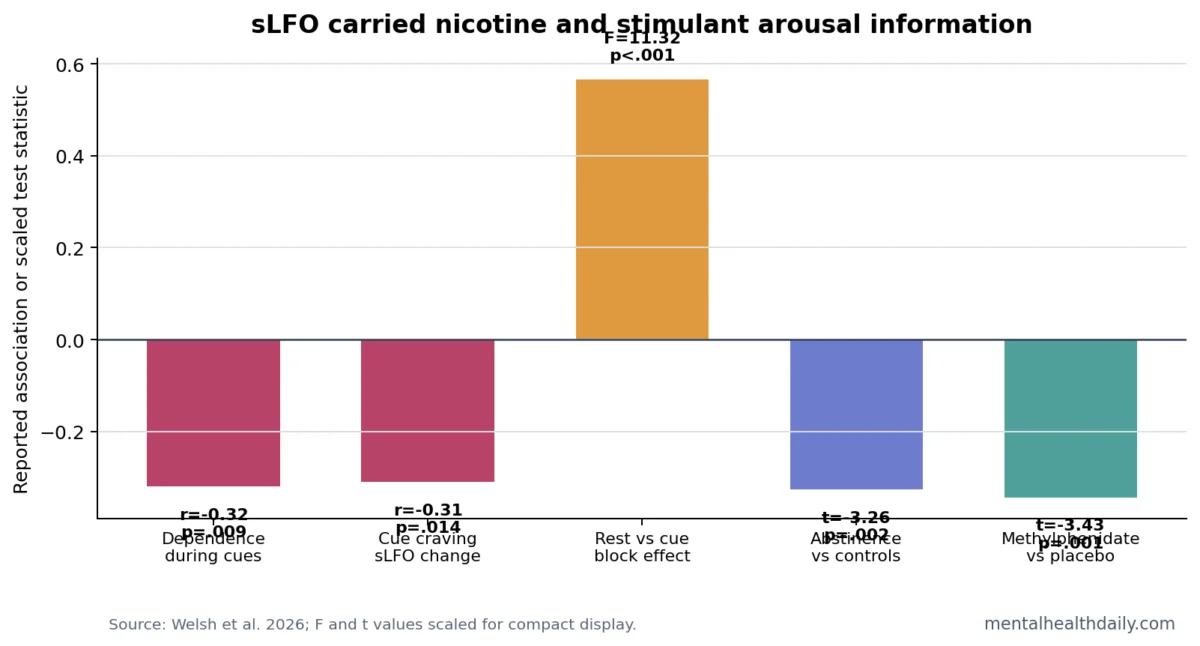
One of the study’s most striking findings relates to the direct association between sLFO amplitude and nicotine dependence during exposure to smoking cues. In a cohort of 64 individuals who smoked tobacco, participants viewed both smoking and neutral cues while undergoing fMRI. During the exposure to cigarette cues, the average brainwide sLFO amplitude was found to be negatively associated with Fagerstrom Test for Nicotine Dependence (FTND) scores. This correlation was statistically significant, with an r-value of –0.32 and a p-value of .009.
In simpler terms, individuals with heavier nicotine dependence exhibited a lower sLFO amplitude during the period of cue exposure. Given the prior interpretation that lower sLFO signifies higher physiological arousal, this result aligns with established addiction models. These models posit that smoking cues trigger a robust physiological arousal state in dependent users, which contributes to craving and drug-seeking behavior. The sLFO signal appears to capture this heightened arousal response directly.
Crucially, this relationship was context-dependent. The study found no significant association between sLFO and nicotine dependence when participants were at rest, prior to cue exposure (r = –0.047, p = .71). This absence of correlation at rest is not a weakness but a strength of the finding. It underscores that the sLFO signal becomes clinically informative precisely when the brain and body are challenged by addiction-relevant stimuli, highlighting the dynamic and state-dependent nature of addiction physiology. This context specificity suggests that sLFO is not merely a generic physiological marker but one that reflects specific responses to drug cues.
Tracking Subjective Craving and Task-Related Changes
Beyond baseline dependence, Welsh et al. also investigated how sLFO changed dynamically across the cue-reactivity task and its relationship to subjective craving. The study revealed that greater cue-induced craving was associated with a smaller cue-related increase in brainwide average sLFO. This inverse relationship was statistically significant (r = –0.31, p = .014) and remained robust even after controlling for sLFO amplitude during the first cue block (r = –0.26, p = .04).
This finding provides a direct link between the sLFO signal and an individual’s subjective experience of craving, further solidifying its relevance to the phenomenology of addiction. It also reinforces the idea that understanding addiction-relevant physiology requires observing dynamic changes during task engagement, rather than relying solely on static, resting-state measures. The fluctuations of sLFO across different cue blocks and in relation to reported craving levels suggest that this signal captures an active, ongoing physiological process linked to motivational states.
The Physiological Spectrum: Abstinence, Satiety, and Stimulant Effects
To further validate the physiological relevance of sLFO, the researchers examined its behavior under distinct pharmacological and withdrawal states. In a separate chronic nicotine-use cohort, the study compared smokers with matched controls. At baseline, there was no significant difference in brainwide average sLFO between the two groups. However, under conditions of abstinence, smokers exhibited significantly higher sLFO than controls (t(99) = –3.26, p = .002). Conversely, during a state of nicotine satiety (after recent smoking), sLFO decreased significantly (t(64) = –4.51, p < .001).
This pattern of sLFO modulation — increasing during abstinence (often associated with heightened arousal and withdrawal symptoms) and decreasing during satiety (associated with reduced craving and a more relaxed state) — lends strong credence to its biological significance. It demonstrates that sLFO is not a mere scanner artifact but a dynamic marker responsive to different physiological states characterized by varying levels of arousal, withdrawal, and autonomic profiles. The signal moves predictably with these critical states, making it a compelling candidate for a physiological biomarker.

To broaden the scope and test if sLFO tracked psychostimulant arousal beyond nicotine, the study also included a methylphenidate cohort. Methylphenidate is a dopamine and norepinephrine reuptake inhibitor commonly used to treat ADHD and narcolepsy, known for its stimulant effects. In healthy controls, methylphenidate significantly reduced brainwide average sLFO at rest compared with a placebo (t(58) = –3.434, p = .001). Furthermore, during the Multi-Source Interference Task, these methylphenidate-related sLFO reductions were associated with measurable changes in reaction times in both congruent and incongruent conditions.
This cross-drug pattern is crucial for interpretation. While nicotine satiety and methylphenidate represent distinct pharmacological states, both can lead to increased catecholamine-linked arousal. The observation that sLFO moved in the same broad direction (reduction) across both nicotine satiety and methylphenidate exposure strengthens the argument that it reflects a general arousal-sensitive signal rather than a tobacco-specific artifact. However, the researchers also offered an important caveat: a shared arousal-sensitive signal does not, by itself, indicate whether a person is craving nicotine, responding to a stimulant, experiencing a change in respiratory pattern, or shifting vigilance. The meaning of sLFO is derived when it is contextualized with cue exposure, abstinence status, specific drug conditions, and concurrent behavioral data.
Re-evaluating "Nuisance" Signals: A Call for Methodological Refinement
The study by Welsh et al. serves as a powerful reminder of the trade-offs inherent in fMRI data processing. While the removal of global physiological signals is often a valid approach for isolating local neural activity and addressing specific research questions, this study clearly demonstrates that such a practice can inadvertently discard clinically relevant information. A signal previously relegated to the category of "nuisance" has now been shown to carry vital data concerning nicotine dependence, craving, abstinence, satiety, and psychostimulant exposure.
The researchers note the robust evidence strength of their study, citing the use of multiple cohorts and converging nicotine/stimulant tests. This multi-faceted approach significantly bolsters the methodological argument for retaining and analyzing sLFO. However, they also prudently caution that the clinical findings remain correlational. Therefore, sLFO amplitude should be considered a candidate physiological marker, not a definitive proof that the signal directly causes craving or dependence. Its utility lies in its potential to reflect underlying physiological states.
The Power of Context: Why Resting-State Null Findings Matter
The initial finding that the correlation between sLFO and nicotine dependence was absent during resting-state scans (r = –0.047, p = .71) might initially appear to be a weakness. However, the researchers skillfully reframe this as a critical piece of evidence that sharpens the interpretation. Addiction is inherently state-dependent. An individual might appear stable at baseline, but their physiological profile can dramatically shift during periods of withdrawal, cue exposure, stress, drug satiety, or decision-making pressure. The sLFO results align perfectly with this model: the signal became clinically informative precisely when the task introduced cigarette cues, engaging the addiction-related motivational system.
This insight holds significant implications for the design of future biomarker studies in addiction. Relying solely on a resting-state fMRI scan may significantly underestimate or entirely miss critical addiction-relevant physiological processes. Instead, a cue-reactivity scan, thoughtfully paired with subjective craving ratings and objective dependence scores, offers a more robust platform to test whether systemic physiology undergoes meaningful changes when drug-related motivation is actively engaged.
Furthermore, this perspective extends to the evaluation of addiction treatment trials. If a pharmacological intervention or a behavioral therapy aims to reduce cue-induced craving, researchers can now investigate whether both regional cue reactivity (e.g., in the ventral striatum, medial prefrontal cortex, anterior cingulate, insula) and systemic sLFO simultaneously shift. A convergent agreement between subjective craving reports, observable task behavior, localized neural activation patterns, and systemic physiological signals would provide a far more compelling and comprehensive assessment of treatment efficacy than any single metric alone.
For the broader scientific community and the public, this study offers a crucial correction: what is labeled as "noise" in brain imaging is often a descriptor for biological processes that the current analytical framework was not designed to study. Fundamental physiological processes such as breathing patterns, vascular timing, autonomic arousal, and vigilance can undoubtedly interfere with the clear mapping of local neural networks. However, these very same processes are often central and integral to the complex biology of addiction, craving, and withdrawal.
Welsh et al. did not assert that sLFO is immediately ready for clinical decision-making. Rather, their work conclusively demonstrates that the default deletion of systemic physiology in fMRI analyses can obscure valuable information that becomes highly meaningful when the research question pertains to nicotine dependence, cue reactivity, or psychostimulant arousal. This represents both a crucial methodological warning for fMRI researchers and a significant clue for addiction biologists.
Future Directions: Towards a More Nuanced Understanding
The next critical steps involve rigorous replication and refinement of these findings. Future studies should aim for even cleaner clinical anchors, including objective measures of current smoking intensity, verified abstinence status, detailed assessments of withdrawal severity, longitudinal tracking of craving changes, long-term relapse follow-up, and precise documentation of medication status. Crucially, simultaneous collection of respiratory and cardiac measures during fMRI scanning would help to disentangle the specific physiological drivers underlying the sLFO signal. If sLFO continues to robustly track cue-induced craving even after these stringent checks, its dismissal as generic scanner physiology will become untenable.
Moreover, it would be highly beneficial to compare fMRI-derived sLFO with conventional autonomic measures. Integrating data from heart rate variability, respiration rate, skin conductance, pupil size, and subjective arousal ratings could help clarify whether the sLFO signal primarily reflects vascular timing, vigilance states, specific withdrawal physiology, or a broader composite of physiological arousal. Such comparisons would help to narrow down the precise physiological underpinnings of sLFO, making its biomarker claim more specific, targeted, and ultimately, far more useful for both research and potential clinical applications.
Understanding sLFO: Key Questions Addressed
Is sLFO brain activity or body physiology?
sLFO is primarily an indicator of systemic physiology that is visible within fMRI data. While not directly reflecting local neuronal firing, it is clinically relevant because broader physiological states such as arousal, vascular tone, breathing patterns, and autonomic regulation are intrinsically linked to brain function and behavior, particularly in the context of addiction.
Does this make fMRI useful for diagnosing nicotine dependence?
No, not directly for diagnosis. The study identified robust correlations between sLFO and measures of dependence and craving. However, the diagnosis of nicotine dependence, or any substance use disorder, continues to rely on comprehensive clinical assessment, including behavioral patterns, reported symptoms, use history, withdrawal experiences, functional impairment, and clinical interviews. sLFO is a promising candidate for a physiological marker that can complement these clinical assessments, providing objective insights into underlying physiological states.
Should fMRI studies always keep the global signal?
There is no universal "one-size-fits-all" preprocessing choice that suits every research question. The practical lesson from this study is to thoroughly understand what specific signals are being removed during preprocessing and to critically evaluate whether those removed signals might contain information pertinent to the research question. When physiological states, such as arousal or autonomic regulation, are relevant to the study’s hypothesis, researchers should consider analyzing these signals directly rather than automatically treating them as meaningless noise. This nuanced approach ensures that valuable biological information is not inadvertently discarded.

