

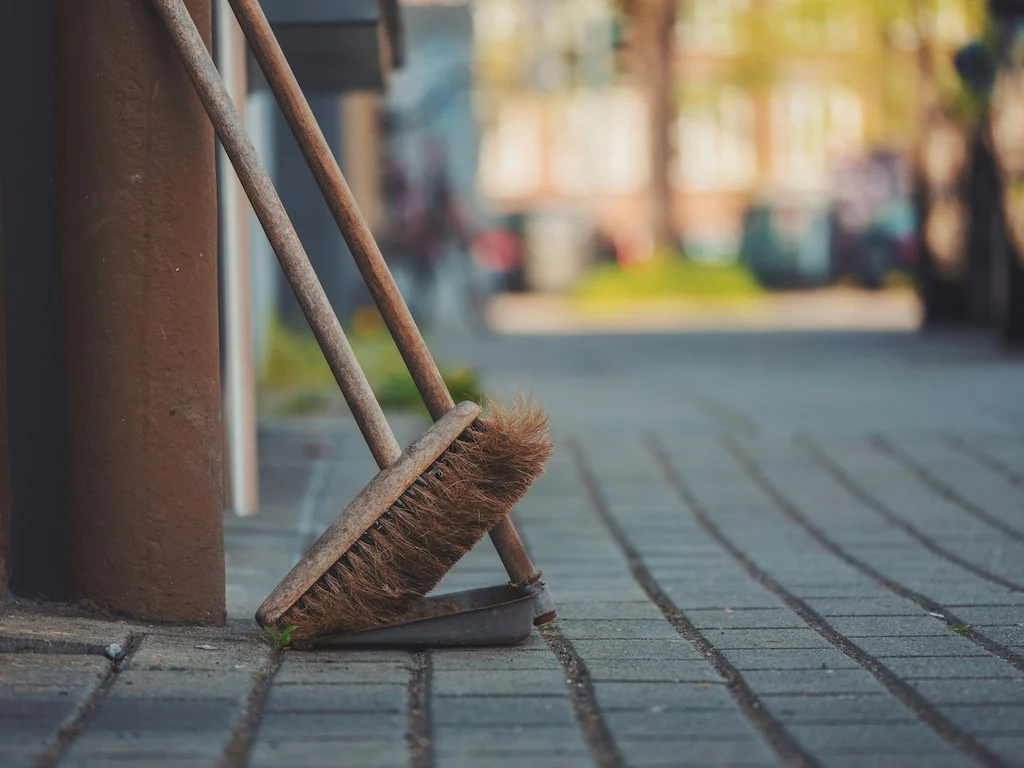
The profound connection between the seemingly mundane act of cleaning and the deep principles of Buddhist philosophy is explored in an insightful excerpt from Shoukei Matsumoto’s latest book, "Work Like a Monk: A Buddhist Guide to Embracing What Matters." This work, presented as a dialogue, draws upon Matsumoto’s experiences as a Shin-Buddhist monk, offering wisdom gleaned from everyday encounters and the individuals he has served. The excerpt delves into the traditional Japanese reverence for cleanliness, framing it not merely as an aesthetic pursuit but as a spiritual practice that fosters mindfulness, gratitude, and a profound sense of interconnectedness.
The genesis of this contemplation for Matsumoto traces back to his elementary school days in Japan, where daily communal cleaning was an integral part of the educational curriculum. This practice, he notes, is deeply rooted in Japanese culture, where cleaning transcends the mere removal of physical dirt. "On one level, it’s removing kegare (defilements), as in dirt," the text explains, "but on another, it’s replenishing kegare, as in low energy. It’s about truly paying attention and caring for both others and ourselves." This dual understanding of "kegare" – as both physical impurity and a depletion of vital energy – highlights the holistic nature of this practice.
This cultural emphasis on cleanliness gained international attention during the 2022 FIFA World Cup, where Japanese fans were observed meticulously cleaning stadium seating after matches. While widely interpreted as an act of "Japanese good manners," Matsumoto suggests a deeper motivation. He posits that such actions are akin to a "greeting" or an "expression of gratitude for having been there, sharing the moment with everyone." This perspective shifts the focus from a superficial display of politeness to a genuine acknowledgment and appreciation of shared experience and space.
The excerpt further elaborates on the idea that cleaning serves as a conduit for connecting with a place. "When you clean a space, it becomes sacred to you," the text asserts. This sentiment resonates strongly with the immaculate condition of Japanese temples, where daily efforts maintain the pristine state of rooms, wooden floors, and ancient pillars. For Matsumoto, this meticulous upkeep is not just about aesthetics; it is a "foundational practice" that cultivates a deep awareness of the present moment. "Our surroundings connect us with who we are," he states. "Messy surroundings can scatter our minds and pull us away from the present. Grounding ourselves in the here and now means bringing harmony both to us and to the space around us."
This mindful engagement with one’s environment, however, can be a challenge in the face of busy modern lives. Matsumoto acknowledges that clutter can accumulate, and many individuals struggle with maintaining order. The common refrain, "Why bother? It’ll just get messy again," is addressed by framing cleaning not as a task with a definitive end, but as a daily habit that nurtures "awareness of interbeing, just like chanting or offering a greeting." This concept of "interbeing," a core tenet in Mahayana Buddhism, emphasizes the interconnectedness of all phenomena, suggesting that our actions, including cleaning, have ripple effects that extend beyond ourselves.
The Subjectivity of Order and the Freedom of Practice
The question of whether a specific standard of cleanliness should be pursued is met with a philosophical response that emphasizes personal perception. "Existence simply is. Our minds are what label it good or bad," the text explains. The notion of "order" is presented as subjective, with no "final goal." This liberality extends to the use of modern conveniences. When Matsumoto suggests hiring cleaning services or employing robot vacuums, the response is pragmatic: "Nothing at all." The monk acknowledges that life’s demands, whether work, childcare, or caregiving, can limit time and physical capacity. Therefore, "looking after our environment together can be a joint endeavor, drawing on one another’s help as needed." This inclusive approach underscores the idea that the spirit of the practice is more important than the method.
The crucial distinction, the text highlights, lies between practice and mere duty. "No one else can meditate on your behalf; no one else can experience ‘here and now’ for you," it is explained. This principle extends to all personal practices, including cleaning. The repetitive, often overlooked, tasks of daily life – straightening a desk, washing dishes – are all forms of samu, defined as "mindful work that aligns you and your surroundings at the same time." This explains the attire of temple priests, who often wear simple samu robes for daily routines rather than ceremonial garments, signifying the spiritual significance embedded in everyday activities.
Cleaning as a Confrontation with Entropy and a Cultivation of Humility
The excerpt then delves into a more profound aspect of cleaning: its relationship with the natural tendency towards disorder, often understood through the lens of entropy. Matsumoto notes that historically, in Japan, imperial decrees would often mandate the cleaning of shrines and temples during times of disaster or national crisis, stemming from the belief that calamities were a consequence of disorder in sacred spaces.
From a scientific perspective, the second law of thermodynamics posits that systems naturally move towards increasing disorder. This concept is illustrated with everyday examples: milk mixing into coffee, objects decaying, and mess accumulating. In biological terms, this can manifest as neglect leading to physical ailments. The question arises: does cleaning, in essence, fight against this natural progression?
The monk acknowledges the validity of this observation, stating, "Cleaning is, by definition, artificial. Sometimes destructively so—pulling weeds, for example, is arguably violent toward other life forms." However, he counters this by framing life itself as a "pushback against entropy." The continuous processes of breathing, eating, and renewal are ways in which living organisms sustain flow and balance. "That cycle of entropy and renewal is what it means to live, and when that balance is lost, death follows. In that sense, there is both positive and negative."
This cyclical interplay between order and disorder, renewal and decay, is where the lesson of humility emerges. The Japanese saying, "Darkness lies at the foot of the lighthouse," is invoked to illustrate the importance of attending to our immediate surroundings rather than solely focusing on distant goals. Just as a lighthouse cannot illuminate the ground directly beneath it, our own efforts to bring order can sometimes blind us to the subtle processes of nature and our own interdependence.
"Our bodies and minds are woven into nature, and we exist by relying on countless other forms of life," the text explains. Recognizing these dependencies and accepting the "richness that sustains us" transcends simplistic notions of good or bad. Cleaning, in this context, becomes an act of acknowledging our place within the natural order and our reliance on the world around us.
The Practicality of Starting Small
When asked where one should begin with such a profound practice, the answer is disarmingly simple: "Right at your feet." The analogy of clutter obscuring our vision, both physically and metaphorically, is powerful. "The more our minds are scattered, the more likely we are to miss what’s important," it is stated. This echoes the sentiment of the lighthouse proverb once more, reinforcing the idea that focusing on the immediate, the tangible, and the close at hand is the most effective way to cultivate presence and order.
The excerpt concludes by emphasizing that even the smallest acts of cleaning are significant. "Everyday routines, like cleaning, are all forms of samu," reaffirming the integration of the spiritual into the mundane. The book, "Work Like a Monk," offers a compelling perspective on how simple, consistent practices can lead to a more mindful, grateful, and interconnected existence, demonstrating that profound wisdom can be found in the most ordinary of human endeavors. The insights shared by Shoukei Matsumoto provide a framework for understanding cleaning not just as a chore, but as a pathway to deeper self-awareness and a more harmonious relationship with the world.

