

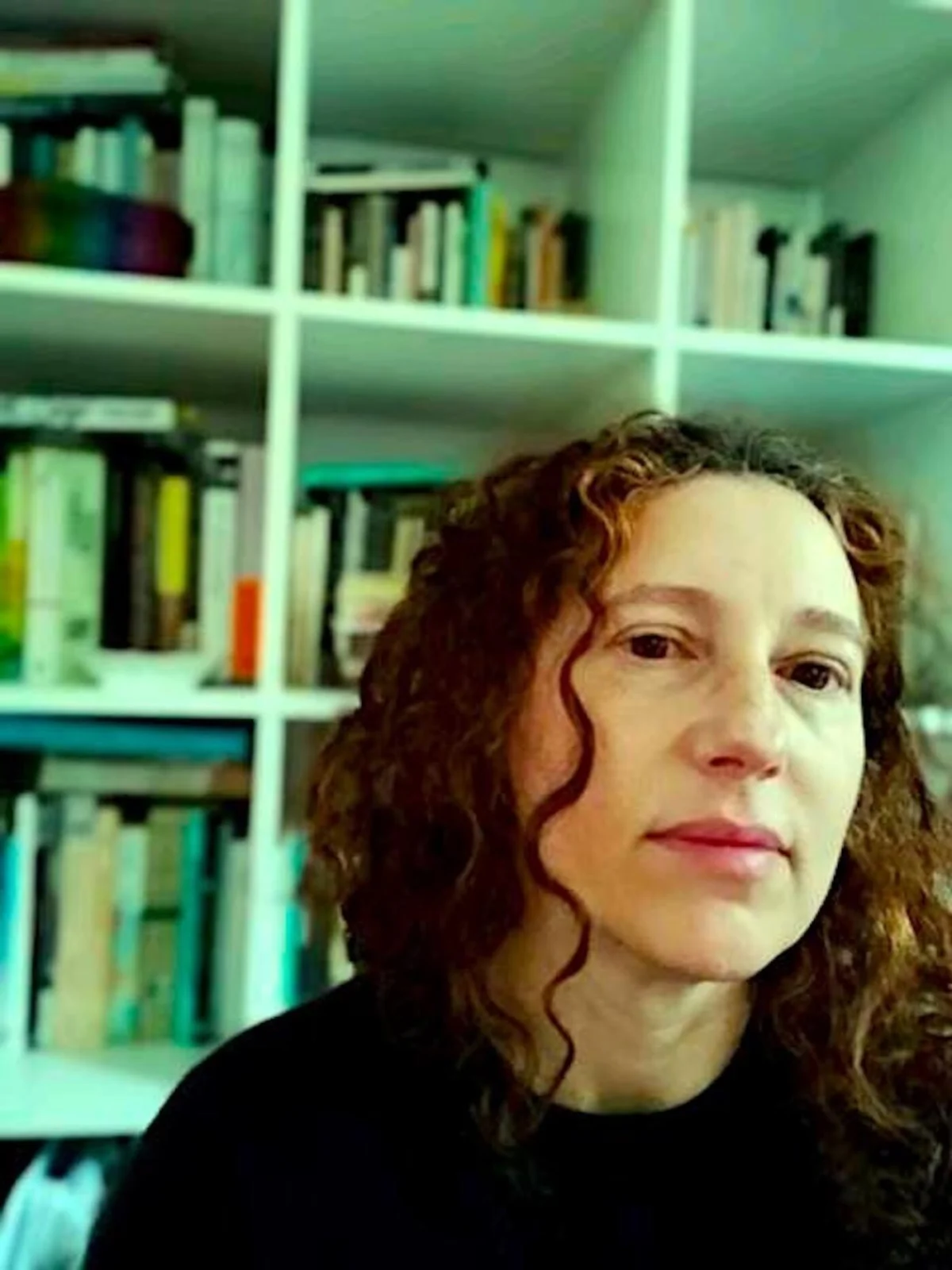
In a world grappling with the profound consequences of environmental degradation and societal fragmentation, Miranda Mellis’s latest novel, Crocosmia, offers a radical vision of renewal. The narrative commences with a startlingly potent metaphor: the spontaneous decapitation of seven heads of state, replaced by colossal, skyscraper-sized flowers that erupt from the earth. This dramatic, almost apocalyptic event is not presented as an end, but as a catalyst for a profound societal and ecological transformation, a "Great Turning" that ushers in new life and art forms.
Mellis, an author with a rich background in experimental fiction and contemplative practices, draws from her studies at Naropa University and the Upaya Zen Center to weave a tapestry of speculative fiction that is deeply rooted in philosophical and spiritual inquiry. Crocosmia follows Maya as she recounts memories of her artist mother, Jane, whose work is credited with igniting this transformative period. Through Maya’s fragmented recollections of an unconventional upbringing among anarchist nuns and in rural isolation, the novel explores the intricate relationship between disintegration and regeneration, catastrophe and possibility.
The Symbolism of the Crocosmia Flower
The novel’s title, Crocosmia, is derived from the vibrant flower that symbolizes this new era. Mellis elaborates on the multifaceted significance of this bloom. "The crocosmia is a beautiful flower that hails from the western grasslands of Africa. It’s on long green stems and it fluoresces in multiple red flowers on a single stem. The flowers are very, very red," she explains. This intense red hue carries a potent symbolic weight, alluding to a "yet-to-be-achieved communism, or a horizon of communism that I describe in the novel using a pun: the ‘redemption of red.’" The flower’s multi-in-one fluorescence, blooming not as a single entity but as a cluster on a single stem, mirrors the novel’s exploration of collective endeavors and interconnectedness. Its tall, burgeoning stature further signifies growth and aspiration.
Adding another layer of meaning, Mellis notes the flower’s Latin name, luciferous, meaning "bringer of light," which introduces a "pagan energy of the fallen angel figure." This duality—of bringing light through a form that might be perceived as fallen or even destructive—resonates with the novel’s central theme of finding renewal in moments of crisis.
Beyond its aesthetic and political connotations, the crocosmia’s ecopoetic quality is crucial. Flowers, by their nature, decay. This process of decay, Mellis argues, is fundamental to ecological health and can be applied to societal structures. "Systems and power structures need to fall away and decay so that other things can flower and come into being," she states. In Crocosmia, the resistance of tyrannical leaders to let their power decay becomes the primary obstacle to societal flourishing, leading to devastating costs for ecosystems and humanity. The novel thus presents a narrative of "composting or recycling of power that results in flowering," where the emergence of new possibilities is intrinsically linked to the processes of decay and nutrient return, much like bracket fungi aiding the breakdown of dead wood in forest ecosystems.
The Great Turning and the Influence of Joanna Macy
The concept of the "Great Turning"—a period of "detoxified land, deacidified oceans, and reparative mentalities"—is central to Crocosmia. This term is directly inspired by the work of Buddhist ecologist and activist Joanna Macy, whose philosophy profoundly shaped Mellis’s thinking. Macy’s "Work That Reconnects," a form of "grief work," provided a ritualized framework for processing suffering in ecologically devastated areas, fostering a sense of collective healing and repair.
Mellis highlights the importance of ritual as a "container for suffering, a space in which grief can be worked on together as a matter of social ecology." She observes that many contemporary challenges are not solely political but also deeply affective and emotional, making ritualistic engagement with these feelings essential for progress.
Macy’s approach, which Mellis likens to speculative fiction, involves "imaginative worlding." By envisioning sites of nuclear waste transformed into monasteries dedicated to remediation and stewardship, Macy offered "utopian ways forward that were about incorporating suffering rather than skipping over it." This spiritual work, Mellis notes, is inherently aesthetic, engaging the senses and the capacity for aesthesis. The Great Turning, as posited by Macy, offers a hopeful counter-narrative to the proliferation of dystopian imaginaries, which can constrict our collective capacity for envisioning a viable future.
The Anarchstery: A Haven for Collective Living
A pivotal setting in Crocosmia is the "Anarchstery," a monastic commune inhabited by anarchist nuns. The name itself, "the Anarchstery of the Sisters Rosas Parks and Luxemburg," is a deliberate wordplay, honoring figures central to movements for justice and liberation. The inhabitants, who refer to themselves as "noons," "nuns," or "no ones," play with the very definition of their identity, opening up new possibilities for communal existence.
This concept is rooted in Mellis’s lived experiences, including collective living in San Francisco in the 1970s and her immersion in Buddhist retreats. She draws inspiration from historical and contemporary examples of small communities that pool resources and skills for egalitarian, non-hierarchical living. Mellis posits that the efficacy of retreat centers lies in their dedicated space and time for contemplative practice, which can "clear the heart and allow people to make decisions and get things done domestically in effective ways." The Anarchstery embodies an experiment in radical resource redistribution and labor equity, where participation is driven by willingness rather than monetary exchange. It is envisioned as an iteration of Ivan Illich’s "learning society," a community focused on mutual learning and cooperation.
The Interplay of Action and Contemplation: Maya and Jane
The novel’s two central characters, Maya and her mother Jane, embody distinct responses to their damaged world, creating a palpable tension that drives the narrative. Jane is characterized by her vita activa, her life of action, driven by a desire for "world-historical transformation and an overcoming of patriarchal warlordism." Maya, in contrast, embodies the vita contemplativa, her desire primarily focused on her mother. Psychologically, Maya’s withdrawal into contemplation can be seen as a reaction to her mother’s fervent activism.
Mellis frames this tension not as a fundamental contradiction, but as a product of Western metaphysics that falsely separates mind and body, action and contemplation. Crocosmia seeks to explore the reunification of these perceived opposites, suggesting that what appears contradictory may, in fact, be interconnected, much like the dual sides of a Möbius strip.
While a philosophical reconciliation of these poles remains elusive, a narrative convergence occurs towards the novel’s end. As Jane nears death, Maya accompanies her, and they undergo an experience that dissolves illusions and defenses. Mellis suggests that this process, often observed in end-of-life care, can lead to profound insights. Ultimately, the tension between action and contemplation is left for the reader, and the author, to continually engage with. The socially engaged Buddhism of figures like Thich Nhat Hanh, Mellis points out, demonstrates that social action and spiritual practice are not mutually exclusive but are intrinsically linked in the pursuit of liberation. Enlightenment, in this view, is not separate from enlightened action.
The Resonance of Names: Maya and Jane
The names of the novel’s protagonists, Maya and Jane, are imbued with significant meaning, further underscoring the thematic interplay of illusion and reality, contemplation and action. Maya’s name references the Vedic concept of maya, or illusion, but also connects to the Russian poet Vladimir Mayakovsky, a figure of revolutionary fervor who ultimately became disillusioned. This layered naming suggests Maya’s position as one who perceives illusion, yet is entangled in the complex realities of her world.
Jane’s name carries echoes of Jainism, a tradition emphasizing ahimsa, or non-violence. The novel describes Jane’s aspiration "not to cause a single harm," referencing Jain nuns who took extreme measures to avoid inadvertently harming even the smallest creatures. This connects directly to Jane’s political vision, grounded in a profound commitment to non-violence, even as her artistic creations aim for radical transformation.
The story itself mirrors this proliferation of meaning, with Maya becoming lost in the etymological branching of words in the dictionary. This reflects the novel’s structure, which Mellis describes as "percolated with branching meanings at various levels," inviting readers to explore conceptual and musical resonances. The tension between violence and non-violence is a key thematic concern, particularly in Jane’s art. Her actions, though deeply committed to non-violence, manifest as a powerful, imaginative force that, while purely projective through her artwork, also "happens" in its impact, a literal and figurative projection that is both imaginary and real.
Contradiction as a Criterion of the Real
Contradiction is a pervasive element in Crocosmia, serving as a deliberate device to stimulate understanding and insight. The novel concludes with Maya reading koans—paradoxical riddles designed to provoke breakthroughs—as Jane is dying, and cites Simone Weil’s assertion that "contradiction is the criterion of the real."
Mellis views the novel itself as a "staging of contradiction." This is achieved through its polyphonic and heteroglossic nature, incorporating multiple voices and perspectives. Drawing on the work of Mikhail Bakhtin, she argues that fiction, unlike discourse that seeks resolution, can explore and even amplify contradiction and uncertainty. Italo Calvino’s analogy of stories as either flames or crystals offers a framework for understanding this. Mellis finds the "crystal" model, with its "constant tendency to add facets, to keep faceting, to be prismatic, diffracting," particularly evocative as a permission and a model for her writing, suggesting a way to inhabit multiplicity.
The Art of Slowing Down and Imagining New Realities
Mellis’s writing style is characterized by its philosophical, speculative, and phenomenological depth, focusing on the "granularity of experience," the sensorium, and the slow, deliberate engagement with sense memory. Influenced by phenomenologists like Alphonso Lingis and anthropologists like Michael Taussig, and with a foundation in poetry, Mellis approaches narrative not solely through plot but through the evolving consciousness of a character observing and noticing the world. This "wandering mind," she suggests, becomes fertile ground for narrative.
As an artist herself, Mellis sees art as playing a crucial role in bringing new realities into being. Art, she posits, can step into the fray of a frayed social fabric, reminding us of possibilities and imaginatively enacting care. Projects like Cassie Thornton’s "The Hologram," a peer-to-peer health forum, exemplify how art can foster communal support and healing. Furthermore, artmaking inherently necessitates slowing down, "bracketing the productivist, commercial aspects of art," and engaging with the medium itself. This act of slowing down, whether through art, seminars, or retreats, is presented as a vital necessity in our contemporary world.
A Future Built on Present Praxes
While Crocosmia is set in a not-too-distant future, its world is already being shaped by present-day efforts. Mellis notes that "many elements of Crocosmia‘s world are already present in our world, in the numberless beings who are and have been working on ecological remediation, social remediation, abolition, and decarceration in every sector." The novel’s imaginary is built upon these ongoing "praxes" of repair, connection, sanity, and healing, guided by love.
However, significant obstacles remain. Mellis identifies "patriarchal, militaristic, colonializing capitalism, and the state form insofar as it serves those ends" as the primary impediments. Overcoming these requires a multifaceted approach encompassing "political, revolutionary, psychoanalytic, spiritual, and scientific skills and practices." The novel provocatively asks what a "psychoanalytic communism" might look like, drawing parallels to Frantz Fanon and institutional psychotherapy, and envisioning liberatory forms of communism infused with psychoanalytic, metaphysical, and spiritual dimensions.
Buddhist Practice and the Consciousness of Fiction
Buddhist practice has profoundly informed Mellis’s approach to writing, particularly in rendering interiority and consciousness in fiction. Meditation provides a unique vantage point for observing "linguistic consciousness," its leaps, gaps, and ruminations. By understanding the Buddhist concept of papanca—conceptual proliferation—writers can better convey the subtleties of characters’ thoughts. Mellis’s descriptions of Maya’s contemplative experiences draw directly from her own retreats and the profound insights gained from days of silence.
Crucially, Crocosmia engages with the Buddhist and ecological principle that consciousness is not confined within individuals but exists "between us and all around us." This interconnected understanding of consciousness underpins the novel’s exploration of collective transformation and ecological regeneration, reflecting Mellis’s deep engagement with Buddhist thought.

